Fisherman Sandals Are Peaking. Check the Sole Before Buying.
The closed leather cage has spread from heritage footwear to seasonal fashion. Its shelf life depends less on the silhouette than on ventilation, sole attachment and whether a cobbler can work on it.
September 3, 2026 · 8 min read
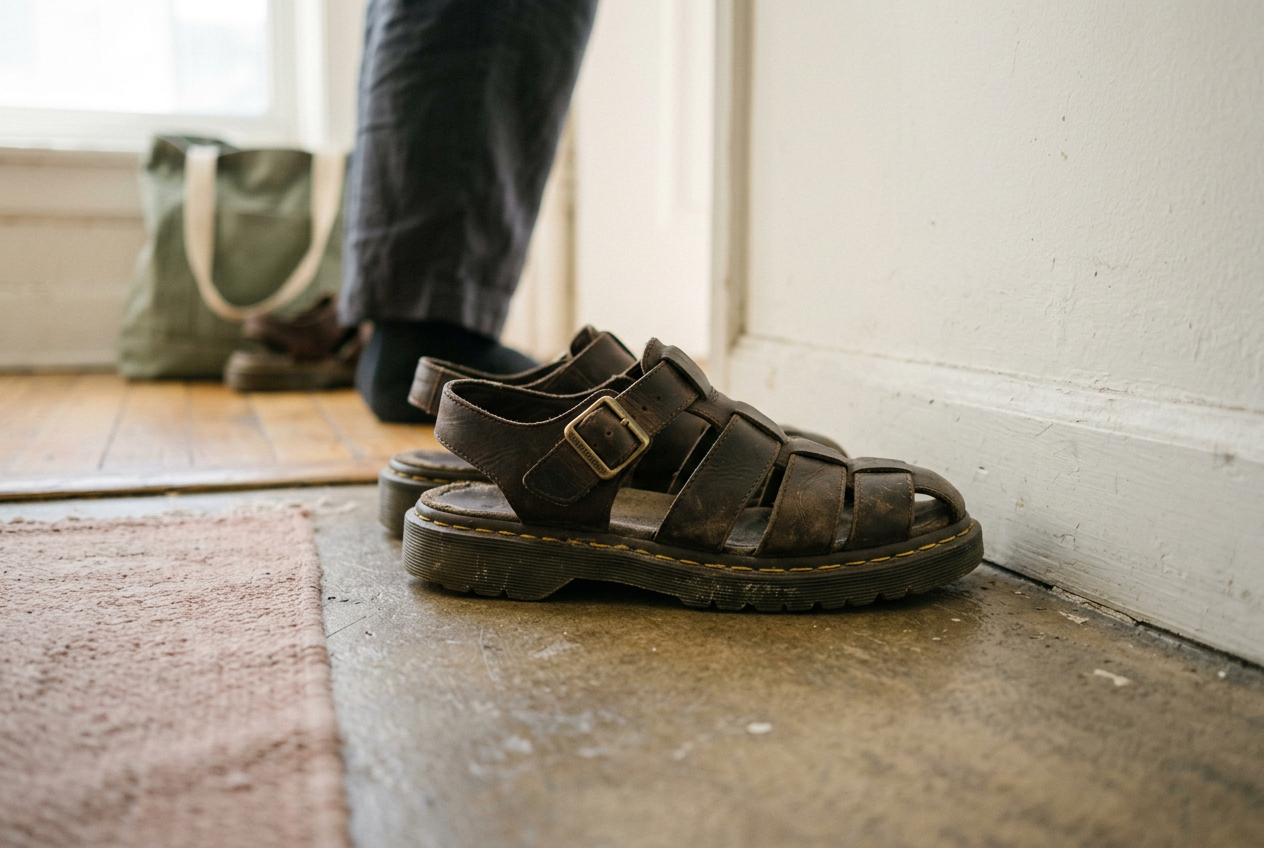
The useful object here is the Dr. Martens 8092 Arc fisherman sandal in dark brown Crazy Horse leather, a waxy full-grain leather designed to show marks rather than hide them. It has a buckled ankle strap, an enclosed woven toe and the brand’s grooved AirWair sole, with the upper and sole joined by Dr. Martens’ heat-sealed, welt-stitched construction.
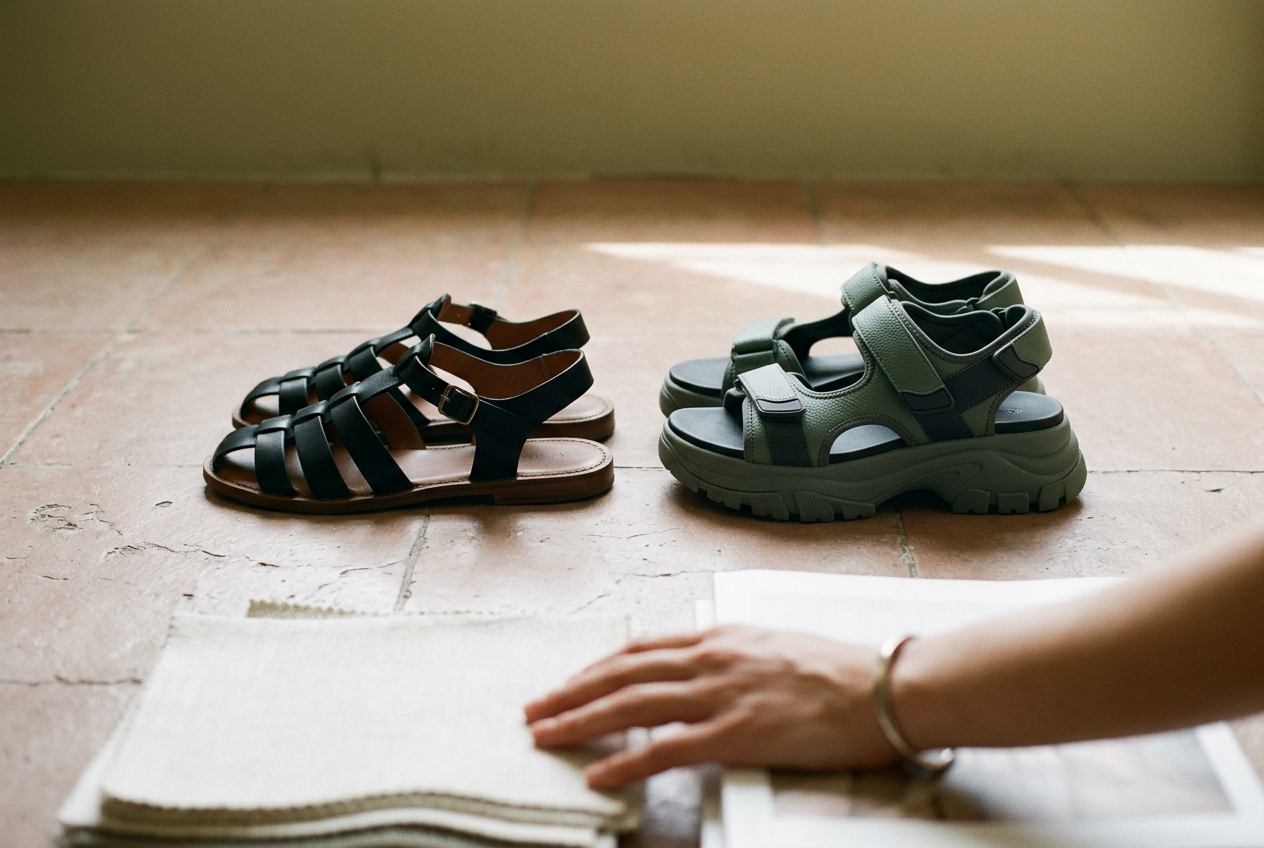
That one sandal contains most of the current argument. Its toe cage looks fashion-specific, particularly beside a plain two-strap sandal, yet the leather and substantial sole belong to a shoe that can age. It also exposes the category’s compromises: more weight than an open sandal, less airflow around the toes, and a sole that appears repairable but may require a cobbler familiar with molded Dr. Martens units.
This is unisex coverage. Fisherman sandals cross women’s and men’s assortments with few meaningful construction differences, although size conversion and width grading vary enough that the number printed on the box should be treated as a starting point.
The silhouette has outrun the original shoe
A traditional fisherman sandal is a closed-toe leather sandal built from interlaced straps, usually secured at the ankle or instep. The openings release some heat while the leather cage protects more of the foot than a slide or thong. It was always a practical hybrid. Current retail assortments have turned that hybrid into a visual code.
The recognizable parts now appear on slim leather shoes, thick platforms, glossy synthetic pairs and molded versions that borrow the cage without retaining much of its function. Heritage-leaning models such as the Paraboot Pacific sit alongside the Dr. Martens 8092 Arc and the water-friendly Salt-Water Shark, while fashion retailers translate the same enclosed toe into lighter, cheaper materials. At the seasonal end, metallic finishes, pale coatings and exaggerated soles make the sandal easier to place in one summer’s imagery and harder to carry into the next.
This breadth signals peak visibility, not automatic longevity. Retailers can keep the outline while changing almost everything that determines how the shoe wears, which means two pairs found under the same category heading may have little in common beyond the gaps between their straps.
The 8092 Arc remains a useful control. Its brown leather, workwear-weight sole and visible welt stitching do not rely on a bright finish or a sharply elongated toe. Even if fisherman sandals recede from the front of stores, it will still read as a sturdy closed sandal. A clear jelly cage on a bulbous platform has a narrower path once the silhouette cools.
Ventilation is easy to overestimate
The gaps look airy. The closed toe changes that impression after walking begins.
Air can move through the sides, but the toe box still covers the warmest and widest part of the foot, and a leather lining adds another layer wherever it appears. A dark, heavy pair such as the 8092 Arc will usually feel closer to a perforated shoe than to an open sandal. That can be useful on transit, uneven sidewalks and days when exposed toes feel impractical. It is less persuasive for humid heat or long stretches on hot pavement.
Look inside rather than through the upper. Wide openings can be backed with lining, while narrow unlined straps may breathe better than the exterior suggests. A padded synthetic footbed can hold heat even when the upper is leather. If the footbed cannot be removed, drying time matters too, particularly when the shoe will be worn without socks.
Salt-Water documents its Shark sandal as using water-friendly leather, rust-proof buckles and a vulcanized rubber sole, meaning heat and pressure bond the rubber into a durable unit. That construction suits wet summer use better than an absorbent leather footbed, although water resistance does not create open-toe ventilation. A sandal that tolerates getting wet can still feel enclosed during a hot walk.
For the 8092 Arc, the sensible care routine follows the leather rather than the trend. Wipe away grit with a damp cloth, let the pair dry away from direct heat and use conditioner sparingly so the waxy surface does not become overloaded. The first scuffs are part of Crazy Horse leather’s appearance. A painted synthetic coating that cracks at the toe bends offers no equivalent recovery.
The fit problem sits across the toes
Interlaced straps suggest flexibility, but the front of a fisherman sandal is more fixed than it looks. Each strip meets another at a seam or attachment point, so the cage cannot expand like an open vamp, meaning the section of a shoe that covers the top of the foot. A buckle can secure the heel without creating more room at the forefoot.
The key fitting check is not whether the toes reach the end. Stand with full weight on the foot and look for pressure where the outer toe meets the side strip, then walk downhill or use a store ramp if one is available. The foot shifts forward under load, and a seam that feels merely present on level flooring can start rubbing once the toes spread.
Wide feet need more than a larger size. Sizing up can move the flex point, the place where the sole bends with the foot, too far forward while leaving the strap pattern almost as restrictive. Seek a rounder cage, adjustable instep fastening and leather that feels substantial without being rigid. If the little toe sits directly beneath an edge, the pair is wrong before break-in begins.
The 8092 Arc’s heavy sole adds another consideration. A loose heel becomes tiring because the foot has to lift the sole on every step, yet tightening the ankle buckle cannot correct excess volume throughout the shoe. Try the pair with the socks or bare feet intended for regular wear. Fisherman sandals can work with thin socks, but that styling option is not a fit remedy.
Repairability is not visible from one row of stitching
A long-lived leather upper only helps if the sole and lining can be maintained. Welt stitching, where a strip or edge construction joins the upper to the sole, often indicates a more serviceable shoe, but it does not guarantee that every repair shop can replace a proprietary molded outsole.
Dr. Martens describes the 8092 Arc as heat-sealed and reinforced with welt stitching. That is a stronger proposition than a thin upper glued to lightweight foam, though a buyer who expects eventual resoling should ask a local cobbler about the exact AirWair unit before relying on that expectation. Repairability depends on available replacement material, machinery and the condition of the upper, not on a stitch line alone.
Cemented construction, where adhesive bonds the upper directly to the sole, is not automatically disposable. A cobbler may replace a flat rubber sole if there is enough clean material to work with. Deeply sculpted platforms and hollow molded units are less straightforward, while peeling synthetic straps may fail before the outsole wears down.
At the lower end of the market, fisherman sandals can cost less than a decent pair of sneakers. That price band makes sense for an occasional styling experiment, but it rarely buys thick leather, a durable lining and a sole worth repairing. Heritage versions rise toward quality-shoe prices. There, inspect the construction rather than paying for the idea of permanence.
Resale separates recognizable models from seasonal copies
Secondhand listings are most useful when searched by model name rather than by “fisherman sandal.” Named pairs such as the Paraboot Pacific, Salt-Water Shark and Dr. Martens 8092 are easier to compare across ages because the buyer can check brand documentation and identify whether an older version uses the expected materials. Generic trend pairs tend to lose that trail.
Listing volume does not prove demand. It may reflect popularity, overbuying or pairs that owners found uncomfortable. Condition photographs reveal more. On an 8092 Arc, look for cracking where the side straps flex, deep wear at one heel, separation around the sole edge and buckle holes stretched into long ovals.
Surface scuffs on waxy brown leather matter less than splits beside a stitch line.
Footbeds deserve close attention because sandals are often worn barefoot. A darkened imprint is cosmetic until it comes with compressed padding, lifting lining or persistent odor that cleaning may not remove. Ask for an outsole photograph and an interior view of the toe cage. If a seller shows only the upper from above, the images omit the expensive parts.
A good secondhand fisherman sandal often looks less pristine but more coherent: real leather has softened, the sole remains level and the fastening still holds. A glossy seasonal pair can photograph as newer while already peeling at the bends. The former has styling range beyond one summer; the latter still depends on looking untouched.
The buying line
Choose the durable version if the sandal will replace a closed shoe on warm days. Brown or black full-grain leather, a low or moderate sole and hardware that a repairer can replace will work with cropped trousers, loose denim and longer skirts without requiring the rest of the outfit to repeat the trend. The 8092 Arc lands here, provided its weight and proprietary sole are acceptable.
Choose a lighter seasonal interpretation only if the finish itself is the reason for buying. A translucent cage, mirrored coating or extreme platform may be enjoyable, but it should be priced and evaluated as a short-run styling piece. It is not worth investment-level money merely because the upper resembles a heritage sandal.
There is no clean verdict on the silhouette. The strongest leather models already have lives outside trend cycles, while the newest interpretations are behaving like a micro-trend attached to them. The distinction sits underfoot and across the toe, not in the name on the retailer’s menu.
Questions people ask
Are fisherman sandals good for hot weather?
They are cooler than a fully closed leather shoe but warmer than a slide or open-toe sandal. Unlined straps, a breathable footbed and generous side openings help. For humid days or long hot walks, the enclosed toe can trap enough heat that a conventional open sandal remains the more comfortable choice.
Should fisherman sandals fit loose or snug?
The heel should stay secure without the buckle cutting into the ankle, while the toe cage needs room for the foot to spread under weight. Do not accept rubbing along the little toe in the hope that sizing up will solve it. Extra length can place the sole’s flex point ahead of the foot.
Can fisherman sandals be resoled?
Some can, but visible stitching is not a guarantee. Flat rubber soles and conventional stitched constructions generally give a cobbler more options than hollow platforms or proprietary molded units. Ask about the exact model before purchase, particularly with Dr. Martens, and inspect used pairs for separation around the sole edge.
What should I check when buying a used pair?
Request clear photographs of the outsole, footbed, buckle holes and every point where a leather strap meets the sole. Even heel wear and surface patina can be manageable. Split straps, compressed footbeds, peeling coatings and missing chunks from a molded sole are stronger reasons to leave the pair behind.
One update a day
Today's fashion update, in your inbox
One fashion update each morning — no hype, no filler, just pieces worth wearing.