Flat Leather Fisherman Sandals Have the Best Odds
The fisherman sandal is splitting into platforms, leather cages and woven hybrids. The version most likely to last is flatter, repairable and already easy to find secondhand.
August 26, 2026 · 8 min read
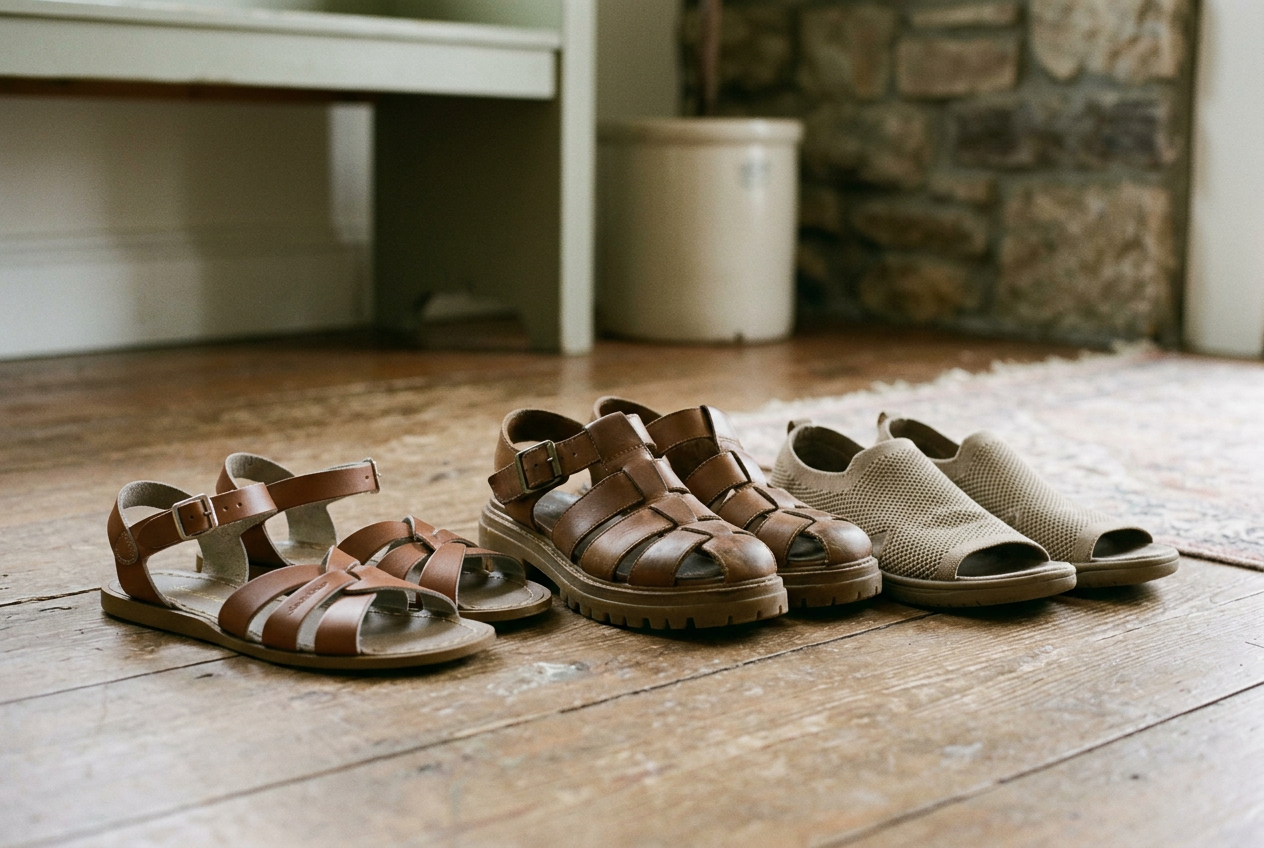
The fisherman sandal has stopped being one clearly defined shoe. Retailers are using the name for leather cages on thin soles, heavy treaded platforms and outdoor hybrids made from woven synthetic cord. They share an enclosed or partially enclosed toe, but they do not wear, age or resell in the same way.
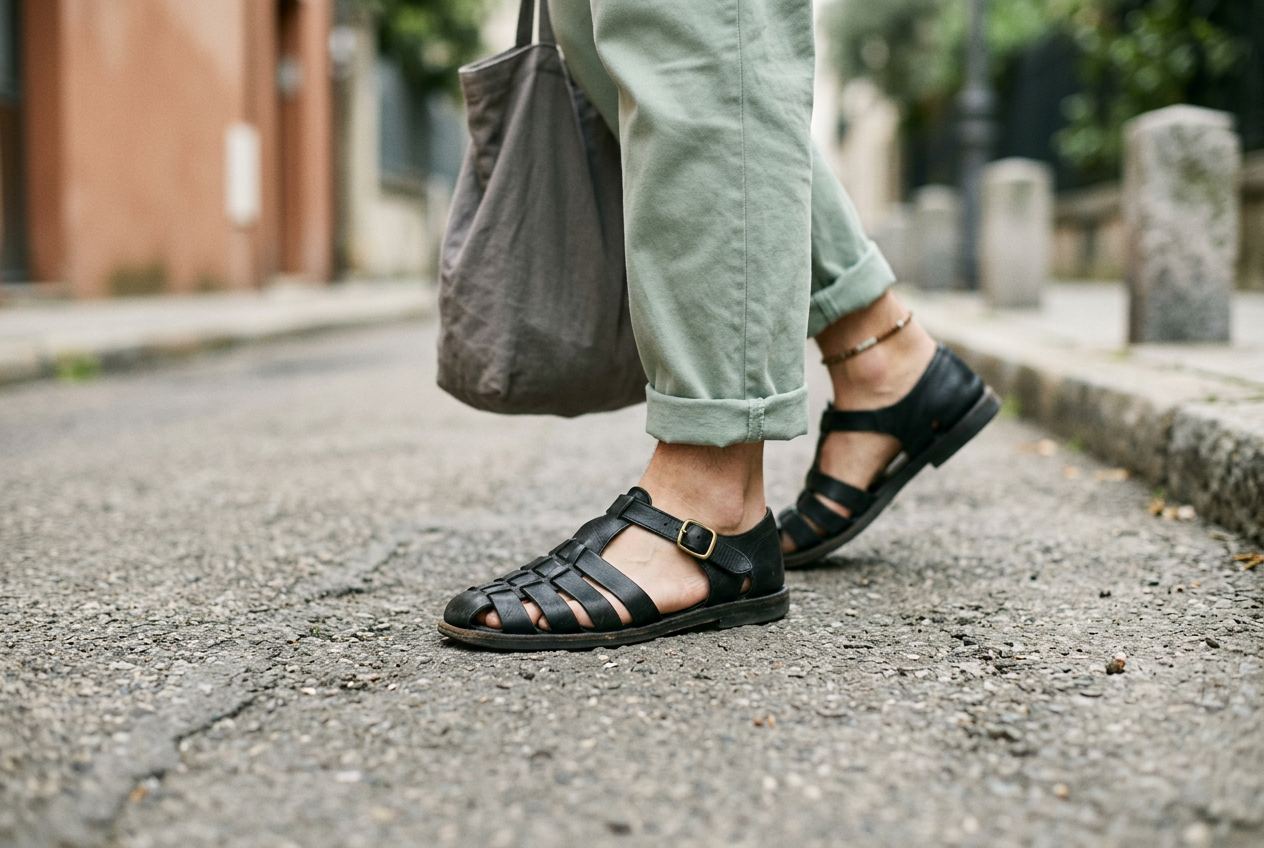
The pair I kept returning to while reviewing those differences was the Salt-Water Shark, a flat sandal with interlaced leather straps, an ankle buckle and a rubber sole. It is useful here because it looks recognizably fisherman-like without relying on an exaggerated platform, yet its bonded construction also exposes the limit of assuming that every traditional-looking leather sandal will be easy to repair.
That distinction matters more than the trend label. A restrained leather cage can survive several silhouette swings, but only if the straps accommodate the foot and the sole does not become the part that ends the shoe.
Chunky rubber has presence, then a repair problem
The platform fisherman sandal makes the strongest first impression. A deep lug sole, meaning an outsole cut with raised blocks for grip, gives the enclosed upper a heavier proportion and works easily under wide trousers, long skirts and loose shorts. It also separates the foot from hot pavement and rough ground better than a thin leather sole.
There are two different constructions hiding inside this group. Some pairs put leather straps onto a separate rubber outsole and foam midsole. Others use a molded unit, a single shaped sole component that wraps upward around the foot. The second can feel stable because the foot sits within raised sidewalls, but once that unit splits, compresses unevenly or pulls away from the upper, a cobbler has fewer neat repair options.
Weight is the immediate fit test. A heavy sole pulls against the ankle strap with every step, so a pair that feels merely substantial in a fitting room can rub behind the buckle after an afternoon. The toe cage must also hold the forefoot securely. If the front is too wide, the foot slides while the sandal remains planted; if it is too narrow, the little toe meets a strap edge rather than open space.
Chunky soles are not automatically comfortable. Many feel firm rather than cushioned, and some place the bend point too far forward or back for the wearer’s foot. Before buying, hold the heel and flex the forefoot. The sole should bend near the ball of the foot, not through the arch.
Then walk quickly enough to find out whether the heel lifts and the ankle strap starts doing all the work.
Secondhand availability is already broad across mainstream resale platforms, particularly for recognizable platform shapes and branded lug soles. That supply is useful for bargain hunters but less reassuring as a longevity signal: a substantial shoe can appear durable in photographs even when its foam has compressed, its heel has worn diagonally or its adhesive has begun to separate at the toe.
Buy this version for the sole’s practical advantages or because heavy footwear already belongs in your wardrobe. I would not pay a large designer premium for a cemented platform, meaning a sole attached mainly with adhesive, unless replacement parts or brand-supported repairs are available.
Flat leather is the quieter long-term choice
The Salt-Water Shark shows why the flat leather version has better stylistic odds. Its narrow straps leave enough foot visible to work as a summer sandal, while the closed cage reads as a shoe under fuller pants. Brown, black and tan leather also collect ordinary signs of wear rather than broadcasting the exact season in which a particular neon sole or exaggerated tread appeared.
Flat does not mean interchangeable. Some leather fisherman sandals use a thin rubber sheet under a leather footbed, while more formal versions have a stacked heel and an outsole that a cobbler can remove. Blake stitching, where a row of stitches passes through the insole and outsole, can make resoling possible, although the cobbler still needs enough sound upper material to work with. A glued rubber sole may last well but is less predictably repairable.
The Shark’s rubber sole makes wet sidewalks less precious than a bare leather outsole would, and the leather straps have more visual permanence than plastic. Yet it should not be bought under the impression that its sole can be replaced as routinely as the heel on a traditional leather shoe. This is the useful middle of the market: familiar materials, moderate visual weight and decent secondhand recognition, with construction that still needs inspection.
Look closely at the points where each strap enters the sole. Darkened leather is cosmetic; cracking around a punched opening or tearing at an attachment point is structural. On a used pair, request photographs of the outsole edge, the heel and the underside of the toe rather than relying on a clean overhead image. A deeply molded footprint can also reveal that the footbed has adapted to someone else’s gait.
Flat leather asks more of the wearer during break-in. A stiff strap across the toe can soften, but a strap that catches the little toe is in the wrong place and will not move far enough to solve the mismatch. Smooth leather lining is usually kinder than exposed synthetic backing, while raw strap edges can become noticeable once feet swell in heat.
This is unisex advice, although fisherman sandals are often separated into women’s and men’s retail categories. Use foot length as the starting point when converting sizes, then check the widest part of the forefoot against the cage. Anyone between sizes should prioritize strap placement over the number printed on the box.
Prices run from roughly the cost of ordinary high-street sandals to several times the price of a decent pair of sneakers. The extra money is easiest to defend when it buys full-grain leather, replaceable sole layers and clean finishing around the strap edges. A prominent label on a fully glued shoe does less for the owner after the trend cools.
Woven synthetics earn their place near water
Woven synthetic fisherman sandals shift the proposition from polish to ventilation. Polyester webbing, nylon cord and molded plastic can tolerate splashes and repeated summer use better than untreated leather, while an adjustable cord or webbing upper can accommodate feet that swell during the day. KEEN’s Uneek is a recognizable edge case: its cord construction is not a classic leather cage, but it occupies the same enclosed-sandal territory and shows why the woven branch persists outside fashion cycles.
The weakness appears where the material meets hardware or sole. Frayed webbing can be patched, but the repair usually remains visible. A cut cord may affect the tension across several neighboring sections, and an injection-molded plastic upper offers little for a neighborhood cobbler to stitch. Synthetic materials also age differently from leather; grime can lodge in textured fibers, pale colors may look tired quickly, and a clean outsole does not prove that internal foam still rebounds.
These pairs make sense for travel, waterside use and long warm days when washable construction matters more than a polished finish. They are less convincing as an investment purchase. Secondhand searches produce recognizable outdoor models and plastic fisherman sandals, but condition varies sharply, and the lower cost of many new synthetic pairs limits how much buyers will pay for used ones.
Try woven versions with the socks or bare feet you intend to wear. Cord can feel forgiving until it presses across one swollen point, while webbing that fits securely when dry may loosen slightly after getting wet. Check whether the footbed can be removed for cleaning and drying. Persistent odor in a fixed foam footbed is a practical reason to skip an otherwise tidy secondhand pair.
The secondhand test favors familiar construction
A useful resale search starts with the model name and material, not just “fisherman sandal.” Broad searches mix children’s shoes, outdoor water sandals, jelly cages and leather dress pairs, which makes apparent abundance difficult to interpret. Add “leather,” “lug sole,” “woven cord” or the product name, then compare several examples of outsole wear before judging the asking price.
Flat leather pairs have the clearest path beyond the styling spike because buyers already understand how to assess creasing, buckle wear and sole loss. The Salt-Water Shark benefits from that familiarity even though it is not the most repairable option. A lesser-known platform with a proprietary molded sole asks the next buyer to trust hidden foam and aging adhesive, while an unnamed woven synthetic pair competes with inexpensive new alternatives.
For a new purchase, the best checklist is short. The toe cage should avoid pressure on every toe, the sole should flex beneath the ball of the foot, and the attachment method should be visible or disclosed. For a used purchase, add heel alignment and strap cracking. Those checks say more about remaining life than an almost-unmarked footbed.
My decision lands with the flat leather version, preferably one with a separate outsole and a heel that a cobbler can rebuild. The chunky rubber sandal remains persuasive when ground protection is the point. Woven synthetic pairs can be the hardest-working choice near water, but their value lies in use rather than future resale.
Questions people ask
Are fisherman sandals supposed to fit loosely?
They should leave breathing room around the toes without allowing the foot to slide forward or sideways. The ankle strap should secure the heel without carrying the full weight of the sole. If a chunky pair lifts noticeably at the heel, try a lighter construction or a narrower forefoot shape.
Can a cobbler resole fisherman sandals?
It depends on how the sole is attached. A leather sandal with a separate stitched or clearly layered outsole is a better candidate than one built around a single molded platform. Ask before purchase if repair matters, because a leather upper alone does not make a sandal resoleable.
Which fisherman sandals are best for wet weather?
Synthetic webbing, cord and molded plastic tolerate water better than most fashion leather, provided the footbed can dry fully. Rubber-soled leather pairs can manage an occasional wet sidewalk, but repeated soaking may stiffen leather, affect dye and weaken adhesive. Smooth wet footbeds can also become slippery.
What should
I check when buying fisherman sandals secondhand?
Inspect the heel for uneven wear, the toe edge for separation and every point where a strap enters the sole. Cracked leather at an attachment point matters more than surface creasing. On synthetic pairs, look for frayed webbing and ask whether a fixed foam footbed has retained odor.
One update a day
Today's fashion update, in your inbox
One fashion update each morning — no hype, no filler, just pieces worth wearing.