Woven Leather-Look Bags Expose Their Weakest Edges
The woven-bag wave makes ordinary totes feel current, but all those exposed strip edges create extra failure points. Material matters more here than the silhouette.
October 29, 2026 · 8 min read
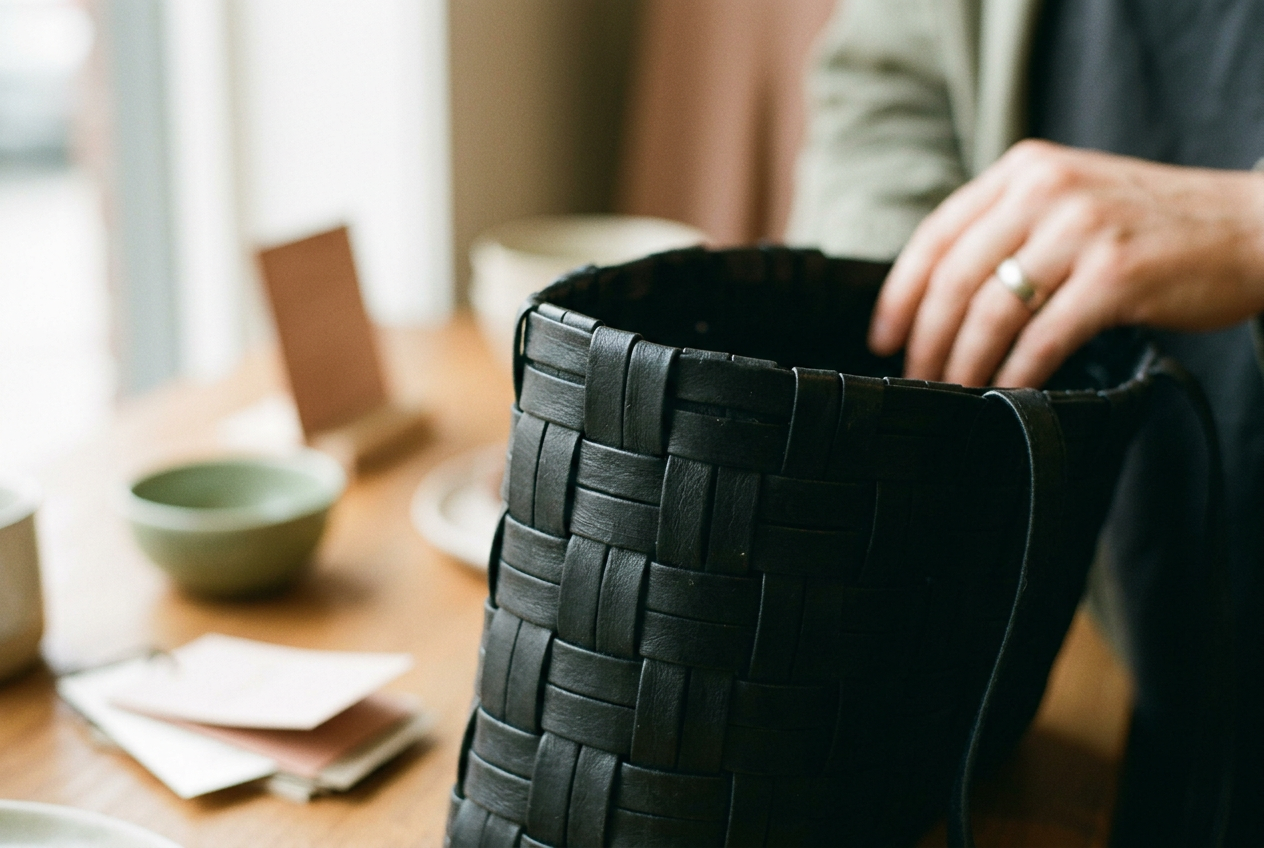
The useful place to judge a woven bag is not its front panel. Start at the upper outside corner, where a horizontal strip passes under a vertical one before bending toward the opening. That small junction carries the whole argument: the strip flexes when the bag opens, its edge rubs against the neighboring strip, and the corner may brush your coat or hip while you walk.
A smooth leather-look tote can hide modest material under a continuous surface. Weaving cannot. It multiplies cut edges and contact points, then places many of them in view.
This analysis applies across women’s and men’s wardrobes, so the coverage is unisex. The relevant differences are construction, load and carrying style rather than the department where the bag was sold.
Why the weave changes the wear
The current basket-weave look ranges from loose, oversized strips to tight checkerboard panels. Some bags weave full-length strips into the structure; others attach a woven outer layer to a fabric body, which means the visible weave is decorative and the lining carries most of the load. The second arrangement can be perfectly serviceable, but it should not command an investment price merely because the surface looks labor-intensive.
At each crossing, one strip is compressed while the other is slightly raised. Pack the bag, bend it around your body or repeatedly reach through a narrow opening, and those strips move by small amounts. Friction concentrates at the edges because that is where a cut material meets the face of its neighbor.
Return to that upper outside corner. A good edge remains flat even when the strip bends, and the crossing has enough room to move without sawing against itself. A weak edge starts to look pale, rough or slightly lifted. On a black bag, a contrasting beige or gray line is especially informative because it may reveal the material beneath the finish rather than ordinary surface dust.
Loose weaving is not automatically gentler. Wider gaps allow more movement, so strips can twist and catch on hardware or clothing. Very tight weaving creates a different problem: the crossings press firmly against each other, and a stiff coating may crease where it cannot flex. The best construction has consistent tension without feeling rigid.
Solid leather has the most forgiving failure mode
“Genuine leather” only establishes that animal hide is present; it does not describe the grade, thickness or finish. A better sign for this use is a strip that appears to be leather through its cut edge, rather than a thin leather layer bonded to another base. Full-grain leather, meaning the hide retains its natural outer surface, is usually resilient, though a woven bag does not need premium full-grain hide to wear well.
Solid leather strips tend to soften at crossings. Their edges may darken, compress or develop fine fibers, but the exposed interior remains leather, so ordinary wear is less visually abrupt than a colored coating peeling away from pale textile. Condition matters, and thin leather can still stretch or tear where a handle attaches.
Heavy surface finishing complicates the picture. A leather bag can carry enough pigment or plastic-like topcoat to crack much like a synthetic one, particularly if the strips are thin and sharply folded. Bend a discreet section gently. Fine creasing that relaxes is normal; a white stress line, surface flaking or a rigid crease deserves caution.
Edge paint, a flexible coating applied to a cut leather edge, can make a strip look neat and slow moisture absorption. On woven construction, however, thick edge paint sits directly in the friction zone. Check whether it has pooled into rounded ridges or split at the upper corner. A clean raw edge can age more gracefully than glossy edge paint that is already separating.
The tradeoff is price. A solid-leather woven bag generally sits around the cost of quality footwear or higher, depending on size and workmanship, and weaving does not excuse weak handles or an unreinforced base. Buy new at that level only if the shape feels useful beyond the current wave.
Bonded material can look convincing until it bends
Bonded leather is made from leather fibers or scraps held together with binders, often with a polyurethane surface. Labels vary by market, and a vague phrase such as “leather material” tells less than a clear fiber or composition statement. If the seller does not identify the outer material, treat the appearance as evidence of style, not durability.
Bonded strips can produce an even, polished weave because their thickness and color are controlled. The weakness appears at repeated bends. Once the upper layer cracks, the compressed interior may crumble rather than develop the soft, fibrous wear of a solid leather edge. Delamination, meaning bonded layers separating from one another, often begins as a tiny lifted lip beside a crossing.
That makes the upper outside corner useful again. Press near it rather than picking at it. If a layer shifts independently, or the edge looks swollen while the face remains smooth, the strip may be separating internally. Repair is rarely elegant because adhesive can stiffen the junction and create another hard point for the neighboring strip to rub.
Bonded material occupies an awkward value band. It may cost more than an obvious synthetic bag while offering less predictable aging than solid leather. Unless the design is distinctive enough to justify a short life, I would not pay a leather-adjacent premium for it new.
Polyurethane is easiest to judge after somebody has carried it
Polyurethane, usually shortened to PU, is a synthetic coating applied over a fabric or other supporting base. A PU woven bag can be light, color-consistent and easier to wipe clean than absorbent leather. It can also deliver the trend at a lower mass-market price, which is a reasonable proposition if the construction is honest and the bag will not be overloaded.
Its exposed edges are the concern. Some PU strips are coated on the face but leave the textile substrate, meaning the supporting material beneath the coating, visible along the sides. Those edges can fuzz at crossings. Others wrap or seal the coating around the strip, producing a cleaner start, but once the seal splits, peeling may travel across the face.
Heat, skin oils and constant flexing can accelerate coating breakdown, while storage does not necessarily preserve PU indefinitely. This is why an unworn older bag is not always a safer resale purchase than one showing light, stable use. A carried bag with intact corners proves more than a pristine bag whose coating has spent years aging in a closet.
For a new PU bag, inspect the underside of the handle and the rim before admiring the central weave. Those areas flex more often. If the edge color differs sharply from the face, any future abrasion will be obvious. Black coating over a black base hides wear better than cream coating over a dark textile, though matching color cannot prevent structural failure.
Secondhand turns wear into useful information
The woven-bag trend makes particular sense secondhand because the market already holds versions from earlier cycles, and the construction announces how it is aging. You are not relying entirely on a product description or a perfect studio image.
Set the bag on a flat surface first. A sagging base does not matter if you like a relaxed shape, but diagonal distortion through the weave suggests that load has shifted tension between strips. Next, open and close the bag while watching that upper outside corner. The strips should move without clicking, sticking or lifting each other’s edges.
Run a dry finger along the inside rim. Loose flakes are more concerning than smooth color loss. Look beneath the handle attachments, where failed coating may be hidden from a straight-on resale photograph, and use your phone light inside the bag to see whether the weave itself carries the contents or sits over a separate lining.
Odor and tackiness should stop the purchase. A sticky synthetic coating is difficult to reverse, and aggressive cleaning may remove more finish. On leather, deep cracking across several crossings is more consequential than ordinary scratches because woven strips cannot always be replaced without opening a large section of the panel.
Secondhand is the stronger choice for a PU or uncertain-composition bag when the price reflects the risk and the photographs show edges closely. For solid leather, buying used also avoids the stiff opening stage and reveals whether the weave keeps its shape. The exception is a bag with dried leather strips at several crossings; conditioning may improve suppleness, but it cannot rebuild fibers that have split.
The trend is worth buying selectively
Woven surfaces have enough design history to outlast a single season, but the current abundance of leather-look totes and shoulder bags is still a trend wave. Color and scale will date faster than the basic technique. A neutral bag with medium-width strips is less dependent on the moment than a tiny novelty shape or an exaggerated open weave.
That does not make the safest option the most desirable one. A bright PU bag may earn its place as a lightweight accent, provided its price matches a limited lifespan and you are willing to keep it lightly loaded. The mistake is paying near-leather money for bonded strips because the weaving looks expensive.
For a daily bag, I would favor secondhand solid leather with stable crossings, or new leather when the handle anchors and exposed edges are as convincing as the front. For a seasonal color, used PU is the more measured experiment. At the resale rack, return once more to the upper outside corner: if that busy junction remains flat after use, the bag has supplied evidence a new one cannot.
Questions people ask
Does real leather always last longer in a woven bag?
No. Very thin leather can stretch, while heavily coated leather may crack where strips bend. Look for a consistent leather edge, flexible crossings and reinforced handle attachments. Solid leather usually fails more gradually than bonded or PU material, which makes scuffs easier to live with and repairs more plausible.
Is bonded leather worth buying secondhand?
It can be, but only at a price that accepts uncertain remaining life. Inspect every bend for lifted layers, crumbling edges and fine surface cracks. If the bag has already been carried and the crossings remain flat, that is useful evidence, though bonded material is still harder to repair neatly than solid leather.
How can
I check a PU woven bag before buying online?
Ask for close photographs of the top corners, handle undersides, opening and base rather than another full front view. Avoid listings where the coating looks sticky, bubbled or flaky. A clear composition label helps, but visible edge condition tells you more about how that particular bag has aged.
Should
I condition the exposed edges of a leather weave?
Use only a small amount of a conditioner suited to the leather finish, and test it in a hidden area because it may darken raw edges. Apply with a cloth rather than pouring product into the weave. Conditioner can reduce dryness; it cannot repair a split strip or reattach separating layers.
One update a day
Today's fashion update, in your inbox
One fashion update each morning — no hype, no filler, just pieces worth wearing.