That Cracked Line on Your Bag Strap Can Be Repaired
Edge paint often splits at the buckle or shoulder long before the leather fails. Here is how to identify the construction and decide whether repair or replacement makes sense.
October 25, 2026 · 7 min read
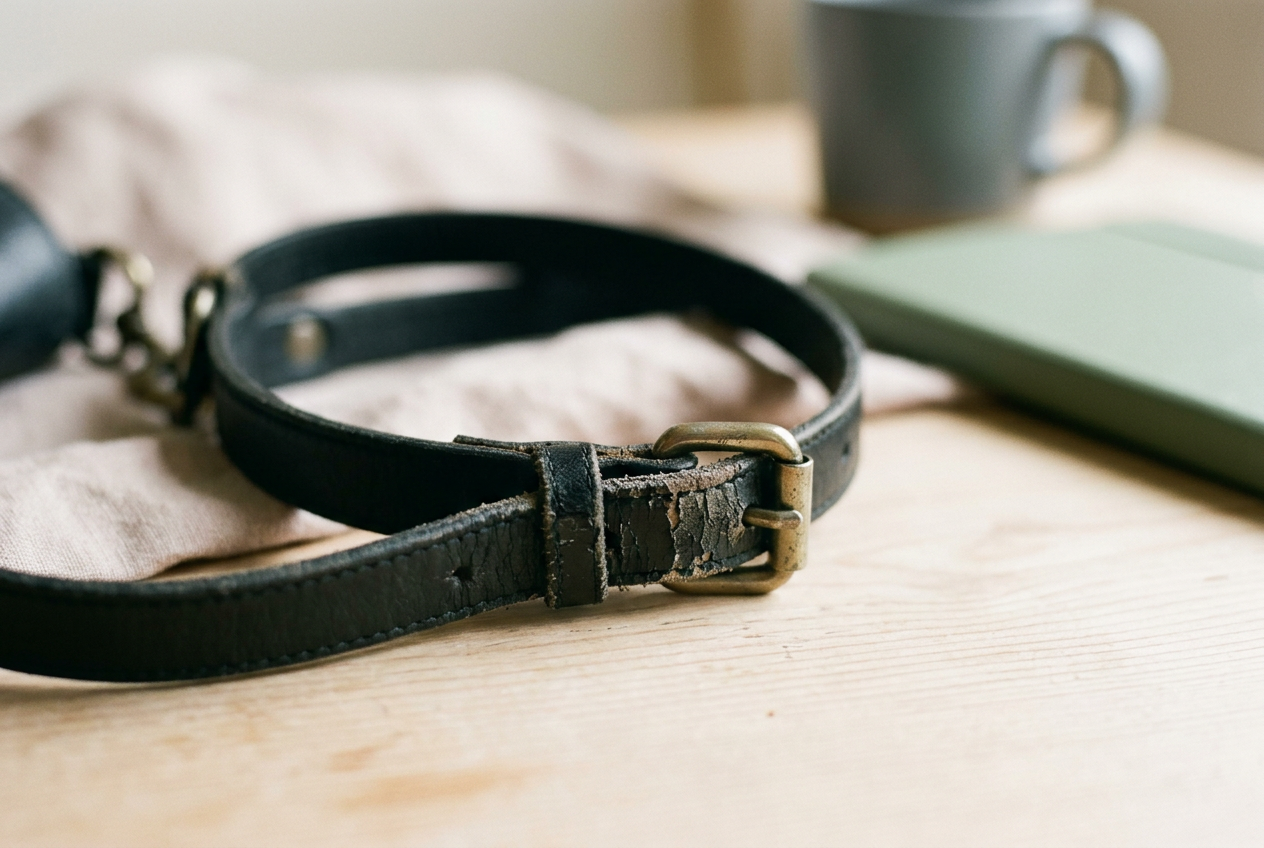
The first split on my black pebbled-leather crossbody strap appeared beside the adjustment buckle, exactly where the strap bends back through the metal frame. A second rough patch formed along the shoulder edge. The bag body still looked good, the stitching held, and the leather beneath the damaged black coating remained firm.
That narrow black line is edge paint, often called glazing in bag repair, meaning the flexible coating applied to a cut leather edge. It gives two layers of leather the look of one smooth strip. Repeated bending can crack the coating before the leather itself wears through, particularly when the finish is thick or the strap keeps folding at the same point.
This is unisex advice. Strap construction and repairability do not change with the department in which a bag was sold, though strap width, drop and hardware finish will affect the replacement options.
Start with the exposed edge
Look at the strap from the side rather than from above. An edge-painted strap usually has a smooth, slightly rounded band of color covering its narrow edge. On the black crossbody, that band concealed two pieces of leather stitched around a thin internal layer, and the first crack ran across the coating rather than into the face of the leather.
A surface crack may look pale, jagged or slightly raised when the strap lies flat. Bend the area gently. If the line opens in the coating while the material beneath stays dense and connected, the problem is mainly cosmetic and is usually repairable. If the leather separates into layers, feels soft at the crease or reveals broken fibers, refinishing the edge will improve its appearance without restoring its original strength.
Pay attention to location. The highest-friction points are the adjustment buckle, the shoulder contact area and the strap attachments, where a loop of material may rub against a ring or repeatedly bend near a stitched joint. Long hair, coat collars and textured knits create surface rubbing, but tight hardware produces the sharper fold that tends to split edge paint.
On my strap, the buckle crack looked worse than the shoulder scuff because it opened every time the length changed. Moving the buckle one hole shifted the fold away from the damaged spot, yet the old crease remained visible. Short fix. Useful diagnosis.
Folded leather wears differently
A folded-leather strap has an outer layer wrapped around its edges, so the side shows leather rather than a separate painted coating. The fold may meet in the center of the underside, where it is glued and often stitched. There is less exposed edge paint to split, although a thin finish may still cover the seam or the leather may crack where it turns tightly around the core.
This construction can age gracefully when the wrapping leather is supple and the fold has enough room, but it is not automatically stronger. Once a folded edge wears through, the damaged area is part of the visible leather surface; a repairer may need to patch, wrap or rebuild the strap rather than strip and repaint a narrow edge.
Check the underside near the buckle first. A lifting center seam can catch on clothing, while a hard ridge beneath the leather suggests that glue has dried or the internal reinforcement has shifted. Pressing the layers back together may tidy a small opening, but glue alone will not correct leather that has stretched out of shape around the hardware.
The black crossbody’s painted construction was less elegant at the cracked buckle, though easier to diagnose and potentially cheaper to refresh. The leather faces were intact. There was no wrapped outer layer to replace.
Raw webbing usually frays instead of cracking
Raw webbing is woven textile used without a leather covering or painted side edge. Nylon and polyester versions appear on camera bags, utility crossbodies and many interchangeable straps. Their edges are woven or heat-finished, so there is no glazing to split.
Wear shows up as fuzzing, pulled yarns or a polished patch where the strap slides through an adjuster. A little surface fuzz is cosmetic. A cut running across the width is structural because the lengthwise yarns carry the load, and continued movement through the buckle can enlarge the break. Stitching that loosens where the webbing folds around a swivel hook also deserves attention before the hook detaches.
Webbing is often the most economical construction to replace. Standard-width straps with common swivel hooks are widely available, and a plain replacement may cost less than specialist labor. Repair makes more sense when the original hardware is distinctive, the strap is permanently sewn into the bag or the webbing color is central to the design.
Do not trim a deep fray and continue carrying the same load. Heat can seal the fuzzy edge of some synthetic webbing, but it cannot rebuild severed yarns, and excess heat may leave a hard nub that abrades clothing. Cotton webbing does not melt closed at all.
Separate a finish problem from a load problem
Empty the bag before inspecting the strap. Clean away loose surface dirt with a dry, soft cloth, then flex each worn area under good light without sharply folding it. The useful distinction is whether the finish moves over a stable base or whether the base itself opens, stretches or sheds fibers.
Edge paint that is peeling in short flakes, while the leather layers and stitching stay aligned, is a finishing problem. A professional repair usually means removing unstable coating, smoothing the edge and applying several thin layers with drying time between them. Painting only the visible crack can leave a raised patch, and the new material may release where it overlaps old, brittle coating.
Separation between leather layers needs more than fresh color. The repairer may reglue and clamp the strap before refinishing it, provided the layers have not distorted. Broken stitches can be replaced if there is sound material around the original holes. Crumbling bonded leather, a material made from leather fibers held together with binders, rarely justifies elaborate strap work because failure may continue beyond the repaired section.
Hardware changes the calculation. A rough buckle bar or ring will scrape a newly finished edge, so it must be smoothed, repositioned or replaced before the strap returns to use. On the black crossbody, the buckle itself felt smooth; the tight bend was the issue. A longer adjustment zone would spread wear more effectively than another thick coat applied over the same crease.
Use the attachment points to set the repair budget
A detachable strap makes the decision easier. Measure its width, usable length and hook opening, then note the hardware color and the size of the bag’s rings. A replacement hook must close fully around the ring without binding, and a very narrow strap can twist a larger bag even when the hardware technically fits.
For an everyday bag, refinishing an intact leather edge is often reasonable when the work costs less than a decent pair of sneakers and preserves matching leather and hardware. A full custom strap can approach the cost of a midrange bag once it requires new leather, reinforcement, stitching and transferred hardware. At that point, replacement only makes sense if the bag body is in excellent condition or difficult to substitute.
Integrated straps deserve a higher repair allowance because replacement may require opening the bag lining or unpicking a structural seam. Still, a damaged attachment tab is more urgent than a cracked shoulder edge. The tab carries the bag. Cosmetic glazing can wait.
For the black crossbody, a complete edge refinish would be the proportionate repair because the strap detaches, the faces remain sound and the original black hardware is worth keeping. If the layers begin separating beside the buckle, an off-the-shelf strap becomes the better budget choice. Rebuilding an otherwise ordinary removable strap would spend labor in the wrong place.
Check a new strap before buying the bag
Run a finger along the edge and flex the adjustment section around the buckle as it will sit in use. Fresh edge paint should remain smooth rather than whitening at the bend, sticking to itself or forming a sharp ridge. A very thick coating can hide a roughly prepared edge, though thickness alone does not prove that it will fail.
Look for enough clearance between strap and hardware. If the leather scrapes both sides of a buckle before the bag has carried anything, the finish will receive concentrated wear. On folded leather, inspect the underside seam for lifting. On webbing, check that the weave stays even where it passes through the adjuster and that the attachment stitching does not sit against a sharp metal edge.
A removable strap also gives a budget bag a longer useful life. Neutral hardware and standard attachments leave room for replacement; proprietary clips and permanently riveted ends do not. The small construction choice matters most after the first black line opens.
Questions people ask
Can cracked bag strap glazing be repaired at home?
A tiny cosmetic chip can be touched up with flexible leather edge paint, but matching the finish and building a smooth edge take preparation and drying time. Peeling along a long section usually looks better after a repair shop removes the unstable coating rather than painting over it.
Does cracked edge paint mean the leather is low quality?
No. Edge paint is a separate finish and can crack on sound leather when a strap bends tightly at a buckle or rubs repeatedly at the shoulder. Leather quality matters more when the base feels weak, separates into layers or cracks through its visible face.
Is replacing a bag strap cheaper than repairing it?
Usually, if the strap detaches and uses common hooks in a standard width. Repair becomes more appealing when the leather and hardware must match the bag, while custom rebuilding may cost enough to make sense only for a valuable or hard-to-replace bag.
Can a frayed webbing strap still be used?
Light fuzzing along the surface is generally cosmetic, but a cut across the strap or loose stitching at the hook can reduce its ability to carry weight. Empty the bag and replace or restitch the damaged section before loading it again.
One update a day
Today's fashion update, in your inbox
One fashion update each morning — no hype, no filler, just pieces worth wearing.