Secondhand Suede Bags Are Rising. The Photos Hide the Wear.
Soft suede hobos look timely on resale sites, but color alone tells little. Nap loss, handle darkening, edge wear, and odor decide whether the bag is worth pursuing.
October 20, 2026 · 8 min read
Soft suede shoulder bags have moved toward the front of resale searches again, particularly the slouchy brown styles that sit somewhere between a hobo and a roomy everyday tote. The trend signal is repetition rather than a verified sales surge: similar shapes, warm colors, and visibly soft finishes keep appearing across public marketplace listings and seller edits.
That visibility makes condition harder to judge, not easier. Suede photographs beautifully from a distance, and the same surface variation that gives it depth can conceal flattened fibers, old stains, or handling marks. A listing can look rich and softly worn in the lead image, then turn out to show a bag whose best side has been positioned toward the camera.
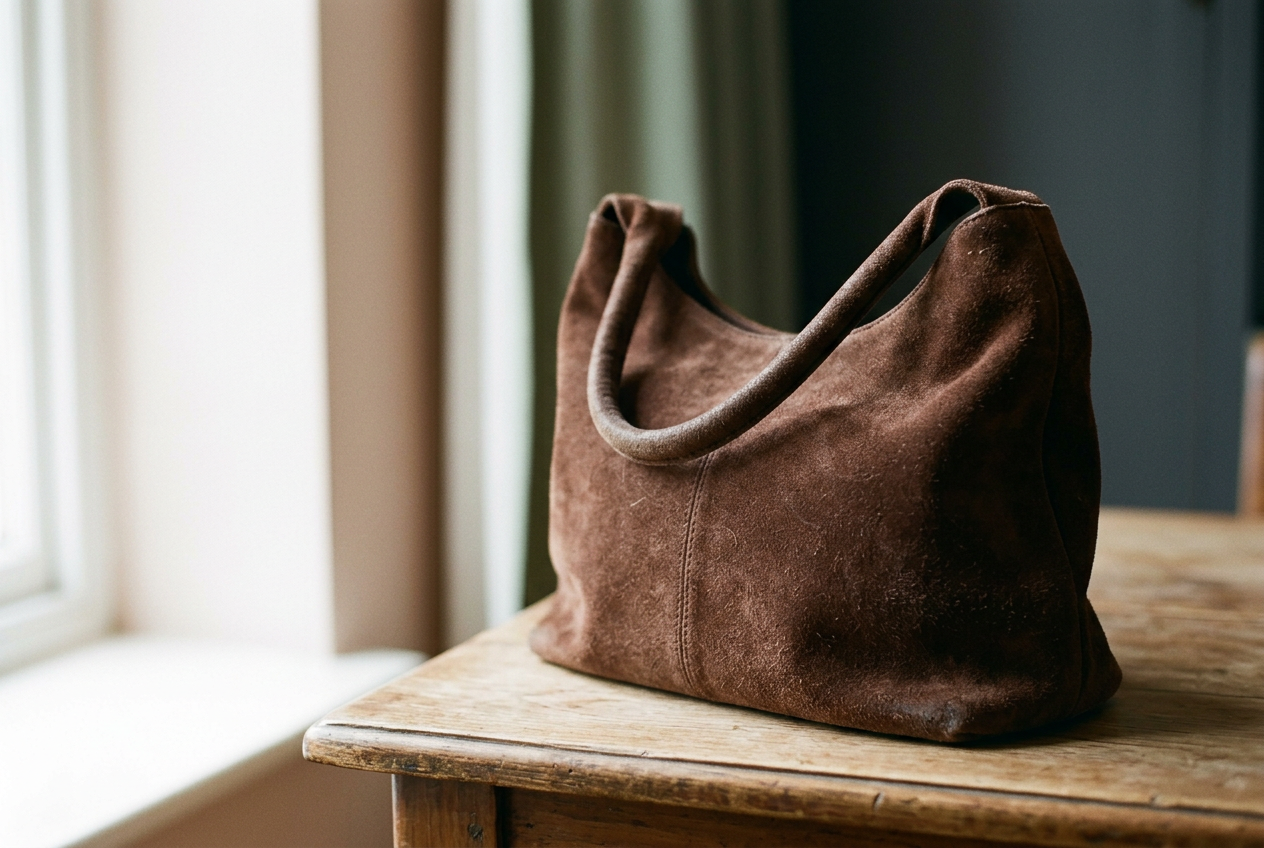
I kept returning to one useful comparison case while reviewing listings: a chocolate-brown, unlined suede hobo with a relaxed body and rolled leather handles. It is the sort of uncomplicated bag that explains the renewed interest. It also concentrates most of suede’s resale risks in a few heavily touched areas.
This is unisex advice. The bag may be styled differently across wardrobes, but suede condition, carrying comfort, and repair costs do not change with the department in which it was originally sold.
Why soft suede makes listing photos unreliable
Suede is leather with a raised, fibrous surface rather than a smooth outer finish. Those tiny fibers create the nap, meaning the soft pile that changes shade when brushed in different directions. Healthy nap can make one panel look lighter than another under directional light even when the color is even.
That natural variation gives sellers and buyers a problem. A dark patch might be the nap lying flat, oil transferred from a hand, moisture damage, or an old cleaning attempt. One front-facing photograph cannot distinguish among them, especially if the image has strong window light or boosted contrast.
The chocolate-brown hobo is a good test because dark suede forgives more than pale suede while still recording use. If its front panel looks evenly plush but the back panel appears shiny near the base, the bag may have spent years rubbing against clothing. If both sides change consistently when photographed from another angle, the difference is more likely to come from the nap.
A worthwhile listing needs images that let the surface move visually. Look for the front and back photographed in comparable light, plus at least one angled view where the fibers catch highlights. A seller does not need studio equipment. The point is to show whether a mark changes with the viewing angle or remains fixed in the leather.
Start where the hand lands
Handles are the quickest condition check because they absorb skin oil, hand cream, rain, and dye from clothing. On an all-suede handle, repeated contact compresses the nap and darkens the surface. Rolled smooth-leather handles behave differently: they may deepen in color attractively, but the finish can also crack where the handle bends over the hand.
For the brown hobo, I would want a close photograph of the underside of each handle, not only the top. The underside shows whether darkening is evenly distributed through normal carrying or concentrated into nearly black patches. Uneven patches are harder to dismiss as ordinary patina, which is the gradual surface change caused by handling and age.
Check the points where the handles join the body. Soft bags put repeated strain there because the contents pull downward while the handles lift upward, and suede can stretch before a tear becomes obvious. Enlarged stitch holes, rippling around the attachment, or a handle that sits at a different angle from its partner deserves more attention than a faint mark on the main panel.
Darkened handles are not automatically a reason to skip. At the lower end of the resale market, evenly worn handles may be a fair trade for an otherwise sound bag. Once the asking price approaches that of cleaner examples, however, the listing should show the handles closely enough that the buyer is not paying a premium for undisclosed wear.
Nap loss does not brush out every time
A suede brush can lift minor compression and remove dry surface dust. It cannot replace fibers that have worn away. The distinction matters around the lower corners, the back of the bag, and the area beneath a flap or strap, where friction can polish suede until it resembles smooth leather.
In photographs, permanent nap loss often appears as a flat, slightly reflective patch with a defined boundary. Temporary compression tends to look softer and may change shade across several images. Ask for a close view taken without flash if the listing shows a glossy corner; direct flash can exaggerate healthy texture, but it can also wash out the boundary between intact nap and a bald spot.
Do not assume professional cleaning will restore the original finish. Cleaning may reduce grime and even out color, yet an older suede bag can come back cleaner without becoming plush again. That is acceptable if the polished areas suit the price and the bag will be carried casually. It is a poor bet when the appeal rests on a velvety, uniform surface.
The brown hobo remains attractive with light flattening across the back because its slouch already suggests use. Bald lower corners change the decision. They interrupt the color, expose the most vulnerable points, and tend to worsen as the bag brushes against coats, denim, and seating.
Read the edges as a structural report
Sellers often describe edge wear as cosmetic, although its location determines whether that is true. A rubbed patch along the bottom piping may only affect appearance. Wear at a folded opening, strap attachment, or seam can expose construction and eventually let layers separate.
Piping is the narrow corded edge that helps a bag hold its outline. On a soft suede bag, intact piping keeps the base from collapsing into an undefined pouch. Request close photographs of all lower corners and follow the piping around the base. Once the covering has worn through to the cord beneath, repair becomes more involved than brushing or spot cleaning.
Also inspect edge paint, the flexible coating applied to cut leather edges on some straps and handles. Small surface cracks may remain stable for a while. Missing sections, sticky areas, or long splits suggest that refinishing could be needed, and a home-applied coating can look worse if the color and thickness do not match.
This is where the bargain calculation becomes plain. Cosmetic rubbing can be priced into an everyday bag. Split handle edges or exposed piping require either tolerance or repair money, so compare the total likely cost with a cleaner listing rather than comparing the asking prices alone.
Odor is the risk photographs cannot settle
No photo can prove that a bag smells clean. Suede and an unlined interior can retain perfume, smoke, damp storage odors, and fragranced cleaning products, while a seller may have become accustomed to a smell that a new owner notices immediately.
Descriptions such as vintage scent or stored condition need clarification. Ask directly whether the bag has any smoke, mildew, perfume, pet, or musty odor, and whether deodorizing products have been used. The answer is useful even when it is subjective because it creates a clearer condition record before purchase.
Pictures still offer clues. Pale tide marks, scattered dark specks, or a distorted base can accompany past moisture exposure, although none proves mildew by itself. An interior photographed only in deep shadow also leaves too much unresolved, particularly with the unlined brown hobo, whose raw suede interior would hold dust and make spills difficult to isolate from the surrounding color.
Odor removal costs time and may not work. Airing and specialist cleaning can reduce some smells, but soaking, household sprays, and heavy powders can alter color or settle into the nap. Buyers who are sensitive to fragrance or smoke should treat an unanswered odor question as missing condition information, not as reassurance.
The photo checklist that earns a closer look
A useful listing lets you compare both broad surfaces before examining wear points. Start with front and back views in similar natural light. If one side looks markedly smoother, ask whether the difference remains after the nap is brushed in one direction.
Move to the handles. The listing should show their tops, undersides, attachment points, and bends. On the chocolate-brown hobo, even darkening would be negotiable; near-black contact patches, cracked rolled leather, or stretched stitching would lower what I was willing to pay.
Next, enlarge every lower corner. Look for exposed piping, sharp color loss, repaired seams, and texture that has become shiny rather than merely flattened. Then inspect the opening and strap edges, where small failures affect how safely the bag carries weight.
Finish with the inside and a direct odor query. An unlined bag needs clear photographs down to the base, while a lined one should show seam edges and pockets rather than only the cleanest central panel. If those images are absent, requesting them costs a message. Buying without them can cost the price of a bag that never leaves the closet.
The trend itself still makes sense. A soft suede hobo adds texture without hardware or a rigid silhouette, and brown works easily with denim, wool, leather, and washed cotton. I remain undecided on paying high resale prices for examples with vague photography. Suede rewards wear only when the wear is visible before checkout.
Questions people ask
Can flattened suede nap be restored at home?
Light compression may lift with a clean suede brush used gently and in a consistent direction. A shiny patch with missing fibers will not grow its nap back, and aggressive brushing can thin the surrounding surface, so judge the bag on its current condition rather than an assumed restoration.
Are darkened suede handles a deal breaker?
Not always. Even, moderate darkening can be normal on a frequently carried bag and may suit a relaxed style. Concentrated black patches, stiffness, cracking, or stretched attachment points carry more risk, particularly when the listing price leaves no room for specialist cleaning or handle repair.
How can
I check a secondhand bag for odor before buying online?
Ask the seller directly about smoke, mildew, perfume, pets, mustiness, and deodorizing products. Also request bright interior photographs and review the return terms before buying, because photos may show moisture clues but cannot confirm how the suede smells.
Which suede edge wear is acceptable?
Soft rubbing and minor color loss along a sound lower edge are mainly cosmetic. Exposed piping, separating layers, enlarged stitch holes, or split handle edges can worsen under weight. On the brown hobo, I would accept a rubbed base before I accepted a weakened handle attachment.
One update a day
Today's fashion update, in your inbox
One fashion update each morning — no hype, no filler, just pieces worth wearing.