A Spinning Push-Pin Earring Is Often Fine. Sliding Is Not.
Rotation alone does not mean a threadless earring is loose. Check the front-to-back movement once, then stop before a fit test becomes irritation.
November 21, 2026 · 7 min read
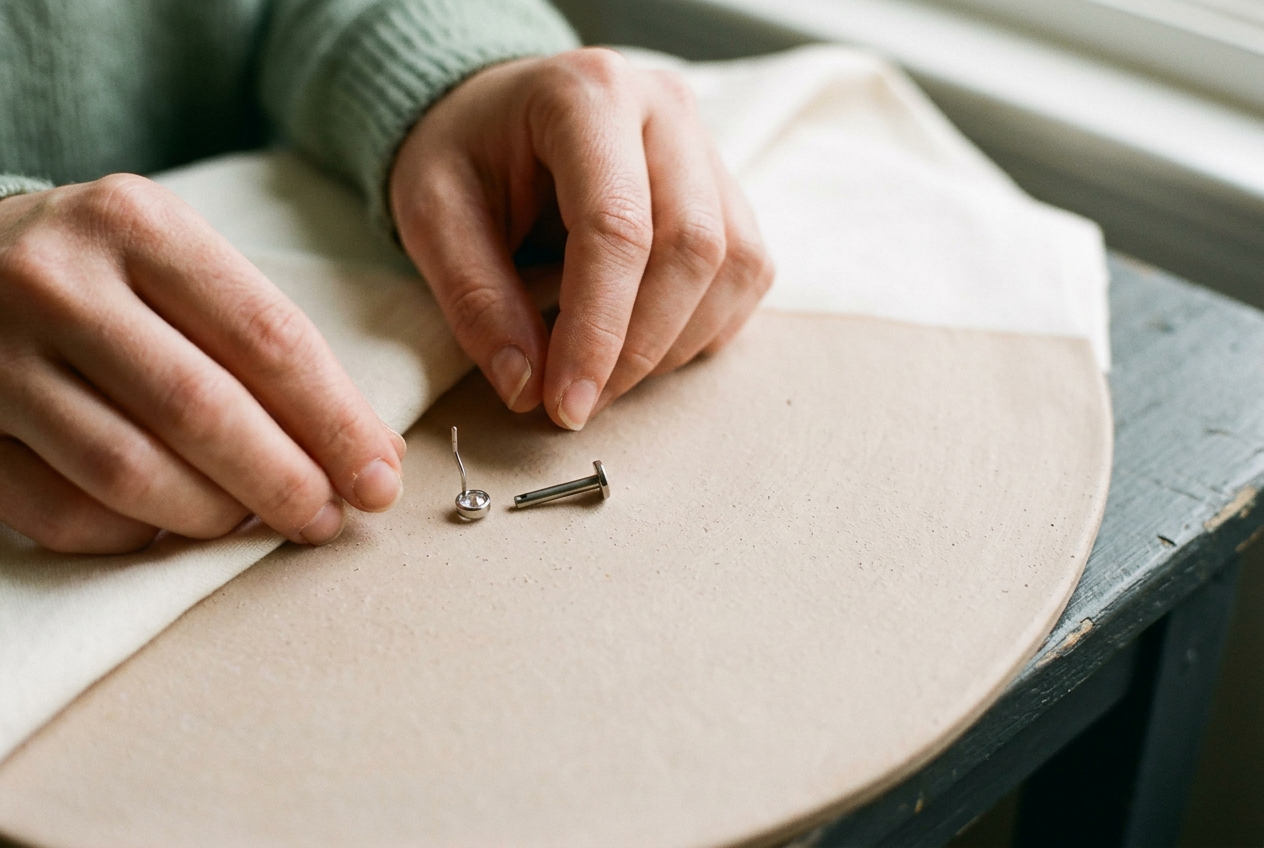
A tiny crystal turns beneath a fingertip, yet the polished disc behind the ear has not moved. That physical detail matters. In a push-pin earring, rotation and release are different motions, so a spinning front is not enough to diagnose a loose fit.
The reference piece for this walkthrough is an implant-grade titanium flat back earring, meaning the post’s backing sits flush against the earlobe, with a small bezel-set crystal end in a healed second-lobe piercing. It is a common unisex setup: discreet enough for daily wear, smooth against a pillow and easy to leave in for a week without thinking about it.
Then the crystal starts spinning.
Why a secure end can rotate
A push-pin end is also called a threadless end. Its slender pin slides into a hollow post, and a slight bend in that pin creates the tension that holds the two pieces together. There are no screw threads fixing the crystal in one orientation.
That construction explains the fit quirk. The end may turn around the post’s axis while the bent pin continues to press against the inside wall, much as a round component can rotate without traveling outward. A smooth spin can feel alarming if the alternative in your jewelry box is a traditional butterfly back, but it does not automatically mean the end is working free.
Return to the titanium crystal stud. If the crystal rotates while its base remains seated against the opening of the post, the back disc stays still and the whole earring does not slide through the piercing, the movement may be normal for that particular end-and-post pairing. Stop spinning it for reassurance. Repeated handling adds skin oil and pressure, while proving little about retention.
Movement becomes more concerning when it changes direction. An end that creeps outward, rocks from side to side at the post opening or reveals a visible length of pin is no longer showing rotation alone. The relevant motion is away from the ear.
Check the seat before testing the pull
Start with sight, not force. Wash and dry your hands, then look at the point where the decorative end meets the post. A phone camera or a second mirror can give a clearer view than twisting the ear toward the bathroom glass.
The end should appear fully seated, with no unexplained strip of pin between the decoration and the post. Some designs have a visible base or setting, so compare the junction rather than expecting every ornament to lie flat against the skin. On the reference stud, the bezel belongs outside the post; the narrow threadless pin does not.
Next, notice which part is moving. Hold the flat disc gently between two fingertips without squeezing the lobe, then touch the crystal with the other hand. If the entire post pivots as one unit, excess post length may be creating play. That is a sizing issue rather than proof that the pin is loose, although a post that catches, angles or repeatedly snags deserves a piercer’s assessment.
A correctly sized post leaves room for healthy tissue without pressing the backing into the skin. Too much length lets the jewelry tilt and catch. Too little can create indentation, pressure or embedding. Do not try to solve either problem by pushing the two ends harder together.
Use one gentle pull check
Only test jewelry in an established, comfortable piercing. The Association of Professional Piercers advises minimizing handling during healing and leaving suitable initial jewelry in place, so a fresh or irritated piercing is not the place for a home retention test.
Stabilize the flat disc. Grip the decorative end close to its base, using clean, dry fingertips, and apply a very light straight pull away from the post. This is a movement check, not a strength test: the aim is to learn whether the end immediately slides, not to discover how much force the jewelry can withstand.
A secure push-pin end should offer clear resistance and remain seated. Once it does, release it. Do not twist and tug repeatedly, because every extra attempt moves the post inside the channel and can leave an otherwise calm piercing sore.
On the titanium crystal stud, one smooth rotation followed by firm resistance to a light outward pull is a reasonable stopping point. Leave it alone. Check visually later only if the front develops a gap, changes angle or begins catching on clothing and hair.
Stop the test immediately if the end shifts outward, exposes its pin or feels as though it will release with little resistance. Keep hold of both parts so the end is not lost, but do not start bending, squeezing or reinserting components while the post is still in the ear.
The stop point for home adjustment
Threadless tension is adjusted by changing the slight bend in the removable pin. That adjustment should happen with the end outside the post, where the pin can be inspected and supported; bending it while assembled can distort the hollow post, damage a fine pin or transfer force to the piercing.
This is the clear home stop point: if a clean visual check and one light pull show outward travel, book a professional piercer. The same applies when an end that used to hold securely has begun releasing, since wear, a mismatched component or a damaged pin may be responsible, and adding a sharper bend without understanding the pairing can make the end difficult to remove later.
Do not repeatedly remove an established piercing to compare pin angles. Even healed channels can tighten, and frequent reinsertion can scrape tissue. Take the complete earring to the appointment, including any loose end, because the piercer needs to evaluate the post opening as well as the pin.
A piercer can remove the jewelry with controlled support, inspect the components, adjust compatible threadless tension or replace the damaged piece. They can also identify a mixed-system fit. Threadless ends and posts are not automatically interchangeable across every maker, even when the parts look similar on a countertop.
Rule out post length and pressure
Spinning is sometimes blamed on the pin when the real problem is a long post. The reference stud may feel active after swelling has settled because the disc and crystal now have room to shift together. In that case, bending the pin will not stop the jewelry from tipping.
Professional downsizing means replacing the initial post with a shorter one after swelling allows. It can reduce catching and keep a curated ear sitting closer to the skin, but the post must still accommodate the anatomy without compression. A backing that leaves a deep mark or starts disappearing into tissue is not a satisfyingly snug fit.
Material quality also matters. Implant-grade titanium is light and suitable for many people with metal sensitivities, provided the maker can document the material standard, but good metal cannot compensate for a damaged or poorly matched closure. Solid nickel-free gold can also be appropriate when its alloy and construction suit body jewelry. Plated fashion posts are a different proposition because the surface layer can wear and the underlying metal may be unsuitable for continuous use.
When the piercing needs more than a fit check
Tenderness after repeated testing is a reason to stop touching the jewelry. Persistent or worsening swelling, heat, marked redness, unusual discharge, significant pain or jewelry beginning to embed calls for prompt assessment; a professional piercer can evaluate the fit, while a qualified health care professional should assess suspected infection or a broader medical concern.
Do not remove jewelry from a possibly infected piercing unless a health care professional directs you to do so. Removal can allow the surface to close while the problem remains underneath. A piercer is useful for jewelry mechanics, but does not replace medical care.
For a calm, healed piercing, the decision is simpler. Rotation with a seated end and firm pull resistance can be left alone. Outward travel, a visible pin, easy release or pressure from poor post length needs an appointment.
The alternative is different, not fail-safe
An internally threaded labret, which accepts a small threaded shaft on the decorative end, may appeal if the sensation of free rotation makes threadless jewelry difficult to trust. Its closure gives more familiar tightening feedback, although threaded ends can also loosen and their tiny components may be awkward to handle.
A butterfly-back stud is easier to recognize, but its protruding post and clutch are less comfortable for sleep and can collect more debris around the backing. For the titanium crystal stud worn continuously, a correctly fitted flat back remains the better shape. The closure needs inspection, not automatic replacement.
Questions people ask
Is it normal for a push-pin earring to spin?
Yes, a threadless end can rotate while the bent pin still holds firmly inside the hollow post. Look for a fully seated connection, then make one gentle straight pull check. Rotation alone is less important than outward sliding, visible pin or a front that releases with little resistance.
Can
I tighten a push-pin earring while it is in my ear?
Do not bend or squeeze the pin while it is assembled in the ear. Threadless tension is adjusted with the end removed from the post, and a piercer can support the fine component while checking for damage or incompatibility. Stop home adjustment if one light pull shows movement.
Should
I test a push-pin end in a healing piercing?
No. Avoid unnecessary twisting, pulling and removal while a piercing heals, and let a professional piercer handle downsizing or a suspected loose end. If the jewelry is embedding, causing increasing pain or accompanied by signs of infection, seek prompt professional assessment rather than performing another fit test.
Does a longer flat-back post make the end spin more?
Extra post length can make the entire earring pivot or tilt, which may feel like a loose end even when the pin is secure. Hold the back gently and observe whether the front turns by itself or the whole assembly moves. A piercer can determine whether the post needs downsizing.
One update a day
Today's fashion update, in your inbox
One fashion update each morning — no hype, no filler, just pieces worth wearing.