Measure a Flat Back Earring Post Before It Starts Pinching
Post length is the space between the front and the disc, not the whole piece. Here is how to measure it and account for swelling, piercing angle, and a weighted end.
August 10, 2026 · 8 min read
A flat back earring, meaning the post’s backing sits flush against the ear, should leave the tissue relaxed between its decorative end and rear disc. It should not clamp. It also should not expose a section of bar whenever you turn your head.
This is unisex fit advice. Anatomy and jewelry construction matter here, not the wardrobe category attached to the earring.
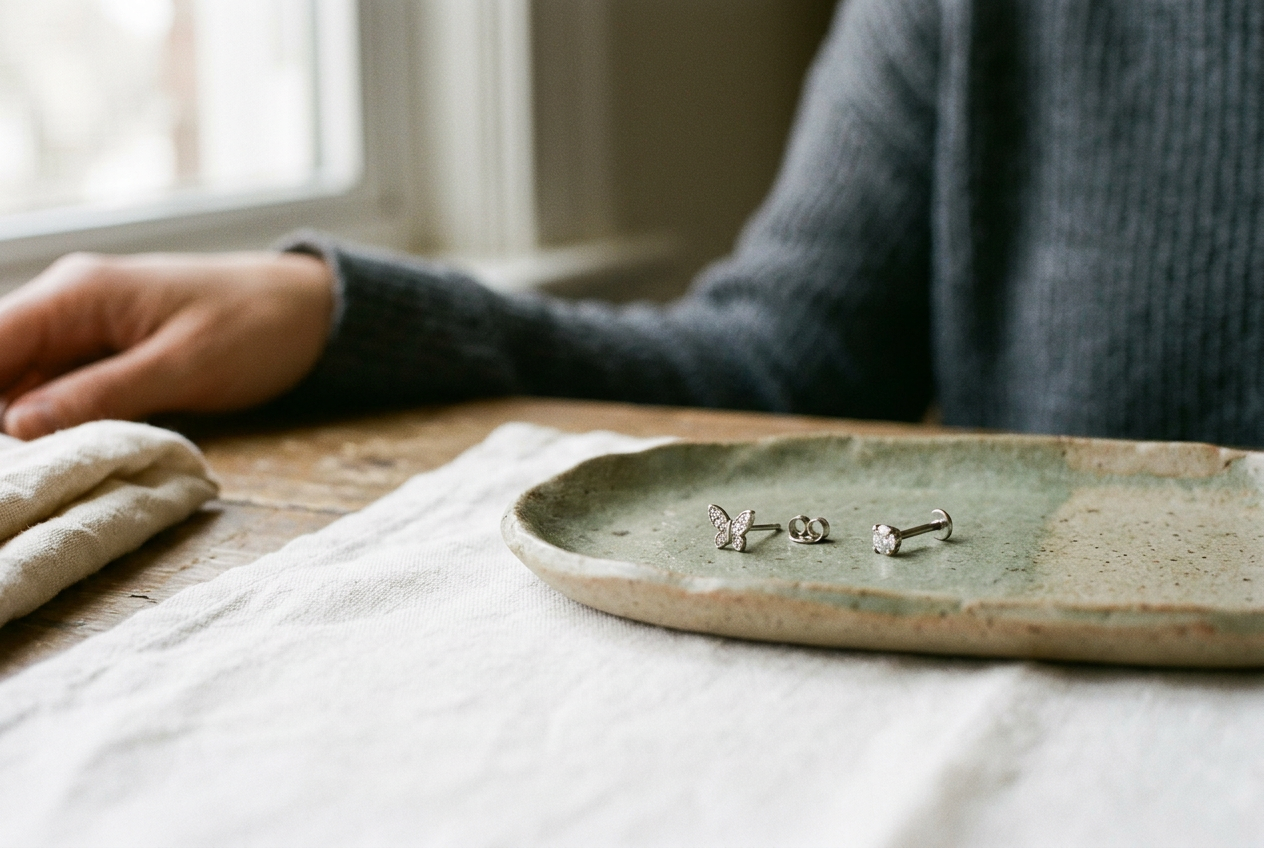
The working example is an implant-grade titanium threadless labret with an 8-millimeter post, a small round disc, and a low-profile bezel-set stone. A threadless labret is a hollow post that holds a decorative end by tension rather than a screw thread. It is common in lobes and cartilage because the back is smooth enough for daily wear and sleep.
That 8-millimeter marking is useful, but it does not tell us whether the earring fits. The number must cover the pierced tissue path, any predictable swelling, and a sliver of comfort space. The angle of the channel and the weight at the front can change what that looks like once the piece is installed.
Start with the jewelry, not the ear
Measure an existing post that you can wear without persistent pressure. It gives you a better starting point than pinching the ear with a ruler, especially when the piercing runs through the tissue at a slight diagonal.
Only remove jewelry at home if the piercing is fully healed and usually tolerates removal. Fresh, irritated, or recently stretched piercings can narrow quickly, and initial jewelry is often longer to allow swelling. A professional piercer should handle downsizing in those cases. This walkthrough is a fit explainer, not professional medical advice.
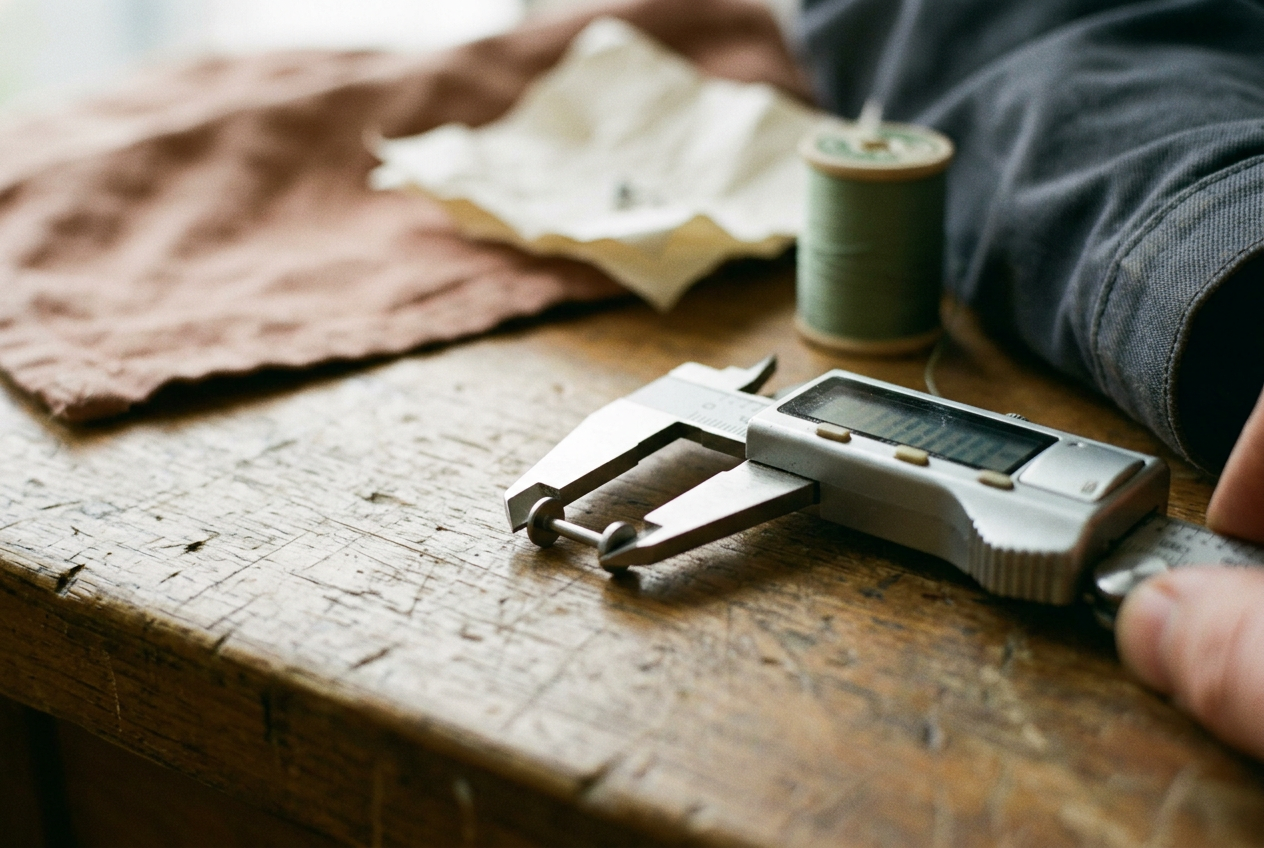
You need the clean post, its matching end, and either a millimeter ruler or a digital caliper, which is a measuring tool with sliding jaws. Calipers make the small difference between neighboring post lengths easier to see. Do not close hard metal jaws on your ear. Measure the jewelry off the body.
Check the jewelry maker’s diagram before ordering. Brands do not always display dimensions in the same way, particularly when a decorative end has a recessed socket or the backing is fixed rather than removable. The size you need is the wearable length, meaning the straight section of post available between the underside of the front and the inner face of the disc.
Do not include the threadless pin that bends inside the hollow post. Do not include the thickness of the rear disc. A ruler laid beside the full assembled earring will overstate the space your ear receives.
Measure the wearable shaft
Remove the decorative end from the titanium labret and lay the post on a flat, well-lit surface. Place one caliper jaw against the platform where the front end seats, then bring the other to the inner surface of the backing disc. Keep the tool parallel to the post. An angled caliper can add a misleading fraction to a very short object.
Take the reading twice. If the post was sold as 8 millimeters and your reading is close to that mark, you have confirmed the maker’s convention and can compare its other lengths with more confidence. If the measurement differs, use the brand’s own chart for the replacement rather than assuming another company labels the same construction identically.
A ruler can work when the markings are crisp. Stand the labret so the shaft runs directly over the millimeter scale, photograph it from overhead, and enlarge the image without changing the angle. This is less exact than a caliper, but it can distinguish an obviously roomy post from one that is only marginally long.
Do not measure the visible portion of a post while pulling the front away from the ear. That pressure compresses the tissue and creates space that was not present at rest.
Read the fit while it is installed
Reinsert the example post only if the piercing is healed and calm, then let the jewelry settle without pushing either end inward. Look at the front straight on and inspect the disc from behind with a mirror or phone camera.
A suitable fit leaves the stone stable while the disc rests against the ear without carving an outline. The disc may touch the skin. Flush does not mean tight. You should be able to clean around the accessible edges without forcing the jewelry through the channel, and ordinary facial movement should not produce a pinching sensation.
Compression has physical signs. The front or disc sinks into a hollow, the surrounding tissue bulges over an edge, or the skin stays blanched after pressure is released. Repeated tenderness after sleeping can also point to a short post, although irritation has more than one possible cause. Jewelry that appears to be embedding, or tissue that is hot, increasingly painful, or producing unusual discharge, needs assessment rather than another home measurement.
Excess room looks different. Part of the shaft remains visible at rest, the front tips downward, or the backing slides far enough to catch hair and headphone padding. On the 8-millimeter titanium labret, a light stone may still look tidy with a little spare room; replace it with a heavier cluster, however, and the same gap gives that front enough leverage to droop.
Check the fit at more than one point in an ordinary day. An ear can look compact in the morning and feel fuller after heat, exercise, pressure from sleep, or other routine tissue changes. One comfortable snapshot is not a complete measurement.
Correct for angle, swelling, and weight
Piercing angle is the reason a direct measurement of lobe thickness can fail. A channel that enters slightly higher at the front and exits lower at the back travels farther than a straight line taken across the thinnest visible part of the ear. Your existing post captures that diagonal path, provided it is sitting normally rather than being pushed flat for the measurement.
Swelling allowance should reflect the piercing you have, not the smallest post that closes. A healed lobe that stays stable may need little extra room. Cartilage, a piercing that becomes puffy after sleeping, or tissue that regularly changes through the day needs more tolerance. If those changes are large or persistent, fit cannot be solved responsibly by choosing a very tight post between episodes.
Decorative-end weight creates another tradeoff. A snugger post can keep a substantial gem cluster upright, but shortening the bar until the end looks perfectly level may transfer its weight into the tissue. Try a lighter end first, or ask whether a wider backing disc is compatible with the post. More surface area can improve stability, though a broad disc may sit awkwardly beside a fold or a neighboring piercing.
The disc itself does not add to wearable length when the maker measures correctly from its inner face. Its diameter still changes the experience. A small disc tucks into crowded anatomy but concentrates pressure over a smaller area, while a larger one spreads the load and needs a flatter landing place. Return to the titanium example: its small round disc is discreet, yet it will reveal a too-short post quickly because its edge presses into a narrow patch of skin.
Choose the next post without overcorrecting
Write down the measured length of the post you own and describe its resting fit in plain terms: compressed, stable, or visibly roomy. That record is more useful than trying to remember whether an unlabeled post once felt short.
If the 8-millimeter example leaves a clearly visible section of shaft throughout the day, compare the next shorter size offered for that exact post system. Do not jump several sizes based on the exposed gap alone. The front setting may hide part of the shaft, and the ear still needs enough room to change without being clamped.
If the current post indents the tissue, do not subtract anything. Move to a longer compatible post or have a piercer assess the angle and installation. Gauge, meaning the thickness of the post itself, is a separate measurement and should remain compatible with the piercing and decorative end. Changing gauge is not a substitute for correcting length.
Threadless tops and posts also need compatible pin and shaft dimensions. A decorative end that fits one system may be loose or impossible to insert in another, even when the advertised post length matches. Buying one post as a test is more sensible than replacing an entire ear stack before confirming the fit.
Give the new size a calm trial rather than judging it immediately after reinsertion, which can make tissue look fuller. Over the following days, check for a persistent rear-disc outline and watch whether the front begins to lean as normal movement works the jewelry forward. The right result is uneventful: the 8-millimeter baseline has become a shorter or longer post that stays aligned without leaving a pressure mark.
Leave unstable piercings to a professional
Do not use this method to downsize a fresh piercing, force jewelry through resistance, or manage a backing that is disappearing into tissue. A reputable piercer can measure the channel, account for its angle, and change the post with less disturbance. A clinician should assess symptoms that suggest more than a jewelry-fit problem.
There is also no prize for reaching the shortest possible length. A tiny margin of room is preferable to a disc that looks perfectly flush only because it is compressing the ear.
Questions people ask
Do flat back earrings need to touch the ear?
The rear disc can rest against the skin, but it should not dig in or leave the tissue bulging around its edge. A fitted post may show almost no shaft while still allowing the disc to sit without pressure. Judge the skin at rest, not while pushing the front and back together.
Can
I measure post length with the earring still in?
You can inspect visible slack while the earring is installed, but you cannot get a reliable total post measurement that way. Measure removable jewelry off the body from the front seating platform to the inner face of the disc. For a piercing that should not be left empty, ask a piercer to measure and change it.
Should a heavy decorative end use a shorter post?
Only if the current post has genuine excess room. A shorter bar can reduce tipping, but it must not hold the heavy end against compressed tissue. A lighter decorative end or a compatible disc with more support may correct the angle without sacrificing swelling allowance.
Does a fresh piercing need a longer flat back post?
Initial jewelry is commonly fitted with room for expected swelling, so it may look longer than the final post. Do not copy that length for a healed piercing or downsize the fresh one yourself. Timing and tissue condition matter, and a professional piercer can decide when a shorter post is appropriate.
One update a day
Today's fashion update, in your inbox
One fashion update each morning — no hype, no filler, just pieces worth wearing.