Anodized Titanium Can Scratch. It Should Not Peel Like Plating.
Titanium’s bright blue, purple and gold tones can come from its own oxide layer rather than an applied finish. The difference becomes useful when wear marks appear.
November 11, 2026 · 8 min read
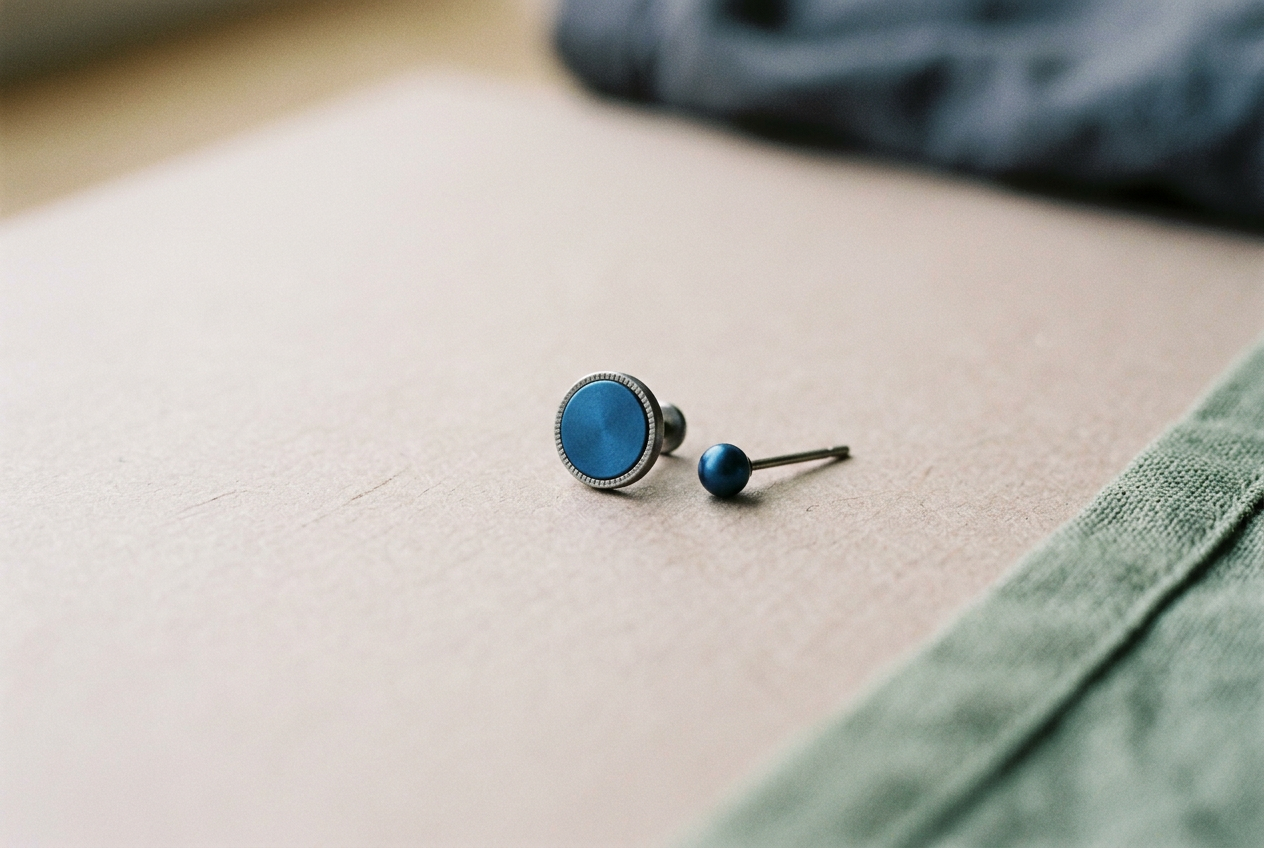
Start with a cobalt-blue titanium flat-back stud in a healed upper-lobe piercing. The front is a small polished disc. The flat back, meaning the post’s backing sits flush against the earlobe, stays in through showers, headphones and sleep. After regular wear, the blue may look slightly muted where fingers grip the disc, while a thin silver-gray line can appear at an exposed edge.
That line is the useful detail. On genuinely anodized titanium, it usually means abrasion has changed or removed part of the colored oxide layer. If the blue lifts in a flake, curls at an edge or exposes a sharply bounded layer underneath, the earring probably carries an applied finish instead.
This advice is unisex. The mechanics do not change with the styling: the same reading applies to a blue flat-back stud worn alone, a purple hoop or a mixed-metal ear stack.
The color comes from light, not blue pigment
Anodizing is an electrical treatment that changes the thickness of titanium’s naturally forming oxide layer. A maker places the prepared titanium in an electrolytic bath and applies voltage, which builds that transparent surface layer to a controlled thickness. No blue dye needs to sit on top.
The visible color comes from interference, meaning light reflects from the oxide surface and the metal beneath it before those reflections combine. Different oxide thicknesses produce different colors. This is why anodized titanium can move through bronze, purple, blue and green tones even though the underlying metal remains gray.
It also explains why the cobalt-blue flat-back can look more violet beside a warm lamp and brighter blue near a window. Finger oil may make it seem dull because residue changes how light meets the surface; washing the healed earring according to the maker’s care instructions can restore its clarity when dirt, rather than abrasion, caused the change.
Anodizing does not fill scratches or disguise rough finishing. The titanium must be polished well before color is added, since machining lines remain visible and high points receive the most contact once the stud is worn. A mirror-polished disc gives a brighter, cleaner color than a matte one, although both can be anodized.
Color matching has limits. Two ends anodized at different times may vary slightly because alloy, preparation and bath conditions affect the result, while curved jewelry changes appearance across its surface as the viewing angle shifts. For a symmetrical pair, buy both earrings together and inspect them under the same neutral light.
A scratch can expose gray or another color
Return to the cobalt-blue disc. A hairline scratch that reaches through the oxide exposes titanium’s natural silver-gray tone. It should read as a narrow interruption in the color, not as a chip with a raised border, because the anodized area is part of the metal’s converted surface rather than a separate colored sheet.
A shallower abrasion can look different. If wear reduces the oxide thickness without cutting all the way through it, the mark may show a neighboring interference color, such as violet or bronze, depending on how much surface remains. This color shift can be easiest to see around the rim, where the stud meets phone screens, helmet straps or other jewelry.
That behavior is one reason anodized titanium ages more quietly than many plated fashion earrings. It can still scratch. It is not color all the way through. Yet there is no thick blue layer waiting to detach, so normal wear more often appears as fine gray lines, softened color or a localized hue change.
Deep damage is permanent unless a specialist refinishes and re-anodizes the piece. Re-anodizing is not a spot repair to attempt while the jewelry is installed, and polishing one mark may alter the surrounding finish. On an inexpensive end, replacement can make more sense. On a well-made piece with sentimental or design value, ask the original maker or a reputable piercing studio whether refinishing is available.
Plated and coated color fails at its edges
Plating deposits another material over the base metal. Other applied finishes, including some physical vapor deposition finishes, add a thin external layer even when manufacturers describe them as durable. These techniques are not automatically poor quality, but their wear pattern differs from anodizing and the care instructions may differ too.
Look closely at a worn edge. A coated blue stud may reveal gray titanium in a hard-edged chip, or another base-metal color if the entire piece is not titanium. Peeling, bubbling and visible lifting are stronger evidence of an applied layer. A scratch alone proves less, since both anodized and coated surfaces can show a line when dragged against something harder.
The back of the cobalt-blue reference stud offers another clue. If the decorative disc is blue but the post has an abrupt boundary where the color stops, that may be an intentional mask used during anodizing or evidence that only the front received a coating. The product description should settle it. Do not infer construction from color alone.
Wording matters here. “Titanium color” may describe a gray shade rather than the metal. “Titanium post” says nothing about the decorative end. “PVD titanium” can refer to titanium-based material deposited over another metal, not a solid titanium earring that has been anodized.
The useful listing identifies the metal of every wearable component and states how the color was made.
Buy the metal first and the color second
For everyday earrings, ask whether the piece is solid titanium and whether the color is anodized or applied. If sensitivity is the reason for choosing titanium, look for a recognized material designation such as ASTM F136, a specification commonly cited for titanium alloy used in surgical implants, or ASTM F67 for unalloyed titanium. The standard does not guarantee that every earring shape is suitable for every piercing, but it gives more information than “hypoallergenic titanium.”
Check the post, backing and decorative end separately. A solid titanium post paired with a plated brass front can still put a different metal against the ear, particularly when the end overlaps the piercing channel. Gold-colored anodized titanium remains titanium at the surface; gold-plated titanium has an added gold layer and will age like plating.
Construction matters as much as alloy. A threadless earring, meaning the decorative end press-fits into a hollow post, should have a secure bend in its insertion pin and a smooth join. External screw threads should not scrape through the piercing channel during insertion. For a fresh or irritated piercing, have a qualified piercer choose and install appropriate jewelry rather than treating an online material label as medical clearance.
Anodized implant-grade titanium generally sits in an accessible piercing-jewelry price band: more than basic plated fashion studs, usually less than comparable solid-gold pieces. Complex settings and hand finishing can push the price higher. Confirm whether a listing covers one end, one complete earring or a pair, since professional piercing jewelry is often sold by the piece.
The small premium over plain titanium is worthwhile when the seller names the alloy, finishing method and full construction. It is not worthwhile when a vague “rainbow titanium” description does all the work. In that case, the cobalt-blue stud may be attractive, but there is no reliable way to predict what its first scratch will expose.
Keep abrasion away from the high points
Anodized color needs uncomplicated care. On healed piercings, remove skin oil and product buildup with the method recommended by the jewelry maker, rinse away residue and dry the piece gently. Skip abrasive polishing cloths on colored areas, since a cloth intended to brighten bare metal can thin the oxide that creates the color.
Storage matters when the earrings are out. Keep each piece from rubbing against chains, harder stones or other studs, especially if the anodized surface is highly polished. Check threadless ends for security before wear without repeatedly twisting the colored face against metal tools.
For the cobalt-blue flat back, the likely first wear point is its outer rim, not the protected center or the disc behind the ear. A smooth gray line there is cosmetic wear. A loose edge of blue material is a construction clue, and it is enough reason to stop treating the listing’s “anodized” claim as settled.
Questions people ask
Does anodized titanium color wear off?
Yes, abrasion can thin or remove the oxide layer that creates the color. Wear usually appears as a muted patch, a neighboring hue or a fine silver-gray line where bare titanium is exposed. The color is not permanent through the full depth of the metal, but it should not detach as a flexible flake.
How can
I tell anodizing from plating on an earring?
Read the material description first, then inspect worn edges under bright neutral light. Anodized titanium tends to show smooth color shifts or gray scratches. Chipping, bubbling, peeling and a raised boundary around missing color suggest an applied finish, although a photograph alone may not identify the exact coating.
Is colored titanium suitable for sensitive ears?
Anodizing does not add a pigmented coating, which removes one common source of uncertainty, but color alone does not establish jewelry quality. Look for a stated titanium standard such as ASTM F136 or ASTM F67, confirm that every part touching the ear uses the claimed metal and consult a qualified piercer for a fresh piercing.
Can a scratched anodized earring be recolored?
A specialist may be able to polish and re-anodize solid titanium after removing the jewelry, but polishing changes the surface and may soften crisp details. Ask the original maker or a reputable piercing studio before attempting a repair. For a basic stud, replacement may cost less than professional refinishing.
One update a day
Today's fashion update, in your inbox
One fashion update each morning — no hype, no filler, just pieces worth wearing.