Flat Backs Beat Sleeper Hoops on a Side-Sleeper’s Pillow
A close hoop looks compact, but its hinge still meets the pillow. This hands-on comparison finds the better overnight closure for lobes and cartilage.
October 27, 2026 · 7 min read
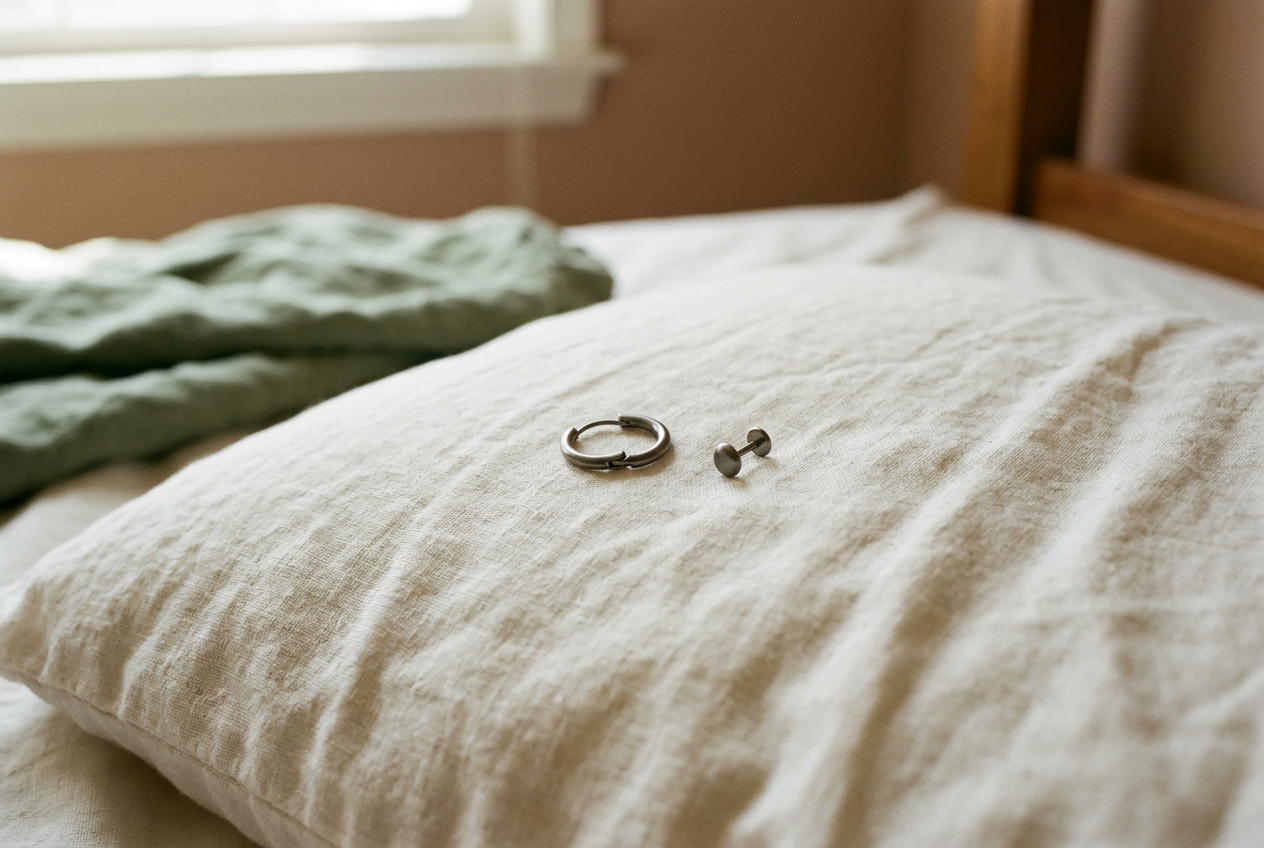
The hard little edge of a hoop hinge is easy to miss between two fingers. Put it between an earlobe and a firm pillow, though, and it becomes the whole point of the earring.
For this comparison, I wore a plain implant-grade titanium sleeper hoop in one lobe and a titanium flat-back stud with a low domed front in the other. Implant-grade titanium means titanium made to a recognized body-implant standard. Both pieces sat close to the skin, without charms, prongs, or decorative stones that could confuse the result. The hoop cleared the bottom of the lobe by a narrow gap.
The flat back had enough post length for a slim space between the ear and the front.
This is unisex advice. The mechanics do not change with wardrobe or gender, although ear anatomy, piercing angle, pillow firmness, and hair length can alter which annoyance appears first.
The pillow finds the hinge
On the flat-back side, pressure spread across the small disc behind the lobe. I could still feel the jewelry against a firm pillow, particularly when my head tipped forward and pushed the lobe toward the jaw, but there was no single edge taking the load. A softer pillow made it close to forgettable.
The sleeper hoop behaved differently. Its circular shape looked neater from the front, yet the ring needed a curved pocket of space below and behind the lobe, and that space disappeared when the ear pressed into the pillow. The hoop then rotated until either the hinge or the closure seam reached skin. Once there, it could produce a precise pinch rather than broad pressure.
That rotation matters. A smooth, well-finished hinge is less troublesome than a bulky one, while a ring that fits too loosely has more room to turn and present its closure to the pillow. Going extremely snug does not solve everything, because a hoop that hugs the lobe can press along its lower edge when the ear folds.
The flat back won this part of the test. Fit remains critical. A post that is too short can pull its disc tightly into the back of the ear, while an unnecessarily long post slides, tilts, and lets the front press at an angle. The useful fit is close, not clamped: the jewelry should not indent settled skin, but it should not travel freely along the post either.
Hair changes the result, but not the winner
The hoop caught more hair. It did not need an open gap to do it; a strand could wind around the ring, reach the hinge, and stay there until I noticed tension while turning my head. The seam was also easier to feel when wiping the earring after washing my hair.
The flat back gave hair less structure to wrap around. Its low front mattered as much as the rear disc, since a tall setting or claw-set stone would restore the snagging problem from the other side. The stud was not immune. Fine hair occasionally slipped into the small space allowed by the post, but it pulled free without the same loop-around-the-ring action.
Long hair makes this difference more noticeable, particularly if it is worn loose to bed. Short hair removes one advantage from the flat back, but pillow pressure still favors it.
Behind-the-ear space is not as simple as flat versus round
A flat disc sounds as though it needs no room. It does. The disc has thickness, and the post must accommodate the ear without squeezing it. If the piercing exits near a fold or close to the head, a wide backing can press against neighboring cartilage even though it sits flush against the pierced tissue.
The sleeper hoop has no post extending straight behind the lobe, which is useful for ears that sit close to the head. Its demand for space follows a different path: the ring occupies the area beneath the piercing and curves behind it. On an ordinary lobe placement, that space is often available until a pillow compresses the ear. In an upper-ear placement, the ring can meet a cartilage ridge before it closes comfortably.
The comparison pair made that distinction clear. The flat back needed a small, stable landing area behind the piercing. The sleeper hoop needed clearance around the full lower arc, even though its hinged section looked tiny in hand. A backing can be measured against one spot.
A hoop has to agree with the anatomy all the way around its curve.
Lobes forgive more than cartilage
For a healed lobe, both closures are workable. The sleeper hoop is easier to understand at a glance: open the hinged segment, guide it through, and click it shut. It also gives a clean uninterrupted-ring effect, which is why it remains appealing for a minimal stack. In daytime wear, when a pillow is not forcing the hinge into the skin, the pinch that decided this test largely disappears.
The flat back is the better leave-in option. The comparison stud used a removable front rather than a butterfly backing, so there were no exposed post ends and no clutch-shaped edges behind the ear. Flat backs may be internally threaded, meaning the decorative end screws into a hollow post, or threadless, with a slightly bent pin held inside the post by tension. Threadless fronts are convenient once the bend is set correctly, but tiny ends can be fiddly to align without good light.
Cartilage shifts the balance further toward a correctly fitted flat back. The tissue is less willing to fold around hardware, and a hoop can transfer pressure across its curve when the head rests on it. A hinge that rotates through the piercing channel may also become the point that feels rough, even when the outer surface looks polished.
There is a catch. A cartilage flat back with the wrong post length can be worse than a roomy lobe hoop, because there is less soft tissue to absorb a tight fit and less tolerance for a disc landing against a nearby fold. This is where professional fitting earns its time. A piercer can assess the angle, choose a disc diameter that clears the ear’s contours, and fit a shorter post only after swelling has settled.
Material and finish matter before style
The test pieces were titanium because it is light, resists corrosion, and is widely used for body jewelry when supplied to an appropriate implant standard. The standard matters more than a vague titanium label. Solid nickel-free gold is another fine-jewelry option, though alloy composition and construction still need checking. Plated base metal is the weaker overnight choice because constant skin contact, moisture, and friction can wear the surface.
Run a fingertip and a piece of fine fabric over any hoop hinge before buying. A closure that catches fabric is likely to find hair or a pillowcase. Close it several times. The click should feel definite, with the ends aligned rather than stepped.
For a flat back, inspect the rear disc and the junction where the post meets it. The surface should feel smooth, and the post should match the piercing rather than forcing a thicker gauge, the diameter of the post, through the channel. Plain implant-grade titanium usually belongs to a more accessible price tier than solid gold, but paying extra for a decorative front does not correct a poor post length.
The practical choice
Choose the flat back if the earring will stay in for sleep, especially in cartilage or under loose hair. Ask for a close post fit and a modest rear disc that does not collide with an ear fold. A low-profile front finishes the job.
Choose the sleeper hoop for a healed lobe when the ring shape is the priority and you are willing to remove it at night, or when a straight backing feels crowded behind the ear. Look for a narrow, polished hinge and enough inner diameter to clear the lobe without hanging loosely.
The comparison hoop remains the better-looking ring from the front. It is not the piece I would keep against a pillow.
Questions people ask
Are flat back earrings comfortable for side sleepers?
They are usually more comfortable than hinged hoops because the rear disc spreads pressure across a small, smooth area instead of letting a seam rotate into the skin. Comfort still depends on post length, disc size, piercing angle, and pillow firmness. A too-short flat back can press even without an exposed post.
Can I sleep in sleeper hoops every night?
A smooth, close-fitting sleeper hoop may be tolerable in a healed lobe, particularly on a soft pillow, but its hinge can rotate and pinch under pressure. Check the seam for roughness and remove the hoop if the skin becomes sore. Cartilage placements are less forgiving because the ring can press against firm tissue.
Do flat back earrings work for a fresh piercing?
Flat backs are commonly used as initial jewelry when a qualified piercer selects the material, gauge, and extra post length needed for swelling. Do not copy the close fit described in this healed-lobe test for a fresh piercing. Leave installation, downsizing, and any response to persistent swelling or pain to a professional piercer.
Which closure is easiest to change at home?
A hinged sleeper hoop is generally easier to see and operate in a healed lobe. Threadless and internally threaded flat backs are more secure for overnight wear, but aligning a tiny front with a post behind the ear takes steadier fingers. Cartilage angles can make that job awkward, so a piercer may be the faster option.
One update a day
Today's fashion update, in your inbox
One fashion update each morning — no hype, no filler, just pieces worth wearing.