A 20-Gauge Earring Fits an 18-Gauge Hole, Not Every Setup
A thinner fashion stud may slide into an 18-gauge piercing, but it cannot necessarily use the flat back or decorative end already there. Gauge is only one part of the fit.
September 24, 2026 · 8 min read
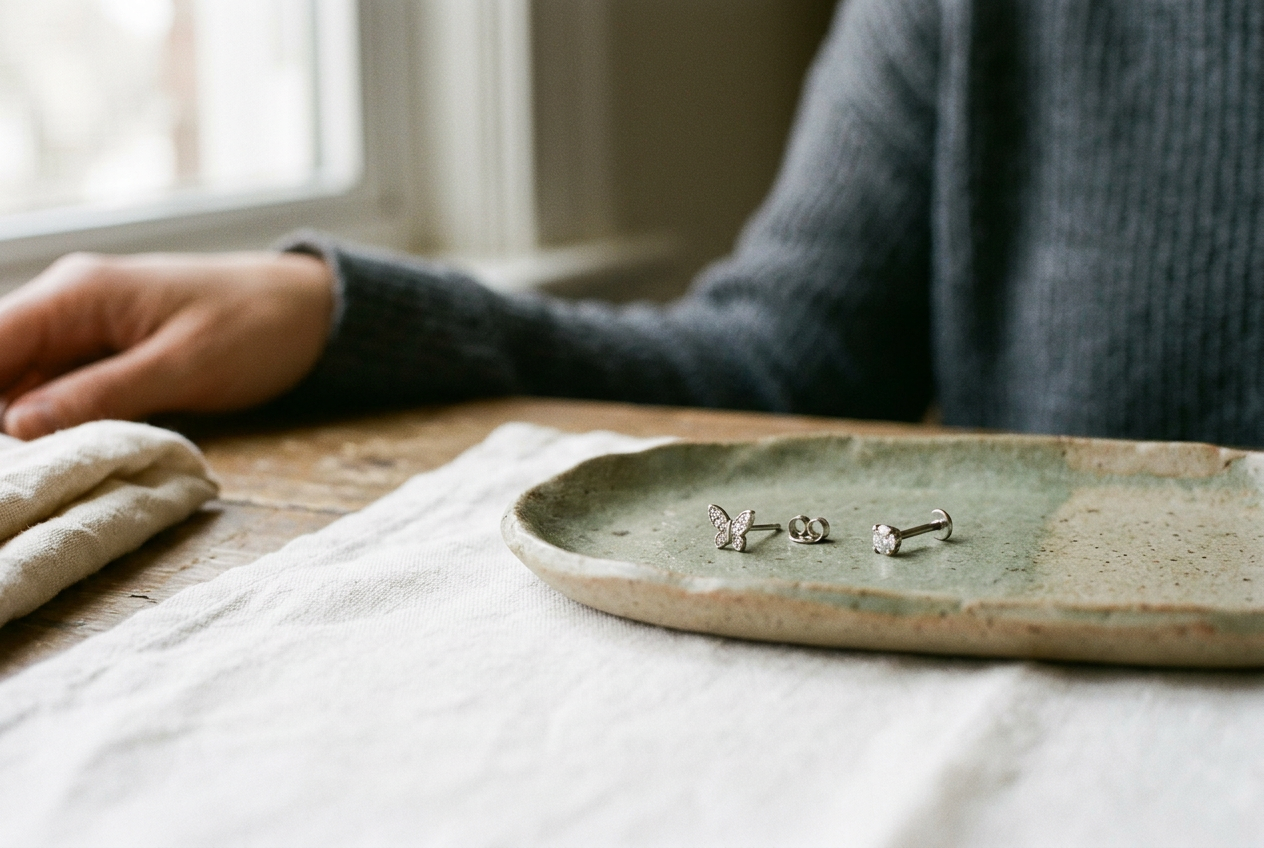
Put two small earrings on a tray: a 3 mm cubic zirconia fashion stud with a butterfly back and an implant-grade titanium flat-back labret with a similarly sized stone. From the front, they can look interchangeable. Turn them sideways and the problem appears. The fashion stud has a thin, fixed post with a groove near its end.
The labret is a hollow post designed to accept a separate decorative end.
That pair is the fitting case to keep in view. The fashion stud is 20 gauge, while the labret post is 18 gauge. Gauge means the thickness of the post that passes through the piercing, and the numbering runs backward: a 20-gauge post is thinner than an 18-gauge one.
In standard body-jewelry measurements, 20 gauge is about 0.8 mm thick and 18 gauge is about 1.0 mm. The difference is only 0.
2 mm. It can be harmless at the piercing channel and decisive at the connection point.
This is unisex fit guidance. Earring mechanics do not change with the wardrobe around them.
A thinner post can enter the piercing
In a healed piercing that comfortably wears an 18-gauge post, the 20-gauge fashion stud will usually slide through without resistance. A thinner object is entering a slightly wider channel. There should be no need to push, twist hard or use the butterfly back to pull the post into place.
For one evening, that small reduction may have no noticeable consequence. The stud might sit a little less steadily, particularly if its decorative front is heavy or its post is long, but the gauge difference alone does not make the earring unsafe. The metal, surface finish, backing pressure and condition of the piercing matter more to immediate comfort.
Longer wear changes the calculation. A piercing channel can tighten around thinner jewelry, especially if it is established but prone to shrinking, so returning to the 18-gauge titanium labret after days or weeks in the 20-gauge stud may feel snug. There is no universal timetable. Piercings vary by location, age and individual tissue.
That makes the 20-gauge cubic zirconia stud a reasonable short-term swap in many healed lobes, but a poor placeholder if the goal is to preserve an easy 18-gauge fit. If maintaining the setup matters, choose an 18-gauge post rather than assuming two-tenths of a millimeter will remain irrelevant.
The flat back is not a reusable earring back
A flat-back earring, meaning the backing sits flush against the ear, is usually built as body jewelry rather than as a conventional stud. Its labret post has a flat disc on one end and an opening on the other. The decorative top connects at that opening.
The butterfly back from the 20-gauge fashion stud cannot be transferred to the labret, because the labret does not have the long exposed stem and retaining groove that the butterfly clutch needs. The labret’s flat disc cannot be moved onto the fashion stud either. It is part of the post, not a loose backing.
This is the main compatibility mistake. A 20-gauge earring may fit through an 18-gauge piercing while none of its components fit the 18-gauge jewelry. Passing through tissue and connecting to hardware are separate tests.
Post length is separate again. The 18-gauge labret may be correctly sized in thickness yet too short if its disc presses into swollen tissue, or too long if the front tips downward and the bar catches on hair. Buying by gauge alone does not preserve the original fit.
Replacement ends must match the connection system
The decorative stone on the titanium labret may attach in one of two common ways. A threadless end uses a slender pin, bent slightly so tension holds it inside the hollow post. An internally threaded post has screw threads inside its opening, allowing a threaded end to twist into it.
A threadless end will not work in an internally threaded post. A threaded end will not work in a threadless post. Even within one category, the pin diameter or thread pattern must match what the manufacturer specifies; gauge can help narrow the choice, but it does not guarantee compatibility across brands or collections.
This matters when the 3 mm cubic zirconia fashion stud is being replaced for its look rather than its post. Its stone is permanently attached to the 20-gauge stem. It cannot be detached and inserted into the titanium labret unless the product was designed and sold as a compatible body-jewelry end.
Threadless systems can sometimes use the same decorative end across more than one post gauge, depending on the maker’s specifications. That convenience belongs to the system, not to all earrings labeled threadless. Check the post and end documentation together, and do not assume that a pin fitting partway means it is correct.
A loose end can fall out. An oversized pin can distort the post. Cross-threading, which means forcing mismatched screw threads together, can damage both pieces before the jewelry ever reaches the ear.
Metal can be the problem when gauge is not
The 20-gauge fashion stud may pass through easily and still leave the piercing tender. Fashion earrings are often labeled hypoallergenic without identifying a recognized material standard, while plating can wear at the post or at the groove where the butterfly back grips. A smooth post matters because every rough edge crosses the piercing channel during insertion and removal.
For a sensitive piercing, implant-grade titanium with documented ASTM F-136 or ASTM F-67 compliance gives the buyer more useful information than the word hypoallergenic alone. Suitable solid gold body jewelry is another option when its alloy and construction are clearly disclosed, though gold costs more and still needs a polished surface and compatible end.
The practical tradeoff is visible in the two-stud example. The 20-gauge cubic zirconia fashion stud may offer the exact front design wanted for an outfit, but the 18-gauge titanium labret offers a flush disc, a known connection and a post selected for the piercing. If the fashion stud causes itching, heat or persistent redness, the tiny gauge reduction is unlikely to be the whole story.
Butterfly backs also collect residue around their folds and can be tightened until they pinch. Leave breathing room behind the lobe rather than clamping the backing against it, and clean jewelry according to its maker’s instructions. A flat back avoids the projecting stem that can press against a pillow, though an incorrectly short labret can be just as uncomfortable.
Never force the return to 18 gauge
The risky moment often comes later. After wearing the 20-gauge stud, the 18-gauge post may no longer pass through with its usual light pressure. Pushing harder turns a routine jewelry change into an unplanned stretch and can scrape or tear the channel.
Stop if the post meets firm resistance, causes sharp pain or produces bleeding. A qualified piercer can assess the angle and, where appropriate, use a taper to guide suitable jewelry through without asking the blunt end of the labret to do that work. Fresh, irritated or still-healing piercings should not be treated as a home sizing experiment.
The reverse swap deserves the same restraint. An 18-gauge post is thicker than a channel that has settled around 20-gauge jewelry. The 0.2 mm difference looks negligible on a ruler, yet tissue registers pressure and surface damage more readily than the eye does.
For the original pair on the tray, the clean buying decision is straightforward. Wear the 20-gauge cubic zirconia stud briefly only if the piercing is healed, comfortable and tolerant of its metal. To retain the flat-back setup, buy the desired decorative end in the labret’s exact connection system, or buy a complete 18-gauge labret with the correct post length.
Read the product page in the right order
Start with the wearable post gauge, then check the connection type and post length. After those match, consider the front size and flat-disc diameter, since a large end can crowd an earring stack while a very small disc may press into soft tissue.
The word fits is doing too much work on many product pages. A listing may say an end fits 18-gauge posts, but that statement refers to its mechanical connection, not to the length required for a particular ear. Another listing may describe a complete earring as 20 gauge without offering any removable end at all.
If the listing does not identify whether the piece is threadless, internally threaded or a fixed fashion stud, do not buy it as a replacement component. A complete, correctly sized piece is usually less expensive than assembling incompatible parts and replacing a bent pin or damaged post.
Questions people ask
Will a 20-gauge earring make an 18-gauge piercing close?
A healed piercing will not usually close around jewelry that is still passing through it, but the channel may tighten toward the thinner 20-gauge post. The amount and speed vary. If keeping an easy 18-gauge fit matters, use 18-gauge jewelry rather than leaving the thinner stud in for an extended period.
Can
I put a 20-gauge end on an 18-gauge flat-back post?
Only if the end was made for that post’s connection system and the manufacturer lists the combination as compatible. A fixed 20-gauge fashion stud has no removable end. Threadless pin dimensions and threaded patterns can vary, so matching the front’s appearance or nominal gauge is not enough.
Is it safe to push an 18-gauge earring into a 20-gauge hole?
Do not force it. Moving from 20 gauge to the thicker 18 gauge is a stretch, even though the diameter changes by only about 0.2 mm. Firm resistance, sharp pain or bleeding means stop; a qualified piercer can check whether the channel has tightened and fit appropriate jewelry.
Does hypoallergenic mean a fashion stud is safe for sensitive ears?
Not by itself. Hypoallergenic is a broad marketing term and may not identify the alloy, plating or manufacturing standard. Look for documented implant-grade titanium or clearly specified solid gold, plus a smooth post and enough wearable length that the front and backing do not compress the tissue.
One update a day
Today's fashion update, in your inbox
One fashion update each morning — no hype, no filler, just pieces worth wearing.