Your Flat Back Earring Top Spins. Here’s When It Is Loose
Rotation can come from the whole post, a secure threadless pin or a threaded end working loose. The movement pattern tells you whether to leave it, refit it or see a piercer.
September 14, 2026 · 8 min read
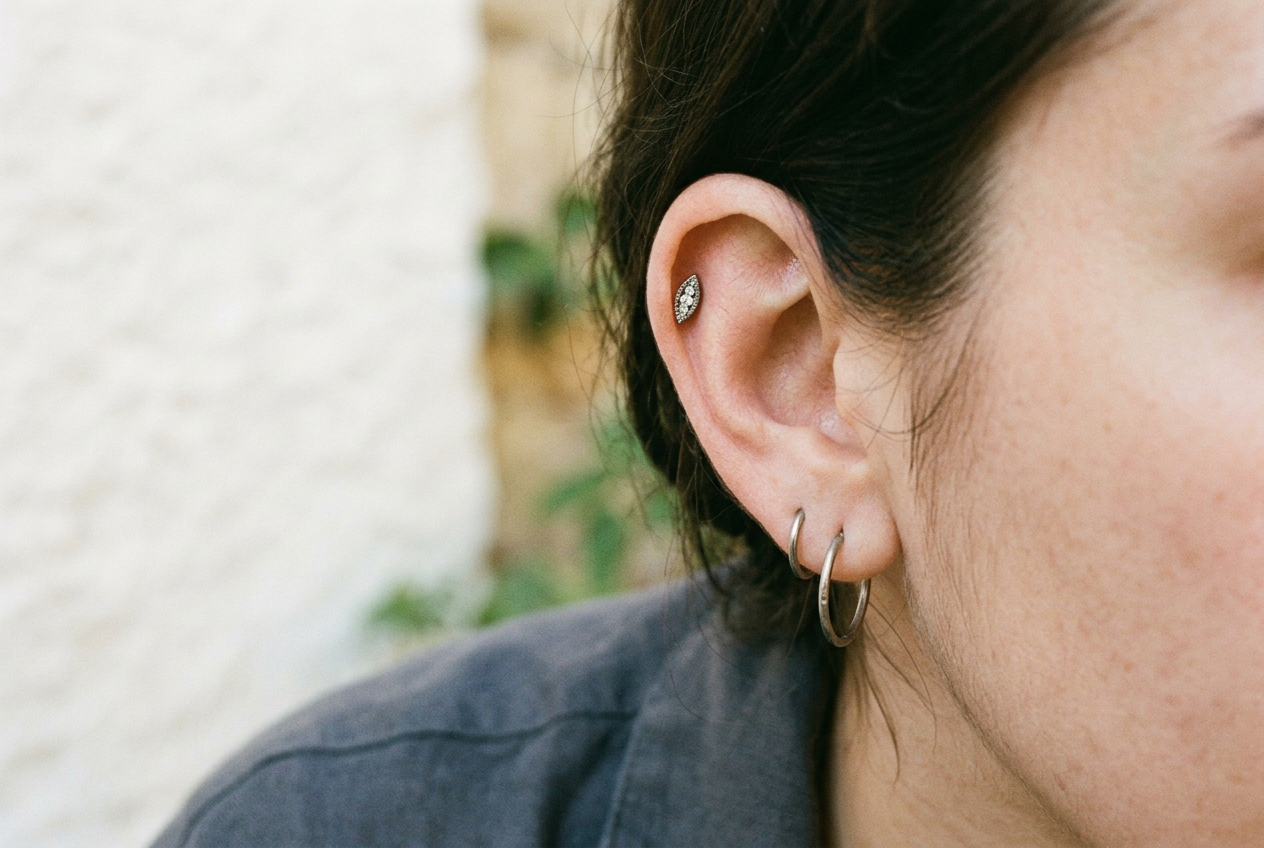
The reference earring for this guide is a small marquise-cut cubic zirconia top on an implant-grade titanium threadless labret, a flat back earring whose post ends in a disc that sits flush against the ear. Worn in a healed second-lobe piercing above a small hoop, its pointed top moved from upright to diagonal during a week of daytime and overnight wear.
The top never lifted. The gap between the marquise and the skin stayed unchanged. Its backing remained close to the lobe without leaving an indentation, and the jewelry did not feel tender when left alone.
That combination matters more than orientation. The marquise was spinning, but it was not showing the usual mechanical signs of an end about to fall out.
This is unisex fit advice. Flat back mechanics do not change across wardrobes, although the weight, scale and arrangement of a stack can make rotation more visible.
Why a secure flat back can still turn
A piercing channel is not a clamp. In a healed piercing with enough room around the post, the complete earring can rotate as the ear meets a pillow, headphones, hair or the neighboring piece in a stack. A directional top makes that ordinary movement obvious; a round bead or bezel turns too, but there is no visible change to give it away.
The marquise top in the reference stack was especially readable. Its lower point occasionally touched the hoop beneath it, which nudged the earring off center, while the slight downward angle of the piercing channel encouraged the heavier end to settle toward the cheek.
Threadless construction adds another possibility. A threadless top has a slender insertion pin that is held inside a hollow post by spring tension from a slight bend in the pin. A correctly tensioned pin can rotate inside the post while still resisting an outward pull, so spinning alone does not prove that the connection has failed.
Threaded jewelry behaves differently. Its decorative end screws into or over the post, depending on the construction, and repeated turning in the loosening direction can gradually open a gap. With a threaded top, rotation deserves more attention because the movement may be the fastener itself backing out.
Start by watching what moves
Use clean, dry hands and good light. Do not start by twisting the top, especially if the piercing is fresh, swollen or sore. Instead, look at the earring straight on and then from the side while making a normal expression and gently moving the outer ear rather than the jewelry.
If the top, shaft and back disc all change orientation together, the entire post is probably rotating inside the piercing channel. That is usually a fit or anatomy issue, not a loose end. A little movement is expected in a comfortable healed piercing.
If the backing stays still while the decorative top turns, the connection at the front is moving. Check for a visible gap, a top that sits farther from the skin than it did before, or side-to-side wobble. Those changes carry more weight than spinning.
The reference marquise passed this visual check throughout the week. Its point wandered, yet the top remained seated at the same depth and did not rock away from the post.
Check the post style before touching the top
Purchase records, packaging and the maker’s instructions are the safest way to identify the mechanism. Threadless jewelry usually pulls apart rather than unscrewing, while threaded jewelry uses a screw connection; appearance alone can mislead because both styles may use the same titanium post and nearly identical decorative ends.
Do not test an unknown mechanism by turning harder. A threadless pin will not become safer through tightening, and force can distort its bend or stress a delicate gold setting. A threaded end can be damaged by cross-threading, which happens when the screw enters at the wrong angle and cuts against the existing threads.
For a healed, calm piercing, hold the back disc steady and apply the lightest possible outward check to a suspected threadless top. A secure end should resist and remain seated. Stop if it slides outward, opens a gap or feels markedly looser than another compatible piece.
Do not bend a threadless pin at home while it remains attached to a stone setting. The amount and location of the bend control tension, and an excessive adjustment can make insertion difficult or snap the pin. A qualified piercer can remove the top, inspect it and adjust or replace it without using the piercing itself as leverage.
For confirmed threaded jewelry, follow the manufacturer’s direction. Standard right-hand threads usually tighten clockwise when the decorative end is viewed from the front, but tiny jewelry is difficult to orient in a mirror and designs can vary. Hold the backing still, make one gentle tightening check and stop at resistance. Overtightening can strip fine threads or make later removal unnecessarily difficult.
Let weight and post length explain the rest
A secure connection cannot make a directional top stay upright when gravity, excess post length and piercing angle are working against it. Long posts allow more front-to-back tilt, so a marquise, chain end or clustered stone can lean and rotate even though its pin is firmly seated.
Shorter is not automatically better. A post that presses the disc into the skin, leaves a persistent indentation or gives the tissue no room to fluctuate is too tight for comfort, and changing it without accounting for swelling can create a worse problem than a crooked top. A well-fitted post on a healed lobe usually keeps the backing close while allowing the jewelry to sit without compression.
Top weight also matters relative to placement. The small cubic zirconia marquise behaved well when worn alone, but the hoop below it created a contact point that repeatedly pushed its lower tip. Moving the hoop to another piercing, or replacing the marquise with a low-profile round bezel, removed the visible alignment problem without changing the post.
Piercing angle cannot be tightened away. When the channel runs slightly downward or sideways, the post follows it, and a long directional top may advertise that angle more than a compact stud would. A piercer can assess whether a shorter post or lighter end will sit better, but jewelry cannot straighten the established channel.
A safe troubleshooting order
First, leave irritated jewelry alone. If the area is hot, increasingly swollen, bleeding, producing unusual discharge or becoming more painful, skip the mechanical checks and contact a qualified piercer; seek appropriate medical care for pronounced or worsening symptoms rather than treating jewelry adjustment as the answer.
On a healed and comfortable piercing, clean and dry your hands, identify whether the post is threadless or threaded, then observe the backing while the top moves. Check seating depth before checking rotational resistance. That order avoids turning harmless movement into a damaged pin or stripped screw.
Next, remove stack interference. Take off the neighboring hoop, chain or large stud for part of the day and see whether the directional top still shifts. If it stays put, the post connection was not the main problem. The styling arrangement was applying leverage.
Then consider scale. A smaller solid-gold or implant-grade titanium end generally puts less leverage on the post than a wide cluster or hanging charm, although construction and stone setting also affect weight. For the reference piercing, changing the shape made more sense than paying to replace a sound titanium post.
Finally, have a piercer assess the fit when the top lifts, the post repeatedly catches, the backing presses into the ear or the jewelry will not stay assembled. Fresh and healing piercings need professional handling because removing the post can disturb the channel, while forcing an end back into irritated tissue adds pressure and contamination risk.
Buy for the angle you have
Directional tops look precise in product photography because the post is held square to the camera. On an ear, a marquise, baguette, letter or tiny motif may rotate during wear. That is a construction tradeoff, not evidence of poor quality by itself.
For a stack that must keep a strict line, choose a compact round bezel in the piercing that tends to turn, then place the directional piece where the channel is straighter and neighboring jewelry cannot touch it. Low-profile tops also catch less on towels and over-ear headphones.
Material still matters. Implant-grade titanium is light and practical for posts, while solid gold offers color and fine decorative work at a higher material cost. Neither metal compensates for incorrect length, weak threadless tension or damaged threads, and paying more for the top will not stop rotation caused by the piercing angle.
The marquise remains wearable. Its changing direction is cosmetic as long as the end stays fully seated, the tissue remains calm and the backing fits without pressure. If a perfectly upright point is essential to the stack, the round bezel is the more reliable buy.
Questions people ask
Is a spinning threadless earring top about to fall out?
Not necessarily. A tension-held pin may rotate while remaining securely seated, and the whole post can also turn inside a healed piercing. A growing gap, easy outward movement or new wobble is more concerning than rotation alone. Have a piercer inspect the connection if the top no longer resists a light check.
Can
I tighten a flat back earring by twisting the front?
Only after confirming that it is threaded and checking the maker’s instructions. Threadless tops do not tighten through twisting. For confirmed threaded jewelry in a healed piercing, stabilize the back and use minimal pressure; stop at resistance rather than forcing tiny threads that may already be misaligned.
Why does my flat back point downward even when it is secure?
The piercing channel may angle downward, the post may leave enough room for the top to tilt, or the decorative end may be heavy on one side. A shorter professionally fitted post or a lighter, rounder top can improve alignment, but jewelry cannot change the direction of an established channel.
Should
I remove a loose flat back from an irritated piercing?
Do not repeatedly handle or remove jewelry from a fresh or irritated piercing without guidance. Contact a qualified piercer promptly so the fit and connection can be assessed without unnecessary pressure on the channel. Pronounced or worsening pain, heat, swelling or other concerning symptoms call for appropriate medical evaluation.
One update a day
Today's fashion update, in your inbox
One fashion update each morning — no hype, no filler, just pieces worth wearing.