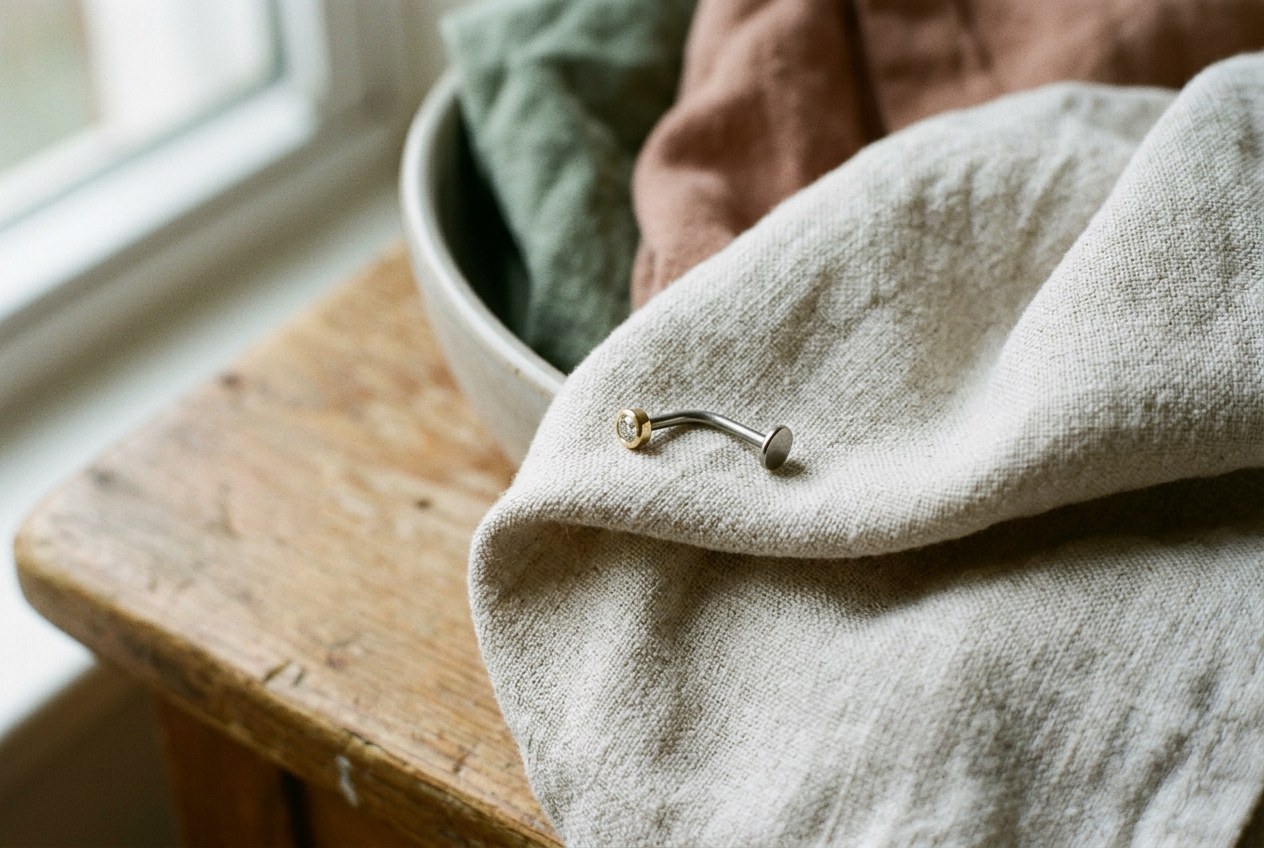
A Threadless Earring Pin Needs a Bend, Not a Kink
A slight curve creates the grip in a threadless labret. Test the end outside your ear first, then stop if the pin kinks, catches or refuses to sit flush.
September 1, 2026 · 7 min read
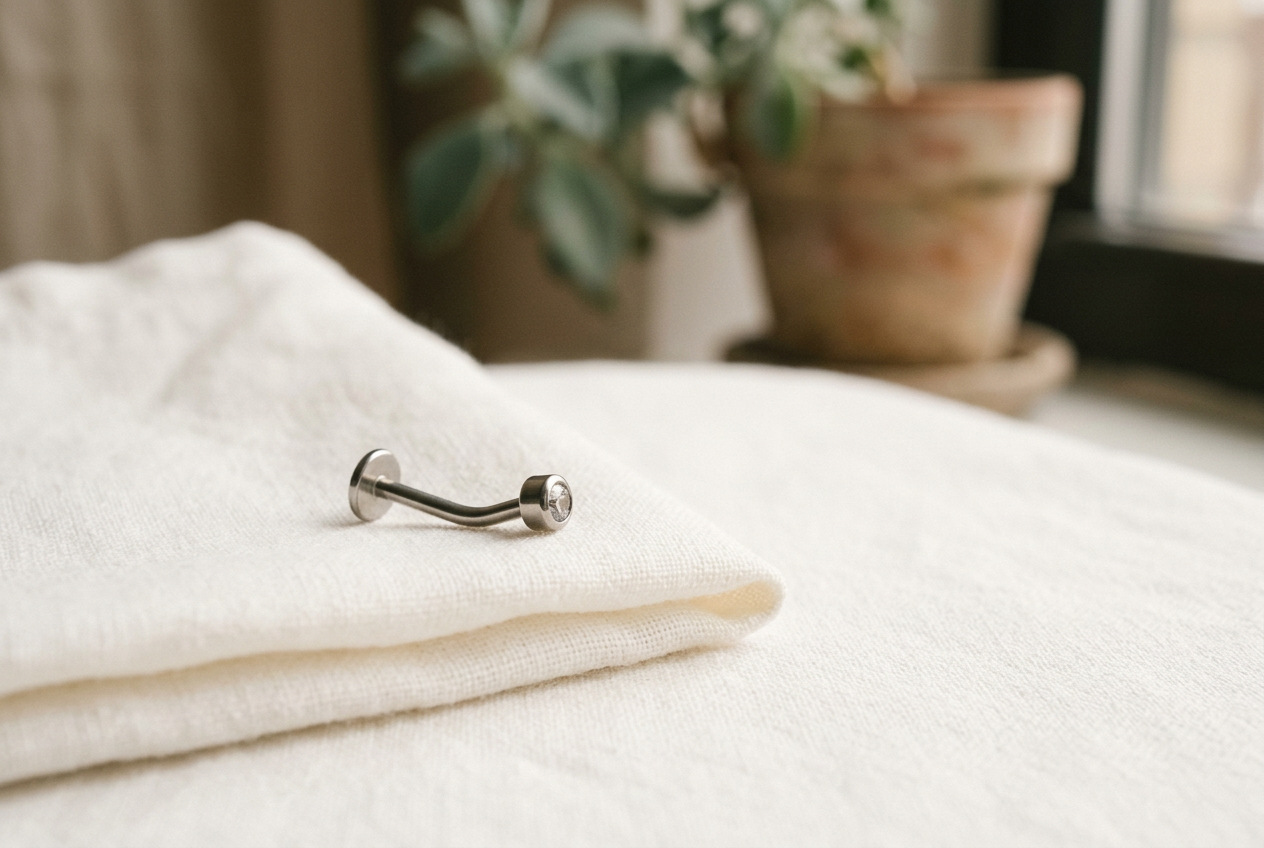
The important detail is the narrow pin beneath the decorative end. On a threadless labret, meaning a hollow post that holds a removable end through pressure, that pin needs a slight bend to grip the inside of the post. Too straight, and the end can work loose. Too far bent, and it may catch at the opening or refuse to seat.
The concrete reference for this guide is a NeoMetal implant-grade titanium flat-back labret paired with a small bezel-set end. A flat-back earring, meaning the post’s backing sits flush against the ear, is comfortable enough for many people to leave in overnight, while the removable front lets the wearer change the look without replacing the post.
NeoMetal’s public instructions describe adding a small bend by placing part of the pin into the post and moving the end slightly to one side. That is the core motion. The difficult part is knowing when to stop.
This is unisex fitting advice and applies to healed lobe and cartilage piercings that already wear compatible threadless jewelry. A fresh, irritated or swollen piercing belongs with a professional piercer, particularly when removing the existing jewelry could disturb the healing channel.
Know which part should bend
A threadless earring has two working pieces. The labret post passes through the piercing and ends in a hollow opening at the front. The decorative end has a slender pin that slides into that opening. Friction between the pin and the post keeps the two pieces together.
Do not bend the labret post itself. Its shaft should remain straight so that it does not press unevenly inside the piercing. The removable pin is the adjustable part, and even there, the target is a smooth, shallow curve rather than a visible corner.
The NeoMetal bezel end makes this distinction easy to see because the narrow pin begins directly beneath the setting. Hold the setting by its solid base. Do not press on a gemstone, prongs or a delicate decorative edge while making an adjustment, since the force intended for the pin can distort those finer parts.
Material matters here. Implant-grade titanium, a titanium alloy made to recognized implant material standards, is widely used for body jewelry because it is lightweight and suitable for many metal-sensitive wearers. Solid gold threadless ends are also common. Both still need appropriate handling; repeated bending can fatigue a small pin even when the surrounding jewelry is high quality.
Prepare the post before fitting the end
Wash and dry your hands, then work over a clean folded towel so that a dropped end does not bounce away. Good light matters more than a special tool. If the jewelry is already in your ear, remove the end only if the piercing is healed and the post comes apart without pain or resistance from the tissue.
Inspect the pin from more than one side. A new pin may arrive straight or may already carry the slight bend needed for its matching post. If it is smooth and gently curved, test it before adding anything. More bend is not automatically more secure.
Check the post as well. Its opening should look round and unobstructed, without dried product, visible deformation or a fragment from another end. Confirm that the end and post are intended to work together. Gauge, meaning the thickness of the post, does not by itself guarantee compatibility; pin dimensions and internal post construction can differ between manufacturers.
This is one reason the NeoMetal post and end remain the reference pair here. Keeping the components within a documented system removes one uncertainty. An end that will not fit an unfamiliar post may be incompatible rather than underbent.
Add tension in one small movement
Start with the jewelry outside your ear. Slide the removable pin partway into the post, leaving enough of the pin exposed that the post can act as a controlled support. Hold the base of the decorative end and move it slightly to one side. Then pull the pieces apart and inspect the pin.
The result should be subtle. Viewed from the side, a useful bend looks continuous along the pin, without a sharp elbow near the end or at the base. If the curve is immediately dramatic, do not test it by pushing harder into the post.
Insert the pin straight into the opening. It should begin without scraping or catching, then offer firmer resistance as more of the curved section enters. Push only on the solid base of the end until the front sits evenly against the post. Pull the pieces apart with steady pressure and test them again.
That outside-the-ear trial costs a minute and can save an expensive solid-gold or gemstone end from damage. It also gives a clearer reading than testing inside the piercing, where an awkward angle, limited visibility or tenderness can feel like excessive jewelry tension.
If the NeoMetal bezel end slips in and out with almost no change in resistance, increase the curve by a very small amount and repeat the test. Avoid jumping from loose to heavily bent in one adjustment. The useful range is narrow.
Read the fit before putting it in your ear
A correctly tensioned end starts cleanly, presses home with controlled finger pressure and stays flush when the post is handled. It should take a deliberate pull to separate the pieces. It does not need to feel locked beyond removal.
A pin that is too straight often feels acceptable during insertion because nothing catches, yet the end comes away with a light tug or loosens during normal handling. Adding a small smooth bend may correct it. If a previously secure end has become loose without the pin changing shape, test another compatible end or post rather than assuming the bend is the only variable.
An overbent pin behaves differently. It may hit the edge of the opening, enter only a short distance or push the decorative end sideways as it seats. A gap between the end and post is another warning. Stop.
Extra force can enlarge the post opening, mark the pin or leave the end stuck partway in.
A smooth curve that is only slightly excessive can sometimes be reduced with one restrained correction, using the post for support in the same way it was used to add tension. A kink is damage. So is a pin that looks twisted, cracked, deeply scratched or loose at the point where it joins the decorative setting. Replace the end or take it to a piercer instead of bending it back and forth.
Household pliers are a poor shortcut. Their jaws can score polished metal, crush a hollow post or place force too close to the setting. A professional piercer has tools intended to hold tiny jewelry without treating the decorative face as a gripping surface.
Insert the tested end straight
Once the tension feels right, place the labret through the healed piercing with the flat disc behind the ear. Stabilize that disc with one finger. Align the pin with the opening from the front, then press the two pieces directly together until the end sits flush.
Short posts leave little room for fingers, particularly in cartilage placements. Long nails make the same job harder. A piercer can fit the end quickly if you cannot keep the post still without pinching the ear, and that small service is more sensible than buying tools for an occasional jewelry change.
After insertion, give the end one controlled check rather than repeatedly pulling at it. Rotation alone does not prove that it is loose because some correctly fitted threadless ends can turn within the post. The meaningful signs are outward movement, a new gap or an end that separates with barely any pressure.
The flat back should also sit without pressing into the skin. Pin tension cannot correct a post that is too short, while a post that is unnecessarily long can tilt and snag even when the end is fitted correctly. Those are post-length problems, not reasons to bend the removable pin further.
Keep the adjustment with the matching post
Store the NeoMetal end with its compatible post when possible, especially if several threadless systems share the same jewelry box. A bend tuned to one post may grip another too tightly or not at all.
Hair products, skin care and residue can collect around a daily-wear end, but cleaning should not become another bending session. Follow the jewelry maker’s care guidance, keep harsh chemicals away from gemstones and check the connection with clean hands if a visible gap develops. For an end that repeatedly loosens after a careful adjustment, replace the suspect component or let a piercer assess the pair.
Questions people ask
How bent should a threadless earring pin look?
The curve should be shallow and smooth, and it may be difficult to see until the pin is viewed from the side. The better test is mechanical: the pin should start cleanly, develop firm resistance and let the decorative end sit flush without force.
Can
I use a threadless end from one brand with another post?
Sometimes, but matching gauge does not guarantee matching pin and post dimensions. Test the components outside your ear and stop if the pin catches, wobbles or needs force. A documented matching pair is the more dependable choice for valuable ends or jewelry worn continuously.
Can
I change a threadless end in a fresh piercing?
Leave initial jewelry changes to a professional piercer. Fresh tissue can swell, narrow quickly when jewelry is removed or become irritated during repeated fitting attempts. This at-home tension test is intended for healed piercings that are comfortable and free from current redness, discharge or unexplained pain.
Is a threadless end loose if it rotates?
Not necessarily. Rotation can occur even when the curved pin still has adequate grip inside the post. Check for a growing gap or outward movement instead, and test the end outside the ear if it separates with very little pulling pressure.
One update a day
Today's fashion update, in your inbox
One fashion update each morning — no hype, no filler, just pieces worth wearing.