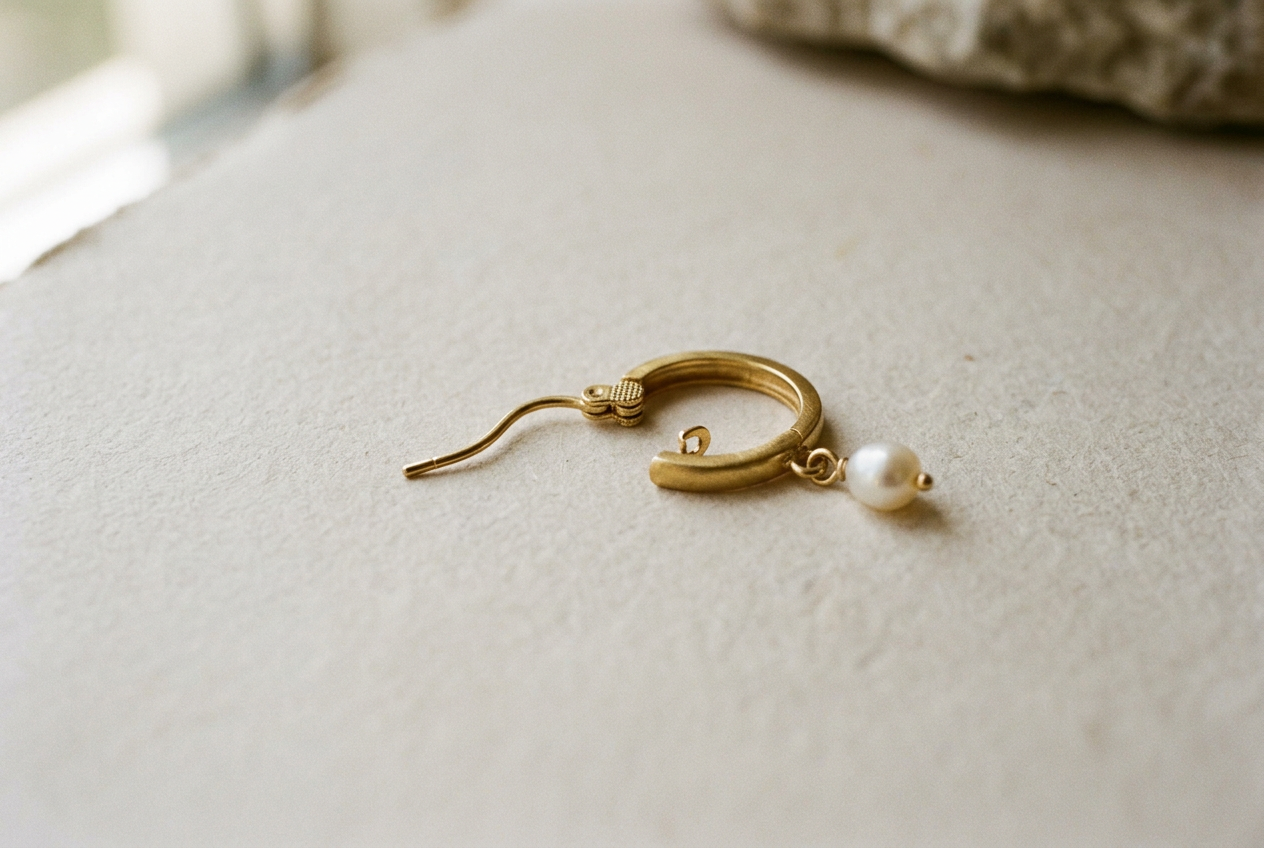
18-Gauge or 16-Gauge? Your Flat Back Post Has to Match
A 16-gauge post is thicker than an 18-gauge post. Confirm the number, length and attachment style before replacing jewelry in a healed piercing.
September 6, 2026 · 8 min read

The difference is visible at the stem: an 18-gauge post measures about 1.0 millimeter thick, while a 16-gauge post measures about 1.2 millimeters. That fraction looks minor beside a ruler.
Inside an established piercing channel, it can decide whether the jewelry slides in comfortably, meets resistance or sits at an angle.
Keep one piece in view while shopping: a 4-millimeter bezel-set gem on a 16-gauge implant-grade titanium threadless post, worn in a healed upper-lobe piercing. It is a common enough arrangement for an everyday ear stack, with a decorative end that has some weight and a flat disc behind the ear. Replace that post with an 18-gauge version without checking the original size, and the gem may still connect to some threadless systems, yet the thinner stem can leave more room for the top to tip forward.
This is unisex fit advice. Gauge describes the jewelry and piercing channel, not the wearer's gender or wardrobe.
Gauge is the post's thickness
A flat back earring, meaning the post's backing sits flush against the earlobe or cartilage, usually has three fit variables that affect daily wear. Gauge is the thickness. Post length is the distance available through the tissue. The decorative end and backing also need a compatible attachment system.
Gauge numbers run backward: the lower number indicates the thicker post. A 16-gauge post is therefore thicker than an 18-gauge one. Both sizes appear in flat back jewelry, and neither should be treated as a universal default merely because a retailer describes its pieces as suitable for lobes or cartilage.
Packaging and product pages may shorten the measurements to 16G and 18G. If the listing shows millimeters instead, look for approximately 1.2 millimeters and 1.0 millimeter, respectively.
Use the manufacturer's own specification for the piece being ordered, since rounded conversions and attachment tolerances can vary.
The reference gem makes the distinction practical. On its intended 16-gauge post, the stem fills the healed channel as sized, while the bezel sits close to the front of the lobe. An 18-gauge replacement is only 0.2 millimeter narrower, but that gap can matter once the 4-millimeter top pulls downward or catches lightly during dressing.
Why a thicker post should never be forced
An established piercing can look calm while still resisting jewelry that is thicker than what it has been wearing. If an 18-gauge channel has settled around a 1.0-millimeter post, pushing a 16-gauge stem through asks the channel to accommodate extra width at once. Resistance is information.
Stop.
Forcing the post can irritate or damage the channel, leading to tenderness, swelling or bleeding. A taper, meaning a gradual tool used to guide jewelry through a piercing, belongs in the hands of a qualified piercer when stretching or difficult insertion is involved; it is not a cue to improvise with pressure at home.
Lubrication does not turn an incompatible size into a compatible one. Nor does the fact that the post enters partway. A thicker stem that stalls near the back of the lobe may be meeting a narrowed section or the wall of the channel rather than following the original path.
If the piercing is unhealed, still tender, producing persistent discharge or otherwise unsettled, leave the jewelry change to a qualified piercer. Fresh and healing piercings can shrink quickly when jewelry is removed, and their sizing needs also account for swelling. This explainer is about confirming replacement jewelry for an established, healed channel, not managing a new piercing.
A thinner post has its own tradeoff
Moving from 16 gauge to 18 gauge may feel easier because the narrower post can pass through more readily. Easy insertion does not guarantee a good long-term fit.
A lighter, small decorative end may sit acceptably on a thinner post, especially when the length is close to the tissue and the channel is stable. A larger gem or metal motif exerts more leverage. With extra space around the post, the end can pitch downward, rotate or refuse to sit squarely in a carefully arranged stack.
Return to the 4-millimeter bezel-set gem. Its weight is modest, but it is concentrated in front of the piercing. If the replacement post is both thinner and too long, the problem compounds: the stem has room inside the channel, and the top has room to move away from the skin. The earring can look droopy even though the back feels comfortable against a pillow.
Remaining in a thinner gauge may also allow the established channel to contract around it over time. That matters if the plan is to reinstall 16-gauge jewelry later. The original size may no longer pass through easily, and forcing it remains the wrong response.
A thinner post is not automatically unsafe or badly made. It is a different fit decision. Small ends, low-profile settings and correctly measured lengths are more forgiving; substantial clusters and charms expose looseness faster.
Confirm four details before ordering
Start with the order confirmation, packaging or product page for the jewelry already installed. Look for the post specification, not just the decorative end's diameter. A listing that says the gem is 4 millimeters across has told you nothing about whether the stem is 18G or 16G.
Next, check the attachment. A threadless post has a hollow opening that grips a slightly bent pin on the decorative end through tension. An internally threaded post has threading inside the stem, and the end screws into it. Those systems do not interchange, and even jewelry using the same broad system may have brand-specific pin, thread or post requirements.
Do not infer gauge from attachment style. Threadless jewelry is sold in more than one gauge, and a decorative threadless end may fit multiple posts within a particular manufacturer's system. That compatibility can disguise a gauge mismatch: the gem clicks securely into the post, but the post itself is still the wrong thickness for the piercing.
Then confirm length. It is usually written in millimeters or fractions of an inch and refers to the wearable section passing through the tissue. Too short can press the front setting and rear disc into the skin. Too long allows sliding, snagging and tilt.
Measure neither the overall earring nor the decorative top.
Finally, check material. Implant-grade titanium is a practical choice for an everyday post because it is light, corrosion resistant and available without nickel in appropriate grades, but the listing should identify the material standard rather than relying on the word titanium alone. Solid nickel-free gold is another common option at a higher price level. Gold plating can wear, so it is a less convincing choice for a post intended to stay in continuously.
If the original paperwork is gone, do not rely on a household ruler pressed against a tiny installed stem. A piercer can identify the gauge with appropriate measuring tools and assess the wearable length while the jewelry is seated. That visit costs time and may involve a fitting fee, but it is usually less wasteful than accumulating posts that connect to the end yet fail in the ear.
The fit check after installation
A correctly matched replacement should follow the established channel without force. The flat disc should rest against the back without digging in, while the front end should sit where intended rather than hanging below the piercing opening.
Check the reference gem from the side. The bezel should not project on a long segment of exposed post, and the disc should not make a deep impression after ordinary wear. A tiny amount of movement can be normal. Repeated tipping, pinching or a front that disappears into the tissue points to a fit problem that gauge alone will not solve.
Sleep-friendly does not mean pressure-proof. A flat disc removes the protruding clutch found on a conventional stud, which can reduce catching on hair and pillowcases, but an overly short post can still compress tissue overnight. A heavy end on an overly long, thin post can still tilt by morning.
Buy the post only after all four details agree: gauge, length, attachment and material. For the 4-millimeter gem, that means replacing its documented 16-gauge titanium threadless post with the same specification unless a piercer has a reason to change the fit. The decorative end being compatible is only half the check.
Questions people ask
Can
I put a 16-gauge post in an 18-gauge piercing?
A 16-gauge post is thicker, so it may not pass through a channel established at 18 gauge. Do not force it, even if it enters partway. A qualified piercer can assess whether the piercing can accommodate the larger size and guide any planned stretch.
Will an 18-gauge post fit a 16-gauge piercing?
It may pass through, but the narrower post can leave a heavier decorative end less stable and may allow the channel to contract over time. Check how the top sits, particularly when the replacement post is also longer than the original.
Are all threadless flat back ends interchangeable?
No. Threadless describes how the end connects, not a universal sizing standard. Check the jewelry maker's documentation for compatible post gauges and pin requirements, and keep the brand or system consistent when the listing does not give enough detail to confirm a cross-brand match.
Can
I change the post in an unhealed piercing?
A qualified piercer should handle changes during healing, including downsizing a post after swelling subsides. Removing or replacing jewelry at home can irritate the channel, introduce contamination or make reinsertion difficult if the opening begins to narrow.
One update a day
Today's fashion update, in your inbox
One fashion update each morning — no hype, no filler, just pieces worth wearing.