An 18-Gauge Flat Back May Fit. A 16-Gauge One Might Not.
Gauge numbers run backward, and a tiny diameter change can matter. Here is how to replace a conventional lobe stud without forcing a thicker flat back through the channel.
August 18, 2026 · 7 min read

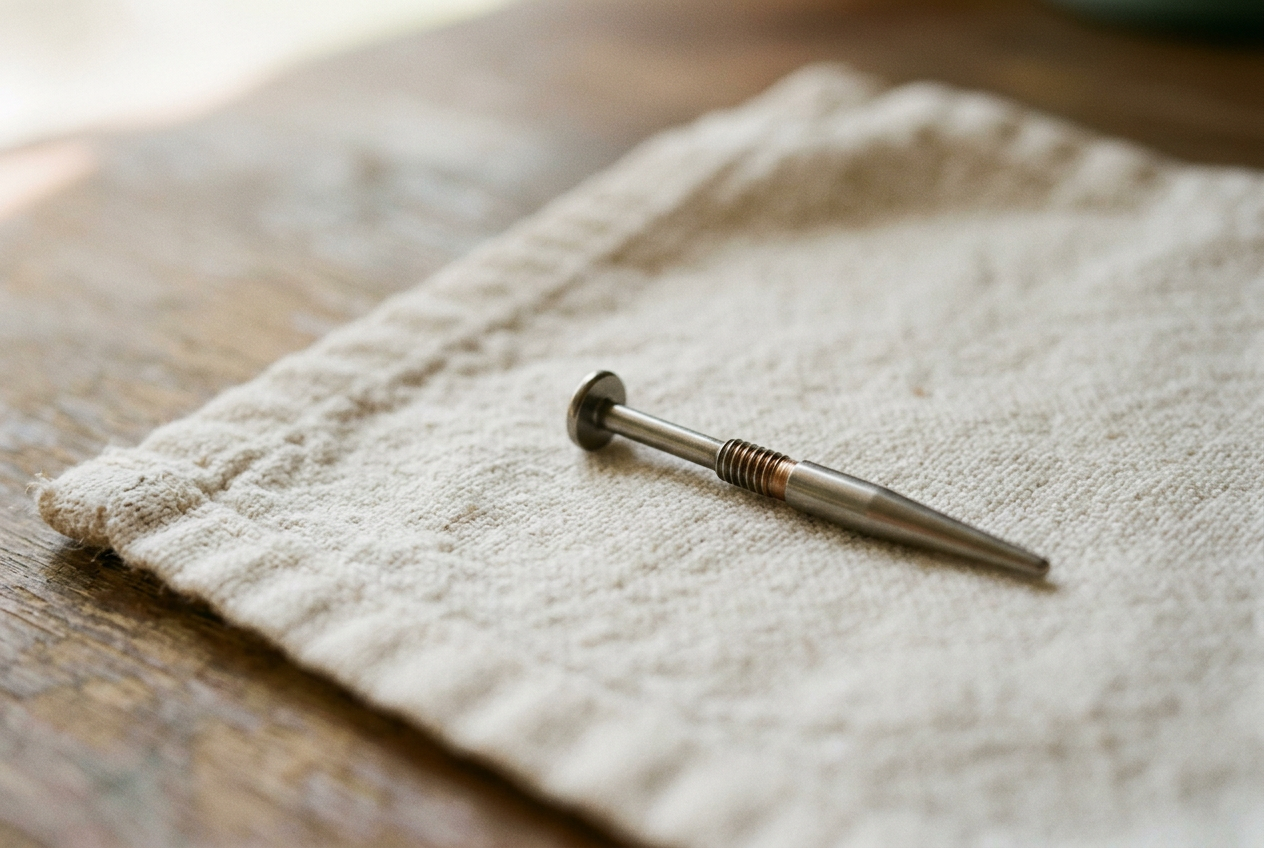
The difference is visible when the posts sit beside each other: an 18-gauge post measures about 1.0 millimeter across, while a 16-gauge post measures about 1.2 millimeters. That fraction is enough to turn an easy jewelry change into a sore lobe.
Consider one concrete swap. A fully healed lobe currently wears a measured 20-gauge solid-gold stud with a butterfly back, and the intended replacement is a 16-gauge implant-grade titanium flat back earring, meaning the post’s backing sits flush against the earlobe. Both pieces look slim. They are not the same size, and the titanium post should not be treated as a direct replacement merely because its decorative end is small.
This sizing advice is unisex. Gauge, post length and the condition of the piercing channel do not change with the wardrobe around them.
Start with the post already in your ear
Gauge describes post thickness, and the numbering runs in reverse: a lower gauge number indicates a thicker post. Conventional fashion earrings are often around 20 gauge, approximately 0.8 millimeter, or 22 gauge, approximately 0.6 millimeter, though manufacturers do not always state the measurement and individual pairs can vary.
That uncertainty matters. If the gold stud in our example has a 20-gauge post, moving to 18 gauge adds about 0.2 millimeter in diameter. Moving straight to 16 gauge adds about 0.
4 millimeter. A piercing channel is living tissue, not a predrilled hole in a fixed material, so age alone does not establish what it will accept; jewelry thickness, how continuously the hole has been occupied and past irritation all affect the fit.
Measure the straight section of the current post with digital calipers if its gauge is not listed. Do not measure the pointed tip or assume every earring in a multipack matches. A professional piercer can measure both the jewelry and the channel when calipers are unavailable or the post has an unusual taper.
The useful buying decision is straightforward. Choose 18 gauge when the existing post measures 18 gauge, or when a piercer confirms that a slightly smaller channel can accept it without trauma. Buy 16 gauge as a direct replacement only when the current jewelry is already 16 gauge or the channel has been assessed for that size.
Resistance is the stopping point
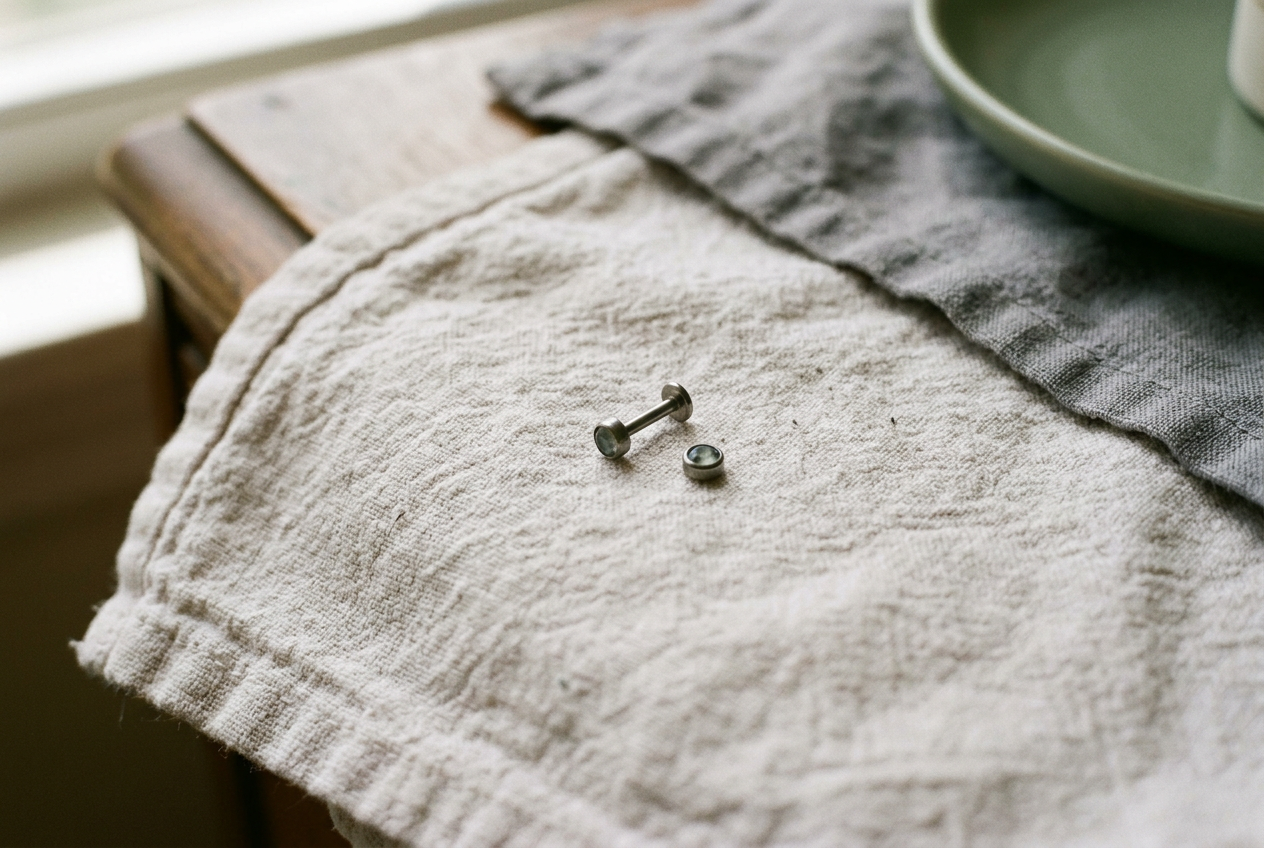
A labret-style post, a straight post with a fixed flat disc at the back, usually enters from behind the lobe. Its front may screw in or press into place. With a threadless design, the decorative end uses a slightly bent pin held inside the hollow post by tension.
Insertion should feel controlled, not like the post is cutting a path. If an 18-gauge post meets firm resistance, catches midway or requires pressure that makes the lobe sting, stop and return to jewelry that fits comfortably. Do not use the decorative end as a handle for pushing harder. Its small surface can make more force feel deceptively manageable.
The 16-gauge titanium post in our example may reach the middle of a 20-gauge channel and then stall. That does not show that the angle is almost right. It can mean the post is too thick, the channel curves slightly, or the back opening is not aligned with the front. Repeated attempts can scrape the channel and cause swelling, which makes the next attempt harder even if the jewelry would otherwise have fit.
A settled piercing can become tender, red or crusty after a forced size change. That irritation is a poor trade for a flatter backing. Put the familiar 20-gauge stud back only if it passes easily and the area is not badly swollen; otherwise, leave further handling to a qualified piercer. Spreading ointment on the post to push it through does not solve a gauge mismatch, and products not intended for piercing care may trap debris or irritate the skin.
Post length is a separate fit decision
A correct gauge can still produce the wrong earring. Post length is the wearable distance between the flat disc and the decorative front, and it determines whether the jewelry sits with a little breathing room or presses into the lobe.
Measure the lobe where the piercing sits rather than choosing length from the old butterfly-back post, which was designed to slide through an adjustable clutch. A flat back has a fixed wearable space. It should not pinch when the ear is at rest, yet a post that projects well beyond the lobe can tilt, snag hair and undermine the tidy look that made the style appealing.
This is where the concrete swap earns a fitting appointment. Even if the 16-gauge diameter is approved, the titanium post still needs enough room for that particular lobe, and a piercer can check the back disc while the jewelry is in place. The disc should rest flat without disappearing into the skin. The front should not leave a deep indentation.
Lobes that fluctuate with irritation may need a longer post temporarily, followed by a shorter one after they settle. That is called downsizing, meaning changing to a shorter post once extra room is no longer needed. It is especially relevant to newer piercings and should be handled on a piercer’s timeline rather than treated as a home styling adjustment.
Material quality matters more after a difficult change
Implant-grade titanium is a practical choice for daily flat backs because it is lightweight and can be purchased with documentation showing that it meets an implant material standard. The phrase “titanium” by itself is less useful; it can describe jewelry without disclosing the exact grade or finish.
A mirror-smooth post matters because rough threads, burrs or damaged plating pass directly through the channel. Internally threaded jewelry keeps the screw threads inside the post, so the threaded section does not scrape through the piercing during insertion. Threadless jewelry also presents a smooth post during fitting, though its tiny removable end can be fiddly until the wearer learns how much bend the pin needs.
Solid gold is another option when the alloy is appropriate for body jewelry and the surface is well finished, but the decorative end usually costs considerably more than titanium. Gold-plated or gold-tone mystery metal is a weaker choice for a piece intended to stay in around the clock because the surface layer can wear. Sellers often price the post and decorative end separately, so check what the displayed price includes before comparing a plain titanium set with a solid-gold front.
For the original swap, a correctly fitted 18-gauge titanium flat back is a better purchase than an aspirational 16-gauge version that the lobe cannot accept. The visual difference is negligible from the front. The comfort difference is not.
When a piercer should check the channel
Book a fitting when the existing gauge cannot be established, the piercing has narrowed after time without jewelry, or the post enters from one side but cannot find the opening on the other. An experienced piercer can use an insertion taper, a tool that guides compatible jewelry through the existing channel, but a taper should not be used at home to force an unplanned stretch.
A check is also sensible when the channel feels firm, has a persistent bump or sits at an angle that makes a rear-entry post difficult to align. The appointment may end with an 18-gauge post, a staged move toward 16 gauge, or a recommendation to keep the thinner conventional size. That last outcome is useful. Flat backs are available in finer gauges, although the selection of posts and decorative ends may be narrower.
Heat, spreading redness, marked swelling, worsening pain or thick yellow or green discharge need attention beyond a jewelry fitting. A health care professional should assess possible infection, while jewelry removal should not be improvised if the area is acutely inflamed.
Questions people ask
Will an 18-gauge flat back fit a normal earring hole?
It may fit a fully healed lobe that regularly wears conventional earrings, especially if the current post measures 18 or 20 gauge. “Normal” is not a measurement, however. Check the existing post with calipers or ask a piercer to size it, and stop if the flat back meets firm resistance.
Can
I put a 16-gauge post through a 20-gauge piercing?
A 16-gauge post is about 0.4 millimeter thicker in diameter than a 20-gauge post, so it is a size increase rather than a direct swap. Some healed lobes can accommodate that change with professional assessment, but pushing the post through resistance can tear or inflame the channel.
Do flat back earrings work in old lobe piercings?
Yes, provided the gauge and wearable length suit the existing channel. Older piercings can still narrow, curve or sit at an angle, particularly after long periods without jewelry. A piercer should check any channel that is hard to follow from the back or becomes sore during insertion.
Is 16 gauge better than 18 gauge for sleeping?
Neither gauge is inherently more sleep-friendly once the piercing is settled. Comfort depends more on a smooth flat disc, an appropriate post length and a front that does not press into the ear. Choose the thickness your channel accepts rather than stretching solely for overnight wear.
One update a day
Today's fashion update, in your inbox
One fashion update each morning — no hype, no filler, just pieces worth wearing.