Your Best-Fitting Pants Can Expose Vanity Sizing Online
Ignore the letter on the label. A few measurements from clothes that already fit can reveal whether an online size will work before it reaches your door.
September 12, 2026 · 7 min read
The useful size chart is not the one that tells you a medium fits a particular body. It is the one that tells you how large the finished garment is.
That distinction catches vanity sizing, the loose practice of assigning smaller or inconsistent labels to clothes with larger dimensions, before checkout. It does not prove why a brand chose its labels. It does reveal that one retailer’s size 8 has little practical relationship to another retailer’s size 8.
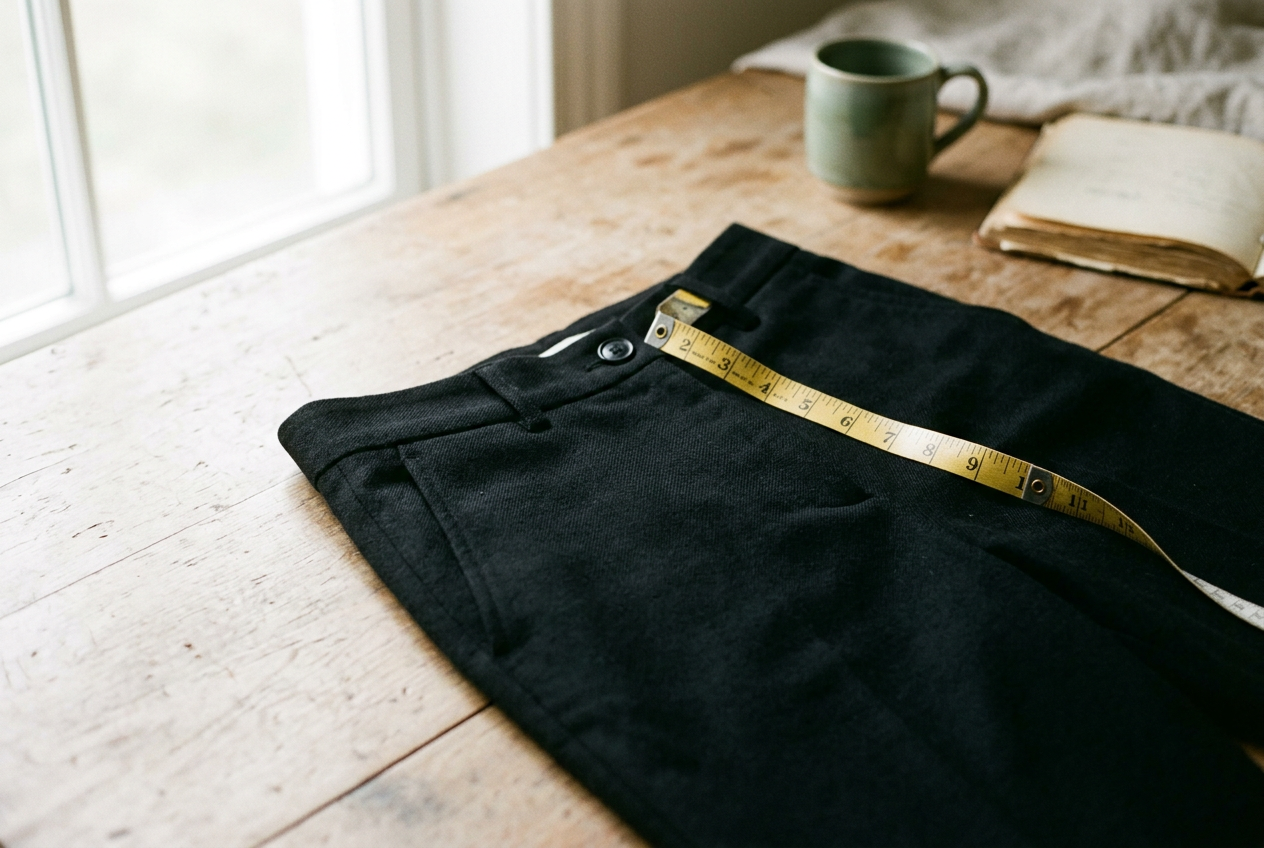
Start with one dependable reference: a pair of black, high-rise wool trousers with a fixed waistband, zip fly and no stretch, worn comfortably with a tucked cotton shirt and loafers. They sit where you want trousers to sit, the waistband does not fold, and the crotch does not pull when you take a full stride. The number sewn inside them is the least useful fact about their fit.
This is unisex guidance. Bodies and clothing categories vary, but a tape measure works across women’s, men’s and gender-neutral wardrobes as long as the reference garment has the same basic cut and material behavior as the item being considered.
Product measurements beat letter-size comparisons
Retailers publish two different kinds of charts, sometimes on the same page. A body-size chart lists the wearer’s measurements that a labeled size is intended to fit. Product measurements describe the finished clothing itself.
Product measurements are more useful for remote shopping because they let you make a garment-to-garment comparison. If the black wool trousers fit, their waistband and rise become a private fit chart that is more relevant than a generic small, medium or large scale.
Check the wording before trusting any figure. “Fits a waist” usually points to a body measurement, while “garment waist” or “measured at waistband” usually describes the trousers. A retailer may also show dimensions for only one sample size and ask shoppers to infer the rest from a stated grade, meaning the amount added or removed between sizes. That is less dependable than a complete table, particularly when the cut changes around plus, petite or tall sizing.
A chart with body measurements alone still helps narrow the field, but it cannot tell you how much room the designer built into a coat or whether a trouser waistband runs close to the stated body size. If returns are expensive or restricted, missing product measurements are a reason to pause rather than make the letter size do work it cannot do.
Make a five-minute fit record
Measure the black trousers after they have rested flat, not straight from your body or while they are warm and stretched from wear. Fasten the zip and closure, smooth the fabric without pulling it, and use a flexible tape held level with the garment.
For the waist, measure straight across the inside or outside of the waistband from edge to edge. Record that flat measurement and note that the full circumference is twice as large. Retailers switch between flat width and circumference, so compare the units and method rather than assuming two waist figures describe the same thing.
Next record the front rise, meaning the distance from the crotch seam intersection to the top of the front waistband. Follow the center front rather than measuring vertically through the air. Rise decides where the waistband can sit while the crotch remains in place, which is why two trousers with matching waists can feel unrelated: a shorter rise may pull upward, while a longer one can place extra fabric through the lower torso.
Return to how the black wool pair is worn. Its waistband belongs at the natural waist, with a shirt tucked underneath. A retailer’s lower-rise trouser might match its waistband measurement yet land several inches lower on the body, where a different circumference is needed. The waist figure has not failed.
The silhouettes are asking the waistband to occupy different places.
Length can be checked separately, but do not let an easy alteration distract from a bad rise. A hem can often be shortened. Rebuilding the crotch and waistband costs more, changes the balance of the trousers and may not be worth doing on an ordinary ready-to-wear pair.
Keep the measurements in a phone note with the garment description, fabric and preferred styling: “high-rise black wool trousers, woven, no stretch, comfortable with shirt tucked.” That context matters more than collecting a large library of unexplained numbers.
Shoulder and sweep show where tops go wrong
The same method works above the waist, though the black trousers cannot act as the reference. Choose a woven shirt, jacket or coat that already fits in the way the prospective item is supposed to fit. A close shirt should not be used to judge an oversized coat.
Measure the shoulder across the back from one shoulder seam to the other, keeping the tape along the garment rather than pulling it into a straight line above the fabric. This works best on a set-in sleeve, where the sleeve joins at a defined armhole seam. It is not directly transferable to a raglan sleeve, which runs toward the neckline and has no conventional shoulder endpoint.
Shoulder width controls more than appearance. Too narrow, and the sleeve seam can sit inward while the upper back strains when you reach forward. Too wide, and a structured jacket may collapse past the shoulder point even if the chest circumference appears correct. Soft knitwear tolerates more variation, so use a woven reference for woven clothing.
Sweep is the circumference at a garment’s bottom edge. Measure the hem flat from side to side and double it when the retailer gives a full circumference. On an A-line skirt, long shirt or buttoned coat, sweep tells you whether the hem has enough room to fall over the hips and move through a stride.
A coat can match through the shoulders and chest yet fail at the sweep, causing its fronts to separate or its vents to pull. Compare it with a coat worn over the same layers, not with a summer dress that happens to share a similar hem width.
Stretch can make the smaller number correct
The black wool trousers are a clean reference because their woven cloth and fixed waistband do not stretch much. Trouble starts when the prospective garment contains elastane, uses a springy knit structure or has an elasticized waistband.
Stretch garments may use negative ease, meaning the finished garment is smaller than the body area it covers because it is designed to expand in wear. A fitted rib-knit skirt can therefore have a smaller waist or sweep than a woven skirt that fits the same person. Doubling its relaxed flat width and rejecting it as too small would produce the wrong decision.
Fiber content offers a clue, not a complete answer. A small amount of elastane can change movement and recovery, which is the fabric’s ability to return toward its original shape after stretching, but the knit or weave, yarn and garment construction also affect the result. Two fabrics with similar label contents may feel different on the body.
Look for retailer notes such as rigid, comfort stretch, high stretch or elastic waist, then compare the item with a garment of similar construction. Stretch jeans belong beside stretch jeans. A compact ribbed dress needs another fitted knit as its benchmark. The black wool trousers remain useful only when the candidate also has a stable woven waistband and a comparable rise.
Some retailers publish a stretch range or both relaxed and extended measurements. Those figures are more informative than a single flat width, although the maximum should not automatically become the target; a waistband worn at its limit may dig in, roll or lose recovery sooner.
Turn the comparison into a checkout decision
Exact numerical agreement is unnecessary. Clothing needs ease, the extra room between the body and garment that allows movement or creates the intended silhouette, and different designs distribute it differently. Focus first on the measurement linked to your usual fit failure.
For the black trousers, waist and rise are the gatekeepers. A close waist match with a notably different rise predicts a different wearing position, while a close rise with a larger waist may be alterable if the waistband construction leaves room. For a tailored jacket, shoulder width deserves priority because changing it is more involved than adjusting a sleeve or waist.
Read the product description and photographs after the comparison, not before it. A model shot may clarify intended looseness, but pose, pinning and styling can hide how a garment hangs. Product measurements, fabric behavior and the return policy carry more weight.
This check takes about five minutes once the reference note exists. If the retailer does not disclose the dimensions that determine your fit, contact customer service or choose a seller that does. Guessing can still work, but it is not worth paying return shipping or tying up money across several sizes when the missing measurement is knowable.
Questions people ask
Should
I measure my body or my clothes for online shopping?
Use both when available, but start with a well-fitting garment for the closest practical comparison. Body measurements help place you within a retailer’s general chart; finished garment measurements show whether the cut resembles something you already wear comfortably. Confirm that both charts use the same units and measurement points.
Do I double every flat garment measurement?
Double a flat waist, chest or sweep measurement when you need the full circumference and the garment is laid evenly from side to side. Do not double rise, inseam, shoulder width or sleeve length. Retailers may already list circumference, so read the chart heading before doing the calculation.
How much difference between two garments is acceptable?
There is no universal allowance because fabric and silhouette change what the number means. A small difference can matter at a rigid waistband or tailored shoulder, while a roomy coat or elastic knit may tolerate more. Compare the item with a reference garment made from similar fabric and intended to fit the same way.
Can measurements guarantee that an online size will fit?
No. They cannot fully show balance, armhole shape, crotch curve or how fabric feels in motion. They can eliminate obvious mismatches and expose inconsistent labels, especially when waist, rise, shoulder or sweep causes your usual returns. For the black wool trousers, the fixed waist and front rise remain the decisive pair.
One update a day
Today's fashion update, in your inbox
One fashion update each morning — no hype, no filler, just pieces worth wearing.