Your 16-Gauge Earring Won’t Fit an 18-Gauge Piercing
A 16-gauge post is only 0.2 millimeter wider than an 18-gauge one. That small difference is enough to stop a flat back and irritate a piercing if you push.
September 27, 2026 · 7 min read
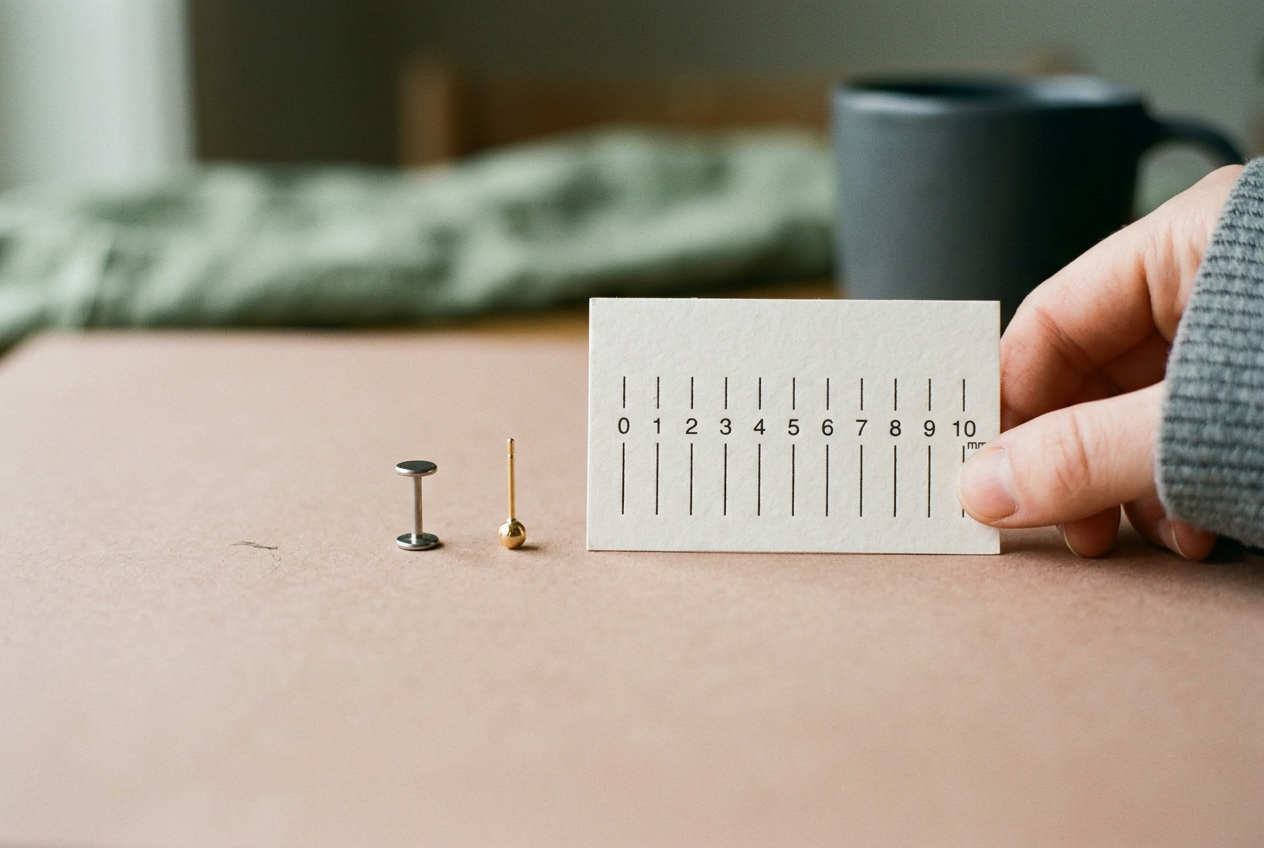
The post looks almost right. A 16-gauge implant-grade titanium flat-back stud can sit neatly beside an 18-gauge gold lobe earring, and the difference between the two shafts is hard to judge without a gauge card or calipers. Try to insert the titanium post, however, and its blunt end may stop at the entrance or partway through the channel.
That resistance is the sizing issue. It is not a stiff hinge, an awkward insertion angle or a job for more pressure.
This guide is unisex because post diameter and piercing fit do not change with the section of the jewelry counter where an earring is sold. The useful measurements are the same across wardrobes, although the construction and decorative end may differ.
The lower gauge number is the thicker post
Gauge means post thickness. In the sizes commonly used for earrings, an 18-gauge post is about 1.0 millimeter in diameter, while a 16-gauge post is about 1.2 millimeters.
The lower number belongs to the wider post, which is the first counterintuitive detail to remember while shopping.
A difference of 0.2 millimeter sounds negligible. Across a circular post, though, moving from 1.0 to 1.
2 millimeters increases the cross-sectional area by about 44 percent. The piercing channel has to accommodate that extra material around the entire post, rather than making room on one edge.
Return to the titanium flat back. Its 1.2-millimeter shaft is not defective because it stops in a channel accustomed to an 18-gauge post. Nor does the neat fit of its decorative front tell you anything about the shaft behind it.
The gauge describes thickness; post length describes how much room the jewelry leaves through the tissue.
Those measurements solve different fit problems. A post that is too thick may not enter. A post that is too short can press its ends into the skin, while one that is too long can shift, snag and sit at an angle. Buying a longer 16-gauge post will not make it fit an 18-gauge channel because the diameter remains 1.
2 millimeters.
Why pushing is the wrong fit test
A healed piercing can feel flexible, particularly in a soft lobe, but flexibility is not permission to drive a larger post through dry tissue. Pressure can scrape or tear the channel, causing tenderness and swelling that make the jewelry harder to insert and may leave an otherwise comfortable piercing irritated for days.
The practical test is brief: align the post with the existing channel and use clean hands with light, controlled pressure. If the post stalls, hurts or requires you to brace the ear and push, withdraw it. Repeated attempts do not improve the size match. They add friction.
Do not use the 16-gauge flat back itself as a stretching tool. Its end may be blunt, threaded or fitted with a small opening for a threadless pin, none of which is designed to guide a piercing gradually from one diameter to the next. A threadless labret post, meaning a hollow post that holds a bent pin by tension, is convenient once the correct post is in place; its fastening system does not make an oversized shaft safer to insert.
Fresh or still-settling piercings need more restraint. A channel can look calm on the outside before it has stabilized internally, and taking out the original jewelry may allow it to narrow or become difficult to navigate. Leave jewelry changes and any proposed gauge adjustment to the piercer during that period.
Confirm both sizes before buying another end
Start with the product listing or packaging for the new pair. Look for either “16g” or “1.2 mm” beside the post specification. Do not confuse that number with the length, which may also appear in millimeters, or with the diameter of the front disk.
Next, verify the jewelry that already fits. If the current post is marked 18 gauge or 1.0 millimeter, the mismatch is clear. If it came from a general fashion-jewelry display with no post measurement, its apparent thickness is only a clue; conventional earrings are often thin, but visual comparison cannot confirm a fraction of a millimeter.
A printed gauge card can help with a first check, provided it is printed at the intended scale. Calipers give a more direct measurement, although gripping a tiny polished post without tilting the tool takes care. A piercer can measure the jewelry and assess the channel without relying on the size a retailer used in a title.
Also check whether the decorative end is tied to one post system. Threadless ends may work with compatible threadless posts in more than one gauge, depending on the manufacturer’s specifications. Threaded jewelry is less forgiving: the end and post need matching thread dimensions, and forcing an incompatible end can strip the connection even if the visible design looks identical.
This is where the titanium pair may still be useful. A compatible 18-gauge post could preserve the same decorative end without asking the piercing to widen, but only if the jewelry maker confirms that combination. Otherwise, exchanging the pair for an 18-gauge version is the cleanest answer.
Choose between matching the piercing and changing it
For a reader who wants an everyday flat back, meaning an earring whose backing sits flush against the ear, matching the existing 18-gauge channel usually costs the least time and discomfort. Choose an 18-gauge post in a suitable length, then check that the back does not press when you sleep or use the phone.
Implant-grade titanium is a practical material for this job because it is light, available in professional body-jewelry construction and contains no nickel as an alloying ingredient. Solid 14-karat or 18-karat gold is another option when it is made for body wear and uses compatible components. Gold generally costs more than titanium, especially when the decorative end is larger or set with stones; plating is a surface finish and should not be treated as the equivalent of solid gold.
If the 16-gauge size is intentional, perhaps because you want access to a wider range of labret posts or prefer the stability of a thicker shaft, book a consultation with a reputable piercer. A mature, healthy lobe piercing may be able to move up one size, but tissue condition, placement and the time since piercing all affect that decision.
A piercer may use an insertion taper, a smooth tool that guides jewelry through an established channel, when the tissue can accept the change. That is different from forcing a flat-ended post at home: the tool offers a gradual transition, and the piercer can stop if the channel is not ready. Expect the appointment to cost more than an at-home swap, with the total depending on the studio, jewelry material and whether a new post is needed.
Stretching is not an upgrade every wearer needs. If the sole goal is to wear one titanium flat-back pair, replacing the posts or exchanging the jewelry is usually more sensible than changing the body to suit the purchase. If 16 gauge is the size you plan to wear across a curated ear, professional fitting can prevent repeated ordering mistakes and help establish an appropriate post length after the change.
The fit after insertion still matters
Passing through the channel is only the first checkpoint. Once the correct-gauge flat back is installed, the disk should rest without digging into the rear of the ear, and the front should not sink into the tissue. A little visible post can allow normal movement, but excess length makes a stud tip forward and catch on hair or clothing.
Do not compensate for swelling caused by a forced 16-gauge attempt by immediately installing a very tight 18-gauge post. Leave the ear alone, and consult a piercer if it remains sore, swollen or difficult to navigate. Heat, spreading redness, discharge or worsening pain calls for assessment by a qualified health professional rather than another jewelry change.
For online orders, read all three relevant fields separately: gauge, wearable length and end size. The 16-gauge titanium post at the center of this guide failed at the first measurement, so its polished disk and low-profile back never had a chance to prove comfortable. An 18-gauge version, or a compatible 18-gauge post, addresses the real obstruction without pressure.
Questions people ask
Can
I put a 16-gauge earring in an 18-gauge piercing?
Not as a routine jewelry swap. A 16-gauge post is about 1.2 millimeters wide, compared with about 1.0 millimeter for 18 gauge, so the piercing may need to be widened.
If the post does not enter with light pressure, stop and let a piercer assess whether the channel is ready.
Will an 18-gauge piercing shrink around thinner jewelry?
Piercing channels can narrow after wearing thinner posts or leaving jewelry out, but the amount and speed vary with placement, age and individual tissue. Do not assume a piercing still measures 18 gauge because that was its original size. Measure the jewelry that fits or ask a piercer to check it.
Can
I use lubricant to make the 16-gauge post fit?
Lubrication can reduce surface friction, but it cannot erase the diameter difference between a 16-gauge post and an 18-gauge channel. If the jewelry meets firm resistance, more lubricant and pressure are not a sizing method. A piercer can determine whether guided insertion or a smaller post is appropriate.
Do
I need to replace the whole flat-back earring?
Not always. Some threadless decorative ends can fit a compatible 18-gauge post, while threaded parts must match the maker’s dimensions and threading. Check the manufacturer’s specifications before mixing components. If compatibility is unclear, exchange the jewelry rather than testing an uncertain connection inside the ear.
One update a day
Today's fashion update, in your inbox
One fashion update each morning — no hype, no filler, just pieces worth wearing.