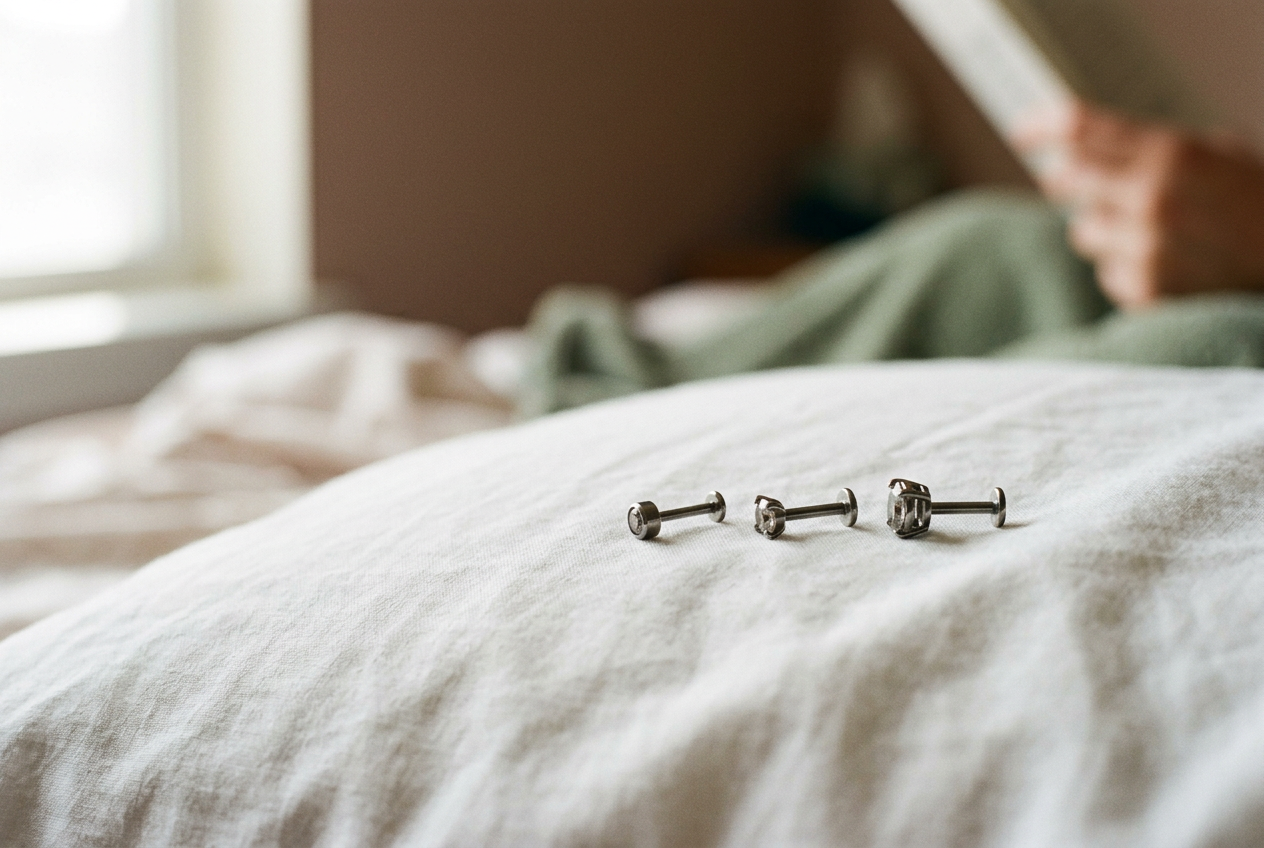
Titanium Posts Don’t Make the Whole Earring Nickel-Safe
A titanium post solves one contact point. Plated fronts, solder joints, moving rings and earring backs may still expose sensitive skin to nickel.
September 10, 2026 · 8 min read
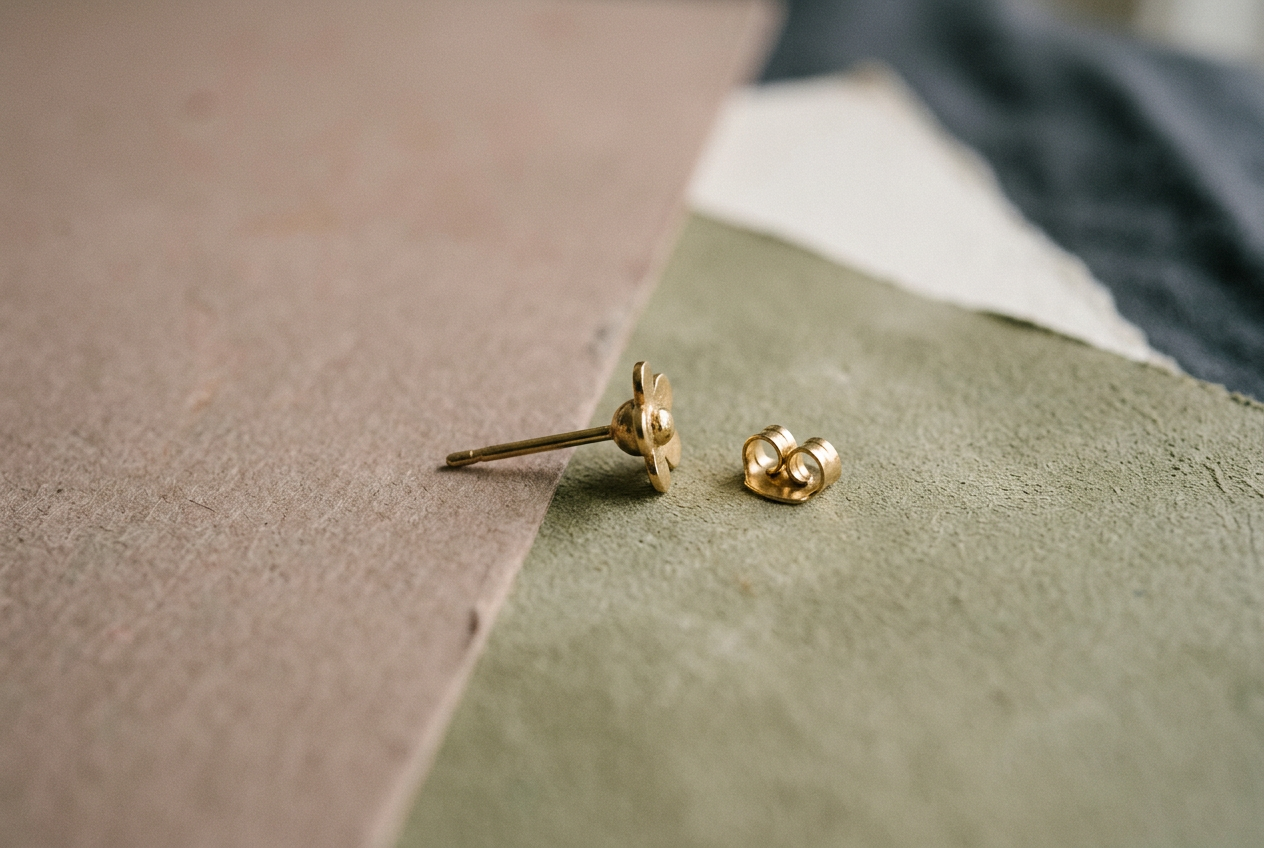
Turn a stud sideways. The straight post is only a narrow part of the structure; the decorative front sits against the lobe, a small joint holds the two together, and the backing closes from behind. Any one of those surfaces can matter when nickel triggers irritation.
Use a gold-tone flower stud as the working example here. Its product description promises an implant-grade titanium post, while the petals are plated brass, the flower is attached with solder, and a standard butterfly back finishes the earring. The titanium claim can be accurate. The complete earring can still put undisclosed metal against skin.
This advice is unisex because the mechanics do not change with the wearer or wardrobe. It applies to studs, huggies, drops and charms, whether the earring came from a piercing studio, a fashion retailer or an independent maker.
A post claim covers the post
Implant-grade titanium means titanium made to a recognized implant-material specification, commonly ASTM F136 or ASTM F67. A seller should be able to identify the grade or specification rather than relying on a gray color, a lightweight feel or the word titanium by itself.
That material is a useful choice for a post. It does not tell you what the decorative end is made from, how the post was attached, whether the back contains nickel or what will touch the ear once the earring shifts. “Titanium post” is a component description, not a complete materials declaration.
Return to the flower stud. The post passes through the piercing channel, but the plated petals may rest across the front of the lobe for hours, particularly if the post is short or the butterfly back is pushed on tightly. Sweat can remain under that broad front. Pressure and friction keep the surface in contact with skin.
A small titanium cylinder does not isolate the surrounding brass.
Nickel contact dermatitis, an itchy or inflamed skin reaction after nickel exposure, can appear wherever the relevant metal meets skin. That location may be the piercing channel, but it can also be a crescent beneath an oversized stud, a patch behind the lobe or a line where a drop component swings against the neck.
Map the earring against your skin
Start at the front rather than the post. On a stud, look at the full underside of the decorative piece, including any rim that overlaps the piercing. Plating, meaning a thin metal coating applied over another metal, may give brass or another base metal a gold or silver finish; it can wear at edges and raised areas, and the underlying alloy may not be disclosed.
The flower stud has another contact point at its center: the place where its post meets the metal cup behind the petals. Solder is a lower-melting metal alloy used to join jewelry parts. Its composition varies. Unless the seller identifies that joint and its material, an implant-grade post does not answer what sits immediately beside it.
Move behind the ear. A butterfly back may be stainless steel, plated base metal, gold or titanium, and it is often sourced separately from the decorative earring. Stainless steel can contain nickel even when it is marketed as surgical steel; how much reaches skin depends on the alloy and surface behavior, but shoppers with a known sensitivity should not treat the category name as a nickel-free promise. Ask about the back on its own.
Fit changes the map. A tight backing pulls the flower stud into the lobe, expanding contact between the plated underside, the soldered cup and warm skin. Too much post length creates a different problem: the front tips or slides, so its lower edge rubs repeatedly rather than resting in one position. The useful fit leaves a little room for ordinary movement without letting a heavy front droop.
Drops require a moving check. Follow the structure from the ear wire or post to every jump ring, a small metal ring that connects jewelry components, then note where the charm lands when the head turns. A titanium hook paired with a plated connecting ring can still bring that ring against the lobe. A long pendant may brush the neck even though nothing except titanium enters the piercing.
Huggies add an inner surface. The post might be titanium while the curved hoop, hinge and catch use other alloys, all close enough to touch the lobe. On a hoop with a dangling charm, inspect the ring holding that charm as closely as the part going through the ear.
Shop the construction, not the headline
A useful product page separates materials by component: post, front, connector and back. “Titanium earrings” is less informative if the description later narrows that claim to posts. “Hypoallergenic” is also not a universal materials specification; it may reflect a brand’s chosen standard without telling a nickel-sensitive shopper what each surface contains.
For the flower stud, the decisive questions are concrete. What are the petals and their skin-facing underside made from? Is the attachment soldered, welded or mechanically set? What metal is the butterfly back?
Does the plating cover the entire underside, and is the base alloy disclosed? A retailer that can confirm only the post has given enough information to judge the post, not the pair.
Photographs help with shape, though they cannot verify composition. Look for a broad metal pad behind the ornament, visible color changes near the post joint, a separate cup holding stones, or exposed connector rings. Those details show where to ask. They do not prove nickel is present.
Price is an unreliable shortcut. Low-cost fashion earrings often use mixed construction because it keeps elaborate fronts accessible, yet an expensive finish, gemstone or designer name does not establish the alloy under the plating. Full-component documentation is worth paying more for when sensitivity repeatedly limits wear; a vague premium claim is not.
The clearest alternative is an earring whose entire skin-contact system is documented, such as an implant-grade titanium post and backing with a titanium decorative end. Threadless labret jewelry, meaning a straight post with a flush disc backing and a removable pressure-fit end, can make that system easier to inspect, but the decorative end may still contain mixed metals. Confirm the end, not just the labret.
Niobium is another metal often considered for sensitive ears, while solid gold can work when its karat and alloy composition are disclosed. Solid gold is not automatically nickel-free, particularly across different white-gold alloys. The tradeoff is straightforward: documented materials and simpler construction often cost more or offer fewer ornate finishes than plated fashion jewelry.
Check what changes during wear
Before wearing an established piercing all day, hold the earring beside the ear and identify every likely contact point. Fasten it without compressing the lobe. Then check the front, back and lower edge after a short wear period, especially if the piece is heavier or larger than your usual earrings. Do not use this trial approach on a fresh or unhealed piercing, which needs suitable jewelry and professional aftercare guidance.
For the flower stud, a red outline matching the petals would direct attention toward the plated front rather than the titanium post. Irritation concentrated behind the ear could point toward the butterfly back or trapped moisture. That pattern cannot diagnose an allergy, but it can show why replacing only the post with another titanium post may change nothing.
Cleaning removes residue from a surface. It does not remove nickel from an alloy. Clear barrier coatings can chip, wear at moving joints and add thickness where a post or catch needs to fit, so they are a temporary compromise rather than a dependable fix for jewelry worn daily. They should not be used to make unsuitable jewelry acceptable for a healing piercing.
Stop wearing a pair that causes persistent itching, swelling, blistering or weeping. A clinician can assess symptoms that are severe, spreading or slow to settle, while patch testing through a dermatologist can help identify a contact allergy. The shopping decision afterward remains material-specific: replace the whole skin-contact system, not just its most marketable component.
Questions people ask
Are implant-grade titanium posts safe for nickel-sensitive ears?
Documented implant-grade titanium is a strong post material for many nickel-sensitive wearers, but the rest of the earring still matters. Check the front, joint and backing, then include any ring or charm that moves against the lobe or neck. A titanium post cannot prevent contact with a neighboring metal component.
Can the decorative front cause irritation without entering the piercing?
Yes. A broad stud front can press plated metal or an undisclosed base alloy against the lobe, where sweat and friction prolong contact. The placement of irritation may offer a clue: a shape matching the ornament’s underside points to a different contact point than discomfort confined to the piercing channel.
Does a titanium post mean the earring back is titanium too?
No. Backs are often separate components and may be stainless steel, plated metal, gold or titanium. Read the materials description for the backing specifically, or ask the seller to confirm it. Replacing an unknown butterfly back with a documented titanium back can remove one contact point, provided the fit remains secure and comfortable.
Should I avoid every mixed-metal earring?
Not necessarily, but a known nickel sensitivity makes undisclosed skin-facing alloys a poor daily-wear bet. Mixed-metal designs are easier to assess when the maker identifies each component and keeps decorative base metals away from skin. For the flower stud, a titanium post alone leaves too many relevant surfaces unanswered.
One update a day
Today's fashion update, in your inbox
One fashion update each morning — no hype, no filler, just pieces worth wearing.