A Nickel-Free Earring Claim Can Miss the Post and Clasp
The decorative metal is only part of the earring. Before ordering, check the post, backing, clasp, connecting rings, and any plating separately.
September 5, 2026 · 8 min read
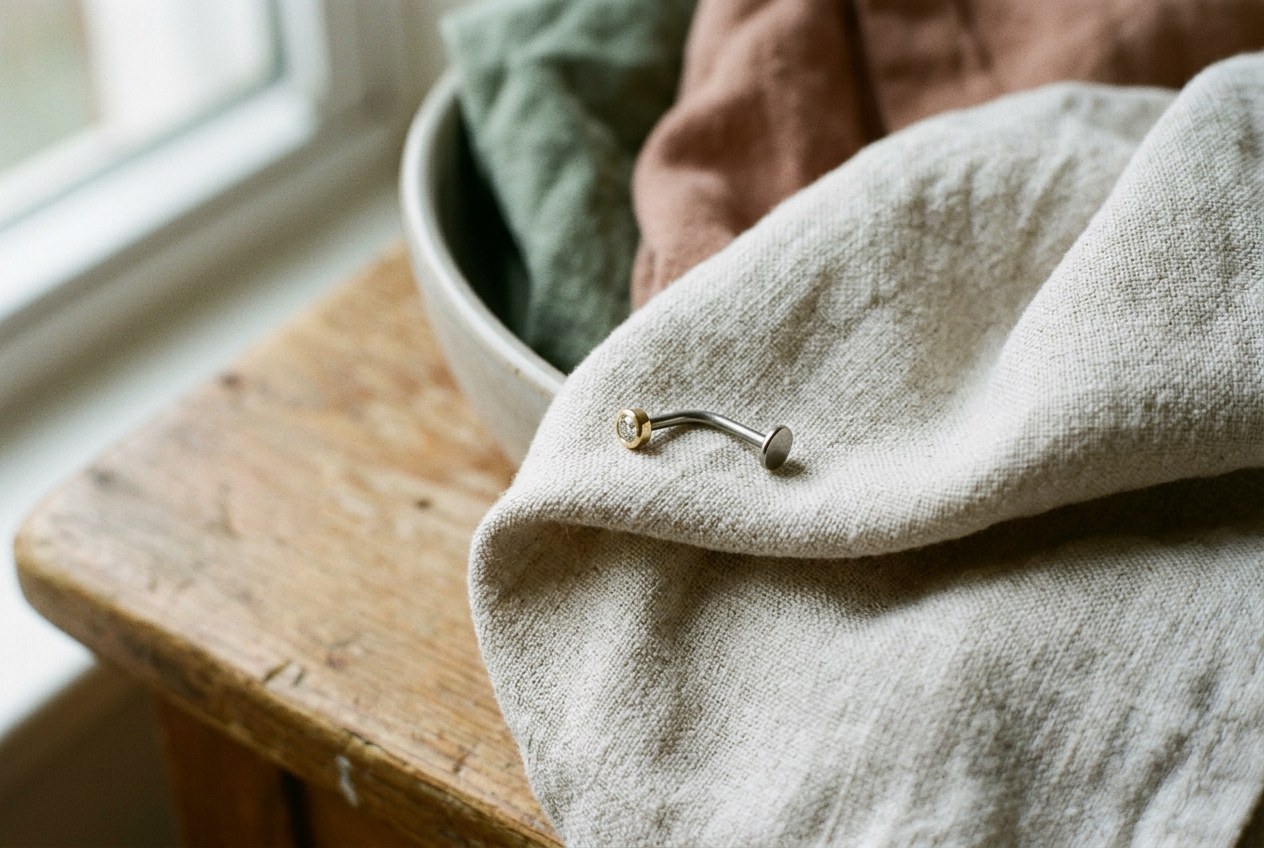
The narrow metal post is easy to miss in a product photo. It is also the part that sits inside the piercing for hours.
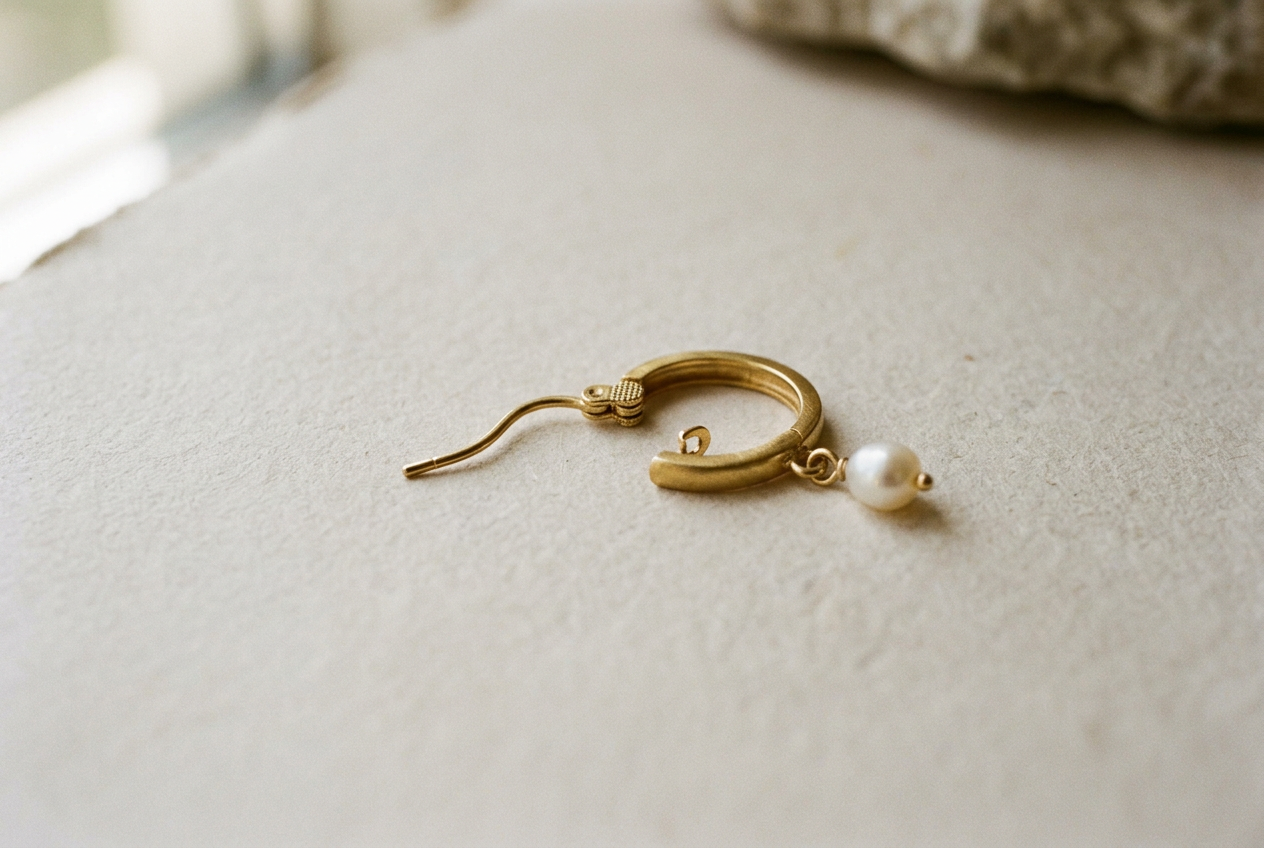
Use one common earring as the test case: a small gold-vermeil huggie, meaning a close-fitting hoop made from sterling silver coated with gold, with a straight hinged post and a removable pearl charm. The listing headline might emphasize vermeil, freshwater pearl, or nickel-free construction. None of those phrases, on its own, tells you what metal closes behind the lobe or connects the pearl to the hoop.
This is unisex buying guidance. The mechanics do not change with the styling category, and the same check applies whether the huggie is sold alone, as part of a curated ear set, or beside conventional studs.
Start with the metal that enters the piercing
A finding is a functional jewelry component, such as a post, hook, backing, clasp, or connector. Findings are often sourced separately from the decorative body, which is why a gold earring can arrive with a steel post or a sterling silver drop can use a base-metal jump ring.
For our vermeil huggie, the first useful disclosure would read something like “sterling silver hoop and post with gold plating.” That wording gives the post a named base metal. “Gold-vermeil hoop” is less complete because it may describe only the circular body, while “gold-tone” identifies a color rather than a composition.
Stud earrings deserve the same scrutiny. The post, meaning the straight stem that passes through the ear, may be welded or soldered to a decorative front made from another material. A butterfly back, the pinched metal fastener that slides onto a post, can come from a different supplier again. If the retailer specifies titanium posts but says nothing about the backs, the disclosure has stopped one component too soon.
Fit matters here. A replacement back must match the post’s diameter and locking shape; a loose back can disappear during wear, while an undersized one may scrape plating from the post or refuse to pass over its notch. Threaded and threadless jewelry use different systems, so buying a titanium back without confirming compatibility is not a reliable fix.
Follow the huggie through every contact point
Open the huggie in our example. Its straight post pivots on a tiny hinge, passes through the piercing, then clicks into a notched catch on the opposite side. The post is the longest contact point, but the catch and inner edge of the hoop can press against the lobe when the fit is close.
That makes “titanium post” useful but incomplete. The next question is whether the hinge pin and catch use the same titanium, the vermeil-covered silver named for the hoop, or an unspecified alloy chosen for spring and strength. Small mechanisms sometimes need a harder or more flexible metal than the decorative body. That construction choice is not automatically poor, but it should be disclosed when a nickel-free claim influences the purchase.
Now look at the pearl. It hangs from a jump ring, a small split ring used to connect one jewelry part to another. The ring moves, rubs the hoop, and can touch the neck or lower lobe as the earring swings. Gold plating on this little component may wear sooner at the opening because tools bend the ring during assembly and the edges continue to rub in use.
Solder deserves a question too. It joins metal parts but may have a different composition from either part being joined. A broad statement that every metal component is nickel-free is more useful than a list that names the hoop and post while leaving the joins, hinge, and jump ring unaddressed.
Read
“nickel-free” as a claim that needs a scope
“Nickel-free” does not tell you the test method, reporting threshold, or whether the statement covers the complete earring. “Hypoallergenic” is broader still. It is not the name of an alloy, and it cannot substitute for a material list.
A strong product page names each skin-contact metal and states that the complete piece, including findings and solder, meets the brand’s nickel-free standard. Better documentation may explain whether the company tests finished jewelry for nickel release, since exposure depends on what reaches the skin rather than the decorative color visible on delivery.
A weak page puts “nickel-free” among general collection filters, then describes the individual earring only as plated brass, mixed metal, or gold tone. Another warning sign is a material tab that identifies the charm in detail but reduces the hardware to “metal.” Customer-service confirmation can fill that gap, provided the reply addresses the exact product rather than repeating a collection-level claim.
Do not use “surgical steel” as shorthand for nickel-free. Steel grades vary, and some stainless steels contain nickel. Implant-grade titanium is a more precise phrase when it comes with a documented standard, commonly an ASTM grade used for implant applications, but the claim still needs to cover the post or other component you will wear rather than an unrelated decorative section.
Solid gold also needs its karat and alloy disclosed. Gold jewelry below 24 karats contains other metals, and white-gold alloys may use nickel or alternatives such as palladium. Yellow color is not proof of composition. Plating adds another limit: even if the outer gold layer is nickel-free, friction at a post, catch, or jump ring can expose the base metal underneath.
Send one precise message before checkout
Generic questions tend to produce generic answers. Ask about the exact style and name the hidden components, particularly if the product page shifts between phrases such as “gold plated,” “sterling silver,” and “hypoallergenic.”
Please confirm the base metal and plating, if any, for the hoop body, post, hinge and clasp, jump ring, and solder in this earring. Does the nickel-free claim cover every metal component in the finished pair, including the removable charm hardware?
Save the reply with the order confirmation. If the answer says only that the “main material” is nickel-free, ask which parts are excluded. If customer service cannot obtain a component-level answer, treat the composition as unknown rather than filling the gap from the earring’s color or price.
A home magnet check will not settle it. Nickel-containing alloys are not uniformly magnetic, and magnetism does not identify every other metal in the piece. Consumer nickel-release tests can screen an accessible surface, but they do not reveal the full alloy or reach sealed hinges and internal joins. Documentation is the cleaner first step before purchase.
Know when the construction is worth the tradeoff
At fashion-jewelry prices, replacing every undisclosed finding may cost more in parts and jeweler labor than choosing a better-documented pair. The remake also changes fit. A thicker post may not enter the huggie’s original catch, and a larger jump ring can make the pearl hang lower or rotate forward.
Replacing a butterfly back is easier because it is separate, although size and locking style still matter. Rebuilding the hinged post on our vermeil huggie is a specialist job. If that post is unspecified, the cleaner alternative is a hoop whose complete construction is documented as titanium, niobium, or a named solid-gold alloy that meets your requirements.
There is a price tradeoff. Solid gold generally sits above plated jewelry, while documented titanium can be visually plainer and may offer fewer stone settings or warm-metal finishes. Gold-colored titanium usually gets its color from a surface treatment rather than becoming gold, so the retailer should identify that finish too. Paying more makes sense for verified construction, not for the word “premium” beside an incomplete material tab.
This guide cannot determine what your skin will tolerate, and it is not medical advice. If earrings cause persistent itching, swelling, pain, or broken skin, stop wearing them and seek guidance from a qualified clinician. For shopping purposes, the decision is narrower: do not order the pearl huggie until the post, catch, and jump ring have names.
Questions people ask
Can surgical steel earrings be nickel-free?
Some steel jewelry may meet a seller’s nickel-release standard, but “surgical steel” alone does not establish that the alloy contains no nickel. Ask for the specific grade, the finished-item testing standard, and confirmation that the post, backing, clasp, and connectors are covered by the claim.
Does gold vermeil prevent contact with nickel?
Vermeil identifies gold plating over sterling silver; it does not describe every separate finding or guarantee how the surface will wear. Check whether the post, hinge, clasp, jump ring, and solder share that construction, and remember that repeated friction can expose the base metal at moving edges.
Can I replace only the earring back?
Often, if the earring uses a removable butterfly or similar slide-on back. Match the replacement to the post diameter and locking shape, and verify its full composition. A new back does not change an undisclosed post, welded joint, or hinged clasp that also touches the ear.
What should I do if earrings irritate my ears?
Remove the earrings rather than testing them through continued wear, then follow appropriate medical guidance if symptoms persist or the skin is damaged. Keep the product page, packaging, and material response from the seller; those details can also help you avoid the same undisclosed post or clasp construction next time.
One update a day
Today's fashion update, in your inbox
One fashion update each morning — no hype, no filler, just pieces worth wearing.