Woven Bags Are Back, but Raffia and Leather Age Differently
Similar weaves can hide very different weak points. A hands-on comparison shows which corners fray, which bags sag, and which damage can be repaired.
August 18, 2026 · 8 min read
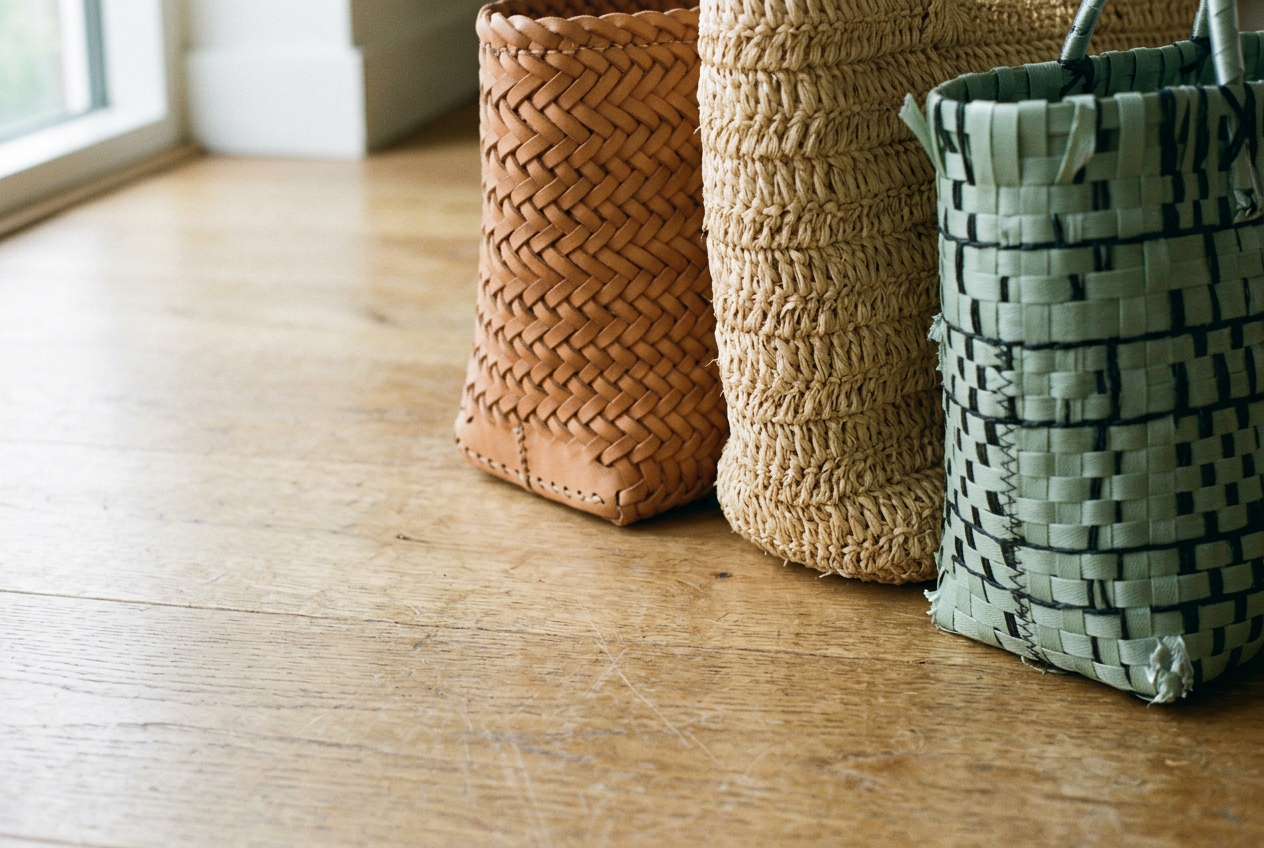
The bag I kept returning to during this evaluation was a medium tan tote made from narrow leather strips, with an unlined interior, a flat leather base and a stitched top binding, meaning the folded strip that covers the raw upper edge. I carried it for a week with a water bottle, paperback, small pouch and folded cardigan inside, setting it under café tables and against the rougher fabric of denim.
Its woven surface looked much like the raffia and plastic-tape bags beside it. The wear did not.
By the end of the week, the leather tote still stood when empty, although its upper corners had softened and one lower corner had become darker and smoother from friction. Nothing had broken. More use will decide whether that polishing develops into appealing wear or exposes a weaker strip beneath the surface finish, but the first changes were gradual and readable rather than abrupt.
That distinction matters now that woven bags have moved beyond one recognizable vacation style. Leather shoppers, raffia basket buyers and people choosing washable plastic totes may all be looking at the same open checkerboard pattern, yet they are buying different relationships with abrasion, moisture and repair. This guidance is unisex because those mechanics do not change across wardrobes; capacity and strap length matter more than the department where the bag is sold.
Start with the corners, not the front panel
A woven front panel can stay handsome while the bag is beginning to fail elsewhere. The lower corners take contact from floors and clothing, while the upper corners absorb the outward pull created by the contents, especially when a soft tote has no structured side panel to distribute the load.
On the tan leather tote, the weave continued around the sides before meeting the separate base. That was useful. The base took most of the contact when I set the bag down, and the seam sat slightly above the floor rather than grinding directly against it. A bag woven as one soft shell, without a distinct base, asks the outermost strips at each corner to perform both as decoration and as protection.
Press an empty bag lightly at a lower corner. Strips that slide back into position are likely to tolerate ordinary flexing. If a gap remains, or one strand rises above its neighbors, the weave may distort once the bag is loaded. This does not prove poor quality, but it tells you that the lining and base construction will have to do more work.
Leather strips make the strongest case for repeated use
Leather is the most convincing investment material here when the strips are substantial, the crossings sit flat and the corners have support. It bends rather than folding into a permanent crease, and surface abrasion usually arrives first as smoothing or color change. Those signs give an owner time to condition the dry area or ask a repair shop to secure a lifting strip.
The tan tote demonstrated the useful version of that behavior. Its lower corner polished during the week, but the strip itself stayed flat. The top binding also kept the vertical strands from spreading when I lifted the loaded bag. On a cheaper leather construction, that same visual effect may be made with very thin strips backed by fabric, or with cut edges heavily covered in edge paint, the flexible coating applied to a leather edge.
Once thick edge paint cracks at a crossing point, touching it up neatly can be harder than treating a plain leather surface.
Shape retention came from more than the weave. The separate base prevented the middle from dropping, and the close crossings limited sideways stretch, though the unlined interior left small objects exposed to the reverse side of every strip. A tightly fitted lining would protect those crossings, but it could also hide a repair route. If one strip eventually snaps, a repairer needs access from inside to stitch it down or weave in a replacement.
Leather is not automatically the durable choice. Very narrow strips create more crossing points and therefore more places for the finish to rub. Wide, thin strips may crease. A rigid leather weave can also feel promising in the store while concentrating stress at the exact point where the body meets the handle attachment.
Pull each handle gently away from the bag and watch the surrounding weave. Movement across several strips is preferable to one strip taking the full load.
Raffia delivers texture with a shorter neat phase
Raffia, a plant fiber traditionally taken from palm leaves, brings the dry, irregular surface that many leather bags work hard to imitate. That unevenness is part of its appeal. It also makes snagging the central concern.
In hand, the raffia sample reacted less to pressing than to brushing. A raised fiber caught against a textured knit, and smoothing it back did not restore the original surface completely. Close weaving reduced the movement between strands, but it did not stop fine ends from lifting where the side of the bag met clothing. A loose, airy raffia weave was more forgiving visually because stray fibers blended into the surface, although it lost shape sooner under the same everyday load.
Corner abrasion is less graceful. Leather can polish; raffia usually fuzzes, splits or breaks. A bag with a leather base and leather corner patches can therefore be worth a meaningful step up in price, provided those pieces are stitched through the body rather than glued over it. Look inside for a corresponding line of stitching.
Glue can hold a decorative patch, but a structural corner needs a mechanical connection.
Raffia repair tends to remain visible. A loose strand can be tucked and secured from inside, while a small gap can be stitched across with a matching natural fiber, but exact color and thickness are difficult to reproduce after sun and handling have changed the original. For an occasional summer bag, that may be acceptable. For a pale tote carried against dark denim several times a week, the likely combination of color transfer, fuzzed corners and snagged fibers makes raffia a seasonal texture rather than the obvious investment.
Plastic tape is washable, but damage can turn suddenly
Plastic-tape bags often enter at the budget end, though the construction varies from flexible handwoven strips to stiff factory-made tape assembled over a frame. Their practical argument is clear: splashes wipe away, the material does not absorb skin oils like unfinished raffia, and a damp base need not end the bag’s day.
The weakness appears at folds. Repeated bending can produce stress whitening, a pale line that forms where colored plastic has stretched, before a strip splits along that line. On the handled sample, the weave bounced back well when pressed at the center, yet the lower corner retained a sharper crease than either natural material. A cut or split would be difficult to disguise because adhesive can leave a hard patch, while sewing through plastic introduces new perforations.
Some plastic bags are repairable if the weave uses continuous, replaceable strips and the interior remains accessible. Many inexpensive versions make that repair cost more in time than replacing the bag. Check the handle junction closely: tape folded over a narrow attachment point can whiten before the wider body shows any wear.
Plastic does have a place. It is sensible for damp towels, market produce or a rainy commute when a leather lining would create worry and raffia would stay wet. I would not pay investment-bag money for it without replaceable handles, an accessible weave and reinforced lower corners. Washability alone does not make the structure durable.
A two-minute inspection separates texture from structure
Set the bag on a flat surface first. The tan leather tote rested on its full base without tipping, and its side walls remained upright even when empty. A woven bag does not need to stand rigidly, but a collapsing base before purchase suggests that the handles and lining will carry more of the shaping work once it is loaded.
Next, follow one strip from the top edge toward the base. This reveals whether it continues through the weave, disappears into a glued seam or becomes narrower near a corner. Then inspect the inside for a baseboard, a stiff insert that supports the bottom. Removable boards are easier to replace, while cardboard concealed beneath a fixed lining can warp after one spill.
Run a plain cotton sleeve lightly over the side rather than pulling at individual fibers. Raffia that catches immediately will be demanding around knits. Leather should not leave tacky residue or shed finish, and plastic should bend without showing a pale crease. Finally, load the bag with your usual essentials and hold it by one handle.
If the top edge buckles around the attachment, the weave is already showing where it will fail.
At the low-cost seasonal end, prioritize a sound handle junction and accept that corner wear may end the bag before repair makes sense. In the middle price band, pay for a separate base, stitched reinforcement and an accessible lining rather than a more complicated pattern. At investment level, leather strips should feel consistent, the crossings should stay flat under load, and the maker or retailer should be able to explain whether handles and damaged strips can be repaired.
The tan tote meets most of that test, though its exposed interior makes it less useful for keys and uncapped pens than its strong exterior suggests. I would carry it repeatedly with a zip pouch inside. I remain less persuaded by paying heavily for delicate raffia or unrepairable plastic tape, however polished either one looks on the shelf.
Questions people ask
How do
I stop a woven bag from snagging my clothes?
Check the sides and upper corners with a plain cotton sleeve before buying. Raised raffia ends and rough leather edges are most likely to catch open knits. A smooth lining protects the contents, but it will not stop the exterior from snagging clothing, so keep delicate sweaters away from coarse weaves.
Is a woven leather bag worth the higher price?
It can be if the bag has substantial strips, a separate base, reinforced handle attachments and interior access for repair. Price alone proves none of those things. A thin leather weave glued to backing fabric may age less convincingly than a modestly priced bag whose structural parts are stitched.
Can a raffia bag be repaired after it frays?
Small loose fibers can be tucked and secured from the inside, and a minor opening can be stitched across with a similar fiber. The repair will often remain visible because raffia changes color and texture with wear. Broken material at a loaded handle attachment is a more serious failure than surface fuzz.
Do plastic woven bags hold their shape better?
Some do at first because stiff tape springs back after light pressure, but repeated corner folding can leave pale stress lines and then split. Look for a supported base and broad handle attachments. If the tape has already whitened near a fold or base seam in the store, skip it.
One update a day
Today's fashion update, in your inbox
One fashion update each morning — no hype, no filler, just pieces worth wearing.