Your Belt Edge Predicts Whether It Will Crack or Fuzz
Painted, folded and burnished belt edges fail in different places. Here is how to inspect the construction, handle minor damage at home and know when repair is worth paying for.
August 10, 2026 · 7 min read
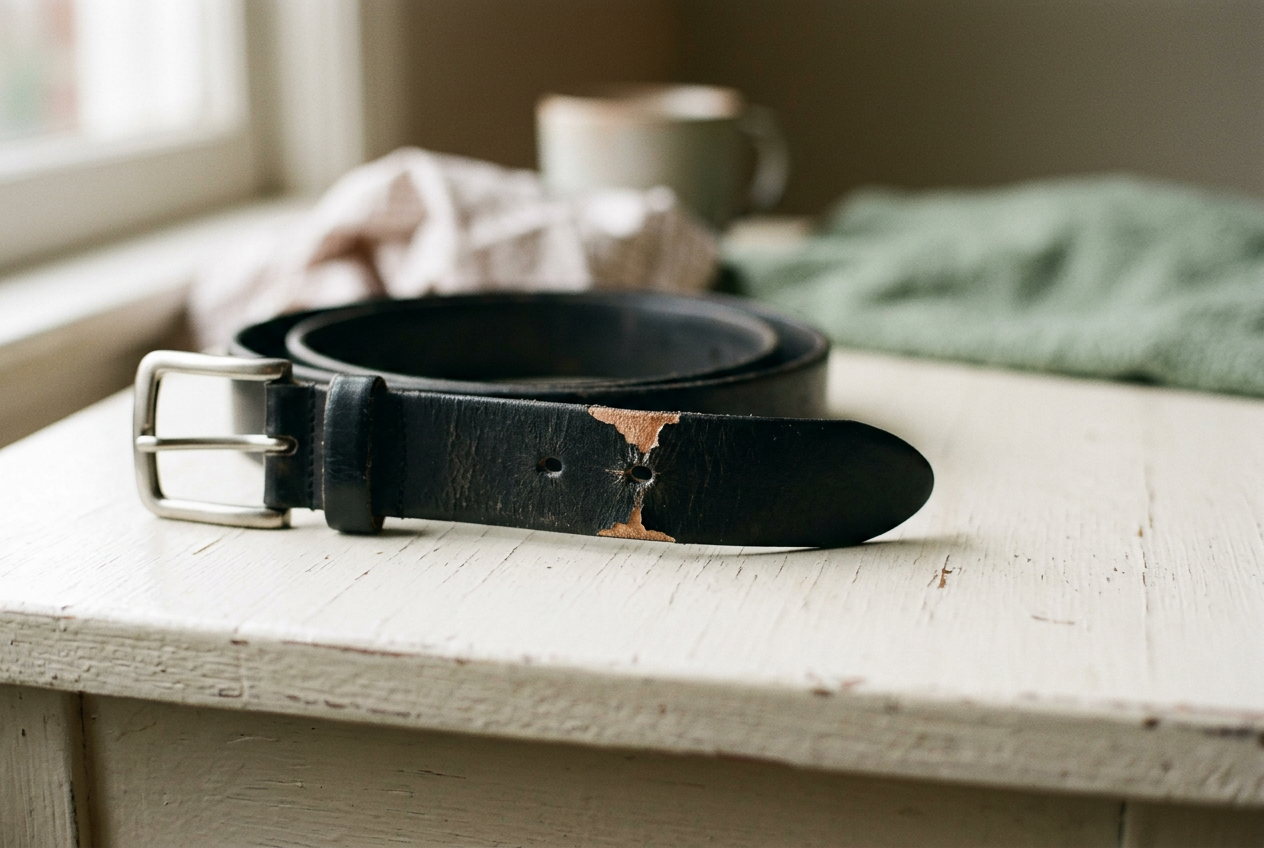
The first failure on my black, medium-width leather belt was narrow enough to miss while getting dressed. Its matte painted edge had split just behind the hole I used most, where the strap curved through the buckle every time I wore it with jeans or trousers. A second chip appeared at the buckle return, the short section folded back around the hardware.
The leather faces still looked presentable after a season. The edge did not.
That distinction matters across women’s and men’s wardrobes, so this is unisex advice: a buckle can be solid, the top leather can feel substantial, and the belt can still age poorly if its edge finish is too rigid for the way the strap bends. Painted, folded and burnished edges solve the same problem differently. Each leaves its own evidence before a larger failure.
Painted edges crack where the belt bends
An edge-painted belt has a flexible coating applied over the cut sides of the strap, usually in several thin layers that are sanded and finished to produce a smooth line. Good edge paint can look precise and stay stable for years. A thick, brittle application can resemble a narrow strip of plastic once it begins to lift.
On the black case belt, the hairline split behind the working hole followed the curve of the strap rather than a scratch from outside. That is the useful clue. Surface scuffs tend to interrupt the color; fatigue cracks open across the coating where the belt repeatedly folds, particularly near a favored hole and around the buckle.
Run a fingertip along those areas. A shallow nick with firm material around it is mostly cosmetic. A raised lip means the paint has begun separating from the leather below, and bending the belt sharply to test it will make matters worse. Look at it under ordinary side light instead.
Paint can also break around punched holes, especially when the coating extends into them as a thick rim. The buckle tongue presses and twists there. Once the rim chips, moisture and friction reach the exposed fibers, which may begin to look pale against a dark finish.
Small damage is manageable at home, but a factory-smooth repair is difficult. Loose paint must be removed without enlarging the bare area, the edge needs light smoothing, and a compatible flexible edge coating has to go on in thin layers with drying time between them. Shoe polish can disguise a pale mark. It cannot reconnect detached paint.
Color is another limitation. Black is forgiving, although differences in gloss still show. Matching tan, oxblood or a seasonal color may take more effort than the belt justifies.
A folded edge hides the cut side but adds a join
A folded edge uses the outer leather to wrap around the side of the belt and meet the lining underneath. The leather is often skived, meaning thinned toward its edge, so the fold does not become bulky. This construction avoids a visible painted border and can feel soft against clothing.
Its vulnerable point moves out of sight. Turn the belt over and inspect the long join where the wrapped leather meets the back. Glue failure starts as a fine dark line, a slight ridge or a section that presses down and rises again. Delamination, meaning layers separating from each other, often becomes easiest to spot near the tip and buckle return, where hands pull and bend the strap.
A folded edge can also crack directly on the turn if the outer leather was thinned too aggressively or has a heavy surface coating. That failure looks different from an open join: the leather face develops short transverse lines along the rounded edge, and no amount of pressing from underneath will close them.
A tiny lifted section may accept a leather adhesive applied sparingly with a toothpick, followed by firm, even pressure while it cures. Household superglue is a poor shortcut. It dries hard, can darken or whiten the surface, and creates a rigid spot beside flexible leather. If the separation runs for several inches or the inner reinforcement has shifted, a leather repair shop has a better chance of aligning the layers without leaving a lump.
Burnished edges usually fuzz before they split
A burnished edge is the exposed leather edge smoothed and compressed with moisture, friction and a finishing compound or wax. It is most successful on firm vegetable-tanned leather, whose fibers can be worked into a dense surface. Soft chrome-tanned leather often stays fibrous and may need paint, binding or another covering instead.
Burnishing wears more visibly but often more honestly. The tip may become fuzzy from passing through belt loops, and the area beside the working hole can lose its sheen. A light-colored edge may darken from skin oils and denim dye. None of those changes automatically means the strap is coming apart.
Home maintenance is realistic if the edge remains structurally sound. Wipe away dirt, let the leather dry, smooth raised fibers with a fine abrasive using very little pressure, then reburnish with a suitable leather gum or wax and friction from a smooth cloth or burnishing tool. Test any product on an inconspicuous section near the buckle because darkening can be permanent.
The stop point is a deep split between layers. Some belts that appear to have one solid burnished edge are laminated from separate pieces, and a line opening through the center is not ordinary fuzz. Wax may flatten it briefly. It will not restore the bond.
Inspect the belt beyond the buckle
Start with the buckle return, where the case belt lost its first small chip. The strap should curve without the edge coating whitening, opening or forming a hard crease. Check whether screws or stitching secure the buckle; removable hardware can make later repairs easier, though it does not guarantee better leather.
Move to the holes. One cleanly punched hole tells less than the area around it, so angle the belt and look for paint bridging the opening, loose fibers or cracks radiating from the tongue’s likely contact point. On a display belt, repeated try-ons may already have marked the middle holes.
Then examine the tip and the underside join. A painted edge should feel continuous rather than thick in some places and sharp in others. A folded edge should lie flat without adhesive residue. A burnished edge can show fiber texture, but it should not shed readily when rubbed once with a dry fingertip.
Do not use edge style as a complete quality ranking. An expensive painted edge may outlast a poorly burnished one, while a folded construction can be elegant until its adhesive gives way. The more useful question is whether the finish suits the leather and the bending demanded by the design. A very thick dress belt forced through a small buckle radius puts unusual strain on any rigid coating.
The black case belt still passes that inspection everywhere except its two painted flex points. That makes it wearable, but no longer worth an ambitious cosmetic restoration. I can seal and recolor the exposed spots, accept that the gloss may differ, and avoid bending the strap backward when taking it off.
Decide whether repair is worth it
For an entry-level fashion belt, professional edge refinishing can approach or exceed the cost of replacing the accessory. A neat home touch-up makes sense when the damage is small and the strap remains stable. Widespread peeling, a cracked core or a lining that has shifted changes the calculation.
Repair becomes more persuasive for an investment belt with strong leather, replaceable hardware or sentimental value. Ask a leather worker whether the quote covers local touch-up or removal and refinishing of the whole edge, because patching one section of colored edge paint may leave a visible change in texture.
Burnished edges offer the easiest maintenance path. Folded edges reward early attention to a small lift. Painted edges look the most exact when new, yet once a broad section starts peeling, matching that factory line at home is rarely realistic.
Questions people ask
Can
I use shoe polish on a cracked belt edge?
Shoe polish can darken a light scuff on black or brown leather, but it does not bond loose edge paint or reconnect separated layers. Use it only as a cosmetic disguise after checking that the damaged section is stable, and expect the color to transfer if excess polish remains on the edge.
Is a burnished belt edge always better than a painted one?
No. Burnishing works best on firm leather with fibers that compress cleanly, while edge paint can give softer or laminated leather a sealed, polished border. Burnished edges are usually easier to refresh at home, but construction quality and the belt’s bend around the buckle matter more than the finish name.
Can a folded belt edge be glued back at home?
A short, clean lift may be repaired with a flexible leather adhesive, a minimal application and even pressure during curing. Stop if the leather has stretched, the lining no longer aligns or the separation continues along the strap, since pressing a distorted join flat can create a permanent ridge.
When should
I replace the belt instead of repairing it?
Replace it when the strap has cracked through its core, several layers are separating, or the working hole has stretched enough that the buckle tongue no longer sits securely. Minor fuzz, isolated paint loss and a small lifted join are maintenance issues; structural movement under the surface is the more important warning.
One update a day
Today's fashion update, in your inbox
One fashion update each morning — no hype, no filler, just pieces worth wearing.