Why a Tighter Tie Will Not Keep a Wrap Dress Closed
A wrap dress stays put when its front panels overlap through movement. Here is how to test that coverage and fix drifting fabric without cinching the waist all day.
Women's · September 10, 2026 · 8 min read
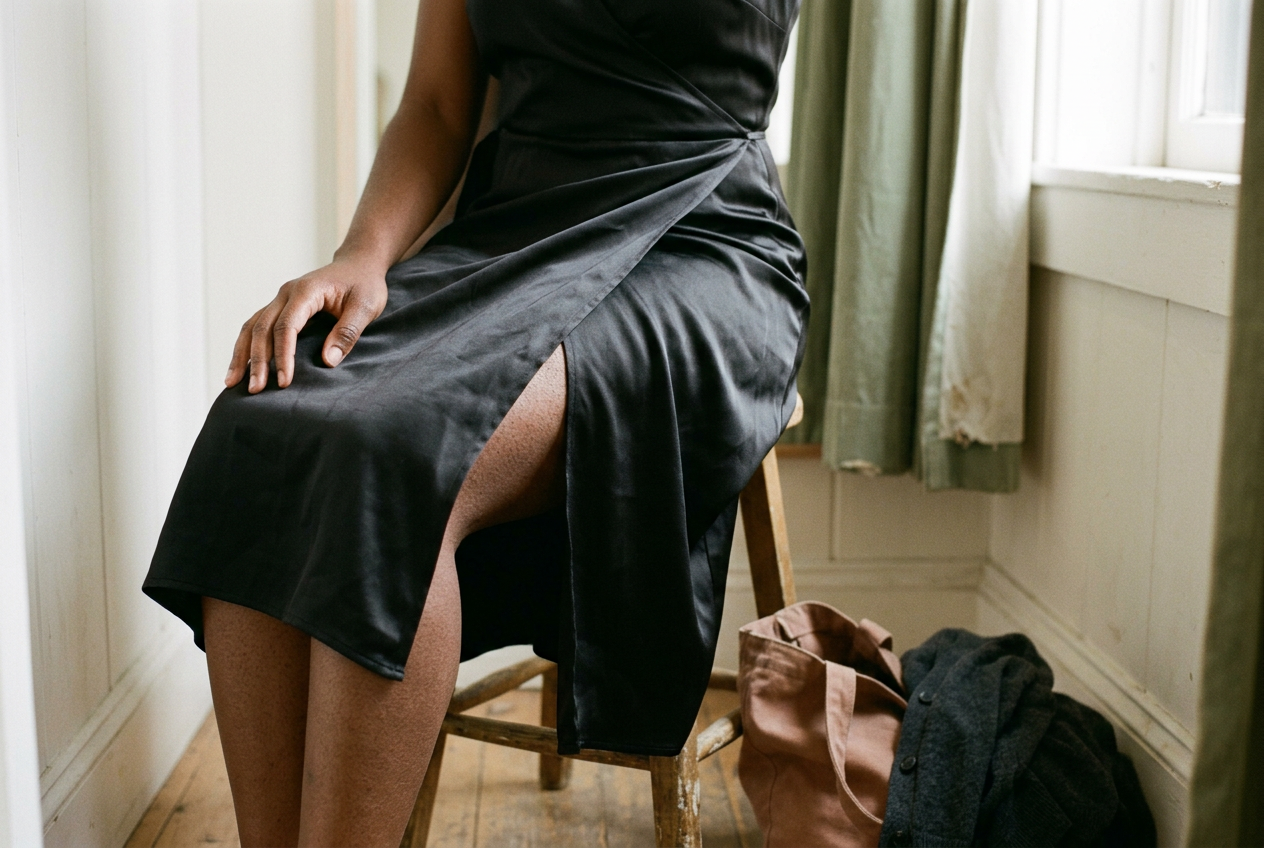
The dress I kept returning to for this evaluation was a black polyester-satin true-wrap midi, meaning its two front panels crossed over the body and fastened with a waist tie. Standing still, it looked secure. After several long steps, the neckline shifted. Seated, the skirt opened over the thigh even though the knot had not loosened.
That sequence matters. The tie was doing its job, but the cut was asking it to control fabric several inches away from the waist. It could not.
This is women’s fit coverage, particularly for shoppers whose bust, waist and hip measurements do not land in one brand size. A wrap shape can accommodate some variation, but it cannot make missing overlap appear.
The tie controls the waist, not the whole dress
A wrap tie creates horizontal tension around the waist. Pull it harder and the waist gets smaller, while the neckline and lower skirt may remain almost unchanged. On the black satin dress, extra tension also dragged the side seam toward the front and produced diagonal wrinkles from the waist to the bust, a clear sign that the garment was being over-tightened rather than stabilized.
Bodice overlap describes how far the two front bodice panels cross each other. Good overlap lets the inner neckline edge travel beyond the fullest part of the opposite breast and stay covered when the rib cage expands. If that inner edge sits close to the center of the bust while standing, a small reach or twist can expose it.
Skirt overlap is separate. The outer panel may cover the inner panel neatly at the waist yet taper away below it, which is why a dress can look closed in a mirror and split open over the upper thigh in a chair. More tie tension at the waist cannot widen that lower panel.
The black polyester-satin midi had both problems in mild form. Its neckline overlap was just sufficient at rest, while the skirt’s inner panel reached across the body without continuing far enough around the opposite thigh. Walking introduced the failure. Sitting made it obvious.
Anchor placement changes the pull
The anchor is the point where the inner tie passes through or attaches to the dress. On many true-wrap styles, one tie feeds through a small opening in the side seam before circling the waist. That opening determines the direction of pull.
An anchor positioned too far toward the back can tug the inner panel sideways, reducing coverage at the bust as the wearer moves. If it sits above or below the natural waist, the tie may pull diagonally and make the neckline creep. A large side opening adds more play, especially when the tie is narrow and slippery.
Check the anchor before blaming your body or the size. Tie the dress once at a comfortable tension, then look at the side seams. They should hang close to vertical, and the waist seam, if there is one, should remain level. A seam twisting toward the front usually means the tie is pulling the garment off balance.
Deep creases radiating from the anchor point suggest the same thing.
On the test dress, the side opening sat slightly behind the side seam and allowed the satin tie to travel within it. The movement was small, but smooth fabric needs little encouragement to drift.
Satin makes a marginal fit less reliable
Satin, a weave with a smooth and reflective surface, has less grip than cotton poplin, textured crepe or many matte jerseys. The care label on the black dress listed polyester, so both the dress and its matching tie had slick surfaces. Once the panels started moving against each other, friction did little to stop them.
A slippery lining can compound the issue. Smooth shapewear, a satin camisole or silky tights let the inner panel slide across the body, while a lightly textured slip tends to hold it closer to its starting position. Static may create temporary cling, but it is inconsistent and can release as soon as the wearer sits or changes humidity.
This does not make polyester satin a poor choice by default. It means shallow overlap has less margin for error in that material. A matte viscose crepe dress cut to the same pattern may feel steadier because its surfaces resist movement, although viscose can relax with wear and should still pass the same tests.
Use the fitting room as a movement test
Start by tying the dress at the pressure you would tolerate through a meal. Do not pull until the waist feels braced. If security depends on discomfort before the test begins, the dress does not fit well enough to buy without alterations.
Face the mirror and slide two fingers under the neckline at the point where the panels cross. The fabric should return to position after you release it rather than staying pulled open. Then take a full breath and reach forward as if lifting a bag from a counter. Watch the inner neckline edge, not only the outer V.
If that hidden edge crosses onto the visible breast area, the bodice overlap is marginal.
Sit fully against the fitting-room bench with both feet on the floor. A cautious perch conceals the problem. The inner skirt panel should continue covering the center of the body, while the outer panel should remain across the opposite thigh instead of dropping between the legs. On the black satin midi, this was the moment the neat standing overlap turned into an exposed wedge above the knee.
Stand and take several long strides, including a turn in each direction. Fabric can reset itself every time you stop, so keep watching the skirt while moving. If the outer panel swings away but falls back into place, a light closure may control it. If the inner panel never reaches far enough across the thigh, no snap can supply the missing cloth.
Finish by raising one arm and then the other as if putting on a coat. This checks whether the armholes and shoulders lift the entire bodice. A dress that passes the seated test but opens when the arms rise may be too short from shoulder to waist, particularly on a fuller bust or longer torso.
Fix the point that moves
For a neckline with adequate underlying overlap, a small sew-on snap can join the panels where they naturally cross. A snap is a two-part metal closure that presses together. It should sit below the visible neckline edge and be sewn through a facing or reinforced seam allowance, not through one unsupported layer of satin, which can pucker or tear under tension.
A hook-and-eye, a small metal hook that catches a matching loop, suits a crossing point under firmer strain. It is flatter than many snaps but less forgiving if the dress pulls during breathing. Either alteration is modest work for a tailor when the panels already meet comfortably. If they must be stretched together, the closure will show the strain.
Double-sided clothing tape is useful for one wear, especially between a neckline and a camisole, but body lotion, heat and repeated movement weaken its hold. Test adhesive on an inconspicuous area because delicate finishes can mark. Tape should support a workable fit, not carry the whole bodice.
At the skirt, a hidden snap can stop a generous outer panel from swinging open. Place it where the panels still overlap during a long stride, usually higher than the point where the opening becomes visible. Putting a closure too low restricts walking and transfers force into a small patch of fabric. Safety pins are a rough substitute and can leave permanent holes in satin.
When the skirt lacks depth, a half-slip or attached modesty panel is the more honest fix. A modesty panel is an extra piece of fabric set behind an opening. A tailor can add one in a compatible matte fabric, although the result changes the dress’s movement and may be visible when walking. For occasional wear, a knee-length slip close to the dress color costs less effort and makes an opening look deliberate.
Anchor drift calls for a different repair. A tailor can narrow the side opening, move the tie position or add a waist stay, which is an interior ribbon that holds the garment at the waist independently of the outer fabric. The waist stay is the strongest discreet option for a dress worth altering because it prevents the satin shell from carrying all the tension.
Know when to change size or leave it behind
Try the next size when both front panels are too shallow and the shoulders still have room. Retest from the beginning. Sizing up is useful only if it creates overlap without dropping the armholes, shifting the shoulder seams or making the back waist sag.
The black satin midi did not earn an alteration. A snap would have steadied its neckline, but the skirt needed more width through the inner panel, and the moving anchor still distorted the side seam. That combination would have required several fixes for a dress whose pattern remained mismatched to the wearer.
A faux-wrap dress, where the crossed front is sewn closed rather than released by a tie, is the practical alternative when dependable coverage matters more than adjustability. It can still gape if the bodice is too short or tight, but the skirt will not unwrap during a stride. For a true wrap, choose deeper panels first. The bow is decoration after that.
Questions people ask
Can
I stop a wrap dress neckline from gaping without sewing?
Double-sided clothing tape can hold a neckline to a camisole or bra edge for a short wear, provided the panels already overlap without pulling. A small fashion clip may work on heavier fabric, but it can look bulky. If the neckline separates under normal breathing, adhesive is covering a fit problem rather than fixing it.
Should
I size up in a wrap dress that opens when I sit?
Try one size up if the skirt’s inner panel falls short of the opposite thigh or the bodice edge sits near the center of the bust. Keep the larger size only when the shoulder seams and armholes remain controlled. Extra waist fabric can be wrapped in, but an oversized upper body often shifts the anchor and creates new gaping.
Where should a hidden snap go on a wrap skirt?
Place it inside the existing overlap at a point that stays covered during a full seated position and a long step. The snap should control swinging fabric, not pull two distant edges together. Sew it into reinforced fabric or ask a tailor to back the area, particularly on lightweight satin or loosely woven viscose.
Is a slip enough under a wrap dress that keeps opening?
A slip handles exposure but does not correct twisting seams, a migrating neckline or an uncomfortable waist. Choose one that reaches beyond the highest point revealed while sitting, and favor a matte surface that grips the dress better than satin. On the black test dress, a slip covered the thigh but did not solve the shifting anchor.
One update a day
Today's fashion update, in your inbox
One fashion update each morning — no hype, no filler, just pieces worth wearing.