Thin-Soled Sneakers Can Still Hide a Lot of Cushioning
The low-profile sneaker shift is easy to see and harder to read. Outsole thickness, sidewall height, sockliners and toe shape reveal whether a shoe is genuinely minimal.
August 14, 2026 · 8 min read
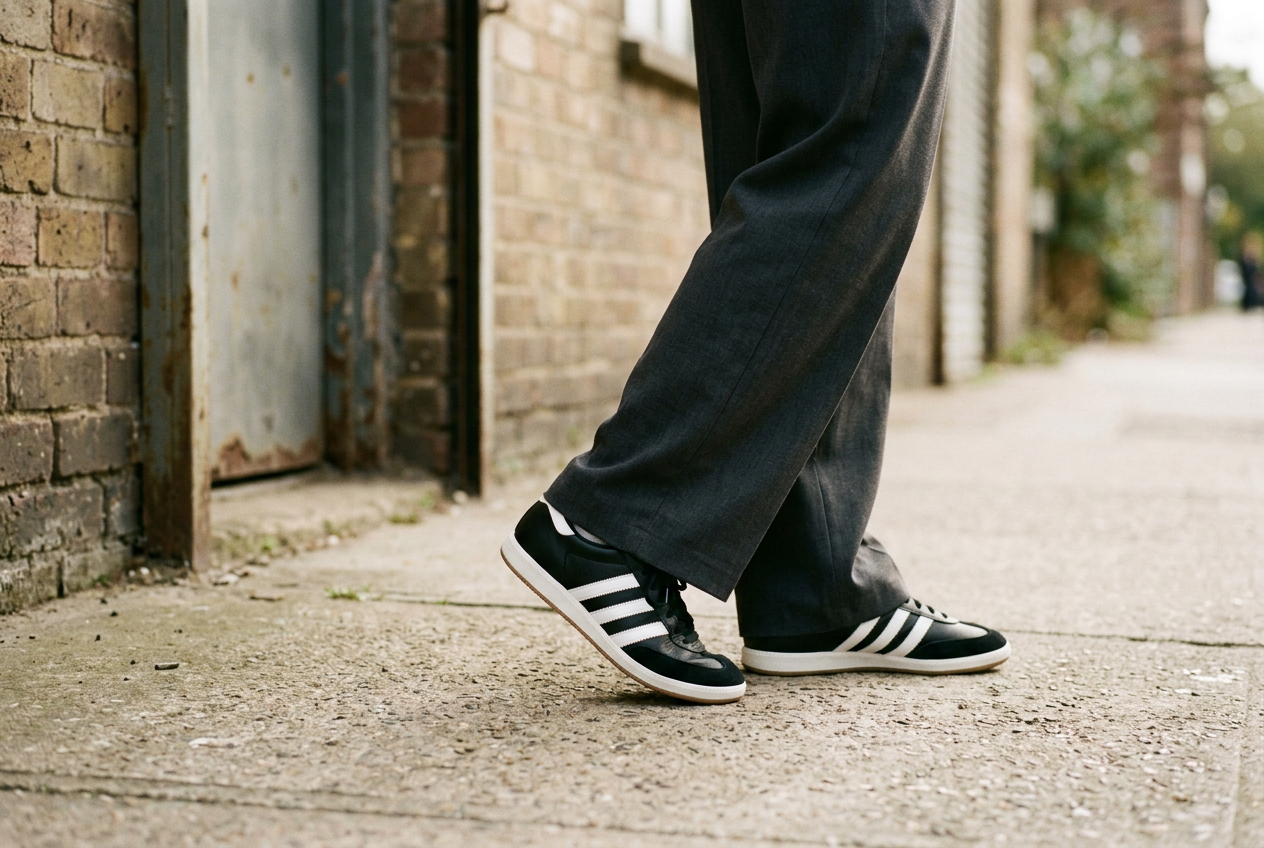
A black-and-white leather adidas Taekwondo Lace under wide charcoal trousers is a useful specimen for this shift. The upper follows the foot, the toe looks low, and the narrow strip of rubber around the bottom barely interrupts the trouser line. It appears markedly lighter than the thick running-inspired sneakers that have occupied the same space in recent years.
The construction supports much of that impression. Adidas lists a leather upper, textile lining and rubber outsole, without identifying a separate foam midsole. An outsole is the layer that meets the ground; a midsole sits above it and supplies much of a conventional sneaker’s cushioning. Removing or compressing that middle layer brings the foot closer to the pavement.
Yet low-profile is now an aesthetic category as well as a physical description. Some shoes borrow a tapered vintage-training shape while retaining enough foam or removable cushioning to feel unlike their archival references. That distinction matters after the outfit photograph, when the shoe has to cross a station, stand through dinner or accommodate a forefoot that does not naturally taper.
This is unisex coverage because the same construction test applies across wardrobes. Where brands separate women’s and men’s sizing, compare the foot-length measurement in centimeters rather than trusting equivalent size labels, especially with narrow, close-fitting uppers.
The sidewall can make a sole look thinner than it is
Start at the outside edge. Sidewall height means the visible vertical distance between the ground and the point where the upper begins, but that measurement does not reveal how much material sits directly under the foot. A raised rubber wall can climb around a relatively thin platform, while a low wall can conceal foam that is recessed inside the shoe.
Look at the heel in profile, then compare it with the forefoot. A sole that stays almost level from back to front will usually feel flatter than one with a concealed heel wedge, even when both look trim from the side. Stack height, meaning the total material between foot and ground, is the useful idea here, although lifestyle sneaker pages rarely publish it.
The Taekwondo Lace makes the visual reading fairly direct. Its rubber boundary is low, and the upper meets it without a bulky ledge. That is different from a court sneaker whose rubber sidewall rises around the upper and makes a moderately cushioned platform look tidy. It is also different from a shoe painted one color from upper to outsole, where the missing contrast disguises the sole’s depth.
Online photographs complicate the comparison. Product images are often shot slightly above the shoe, reducing the visible sidewall, while on-foot pictures may hide the heel under trousers. Find a level side view and an outsole image. If neither is available, the shoe is difficult to assess remotely, no matter how persuasive its vintage reference looks.
Removable cushioning changes the answer
The sockliner is the shaped insert directly beneath the foot, often called an insole in retail descriptions. If it lifts out, check its thickness at the heel and under the ball of the foot. A low rubber shell paired with a substantial foam sockliner can deliver a thin silhouette without a truly close-to-ground feel.
That is not deception. It may be the more wearable version of the trend, particularly for someone moving from a modern running shoe, but the tradeoff should be visible before purchase. Soft removable cushioning can compress after repeated wear, and replacing it with a thicker insert steals internal volume, which may press the toes against an already shallow upper. A thin replacement can preserve the fit while doing little for impact.
Brand documentation offers useful clues. Nike’s descriptions of the retro-shaped LD-1000 identify a foam midsole, so its narrow profile should not be read as equivalent to a shoe built from upper, sockliner and rubber alone. PUMA’s motorsport-derived Speedcat family uses a close, low shape, though shoppers still need to inspect the specification for the particular version because materials and internal cushioning can vary across updates.
Where a product page lists only the upper, lining and rubber outsole, the missing midsole entry is meaningful, but it is not a complete comfort report. The board beneath the sockliner can be stiff, the rubber can be dense, and a padded heel may soften the first impression without reducing ground feel. Materials tell you where cushioning could exist. They do not tell you whether your foot will like the result.
For an in-store check, remove the sockliner if the shoe permits it and press it between finger and thumb. Then flex the empty shoe at the forefoot rather than folding it through the arch. A shoe that bends where the toes bend can feel natural despite limited padding; one that collapses at midfoot may lack useful structure, while an inflexible forefoot can make a thin sole tiring because the foot has to fight it at every step.
The toe is doing as much work as the sole
The Taekwondo Lace looks especially slight because its toe box, the part surrounding the toes, is shallow and tapered. That shape removes visual volume above the sole. It also creates the fit quirk most likely to make this trend fail.
A pointed or almond-shaped outline may leave adequate length at the big toe while narrowing too soon across the smaller toes. Sizing up can move the widest part of the shoe ahead of the widest part of the foot, producing heel slip without solving the squeeze. The better alternative is a low-profile model with a rounder forefoot, even if it reads more like a 1970s runner than an indoor training shoe.
Check the last, meaning the foot-shaped form around which the shoe is built. Consumers cannot usually see the last itself, but the outsole outline gives it away: a sole that pinches inward sharply before the toe will not become spacious because the upper is soft. Suede and unstructured leather can relax across pressure points. The rubber perimeter does not stretch with them.
Thin socks preserve the intended volume in the adidas pair and keep wide trousers from catching on the collar, but they also remove a layer of protection from seams and heel edges. A shopper who relies on cushioned athletic socks should try the shoe with those socks rather than planning to change a daily habit around a silhouette.
Vintage-looking and minimal are separate decisions
A genuinely minimal underfoot build usually combines a thin outsole, little or no distinct midsole, a modest sockliner and limited heel lift. A vintage-looking trainer needs only the cues: a slim upper, restrained sidewall, gum or dark rubber, and a toe that narrows in profile. Those cues can sit on top of more cushioning than the eye expects.
The practical choice depends on the intended day. For short trips, office wear and outfits where a heavy sneaker interrupts the line, the Taekwondo Lace construction makes sense if the wearer already tolerates flat shoes. For long pavement days, a low-looking retro runner with a documented foam midsole is less doctrinaire and probably more useful. Neither should be purchased as a substitute for a supportive walking shoe without trying it over the distance that matters.
Price does not resolve this. Sports-brand models occupy the familiar sneaker band, while designer interpretations can cost several times more without adding replaceable cushioning, a roomier last or a more durable outsole. The premium may buy leather, finishing and a specific proportion. It should not be mistaken for impact protection.
The styling advantage is real. A thinner sole slips beneath straight or pooled trousers without creating a second horizontal block at the floor, and it works with fuller skirts because the shoe does not compete with the hem. The shape will probably outlast its most visible micro-trend phase when the color is quiet and the toe is not extremely elongated. Very narrow racing shapes feel more time-stamped.
I remain undecided on the most reduced versions. The visual correction after years of deep, sculpted soles is welcome, but a shoe that leaves the closet only when the day involves little walking has solved an outfit problem by creating a scheduling problem. The useful middle is a low sidewall, flexible forefoot and enough removable cushioning to adjust, provided the toe still matches the wearer’s foot.
Questions people ask
Are thin-sole sneakers less comfortable?
They can be, especially on hard pavement, because less foam separates the foot from repeated impact. Flexibility, fit and walking distance matter as much as visible thickness, though. A thin shoe that bends correctly and holds the heel may feel better than a padded shoe that is stiff or poorly shaped.
How can
I tell whether a low-profile sneaker has hidden cushioning?
Read the materials for a foam midsole, then inspect the heel and remove the sockliner if possible. A thick insert or concealed heel wedge can create more stack height than the sidewall suggests. Online, use a level side photograph and outsole image rather than an angled campaign shot.
Should I size up in narrow retro sneakers?
Not automatically. Extra length rarely fixes an outsole that narrows too early, and it may cause heel slip. Check where the shoe and foot are widest, try it with your normal socks, and choose a rounder low-profile model if your smaller toes sit against the rubber perimeter.
Can I add an insole to a minimal sneaker?
Only if the shoe has enough internal depth. A thicker insole raises the foot, which can tighten the toe box and move the heel into the collar edge. In a shallow shoe such as the adidas Taekwondo Lace, replacing a removable sockliner with one of similar thickness is safer than stacking another insert on top.
One update a day
Today's fashion update, in your inbox
One fashion update each morning — no hype, no filler, just pieces worth wearing.