That Squishy EVA Sandal Got Less Stable in One Hot Week
A deeply soft EVA footbed felt persuasive indoors. After repeated warm-pavement wear, visible compression made the same sandal less supportive over longer walks.
November 17, 2026 · 7 min read
The fitting-room softness did its job
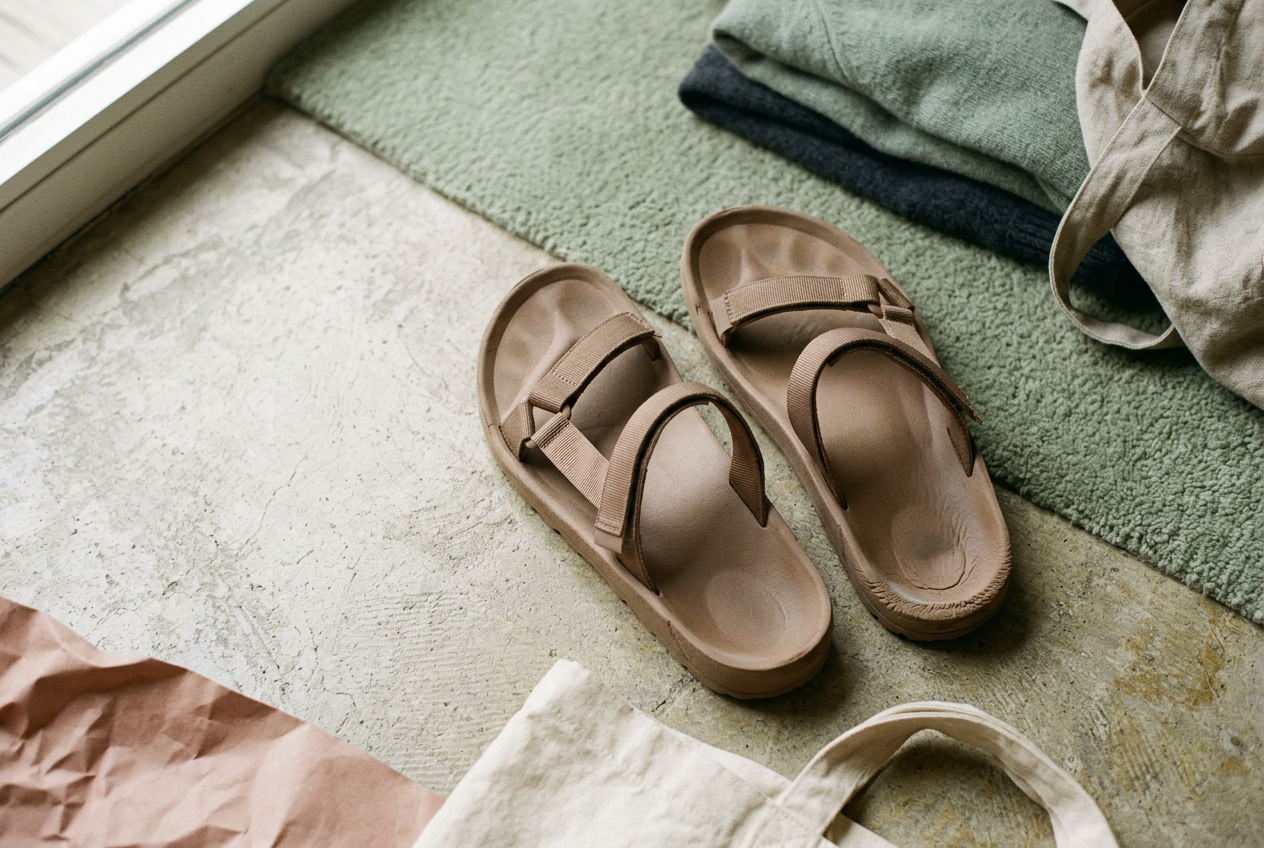
The test centered on one pair of deeply cushioned molded-EVA sandals worn repeatedly during a week of hot-weather walking. EVA, meaning ethylene-vinyl acetate, is the lightweight foam commonly used in midsoles and molded footbeds because it cushions impact without making a shoe particularly heavy.
At first fitting, this pair made a strong case for itself. The footbed yielded immediately under the heel and forefoot, with none of the hard, flat resistance that makes some inexpensive sandals feel like decorated paving slabs. Standing still was pleasant. A short indoor walk felt easy, and the upper held the foot without an obvious pressure point.
That first impression was accurate but incomplete. Deep softness reduces the sharp sensation of impact, yet a footbed also needs to control how far and how quickly the foot moves through the foam. In a fitting room, where the floor is level and the walk lasts a few minutes, the sandal never has to demonstrate much beyond immediate give.
The same pair behaved differently once warm pavement, repeated loading and longer periods on foot entered the test. It remained soft. It did not remain equally steady.
A week left visible compression
By the end of the wear period, the test sandal showed a distinct heel impression and a flatter patch beneath the ball of the foot. The changes were visible without measuring equipment, particularly when the worn sandal was viewed from the side and compared with areas of the footbed that had received less pressure.
Some indentation is normal. A footbed that molds slightly to the wearer can improve contact and reduce sliding, especially when the sandal has a shallow heel cup, the raised border intended to help center the heel. The issue here was that the compressed zones no longer rebounded to the same level as the surrounding foam after the sandals had rested overnight.
That lingering deformation is called compression set, meaning the foam stays partly flattened after pressure is removed. The term sounds more dramatic than the result looked. Nothing collapsed, cracked or became unwearable. The surface still felt cushioned when pressed by hand.
Underfoot, however, the difference was clearer. The heel settled into its existing impression quickly, while the softer perimeter allowed a little more side-to-side movement. Beneath the forefoot, the flattened contact patch gave less resistance during push-off. Each change was modest, but modest changes become irritating when they repeat for the length of a walk.
The discomfort was not the blunt soreness of a hard sole. It was fatigue: more work from the foot to keep the sandal aligned, followed by the sense that the cushioning had become something to manage rather than something helping. Softness was still present. Useful structure had started leaving early.
Heat exposed the tradeoff
EVA becomes more compliant as it warms, although the effect varies with the foam formula, thickness and construction. This was a practical wear test rather than a laboratory trial, so it does not assign a pavement temperature or calculate how much the material softened. The observable point was narrower: the sandal felt less controlled after sustained outdoor wear than it did indoors or at the beginning of a walk.
A deeply cushioned footbed can exaggerate that change because the foot has farther to sink before meeting meaningful resistance. Once the heel drops into softened foam, the edges of the footbed must stop lateral movement; if those edges are equally yielding, the foot shifts while the upper tries to pull it back into place.
That correction is easy to miss during a quick try-on. Over distance, it can make the toes grip and the ankle make small adjustments, particularly on sloped sidewalks or uneven pavement. The sandal is not forcing a visibly unstable stride. It is asking for a quiet amount of extra work, which is less cinematic and more annoying.
This is why softness and comfort should not be treated as interchangeable. Softness describes how readily the material gives way. Walking comfort also depends on fit, platform width and whether the foam firms up before the foot reaches the limit of its movement. A sandal can feel plush under a stationary heel while offering very little guidance once that heel starts moving.
Fit became less forgiving
The advice here applies across women’s and men’s wardrobes, so this is unisex coverage, but sizing still needs attention because molded EVA sandals often use whole sizes and broad foot-shaped platforms. The test pair initially fit with the heel centered and a small border of footbed visible around it. That margin mattered more after the foam softened.
A heel already sitting close to the rear edge would have had less room for error once the footbed compressed. The same applies at the sides: if the widest part of the foot overlaps the platform when new, a soft perimeter cannot provide much support after it warms and yields.
The upper also deserves more scrutiny than it gets. On the test pair, the upper felt secure enough at first, but the compressed footbed lowered the foot slightly relative to it. That created extra space, which allowed more forward movement on longer walks. An adjustable strap could have corrected some of the looseness.
A fixed molded upper could not.
Do not size down merely to make a loose EVA sandal hold tighter. A shorter platform can leave the toes or heel near the edge, while the upper may still loosen in practical use as the foot settles deeper. The better starting point is a centered heel, full support beneath the forefoot and an upper that holds without requiring the toes to clench.
The useful shop-floor test
Press the footbed with a thumb, but do not stop at noticing that it feels nice. Watch how far the foam travels and how quickly it returns. Deep foam that rises slowly may feel luxurious for ten seconds while offering less resistance over a long walk.
Next, put on both sandals and shift weight toward the outer edge of each foot. The platform should remain broad beneath you, and the upper should prevent the foot from drifting beyond the sole. Then walk fast enough to make the heel lift naturally. If the toes grip to keep the sandal attached, additional softness is unlikely to negotiate a peace treaty.
Flex the sandal at the forefoot, where the foot bends, rather than folding it through the middle. A sole that twists and collapses everywhere can be easy to pack, but it asks the foot to supply most of the structure. For a sandal intended for substantial walking, some resistance through the center is useful.
The stronger alternative is often a dual-density footbed, meaning it combines a softer upper layer with firmer foam underneath. That construction can preserve the initial cushioned sensation while limiting how far the heel sinks. A contoured cork-latex footbed is another option for readers willing to accept a firmer first wear and a longer break-in period.
Neither alternative guarantees comfort. Strap placement can still ruin an otherwise sensible sole, and a firm contour that does not match the wearer’s foot can become an expensive ridge. Still, both constructions make a clearer attempt to balance cushioning with control than a uniformly deep, squishy slab of EVA.
The buying decision
The test pair still worked for short trips and low-demand wear after the week ended. Its light weight remained useful, and the foam never became hard. For standing around, poolside use or brief errands, the loss of precision may not matter.
I would not choose this degree of softness for a full day of pavement walking, particularly in sustained heat. The pair did not fail spectacularly; it became tiring in the ordinary way that produces no good anecdote and a strong desire to sit down.
Price does not settle the issue. Soft molded EVA appears from the budget end through more fashion-led price bands, while a higher price can reflect shape, color or branding rather than a firmer base. Judge the platform and upper before the logo. If the sandal is meant to cover real distance, controlled compression is worth more than an impressive first squeeze.
Questions people ask
Do EVA sandals get softer in hot weather?
EVA can become more compliant as it warms, though the amount depends on the foam formula and sole construction. In this test, the sandal felt less stable during sustained warm-pavement wear than it did indoors, and repeated use left visible compression beneath the heel and forefoot.
Is visible footbed compression always a problem?
No. A slight impression can improve contact between the foot and sandal. It becomes less useful when the foam stays flattened, the heel begins moving within the upper or the perimeter no longer resists sideways pressure. Compare both sandals regularly because uneven compression can also reveal a fit problem.
How soft should a walking sandal feel?
A walking sandal can yield under the heel without allowing it to sink freely toward the base. Look for foam that rebounds promptly, a platform wider than the foot and an upper that stays secure as the heel lifts. Immediate plushness matters less than controlled movement over a longer walk.
Can compressed EVA cushioning recover overnight?
Some temporary compression rebounds after the sandals cool and rest. The test pair recovered partly, but its heel and forefoot impressions remained visible the next day. If the footbed stays uneven or the upper becomes loose because the foot sits lower, reserve the sandals for shorter wear.
One update a day
Today's fashion update, in your inbox
One fashion update each morning — no hype, no filler, just pieces worth wearing.