That Polyester Skirt May Still Need Dry Cleaning
The shell may tolerate water while the lining shrinks, the waistband bubbles or the pleats relax. Here is how to judge the whole garment before accepting its care costs.
October 22, 2026 · 8 min read
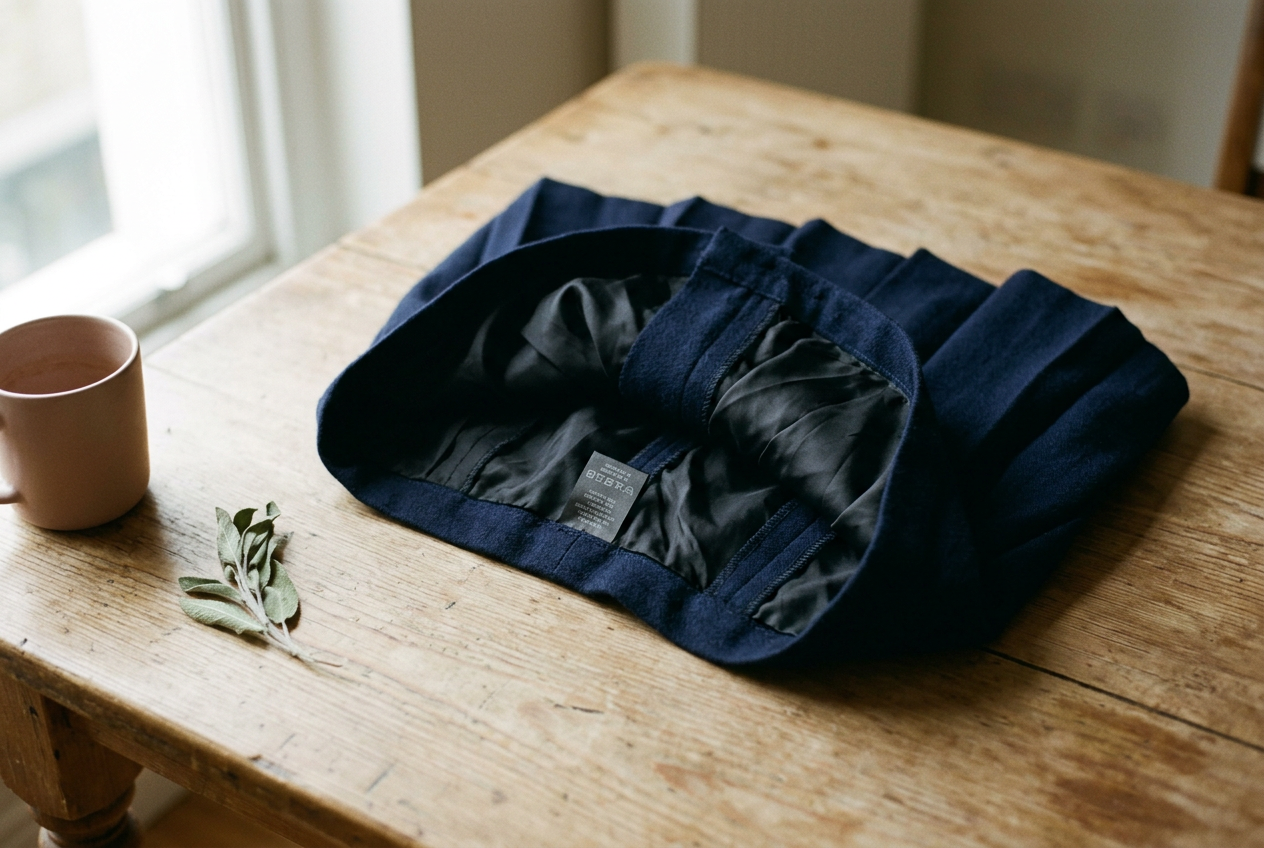
Consider one navy knife-pleated midi skirt: a polyester outer, a smooth acetate lining, a structured waistband and a sewn-in label that says dry clean only. Polyester often washes well, so the instruction can look unnecessarily cautious. Yet the shell is only the visible layer, and it may be the least vulnerable part of this skirt.
The real test is whether water, detergent, agitation and drying will leave every component the same size, color and shape. A garment fails if the shell survives but its lining tightens, its waistband develops bubbles or its pleats lose their edges. This unisex care advice applies across wardrobes, from pleated skirts and lined trousers to tailored jackets and coats.
Read the instruction as a whole-garment label
In the United States, a care label identifies a cleaning method the manufacturer has reason to believe is safe for the finished garment. The label does not describe the theoretical washability of its largest fiber percentage, nor does it promise that every possible dry-cleaning treatment is harmless.
Wording matters. Dry clean gives a professional cleaner a permitted method. Dry clean only warns against washing the garment. That stronger instruction is a reason to pause rather than perform an improvised sink test, particularly when the piece depends on crisp shaping or combines materials that respond differently to water.
Return to the navy skirt. Its polyester shell might emerge from a gentle cycle intact, but that tells us little about the acetate lining or the adhesive holding the waistband's internal layer in place. Fiber-content labels are useful shopping information. They are not construction diagrams.
The lining can change the fit
A lining hangs independently inside a garment, reduces friction and keeps the outer fabric from clinging. It also creates a second set of shrinkage and drying risks.
Acetate and rayon-based linings can lose body, distort or shrink in water depending on how the fabric was made and finished. If the navy skirt's lining contracts while the polyester shell stays stable, the outer layer may begin to pull upward around the hem or form horizontal ripples near the seat. The skirt still closes. It no longer hangs as designed.
A lining can also trap water between layers and dry more slowly than the shell, making seam puckering more visible. Pressing may correct minor wrinkling, but pressing cannot reliably restore a lining that has changed dimensions. Replacing it requires opening the garment and is closer to alteration work than routine laundry.
Before buying a lined piece, pinch the outer and lining separately near an accessible hem. Check the label for each listed fiber, then look for a lining that already pulls at the seams or seems shorter on one side. Existing tension leaves less tolerance for even a small dimensional change.
Interfacing is often the hidden reason
The navy skirt's waistband feels firmer because it contains interfacing, an internal material that supports areas such as waistbands, collars and lapels. Some interfacing is stitched in. Fused interfacing is attached with heat-activated adhesive, and its bond can react badly to water, excess heat or prolonged agitation.
When that bond weakens unevenly, the surface can blister or bubble. A home iron may flatten the area for a moment without rebuilding the original bond, while too much heat can shine the outer fabric or distort polyester. This is why a plain-looking waistband can carry more care risk than an unstructured polyester dress made from a similar shell fabric.
Tailoring raises the stakes. A jacket may combine a shell, lining, shoulder structure and several internal support materials, all cut to work together; even if each fiber can be washed in some form, the assembled jacket may not tolerate the same temperature, motion or drying method. The more the fit depends on internal shaping, the less useful a shell-only judgment becomes.
Pleats need more than a washable fiber
Knife pleats, meaning narrow folds pressed in one direction, give the anchor skirt its shape. Polyester pleats are often set with heat, which can make them durable, but permanence varies with the fabric, finish and manufacturing method. Water alone may not erase them. Warmth, mechanical action and an unsuitable pressing attempt can still soften their edges or shift the fold line.
The risk is not always a completely flat skirt. More often, several pleats open differently near the seat or hem, so the garment looks tired even though the fabric remains wearable. Re-pressing a full pleated skirt takes time and accuracy, and a professional may need to rebuild each fold rather than run an iron over the surface.
Look at the inside before purchase. Pleats stitched down at the top have more control around the waist, while folds held only by pressing rely more heavily on the original setting. Neither construction automatically makes home washing safe. It tells you what stands to be lost.
Dye can be less stable than the cloth
A dark navy surface adds another variable: colorfastness, meaning a dye's ability to resist fading or transfer during wear and cleaning. A fabric can remain physically strong in water while releasing enough dye to streak itself, tint a pale lining or leave lighter marks where wet areas were rubbed.
A hidden damp-cloth test may reveal immediate transfer, but a clean result does not reproduce a full wash with detergent, a longer soak and repeated movement. It also says nothing about whether different panels were cut from batches that respond alike. Spot cleaning has its own risk because the edge of a wet patch can dry into a visible ring.
Tell the cleaner about spills rather than rubbing at them first, especially on dark matte fabrics where water marks and abrasion show readily. Dry cleaning, which uses a solvent rather than water as the main cleaning fluid, is not friction-free or universally gentle. It is the method the label identifies for this finished piece, and the cleaner still needs to know what happened.
Mixed materials raise the uncertainty
A garment with a wool front, synthetic back and leather trim is governed by the component with the narrowest tolerance. Decorative coatings, contrast piping and covered buttons may matter as much as the fabric named first on the fiber label. Removable parts deserve attention too, since a belt may carry separate instructions or use a backing that cannot be washed with the garment.
Mixed materials are most concerning when they meet at a long seam. If one side shrinks and the other does not, the seam can twist or pucker. Small differences become conspicuous along a trouser leg, jacket opening or the long vertical panels of the navy skirt.
This is also where a bargain can become poor value. A low-priced garment that needs frequent professional cleaning may cost more to keep in rotation than an unlined, washable alternative, while an investment coat worn over other clothes may need cleaning rarely enough for the requirement to feel reasonable.
Make a risk assessment before checkout
Start with consequence, not optimism. The lowest-risk candidate is an unlined, softly constructed garment made from one familiar washable material, without coatings or shape-setting details. That still does not amount to permission to override its label, but it gives you a focused question to take to the maker or a cleaner.
Risk rises when the garment has a contrasting lining, a firm fused waistband, sharply pressed folds, deep color or components with different care needs. It becomes a poor home experiment when replacement would hurt, the silhouette depends on precision, or you cannot accept the possibility that the first wash is also the last wearable one.
For the navy pleated skirt, the combined evidence points toward following the dry-clean-only instruction. The shell offers reassurance, but the lining, waistband and pleats create three separate ways to lose the fit. Buying a washable unlined skirt would be the lower-maintenance alternative, though it may not deliver the same movement or crispness.
Build care into the wearing plan. Air the skirt between uses, brush away dry surface debris with a suitable clothes brush and avoid cleaning solely because it has been worn once. Do not store it with untreated stains, and do not press the pleats casually after steaming. Less frequent cleaning can control expense, but neglect is not a care method.
Questions people ask
Does polyester ever need dry cleaning?
Yes. Polyester itself is often washable, but a polyester garment may contain a shrink-prone lining, fused interfacing, unstable dye or pleats that need controlled finishing. Read the care label as an instruction for the assembled item rather than a verdict on polyester as a fiber.
Is hand washing safer than a washing machine?
Hand washing reduces some agitation, but the garment still absorbs water and must be rinsed, supported and dried. It cannot prevent dye movement, differential shrinkage or adhesive failure. A dry-clean-only label does not become a hand-wash label merely because the sink feels gentler than the machine.
Can a cleaner guarantee that pleats will stay sharp?
Ask the cleaner to inspect the garment and point out any risk before accepting the service. Pleat durability depends on how the folds were set, previous treatment and the fabric's condition, so no general answer covers every skirt. Mention loosened folds or earlier water exposure at drop-off.
Should
I skip every dry-clean-only garment on a budget?
No. Judge cleaning frequency alongside purchase price and use. A lined coat worn over layers may justify occasional professional care, while a pale fitted top that touches skin and needs cleaning often can become expensive to own. For the navy skirt, the practical alternative is a washable style with less internal structure.
One update a day
Today's fashion update, in your inbox
One fashion update each morning — no hype, no filler, just pieces worth wearing.