Bubble-Hem Dresses Look Easy. Their Laundry Is Not.
Everyday bubble dresses depend on layers that may shrink, stretch and dry differently. The useful shopping question is not whether the hem looks full, but how it is built.
Women's · October 11, 2026 · 8 min read
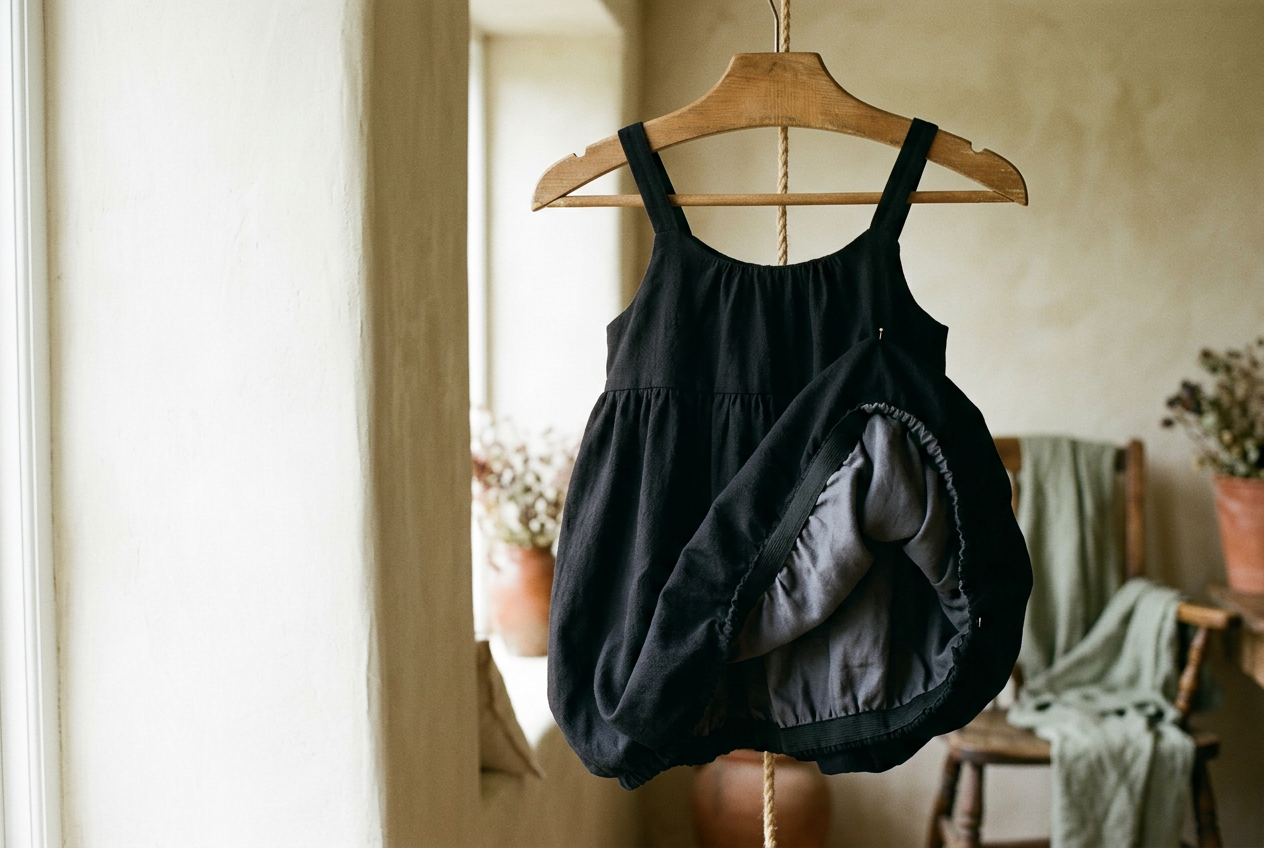
The bubble hem, meaning an outer layer folded under and secured higher inside the garment, is no longer confined to party minis or sculptural runway pieces. It is turning up on women's day dresses: sleeveless poplin midis, dropped-waist jersey styles and loose shifts intended to work with flat sandals or sneakers.
That translation makes the silhouette easier to wear. It also makes laundering more consequential, since the everyday version is likely to meet a washing machine rather than a specialist cleaner.
Keep one construction model in view: a black sleeveless midi with a cotton-poplin outer, a polyester lining and elastic running through the turned-under hem. Its care label says to wash cold and line dry. This is not one named product but a common enough combination to use as a fitting-room test, because each component responds differently to water, heat and gravity.
The volume comes from a hidden connection
A bubble dress does not hold its shape through fullness alone. The outer fabric is cut longer or wider than the layer beneath it, then gathered into a shorter inner edge. When that lower edge is turned under and attached to a lining, facing or elastic channel, the surplus cloth has nowhere to hang straight. It rounds outward instead.
In the black midi, the cotton outer descends past the intended finished hem, folds inward and meets elastic inside. The polyester lining stops higher and helps tether the folded fabric. A casing, meaning a narrow fabric tunnel that contains elastic, lets the lower edge contract without exposing the elastic itself.
The result depends on controlled disagreement. The outer wants to fall lower; the inner attachment holds it up. Elastic distributes the fullness and allows movement, while the lining prevents the underside from becoming a loose mass around the legs. If those parts stay in proportion, the dress keeps a rounded hem with an even amount of volume from front to back.
Construction can be lighter than this. Some dresses omit a full lining and connect the outer layer to a narrow inner band. Others use drawcords or fixed gathering instead of elastic. A jersey bubble may rely on a doubled hem made from the same fabric, which reduces the mixed-fiber problem but can become heavy while wet.
One wash can change the proportions
Cotton fibers can contract during washing and drying, particularly when heat and mechanical action are involved. Polyester is generally more dimensionally stable under ordinary home laundering. In the black midi, that means the cotton outer may become slightly shorter while the polyester lining changes less, altering the amount of cloth available to form the bubble.
The failure is not always dramatic shrinkage. A small change can make the lining peek below the outer layer, pull the front hem upward or leave one section flatter than the rest. If the shell was gathered unevenly at the factory, laundering may expose that imbalance once the temporary pressing and finishing relax.
Drying adds another variable. Cotton poplin absorbs more water than a lightweight polyester lining and may remain damp after the lining feels dry. Hang the dress from its shoulders while the shell is wet, and the weight can pull on the bodice and attachment points; drape it over a narrow rail, and the rail may press a crease into the rounded hem. The layers can also cling together, slowing evaporation where the folded outer fabric is densest.
Elastic has its own limits. Repeated high heat can weaken or distort some elastic fibers, and a tight spin may leave the casing twisted. Once the elastic rolls inside its tunnel, the bubble tends to look fuller in one area and pinched in another. Opening the casing to correct it is a repair, not routine reshaping.
This is why the line-dry instruction on the black midi matters. It is part of the garment's operating cost. A dress that needs to be removed promptly, reshaped by hand and dried with air circulating between its layers asks for more time than an unlined cotton shift, even if both are sold as casual summer clothes.
The fitting room reveals most weak points
Start at the inside hem. Lift the bubble and find where the outer fabric connects to the lining or inner band. The stitching should run at a consistent distance from the edge, with the gathers spread rather than bunched into a few dense sections. Loose thread tails are less important than visible strain, skipped stitches or fabric already pulling away from the seam.
Next, compare the fiber labels for the shell and lining. A cotton shell over polyester is not an automatic rejection; it is the reason to take the care instructions literally. A same-fiber shell and lining may behave more consistently, although fabric weight and weave still matter. If the label gives separate compositions but the care direction is vague, assume the more delicate component sets the rules.
Feel the elastic through the casing. It should lie flat and recover after a gentle stretch. If it is already rolled, sharply folded or anchored in a way that concentrates all the gathers at the side seams, laundering is unlikely to improve it. Wider elastic can distribute fullness smoothly, but width alone does not compensate for a poorly sewn channel.
Check the lining length while standing and sitting. The outer bubble shortens as it expands around the body, so a mini that looks adequate on a hanger can rise more than expected once the lining meets the hips. On a midi, a short inner layer may catch above the knees while the shell continues downward, producing a tug that feels unrelated to the visible hem.
This is a fit issue, not merely a modesty calculation. Sizing up may add width through the bodice without lengthening the inner tether enough to solve it. If the lining pulls when you take a full step, the dress is too restricted in that size or badly proportioned for your height.
Finally, inspect the care label before treating price as evidence of durability. At lower high-street prices, bubble volume may come from a narrow elastic channel and minimal lining. More expensive construction may use a fuller lining, enclosed seams and better-distributed gathering, but the extra cost does not guarantee machine-dry convenience. The label on the black midi remains more useful than the price tag.
Washing needs space and a pause before drying
Turn the dress inside out and close any zippers or hooks so they do not catch the lining. A mesh laundry bag can limit tangling, though the dress still needs enough room in the machine for water to move through the folded hem. Use the temperature and cycle on the label rather than assuming cotton permits heat, because the elastic and lining may be the less tolerant parts.
After washing, do not judge the silhouette while the shell is plastered against the lining. Separate the layers with your hands, smooth the casing and distribute any gathered sections that have shifted. If the care label allows line drying, support the dress on a broad hanger or drying rack and leave space for air to reach the underside. Avoid pulling down on the wet bubble to restore length; that can stretch the attachment seam without correcting the overall proportion.
A dryer is the faster option and the riskier one when the shell, lining and elastic have different tolerances. Even low heat may be outside the stated care method. If routine line drying is unrealistic in your home, that inconvenience belongs in the buying decision rather than becoming a surprise after the first wash.
The simpler alternative is a dress with a gathered or balloon-shaped skirt that falls to a conventional free hem. It can provide hip-level volume without tethering the bottom edge to a lining. The silhouette is less rounded, but laundering is easier because the layers can move and dry independently.
The everyday bubble dress is persuasive when its inner construction feels deliberate and its care fits the owner's routine. For the black cotton-and-polyester midi, the deciding detail is still that cold-wash, line-dry label. If there is nowhere to dry it with the folded hem opened to the air, the useful answer may be to leave it on the rail.
Questions people ask
Can a bubble-hem dress go in the washing machine?
Yes, if its care label permits machine washing. Use the stated temperature and cycle, then separate and reshape the layers before drying. Machine washable does not necessarily mean machine dryable, especially when a cotton outer, polyester lining and elastic casing share the same hem.
Why is the lining showing after washing?
The outer fabric may have contracted more than the lining, or the gathered connection may have shifted while wet. Reshape the dress according to its label and let it dry fully before reassessing. If the lining still hangs below the shell, shortening the lining may require an alterations professional.
Should a bubble dress feel tight around the legs?
The inner lining or band can limit stride even when the visible outer layer looks loose. Walk, sit and climb a step before buying. If the lining catches above the knees or the hem rises sharply with each step, sizing up may not help because the restrictive part may not gain enough length.
Is an unlined bubble hem easier to care for?
Often, but construction still matters. A doubled jersey hem made from one fabric avoids competing shell and lining shrinkage, yet it can become heavy and slow to dry. Check whether the inner band lies flat, whether the hem twists and whether the care method suits the space available at home.
One update a day
Today's fashion update, in your inbox
One fashion update each morning — no hype, no filler, just pieces worth wearing.