That 22-Inch Chest Measurement May Not Mean What You Think
Some online size charts measure the person; others measure the finished clothes. Here is how to spot the difference, account for ease, and compare a listing with something you own.
August 13, 2026 · 8 min read
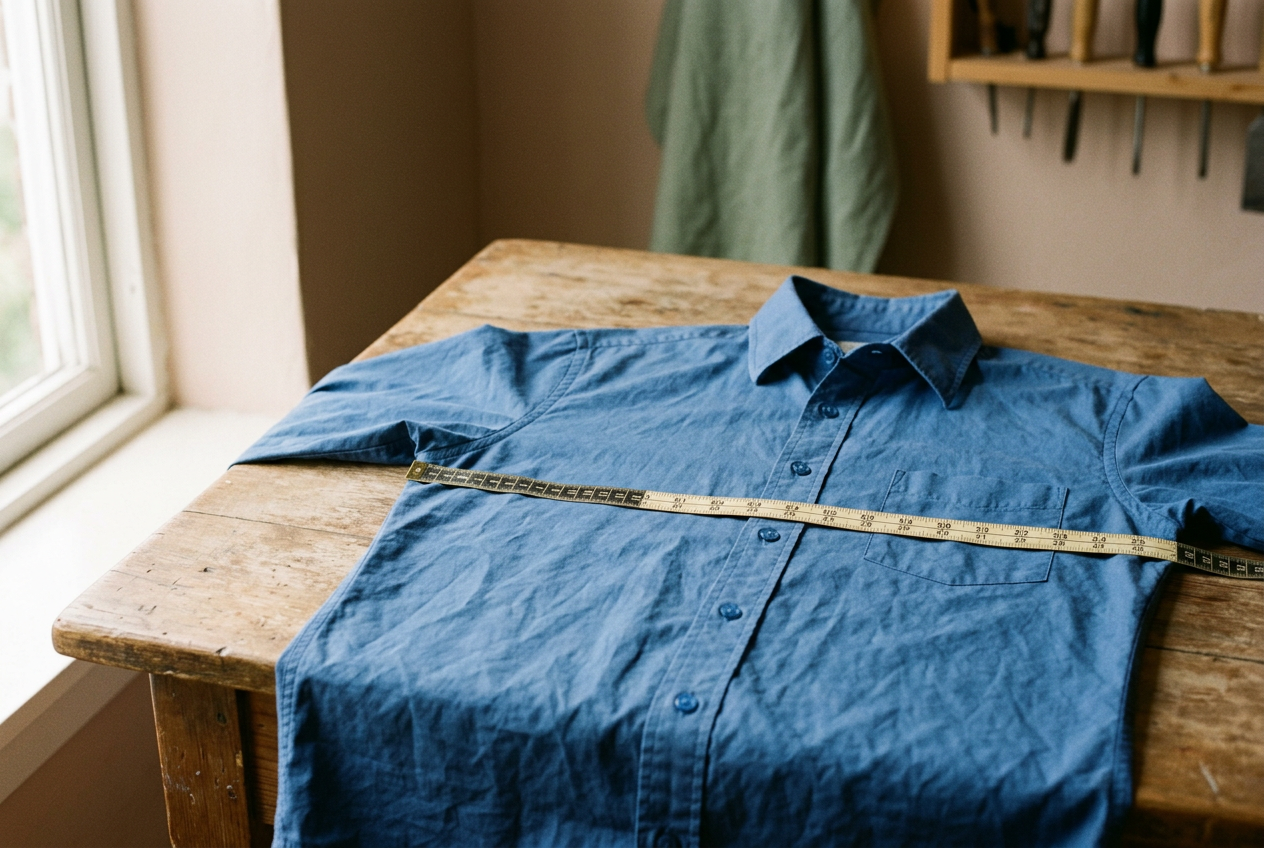
The line to watch is deceptively plain: “chest: 22 inches.” On a product page for a shirt, that could mean the shirt measures 22 inches across when laid flat, giving it a circumference near 44 inches. It could also be an incomplete or poorly labeled body measurement, although adult body charts usually show a full circumference instead.
Our test case is a blue cotton poplin button-up, made from a tightly woven fabric with little natural stretch, that fits comfortably when buttoned and tucked into trousers. It does not pull across the chest, its shoulder seams sit where you want them, and the hem stays tucked when you reach forward. That shirt is more useful than the size printed inside its collar.
This is unisex advice. The chart labels may say bust or chest, and the pattern proportions can differ across women’s, men’s and gender-neutral ranges, but the comparison method works across wardrobes.
First identify what the chart measures
A body-measurement chart matches sizes to the wearer. It will often use ranges, such as a size covering bodies between one chest measurement and another, and its instructions may tell you to wrap a tape around the fullest part of your chest while wearing light clothing. Diagrams usually show a person rather than a garment.
A garment-measurement chart describes the finished piece. Look for labels such as “product measurements,” “finished measurements,” “laid flat” or “actual garment dimensions.” These charts may include shoulder width, sleeve length and the width across the chest, details that cannot be read directly from a person’s measurements.
The size chart’s location offers another clue. A general guide linked from the site header often contains body measurements used across the brand, while a chart inside one product page is more likely to give garment dimensions for that style. This is a clue, not a guarantee. Read the chart heading and measuring instructions rather than trusting placement.
Units reveal mistakes quickly. An adult shirt listed with a 22-inch chest probably uses a flat measurement, meaning the width of one side of the garment while it lies on a surface. Double it to estimate the circumference. A body chart showing 22 inches across the chest would be unusual for most adult ranges and needs clarification before purchase.
Do not assume every flat measurement doubles cleanly. A wrap front can overlap, a thick coat may be measured on the outside, and a shirt placket adds construction that can slightly complicate the total. For an ordinary button-up like the blue poplin shirt, doubling the underarm width is a useful working comparison.
Ease explains the gap
If your body measures 38 inches around the chest and the finished shirt measures about 44 inches, the difference is six inches of total ease. That room lets you breathe, move your arms and wear a thin layer underneath; some of it may also create the designer’s intended silhouette.
The equation is straightforward:
Garment circumference minus body circumference equals total ease.
The number is descriptive, not a universal fit rule. A crisp poplin shirt needs room because the weave barely stretches, while a ribbed knit can fit with negative ease, meaning the garment measures smaller than the body and stretches when worn. An oversized shirt may carry far more ease than either, even though all three pieces technically fit the same body.
This is why comparing a garment chart directly with your body can lead you astray. If the listing says the blue shirt’s chest is 44 inches and your chest is 38 inches, choosing a smaller size just because 44 sounds too large would remove the room that makes the shirt wearable. Conversely, treating a body chart’s 38-inch size recommendation as a finished 38-inch garment measurement would suggest a much tighter shirt than the brand intends.
Ease also changes by area. A shirt can have enough room through the chest yet still fail at the shoulders, where seam position and armhole shape control movement. A pair of trousers may have adequate hip ease but pinch at the waistband. One subtraction cannot describe an entire pattern.
Compare clothes, not size labels
Set aside about ten minutes and use the blue poplin shirt as the reference. Choose it because its fabric, cut and intended use resemble the listing. A stretchy jersey top is a poor reference for woven poplin, just as wide-leg trousers will not tell you how a rigid straight-leg pair should fit.
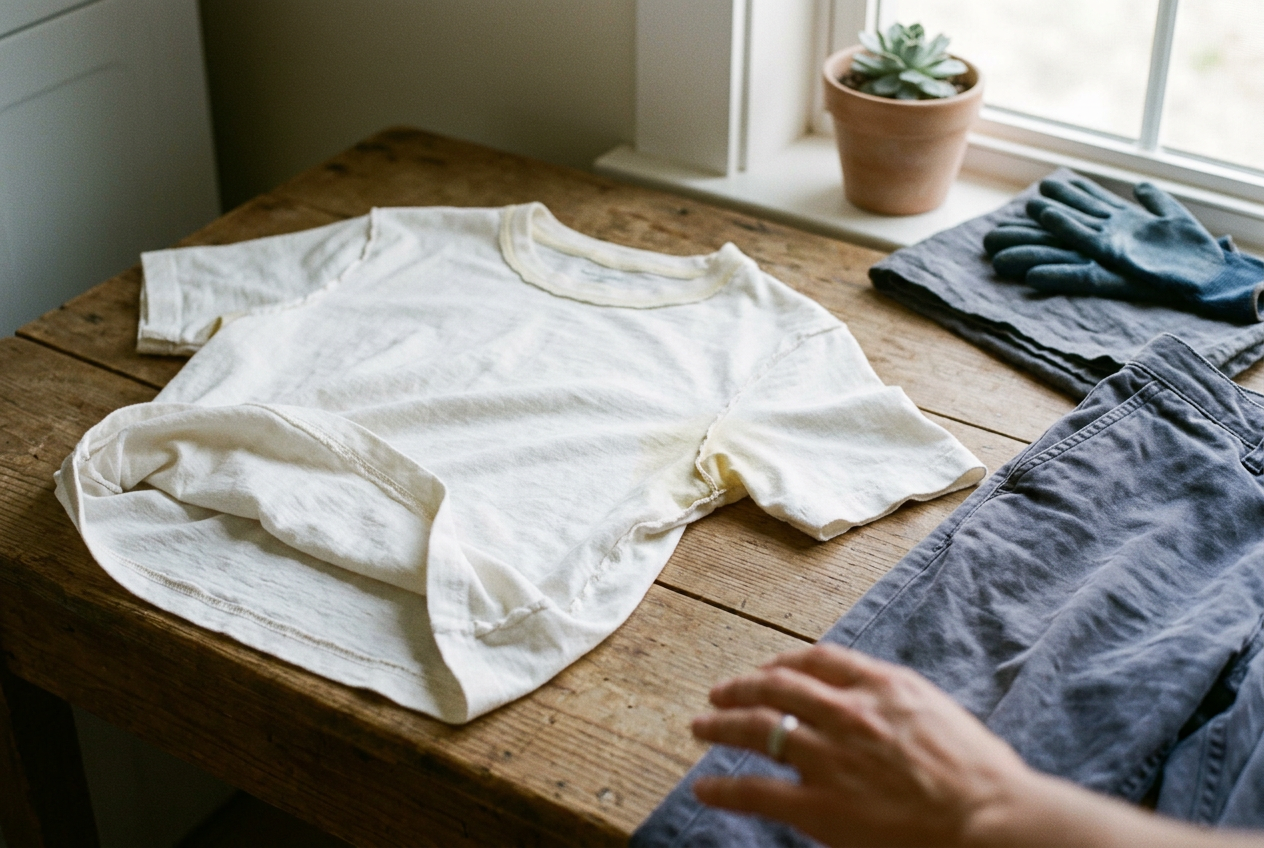
Fasten the shirt as you normally wear it, then lay it on a hard, level surface without pulling the fabric. Smooth major wrinkles, but do not stretch the seams. Measure straight across from one underarm seam to the other. This is often called pit-to-pit, meaning the flat width across the garment immediately below the armholes.
Now measure the points supplied by the product page, following its method rather than inventing your own. For shoulder width, measure between the shoulder seam endpoints across the back. For sleeve length, check whether the brand starts at the shoulder seam or at the center back of the neck, since those methods produce different numbers. Shirt length may begin at the high point shoulder, the spot beside the neck where the shoulder seam starts, or at the center back.
Write down the reference shirt’s dimensions and how you measured them. Beside each one, note what you would change. If the chest is right but the sleeves feel short when you reach for something, keep the chest measurement and look for more sleeve length. If the shirt works tucked but feels too long when worn open, the hem measurement becomes part of the buying decision rather than an incidental detail.
Return to the listing’s “chest: 22 inches” line. If your blue shirt also measures about 22 inches from underarm to underarm and both shirts are nonstretch poplin with similar cuts, you have a strong starting point. A small difference may still matter in a fitted cut, particularly across the back, but the comparison tells you much more than matching the letter size.
Photograph the tape in place or keep the measurements in your phone. The useful record is not “I usually buy medium.” It is “this button-up fits at this chest width, shoulder width, sleeve method and length.” That note remains useful when another brand calls the same physical dimensions small, large or a numbered size.
Read the fabric and fit notes together
Measurements do not capture fabric behavior. Check the fiber content and product description before treating two matching charts as equivalent. Cotton poplin may soften with washing but will not behave like a knit containing elastane, while linen can relax during wear and then draw up again after laundering.
Fit language also changes the target. “Slim,” “regular,” “relaxed” and “oversized” describe an intended relationship between body and garment, though brands do not use those labels consistently. Compare the listing with an owned piece that creates the same silhouette you want, not merely one from the same clothing category.
Model information can provide context, but it is weaker than finished garment measurements. Height and worn size do not reveal shoulder breadth, torso length or how the item was pinned for photography. Use the images to inspect where seams land and how fabric falls, then use measurements to make the decision.
Know where the method can fail
Some listings provide only a generic body chart. In that case, follow the body-measuring instructions and use the brand’s recommended size as a starting point, then search the product description for cut, stretch and length information. If the item is expensive to return or final sale, missing garment measurements are a practical reason to pause.
Manufacturing tolerances mean two garments labeled the same size may differ slightly, and washing can alter an owned reference piece. Measure the shirt in the condition you wear it, after its normal laundry routine, because that is the fit you are trying to reproduce.
For tailored jackets, bras and close-fitting pants, flat comparison measurements may not capture shaping, cup volume, rise or internal construction. The method still narrows the choice, but it cannot replace trying on a pattern whose fit depends on curves rather than simple widths.
Make the purchase decision
Use the size label last. First confirm whether the chart describes a body or garment, convert flat widths when needed, and compare like with like. Then decide whether any difference supports the intended fit.
For the blue poplin shirt, a candidate with the same chest width but a shorter body may work better untucked. One with a narrower chest and stretch fiber is not an automatic substitute, because the fabric may pull between buttons even when it technically closes. If the listing never identifies what its 22-inch line measures, ask customer service or skip the purchase rather than paying to test an ambiguous chart at home.
Questions people ask
Do
I double every garment measurement in a size chart?
Double a flat chest, waist or hip width when the garment is measured straight across one side and you need an approximate circumference. Do not double lengths, shoulder widths or sleeve measurements. Wrap garments, elastic waists and thick outerwear may require a different method, so check the brand’s instructions first.
How much ease should a shirt have?
There is no single correct amount. Woven shirts need enough room for movement, while fitted knits can measure smaller than the body and oversized shirts carry deliberate volume. Compare the finished measurement with a similar shirt that already fits the way you want, rather than relying on a universal allowance.
Are body measurements more reliable than garment measurements?
Body measurements help you enter a brand’s size system, but garment measurements make cross-brand comparisons easier because they reveal the dimensions of the specific piece. The strongest decision uses both: your body measurement shows the available ease, while an owned garment shows whether that amount and cut feel right.
What should
I do when the chart does not say what it measures?
Look for measuring diagrams, ranges and phrases such as “laid flat” or “finished garment.” A 22-inch adult shirt chest usually suggests a flat garment width, but do not treat that clue as confirmation. Ask the retailer for the measurement method, especially when returns cost money or the item is final sale.
One update a day
Today's fashion update, in your inbox
One fashion update each morning — no hype, no filler, just pieces worth wearing.