A Body Size Chart Still Doesn't Tell You How the Shirt Fits
Body measurements identify the intended wearer, not the garment’s dimensions. Here is a practical way to estimate ease before ordering.
August 10, 2026 · 8 min read
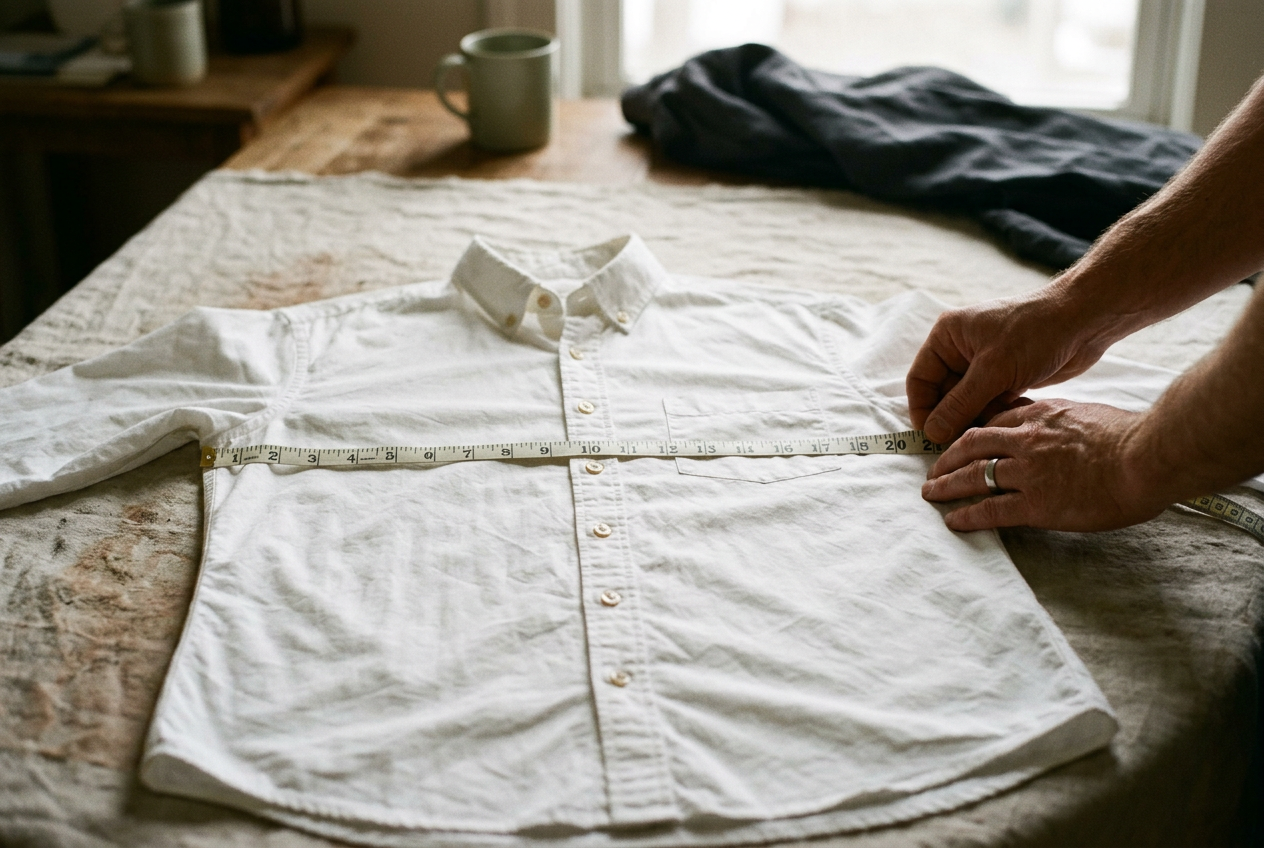
Consider a white cotton-poplin button-down that you want to wear open over a tank, then loosely tucked into trousers. The product page calls it relaxed, but its chart lists only body measurements. If your chest is 39 inches and the medium covers bodies measuring 38 to 40 inches, you know the brand points you toward a medium. You still do not know whether that medium shirt measures 42 inches around the chest or 48.
That missing difference decides whether the shirt looks lightly relaxed or deliberately oversized. It also determines whether the buttons pull when you sit, whether the shoulder drops past your own, and how much fabric collects at the waistband. This is unisex advice: women’s, men’s, and unisex departments use different grading conventions, but a body chart creates the same information gap in each.
Ease is the number the chart leaves out
Ease means the difference between a body measurement and the corresponding garment measurement. A 39-inch chest inside a shirt measuring 44 inches around the chest has 5 inches of positive ease. A stretch top that measures less than the body has negative ease, which lets it sit close by expanding during wear.
Positive ease is not wasted fabric. A woven shirt needs enough room for breathing and movement before a designer adds the extra volume that creates a relaxed or oversized silhouette. That is why choosing a size whose body range matches your chest does not mean the finished garment will measure close to 39 inches, and why comparing your body directly with a flat garment measurement can produce the wrong conclusion.
The useful question is not whether the medium fits a 39-inch chest. The brand has already said it should. You need to know how much design ease, meaning the additional room chosen for the intended silhouette, is likely to be built into that medium.
Start with a shirt that already fits
Before decoding the product page, measure a comparable garment from your closet. For the white poplin shirt, choose another non-stretch button-down rather than a T-shirt or knit polo. Button it, lay it flat without pulling the fabric, and measure straight across from one underarm seam to the other. Double that number to estimate the garment’s chest circumference.
Suppose your existing shirt measures 22 inches across, or about 44 inches around, and gives you the lightly relaxed fit you want. Against a 39-inch body measurement, it contains about 5 inches of ease. You now have a working target grounded in a garment you wear, rather than a generic rule about how a medium ought to fit.
Match construction as closely as possible. A dropped-shoulder shirt may place its underarm seam lower than a set-in sleeve, making the same pit-to-pit measurement feel roomier through the upper arm. A cropped boxy shirt also distributes volume differently from a long shirt with curved side seams. The comparison does not need to be exact, but it should be close enough to expose a major mismatch.
Turn silhouette language into a range
Fit notes are useful when treated as directional evidence. Slim, close, tailored, regular, relaxed, boxy, and oversized do not have universal numerical definitions, yet they tell you whether the brand intends the garment to sit near the minimum movement allowance or well beyond it.
For a non-stretch woven shirt, a description such as fitted or tailored suggests less ease than the 5 inches in the closet example. Relaxed suggests something near that familiar shirt or somewhat roomier. Oversized should produce visible extra width through the chest and body, often alongside a dropped shoulder or extended sleeve. If the photos show those features but the copy says regular fit, trust neither signal alone.
Read the whole product description for construction clues. Back pleats can release extra room when you reach forward, while darts remove volume and shape the shirt closer to the body. A straight, wide hem supports a boxier fit; a deeply curved hem may look loose when untucked but disappear into a waistband more easily. Return to the wearing plan here.
The white shirt needs enough room to layer over a tank, but a very wide hem could make the loose tuck bulky.
Let the fabric adjust your estimate
Cotton poplin is tightly woven and usually offers little mechanical stretch unless the composition includes an elastic fiber or the product description specifically identifies stretch. For the test shirt, that makes chest and upper-arm ease important. A size that merely clears the body measurement may feel acceptable while standing, then pull across the back when you reach for a bag.
Fiber content helps, but it does not reveal the full behavior of the cloth. Elastane suggests recovery and stretch, although a small amount does not tell you how far the finished fabric moves. Knitted construction generally stretches more readily than woven construction, while a loose weave may yield without recovering cleanly. Product copy that says rigid, crisp, fluid, clingy, or compression fit can therefore be more useful than the fiber percentages alone.
Do not use stretch as a reason to erase intended ease. A ribbed knit top may be designed with negative ease so the ribs open across the body. Stretch woven trousers still need room at the hips and seat if the intended line is straight rather than legging-close. In the poplin-shirt case, assume the fabric will not rescue a tight size unless the page supplies clear evidence that it stretches.
Read photos for tension and scale
Product photos cannot give you a finished measurement, but they can show where the garment spends its ease. Start at the shoulder. A seam sitting beyond the model’s shoulder point supports a relaxed or oversized reading; a seam landing close to that point suggests a more conventional cut, even when the torso looks broad.
Then look for tension. A placket that stays straight, an armhole without radiating creases, and a back that remains loose when the model bends an elbow all suggest usable room. Styling can conceal the opposite. An open shirt never has to close across the chest, a hand in a pocket can pull fabric forward, and a front-only tuck hides the true hem width.
Model measurements help only when the listed garment size and the photographed fit are both clear. Compare the model’s body measurement with the size chart, then note whether the worn size is the chart recommendation or a deliberate size-up. Height alone says little about chest ease. If the page gives only height and a size, use the photo for proportion rather than calculation.
For the white shirt, the strongest evidence would be a closed front view, a side view showing the fabric hanging away from the torso, and a back view with the arms in a natural position. If every image shows the shirt open, heavily tucked, or covered by a jacket, mark the fit as uncertain rather than filling the gap with optimism.
Make the size decision in four passes
First, find your body size from the brand’s own chart, using the measurement that controls the garment. That is usually chest for a shirt, although shoulders or upper arms may control the fit for some bodies. Second, compare the advertised silhouette with a similar garment you own. Third, adjust for the fabric’s willingness to stretch.
Last, check whether the photographs support the written description.
If all four signals agree, order the chart size. If the chart says medium, the shirt is described as relaxed, rigid poplin hangs away from the body in a closed-front photo, and your comparable 44-inch shirt has the look you want, medium is the defensible choice even though the finished measurement remains unknown.
Size up when a non-stretch garment sits near the top of your body range and the photos show little spare room at a personal pressure point. Size down only when the intended silhouette is visibly larger than you want and the smaller size still accommodates your controlling body measurement. With the test shirt, sizing down to reduce hem bulk is a poor trade if it also narrows the upper back and prevents comfortable layering.
Know when the evidence is too weak
Some pages do not support a responsible estimate. A body-only chart paired with vague fit copy, highly styled photos, and no fabric detail leaves too many variables open. Final-sale status raises the cost of that uncertainty. Unless the return policy is forgiving, the better alternative is a similar shirt with finished measurements or customer service that can provide the chest width, shoulder width, and sleeve length.
When contacting a retailer, ask for one specific garment measurement rather than general sizing advice. For the poplin shirt, pit-to-pit width in the medium gives you a direct comparison with the 22-inch shirt in your closet. Confirm whether the garment was measured flat and buttoned. That short exchange can prevent ordering two sizes and turning your hallway into a return department.
Questions people ask
Is garment ease the same in every size?
No. Brands grade garments between sizes, and the body-chart intervals do not always increase at exactly the same rate as the finished garment. Ease may stay fairly consistent or shift across the range, so one published sample measurement cannot reliably describe every size unless the brand also explains its grading.
How much ease should a button-down shirt have?
There is no universal amount because shoulder shape, armhole depth, fabric, and intended silhouette change how the same number feels. Measure a button-down you already like, subtract your body chest measurement, and use that result as your target. Add room if you plan to layer it over more than a thin base.
Can
I calculate garment measurements from a body size chart?
Not exactly. You can estimate a likely range by combining the fit description, fabric behavior, construction, and product photos, but the chart alone does not disclose design ease. A finished chest or flat pit-to-pit measurement from the retailer remains more reliable than any calculation based only on the labeled body range.
Should
I size up when I am between body-chart sizes?
For rigid woven clothing, sizing up is usually the lower-risk choice when the smaller size leaves little room at your controlling measurement. Stretch, a loose silhouette, or a particularly narrow shoulder may change that decision. Compare both options with a garment you own before accepting extra length and width elsewhere.
One update a day
Today's fashion update, in your inbox
One fashion update each morning — no hype, no filler, just pieces worth wearing.