Textured Jelly Slides Grip Sweat Until the Ridges Start Hurting
Fine pebbling beat both smooth PVC and firmer ridges in a warm-weather walking test. The catch is that footbed grip means little if the slide fits too long or the outsole is slick.
September 16, 2026 · 8 min read
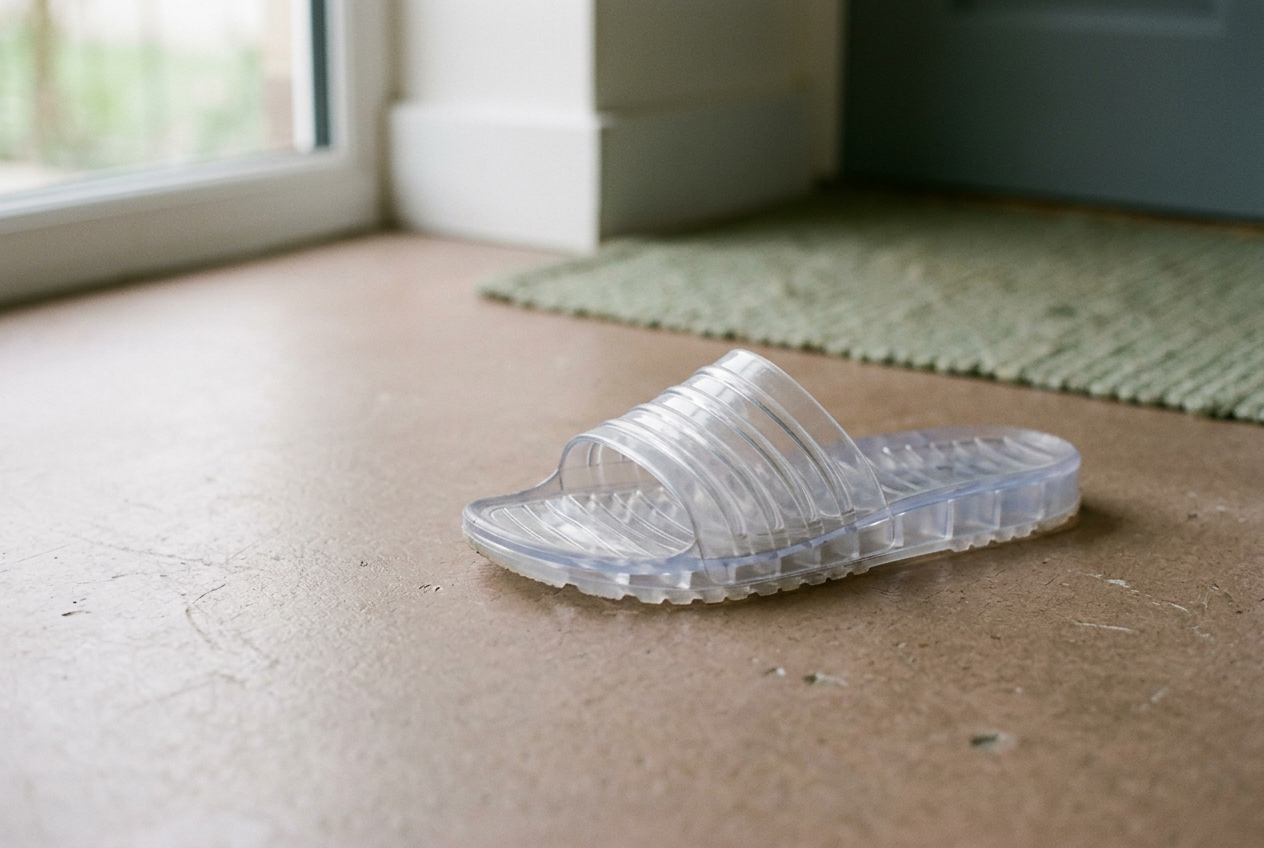
The pair that clarified the problem was a clear PVC slide with a broad strap and low ridges running across the footbed. PVC, or polyvinyl chloride, is the glossy plastic commonly used for classic jelly shoes; it does not absorb sweat, which leaves moisture sitting between skin and shoe with nowhere interesting to go.
That clear ridged pair looked more practical than a smooth jelly slide. For the first part of a warm walk, it was. Later, those same ridges became noticeable under the ball of the foot, then remained noticeable in the way a chair edge does once someone mentions it.
Over a week, I alternated it with two otherwise similar jelly constructions: one had a smooth footbed, while the other used fine, rounded pebbling. All had broad single straps and low heels. The comparison was not a laboratory trial, and the shoes were not identical molds, but I wore them barefoot on the same neighborhood loop, without foot lotion, then checked movement inside the shoe separately from the outsole’s contact with the ground.
That distinction matters. A slide can remain firmly planted on the sidewalk while your foot travels toward the front opening, which is excellent news for the sidewalk and less useful for you.
Smooth PVC loses once sweat has a surface
A smooth footbed feels benign when first put on. There are no raised elements pressing into the heel, no patterned surface to leave temporary marks and no texture competing with a tender spot. Standing indoors, it may even seem like the comfortable choice.
Walking changes the result because each step creates shear, meaning one surface moves sideways against another. Dry skin initially develops enough friction against smooth PVC to keep the foot centered. Once sweat forms a thin film, the contact becomes less dependable, particularly during a downhill stretch or the braking phase of a stride, when the foot wants to move forward while the shoe is still meeting the ground.
In the smooth sample, the first clear failure was not dramatic. My toes began gripping the front edge, followed by more pressure against the underside of the strap as the foot slid and tried to recover. The outsole stayed stable on dry pavement. Inside the shoe, however, the footbed had become a small administrative problem requiring constant correction.
Fit amplifies this. Extra length behind the heel gives the foot more room to travel, while a loose strap fails to limit that motion; sizing down may reduce sliding, but only if the toes and sides of the foot still sit fully on the sole. A jelly slide that is narrow enough to contain the foot by squeezing it is not a traction system. It is a plastic clamp.
Smooth PVC still has a use case. It suited the shortest wear periods, especially when the foot stayed relatively dry, and it avoided concentrated pressure underfoot. For standing, poolside use or a brief trip, that tradeoff may be acceptable. It was the least convincing option for sustained warm-weather walking.
Ridges grip, then announce themselves
The clear ridged pair performed better as sweat built. Its transverse lines interrupted the continuous moisture layer and gave the skin edges to press against, reducing the forward slide that appeared in the smooth pair. The improvement was easiest to feel on a slight descent, where the foot remained farther back instead of loading the strap.
Ridge shape mattered more than the mere presence of texture. These ridges were low but firm, with enough spacing that each line carried a distinct band of pressure. As the PVC warmed and the sole flexed, I could feel the pattern most strongly beneath the ball of the foot and along the outer heel, where my stride loaded the shoe unevenly.
Nothing cut the skin, and the pair did not become unwearable. The irritation was cumulative. After a longer outing, the ridges left temporary lines and encouraged small shifts in foot position to escape the same pressure points, which partly defeated the stability they had supplied. Grip that makes the wearer alter a normal stride is charging for its service.
Deep ridges can also collect grit. A grain of sand on a smooth footbed is easy to locate and remove; lodged beside a molded ridge, it remains under load until the shoe comes off. Jelly slides are often treated as low-maintenance footwear, but textured PVC needs a rinse and a soft brush rather than an optimistic wipe across the top.
The clear pair remained the better walker than the smooth one. It would suit someone whose main complaint is forward migration and whose feet are not sensitive to firm underfoot texture. I would still reject a pronounced ridge that can be felt sharply during an indoor try-on. Heat and distance rarely make molded plastic less opinionated.
Fine pebbling made the better compromise
The pebbled footbed used many small, rounded bumps rather than long bars. That texture did not lock the foot into place as firmly as the ridged pair during the first sweaty stretch, but it reduced broad sliding without creating a few obvious pressure lines. Contact was distributed across more points, and the gaps gave moisture somewhere to move as the foot compressed the surface.
This was the construction I stopped thinking about soonest, which is a modest but useful standard for a slide. The foot still shifted slightly on descents, since no open-backed PVC shoe can control movement like a fitted sandal with a heel strap, yet the toes did less gripping and the upper edge rubbed less because the foot was not repeatedly driving forward.
Pebbling is not automatically soft. Large, widely spaced studs can behave like ridges, concentrating load beneath the heel and forefoot, while sharply molded dots may feel harmless for several minutes and tiresome after the first errand becomes several. The useful version is shallow, rounded and dense enough that no single bump feels responsible for holding up the wearer.
For this unisex comparison, foot shape mattered more than the gender label on the size run. A higher-volume foot filled the broad strap and gained some stability, though too much strap pressure increased rubbing as PVC warmed. A lower-volume foot had more internal movement even on the pebbled sole. Anyone between sizes should prioritize strap hold and full sole width, not the smallest possible patch of empty heel.
Footbed grip is not outsole traction
Underfoot grip describes how securely the foot stays against the footbed. Outsole traction describes how the bottom of the shoe holds the walking surface. Retail descriptions often blur the two, perhaps because “textured for grip” sounds tidier than specifying which side of the shoe is doing the gripping.
I checked them separately on dry pavement and smooth indoor flooring. The clear ridged pair held my foot reasonably well, but its shallow outsole pattern felt less planted on the smooth floor than one might expect from the busy-looking footbed. The smooth-footbed sample, meanwhile, had a more defined outsole and stayed under itself even while my foot moved inside it.
A shopper can inspect this before buying. Turn the slide over and look for a tread pattern with channels and edges rather than a nearly flat sheet of plastic. Press a thumb across the outsole if handling is permitted; a sole that has some flexibility can maintain contact more readily than a rigid slab, although material hardness and floor conditions still affect the result. None of this guarantees wet-surface security.
PVC slides should not be treated as technical water shoes merely because water cannot ruin them.
The practical test at home is equally plain. Wear the slides on a clean floor, take several normal steps, then stop without shuffling. Notice whether the shoe stops with the foot, whether the foot moves forward inside it or whether the entire slide skates. Those are different failures and call for different returns.
What is worth paying for
Jelly slides occupy everything from low-cost seasonal racks to designer shelves, but price alone does not resolve the sweat problem. The useful details are visible: a shallow pebbled footbed, a strap that holds without cutting across the foot and an outsole with genuine tread. Thick, clear PVC and elaborate molding can make a pair look substantial while adding weight and underfoot firmness.
For regular city walking, the pebbled sample was the best of these three, though a cushioned slide made from softer foam would still be the more forgiving alternative. A backless leather sandal with a lined footbed handles moisture differently, while a heel strap controls forward movement rather than asking texture to do all the work. Those options may lack the transparent, glossy point of a jelly, which is why the jelly remains in the conversation.
The clear ridged pair earned a narrower recommendation. It improved internal traction and worked for moderate walks, but the ridge pattern needed a break between wears once the forefoot became tender. The smooth pair was the one to skip for hot, extended outings unless its strap fit happened to limit movement unusually well.
Try the surface with bare feet, not just fingertips. Walk long enough for warmth to develop, check whether the toes have started working overtime and return the pair if the texture leaves discomfort before the shoe has even left the house. PVC may soften slightly with heat, but a molded pressure point is not a break-in project worth assigning yourself.
Questions people ask
Are pebbled jelly footbeds less slippery than smooth ones?
Fine, rounded pebbling reduced internal foot movement more reliably than smooth PVC in this comparison because it interrupted the sweat layer without creating a few dominant pressure lines. Large or sharp bumps can still become uncomfortable, so the texture should feel diffuse under the whole foot rather than obvious beneath one spot.
Do ridged jelly slides hurt after walking?
They can. Low ridges improved forward grip in the clear test pair, but pressure became noticeable under the ball of the foot and outer heel during longer wear. If each ridge feels distinct during a short indoor fitting, expect the pattern to become more intrusive once heat, sweat and repeated loading enter the arrangement.
How can
I test jelly slides for sweaty feet at home?
Wear them barefoot on a clean indoor surface until the PVC warms, then walk, stop and change direction at a normal pace. Check whether your foot travels toward the opening while the outsole remains still. Keep the soles pristine until you decide, since the useful test should not cancel the return option.
Does a textured footbed mean the outsole has good traction?
No. Footbed texture controls movement between the foot and shoe, while outsole tread controls contact with the floor or pavement. Turn the slide over and assess the bottom separately. A ridged footbed can sit above a nearly smooth outsole, leaving the foot secure inside a shoe that still slips as a whole.
One update a day
Today's fashion update, in your inbox
One fashion update each morning — no hype, no filler, just pieces worth wearing.