Soft Suede Totes Are Replacing Rigid Bags. Check the Base.
The relaxed suede carryall looks current, but commuting weight exposes weak floors and handles. Here is what to inspect before choosing slouch over structure.
Women's · September 21, 2026 · 8 min read
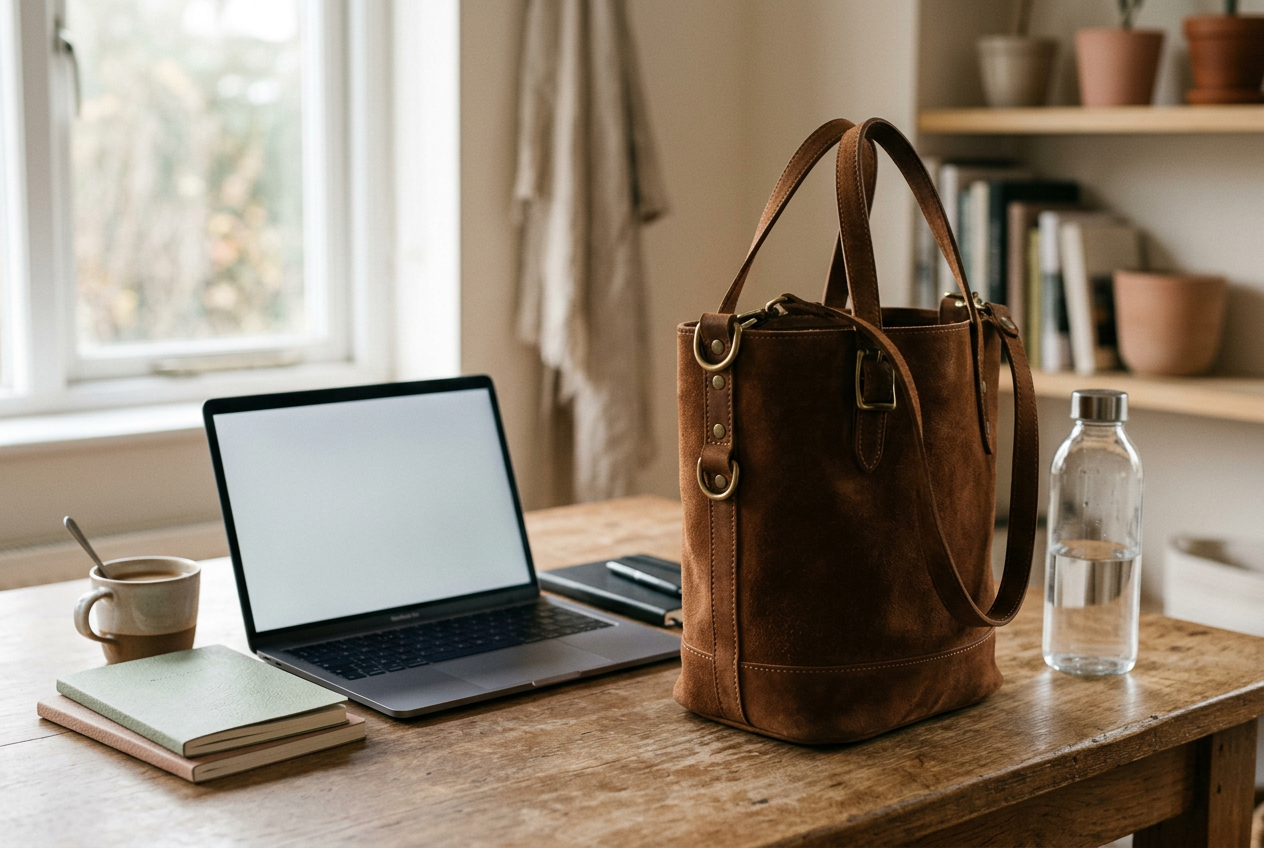
The useful detail on a soft suede tote is not the drape visible in its front-facing product image. It is the underside, which few people inspect until a water bottle has pulled the floor out of shape.
Madewell’s Essential Bucket Tote in suede is a useful case. Its broad, relaxed body represents the appeal of this shift away from firm top-handle bags: it sits close to the body, takes an irregular load and looks better when it is not arranged with precision. It also directs attention to the central problem. A bag can look softly collapsed at the sides while still needing a disciplined base.
This is women’s coverage, though the construction test applies to any suede carryall. The relevant load is an ordinary commute rather than an overnight trip: a laptop, a full water bottle, a charger, a pouch and perhaps a compact umbrella, with keys and a phone moving around above them.
Suede, meaning leather with a raised, velvety surface, makes that load feel less formal than polished calfskin does. It also shows pressure, moisture and friction more readily. That sensitivity is not necessarily a reason to skip it. It is a reason to stop judging the bag by silhouette alone.
The floor decides how the slouch ages
A rigid tote usually telegraphs its engineering. The walls stand up, the corners are defined and the base feels separate from the body. On the Essential Bucket Tote, as on many softer carryalls, the shape asks the suede to fall inward. That makes the base construction harder to read, although it matters more once the bag is loaded.
Look first for a distinct bottom panel rather than a single uninterrupted piece of material folding beneath the bag. A separate panel does not guarantee strength, but its perimeter seam can help control where the body bends. Press lightly across the empty floor. If it feels no more substantial than the side wall, a laptop and bottle may create two low points rather than one even platform.
Base reinforcement is an extra layer placed between the exterior and lining to spread weight. A shopper cannot usually identify the exact material without cutting the bag open, but there are clues: the bottom returns to shape after gentle pressure, the corners do not fold sharply, and the floor can support the empty bag without feeling board-stiff. A fully rigid insert would undermine the point of the style. A thin stabilizer is the more convincing compromise.
Feet are less important than they appear. Metal feet can keep part of the suede away from a dry tabletop, yet they do little if the base bows lower than the hardware once the bag is full. They also cannot protect the broad underside from wet pavement or a coffee-shop floor. The question is whether the floor stays level enough for the feet to remain the contact points.
A removable base shaper can rescue an underbuilt tote, but it adds cost, creates harder corner pressure and changes the intended drop. On the Madewell bag, that would trade some of the bucket shape for a flatter, more conventional footprint. It is an option, not an invisible fix.
A lining should control the load
The lining has two jobs here. It keeps small objects away from the suede’s reverse surface, and it limits how far the exterior can stretch when weight shifts. A bag with a loose, oversized lining may still look finished at first, but the fabric can bunch under a laptop or pull at its upper seam.
Open the bag and lift the lining gently from the bottom. Some movement is normal. A large pocket of loose fabric, especially at the corners, suggests that the lining will carry objects without helping the shell hold them. At the other extreme, a lining stretched drum-tight may take the strain every time the suede flexes.
The better version follows the body with a little ease and appears secured around the base or lower seams.
Color matters inside. A pale lining makes keys and earbuds easier to find, while also documenting every pen leak and makeup spill. A dark lining hides those marks but can make a deep bucket tote frustrating in low light. For commuting, an interior pocket that can hold keys without sagging is more useful than several shallow compartments whose stitching pulls against one soft wall.
Product pages often devote more language to pocket count and closure than to the bottom construction. Use the interior photographs differently: trace the lining into the corners, inspect whether the pocket is sewn into a reinforced upper section, and note whether the base looks smooth or already puckered while empty.
Handle attachment matters more than handle softness
A generous shoulder drop can make a suede tote feel easy over a coat, and wide straps distribute pressure better than narrow ones. Neither feature tells you how the handles join the bag.
The strongest visible attachments usually spread force over an area rather than ending at one short line of stitches. A box stitch, meaning a rectangular stitched outline that distributes tension, is easy to recognize on an unlined canvas tote but may be concealed between layers on leather. With a lined suede bag, feel where the strap enters the body. There should be substance beneath the attachment, not just two soft layers pinched together.
Watch for puckering around the stitch holes in showroom samples or customer-posted photographs. Suede is flexible, but a line of enlarged holes or a top edge curling toward the handle indicates concentrated strain. Rivets can support stitching, although hardware alone is not proof of an internal reinforcement patch.
Then put the bag on over the outerwear you use most. A strap that fits a T-shirt but catches at the armhole of a wool coat will encourage hand carrying, which changes the pull on the attachments and makes a large tote less practical. The Essential Bucket Tote’s relaxed proposition only works if it can remain on the shoulder when full.
Suede can transfer color in both directions
Crocking is pigment rubbing from a material onto another surface. Dark suede can leave color on a pale coat, particularly where the bag moves against the hip, while dark denim can transfer dye onto a lighter tan or beige bag. Moisture and friction increase the risk.
Before removing tags, check the brand’s care instructions and return rules. If testing is permitted, rub a clean white cotton cloth gently over an inconspicuous dry area and inspect the cloth. Do not start with water on untreated suede. A slightly damp test may reveal more, but it can also mark the nap, so it belongs only within the maker’s guidance or with a leather-care specialist.
Protective spray is not a neutral step. It may deepen the color or alter the surface, and an even application requires space, ventilation and drying time. Patch testing cannot be skipped. Someone who regularly wears cream wool, pale denim or an unlined light jacket has a narrower margin for error than someone whose commute wardrobe is mostly dark and washable.
The reverse transfer problem is easy to underestimate. A pale suede tote worn against new indigo jeans may collect blue at the lower corners long before the handles show wear. That placement is difficult to clean evenly because the nap changes direction as it is brushed.
Give the bag a commuter load before deciding
If store policy allows handling, bring the objects the bag must carry or reproduce their approximate weight with items from the store. Put the laptop against the side closest to the body, place a full bottle upright and leave the bag standing for several minutes. Water alone adds more than two pounds per liter, so an apparently modest bottle changes the test.
Now inspect the Essential Bucket Tote’s governing detail again: the floor. A gentle curve is consistent with a slouchy bag. A narrow bulge directly beneath the bottle means the load is not being distributed, while a laptop corner printing through the suede suggests that an organizer or padded sleeve will become mandatory. That extra equipment adds weight and takes away interior room.
Lift the bag by one handle, as people do while reaching for transit gates or keys. The top edge should flex, but one attachment should not visibly distort before the other. Set it down and check whether the base recovers. Finally, wear it for a few minutes over a coat.
A bag that passes the tabletop test can still become uncomfortable when its contents gather at one hip.
This test also clarifies capacity. A huge soft tote encourages overpacking because it can accept one more object without resisting. If the commute routinely includes a large laptop, lunch and gym gear, nylon with a reinforced floor may be the more honest choice. A structured leather tote remains better when files need to stay upright and the bag must stand beside a desk.
The price is buying material, not certainty
Most suede carryalls occupy the broad middle between inexpensive synthetic fashion bags and fully structured luxury leather work bags. The Madewell example sits in the contemporary high-street part of that spectrum, where a shopper can reasonably expect leather, considered hardware and a usable lining, but should not assume luggage-grade reinforcement.
Paying more may bring denser suede, cleaner edge finishing and better hidden structure. It may instead bring a fashion name and a deliberately unconstructed bag. The product description should settle material and care questions; the load test settles whether the design fits the job.
I remain undecided on suede as a primary commuter bag. The silhouette has moved on from the rigid office tote in a way that feels wearable rather than forced, and a properly stabilized soft base can handle ordinary days. A version that needs an organizer, a base shaper and constant separation from pale clothing is no longer an easy bag, whatever the front image promises.
Questions people ask
Can a suede tote carry a laptop every day?
It can if the base spreads the laptop’s weight and the handle attachments do not distort when loaded. Use a padded sleeve if the bag lacks a dedicated compartment, then check whether its corners print through the suede. A large work laptop may make nylon or structured leather the safer daily choice.
How can
I tell whether a tote base is reinforced?
Press the empty floor and compare it with a side wall. A reinforced base usually feels more stable, returns after gentle pressure and supports weight without forming one sharp low point. Product photographs of the underside and interior corners are often more informative than the main front view.
Will a dark suede bag stain light clothing?
It can. Pigment may rub from dark suede onto pale wool, cotton or denim, especially with moisture and repeated friction. Check the care guidance and, where returns and maker instructions allow, test a hidden dry area with white cotton before wearing the bag against a light coat.
Is a base shaper worth adding to a soft tote?
A thin, well-fitted shaper can distribute a bottle or laptop, but it also adds weight and makes the silhouette more rigid. If the bag needs a thick insert merely to stand level, its original construction may not suit commuting. Check that an insert does not press hard into the suede corners.
One update a day
Today's fashion update, in your inbox
One fashion update each morning — no hype, no filler, just pieces worth wearing.