Soft Slouchy Bags Are Replacing Minis. Check the Pockets.
Unstructured leather and nylon bags hold more than rigid minis, then make that capacity hard to manage. A week with Baggu’s Nylon Shoulder Bag shows which construction details matter.
Women's · September 4, 2026 · 8 min read
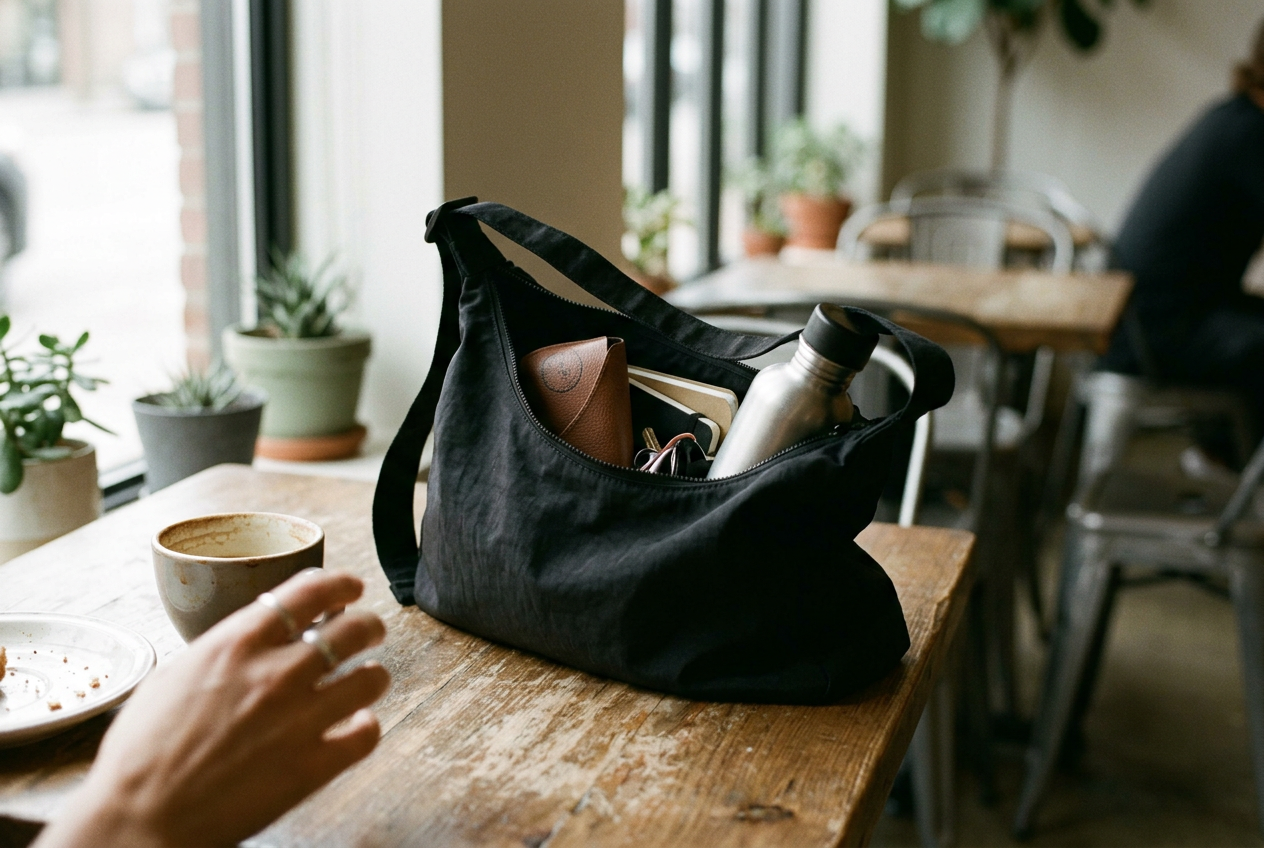
The useful difference between a slouchy bag and a rigid mini appears after the outfit photo, once a water bottle rolls across the bottom and the keys settle under everything else. Soft bags make room. They also surrender control.
For one week, I carried Baggu’s black Nylon Shoulder Bag instead of a small, structured leather crossbody. The Baggu is made from recycled heavyweight nylon with a recycled ripstop lining, meaning the lining uses a reinforced grid weave intended to limit tearing. It has a zippered top, an adjustable quilted strap and one interior zip pocket. What it does not have is a rigid base or a divider through the main compartment.
That made it a useful test case for the wider shift toward relaxed shoulder bags. It is roomy without reading as luggage, soft enough to fold in a drawer and priced below most leather versions of the look. It also exposes the central tradeoff plainly: the bag carries more than a mini, but the wearer has to supply some of its internal order.
The rigid mini is losing its practical argument
Small box bags and top-handle minis gave an outfit a firm punctuation point, even when they held little beyond a phone and cardholder. Their hard sides protected sunglasses, kept lipstick upright and made every object occupy a predictable place. That neatness came with a cost. A rigid shell cannot yield around an extra glasses case, paperback or compact umbrella, so the bag becomes unusable before it looks full.
The newer slouch is less formal and more forgiving. Current versions range from supple leather shoulder bags, including long east-west shapes, to nylon crescents and soft totes that fold against the hip. Some are deliberately collapsed at the center; others gain their shape only after they are filled. The common idea is volume without a visibly bulky frame.
This is women’s coverage, and the shift matters most in wardrobes where a polished mini has been the default companion to tailoring, dresses and evening separates. A soft black shoulder bag changes those combinations without demanding a new outfit formula. It sits closer to the body, looks less ceremonial and accommodates the objects that the mini forced into a second tote.
The fading shape is not obsolete. A rigid mini remains better for a short evening when the load is fixed and light. It becomes harder to defend as an all-day bag.
A week inside the Baggu shoulder bag
The Baggu’s main compartment swallowed my usual small crossbody load with room left for a paperback and refillable bottle. The gusset, an inserted panel that creates depth at the sides and bottom, lets the bag expand rather than forcing the contents into a flat stack. On the shoulder, the wide quilted strap distributed the added weight better than a narrow leather strap would have.
The first failure was predictable. With no supported base, the bottle moved toward the lowest corner, pulling the bag out of its clean horizontal shape. The glasses case followed it. My wallet stayed accessible only because I placed it in the interior zip pocket, while keys dropped to the bottom whenever I forgot to return them there.
By the middle of the week, I had divided the load myself: wallet and keys in the pocket, loose care items in a small pouch, larger objects in the main compartment. That restored order, but it also reduced the advantage of owning one generous opening. Every extra pouch adds another closure to open and another object that can migrate.
The interior pocket is useful because it closes and sits high on the wall of the bag. It is not large enough to act as a true second compartment, and filling it heavily makes one side sag more than the other. A pair of open slip pockets would help with a phone or transit card, provided their top edges were firm enough not to collapse against the lining.
The top zipper mattered more. It kept the opening controlled on public transit and stopped the soft sides from spreading when the bag was placed on its side. Under a light load, however, the flexible body offered little resistance, so closing the zipper sometimes required holding the opposite end. A bag can have secure hardware and still need two hands.
The bottom decides whether slouch becomes collapse
A base panel is a stiff layer sewn into or placed at the bottom of a bag. It need not make the body rigid. A thin panel can stop a bottle, hard glasses case or makeup pouch from forming separate low points while allowing the upper half to fold naturally.
The Baggu has a broad enough gusset to stand when packed with balanced objects, but it does not maintain that stance once the weight shifts. This was tolerable on the shoulder, where the bag conformed to my side, and irritating on a café floor, where it folded around its contents. A removable organizer improved the latter problem but imposed a rectangular outline that worked against the reason to choose the bag.
Leather versions pose a slightly different calculation. Supple calfskin or lambskin can drape beautifully, but an unsupported bottom may stretch around hard objects over time, particularly when the same heavy item occupies one corner every day. Pebbled leather disguises minor marks and unevenness better than a smooth finish, though it does not prevent distortion. Suede adds friction, which can help the bag stay on a shoulder, while making spills and color transfer more consequential.
Nylon is lighter and usually easier to maintain. Baggu describes this model as machine washable, an unusual advantage over leather, yet the pliable shell also broadcasts the outline of whatever presses against it. A bright or pale lining would make small black objects easier to find than this bag’s dark interior, and it would improve usability without changing the exterior silhouette.
Pocket count is less important than pocket position
A product page can advertise several pockets and still describe a poorly organized bag. The better test is whether each pocket controls a particular kind of movement.
High wall pockets suit light objects that need quick access. A full-width divider can separate flat items from bulky ones, though it may sag into the center unless its upper edge is reinforced. A bottle sleeve prevents the heaviest object from rolling, but only if it is anchored close to the base. Small pockets placed low in a soft lining tend to disappear beneath the main load.
Closures need the same scrutiny. A magnetic snap is quick but allows the mouth to gape when the bag is full. A recessed zipper, which sits slightly below the top edge, preserves a relaxed profile and offers better security, although the fabric around it must be stable enough to operate one-handed. Drawstrings create attractive folds but compress the usable opening, especially when the bag is already crowded.
The Baggu’s straightforward top zipper won this part of the test. I would choose it over a more sculptural closure for commuting, despite the occasional two-handed pull, because it contains the whole opening rather than securing one point at the center.
The store test takes less than five minutes
Start by setting the empty bag on a flat surface. It does not need to stand upright, but the bottom should unfold into a clear footprint rather than twisting immediately. Press the base between two fingers. Some resistance suggests a panel or dense reinforcement; fabric that folds as easily as the side wall will depend on the contents for structure.
Open and close the main closure while holding the bag as you would wear it. If a zipper jams because the body bunches, adding weight may improve the pull but will not fix an unstable zipper track. Put your phone in each intended pocket and lift the bag. The phone should remain above the main pile without tipping the whole bag toward one side.
Next, use the objects a store permits rather than judging empty volume. A wallet and glasses case reveal more than tissue stuffing because they create firm edges, while a filled water bottle shows whether the base tilts. Look at the bag from the side after loading it. A good slouch changes shape; a poor one develops a single strained corner.
At the lower end of the market, nylon gives the clearest route into the trend because the material keeps both weight and cost down. Midpriced leather demands closer inspection, since money spent on the hide does not guarantee reinforcement, a durable lining or sensible pockets. At luxury prices, a beautifully collapsed silhouette may be the design itself. Paying more will not make it organized.
After the week, I preferred the Baggu to the rigid crossbody for transit days and errands because it absorbed an extra layer and did not punish an unplanned purchase. I did not prefer it for a meeting followed by dinner, when I wanted to retrieve a small object without rearranging the bag on my lap. The soft shape stayed. The loose interior remained the price.
Questions people ask
How many pockets should a slouchy bag have?
Pocket placement matters more than the total. Look for at least one closable pocket mounted high enough to stay above the main load, then consider a divider or anchored sleeve if you routinely carry a bottle. Several small pockets sewn low into a flexible lining can collapse into the same pile as everything else.
Does a slouchy bag need a rigid base?
Not necessarily. A thin base panel can distribute weight without turning the bag into a box, which preserves the relaxed upper shape while stopping hard objects from creating isolated corners. Skip firm support only if you carry a light load or do not mind setting the bag down on its side.
Is nylon or leather better for a soft shoulder bag?
Nylon is lighter, easier to fold and often easier to clean, but hard contents may show through its surface. Leather gives the slouch more visual weight and can look polished with tailoring, yet unsupported soft leather may stretch around repeated loads. Choose according to what you carry, not the material’s perceived status.
Can an organizer insert fix a bag that collapses?
An insert can add pockets and flatten the base, though it also adds weight and may force a fluid bag into a stiff rectangle. Choose a thin insert that stops below the zipper and leaves room around the sides. In the Baggu, that compromise improved retrieval while reducing the close-to-body drape.
One update a day
Today's fashion update, in your inbox
One fashion update each morning — no hype, no filler, just pieces worth wearing.