Socks Stop Jelly-Shoe Blisters, Then Trap the Heat
Inside a clear PVC jelly slide, socks reduce skin-on-plastic rubbing but hold sweat where it cannot evaporate. One style handled the compromise better than the others.
September 29, 2026 · 7 min read
Jelly shoes have returned to regular summer rotation, but the material has not acquired ventilation while we were away. A molded upper made from polyvinyl chloride, or PVC, a flexible plastic commonly used for jelly footwear, does not absorb sweat and allows little air movement. Add warm pavement and a walking pace, and the foot starts negotiating with the shoe almost immediately.
This is unisex advice. The same friction and moisture problems apply across women’s and men’s wardrobes, though the exact pressure points change with foot width, instep height and whether the jelly style uses straps, a closed upper or a slide construction.
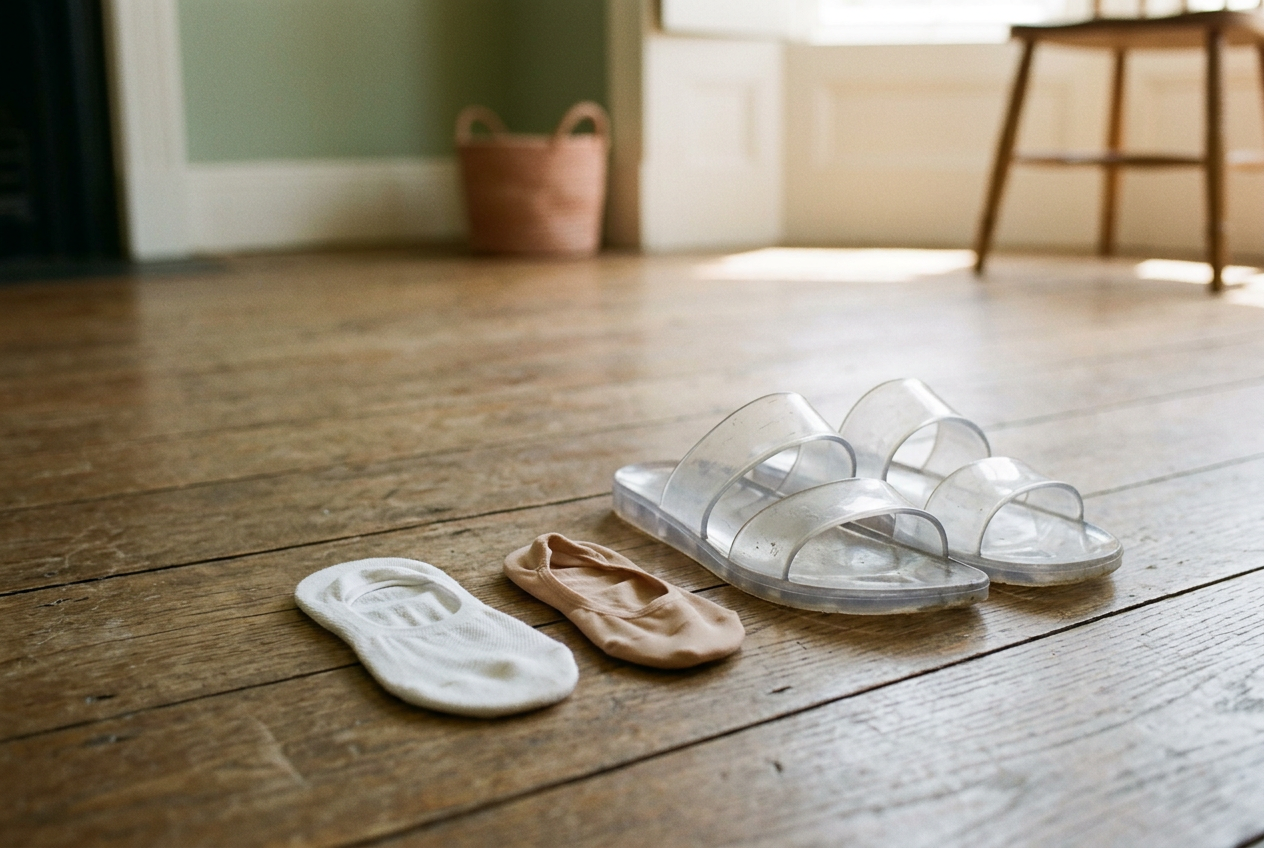
The concrete case here was a clear, two-band jelly slide with a smooth molded footbed, a flat sole and no lining. Its fit was correct in length, but the front band sat close enough to the toes that it became the main rubbing point once the foot grew warm. That ordinary fit quirk matters more than the nostalgic transparency: plastic does not relax around the foot in the forgiving way a soft leather strap can.
Over a week of warm-weather wear, the same slide was paired with a thin cotton no-show sock, a low synthetic liner and no sock. Each setup reduced one annoyance by introducing another. Jelly-shoe comfort, apparently, remains committed to administrative complexity.
The bare-foot baseline
Without socks, the clear slide looked as intended and felt coolest at the start. There was no fabric peeking above the bands, no wrinkled heel and no extra layer taking up space. For standing around or covering a short distance, bare feet made the strongest case.
Walking changed it. The footbed became slick as moisture collected, which let the foot travel forward and brought the toes closer to the front edge. At the same time, the first band gripped damp skin rather than gliding over it. That combination created friction at the top of the toes and under the ball of the foot, even though the slide had not felt tight when first put on.
Friction is not just a product of a visibly narrow shoe. Repeated movement between skin and material does the damage, and a loose slide can rub precisely because the foot keeps shifting. The smooth PVC footbed also offered nowhere for moisture to go. It stayed on the surface until the shoe came off or was wiped down.
Bare feet remained the least hot option because there was no sock insulating the skin, but “least hot” is doing some work. The slide still enclosed part of the foot in nonbreathable plastic. On a warm walk, the temperature rose quickly enough that the cooler opening minutes did not compensate for the later rubbing.
Thin cotton reduced rubbing but held the damp
A lightweight cotton no-show sock softened the contact under both plastic bands. It also absorbed some surface moisture, so the foot stopped sliding forward as readily and the top of the toes did not meet bare PVC at every step. For a reader mainly trying to protect an existing tender spot, this was an obvious improvement.
Cotton’s weakness appeared later in the walk. Absorbency moves sweat off the skin at first, but cotton tends to retain that moisture rather than moving it efficiently toward the outside of the fabric. Inside an open sneaker, airflow can help. Trapped between a foot and a plastic footbed, the damp sock has fewer opportunities to dry.
The result was less direct rubbing and more generalized heat. The sock felt heavier under the forefoot, where body weight pressed the wet fabric against the smooth footbed, and the benefit declined once the material started folding near the toes. A wrinkle inside a jelly shoe is not a minor styling matter. It becomes a raised pressure line under a material that does not yield much.
Visibility was the other failure. The cotton edge showed through the clear bands, while extra fabric gathered at the sides because the sock had been cut for a closed shoe rather than a transparent slide. A tonal sock could make that exposure deliberate in an opaque colored jelly, but white cotton inside clear plastic looked less like styling and more like a person trying not to bleed before lunch.
Cotton still has a place. It works for brief errands, cooler evenings and jelly shoes with enough internal volume to avoid crushing the toes. Choose the thinnest version available, with a low edge and minimal seam bulk. Thick athletic cotton solves the rubbing problem by creating a fit problem.
The synthetic liner managed moisture better
The low synthetic liner produced the best walking compromise in this particular slide. Its fine knit created a barrier at the front band without taking up as much room as cotton, and it handled dampness better once the foot warmed. Moisture-wicking fabric, meaning material engineered to spread moisture across its surface so it can dry faster, cannot perform miracles inside PVC, but it can keep one soaked patch from sitting under the forefoot.
Heat still accumulated. The jelly upper remained nonbreathable, and adding polyester or nylon did not install an air-conditioning system. Compared with cotton, however, the synthetic liner felt less waterlogged and maintained a smoother surface against the footbed, so the foot moved less and the fabric did not bunch as quickly.
The heel was its weak point. A no-show liner relies on elastic and often a small silicone grip to stay in place; once that edge slipped below the heel, fabric migrated forward and collected under the arch. The test pair exposed enough of the sides that the liner’s opening was also visible through the clear PVC, especially where the edge cut across the instep.
Fit decides whether this option works. The liner needs to sit close without pulling the toes together, and its heel must remain up during several minutes of indoor walking before the shoes leave the house. If it slips on a clean floor, it will not become more disciplined on hot pavement.
The shoe fit matters before the sock does
A sock cannot rescue a jelly shoe whose plastic bands press firmly into a relaxed foot. Feet tend to swell during warm-weather walking, and the added fabric reduces internal space before that swelling begins. In the clear two-band slide, cotton made the front band feel close almost at once; the finer synthetic liner preserved more room, although neither changed the underlying shape.
Look at width as well as labeled size. Many slides leave spare length behind the heel while narrowing abruptly across the forefoot, so sizing up may create extra movement without removing the pressure point. The useful fit check is whether the foot sits centered, the toes remain behind the sole edge and a thin sock can lie flat without leaving a deep band mark.
That check applies at every price band. More expensive jelly footwear may offer a more refined shape, softer compounds or a better footbed, but a clear plastic upper still has to match the wearer’s width. Paying designer prices does not make a misplaced strap stop rubbing.
The practical choice
For sustained warm-weather walking, the synthetic liner won this comparison, narrowly and without glory. It reduced direct friction, stayed smoother than cotton and retained less obvious moisture. The tradeoff was visible edging plus a warmer foot than the bare option.
Cotton suits shorter wear when softness matters more than drying speed. Bare feet make sense for minimal walking, provided the shoe has already shown that its bands do not rub and the footbed does not become dangerously slick. For a long day involving pavement, public transportation and few chances to remove the shoes, a breathable sandal is the better alternative. The jelly slide does not become a walking shoe merely because a sock has been assigned to supervise it.
After wear, remove the socks and wipe the footbed rather than leaving moisture under the bands. Let the shoes dry away from direct heat, which can affect flexible plastic, and wash liners between wears. A sock that already carries dried sweat and grit adds texture exactly where the setup is supposed to reduce friction.
Styling is easiest when visibility looks intentional. Match a liner closely to the shoe or the wearer’s skin tone for a quieter effect, or choose a fine sock in a deliberate color with opaque jellies. Clear shoes reveal every folded edge. If the sock has to be tugged and hidden throughout the day, the combination has failed its practical test before the blister arrives.
Questions people ask
Do socks prevent blisters in jelly shoes?
They can reduce direct skin-on-plastic friction, especially under a tight band or across the toes. They cannot correct a poor fit, and damp or bunched fabric may create a new rubbing point. A thin, smooth sock works better than a thick one because jelly uppers offer little extra room.
Are cotton socks good inside jelly shoes?
Thin cotton feels soft and absorbs early moisture, making it useful for short trips or cooler conditions. During longer warm-weather walks, it tends to hold dampness against the foot and can bunch under pressure. Avoid thick cotton socks unless the jelly shoe is unusually roomy.
Are synthetic no-show socks cooler than cotton?
They are not cool inside nonbreathable PVC, but a fine synthetic liner generally spreads moisture better and becomes less saturated than cotton. Its advantage disappears if the heel slips or the opening cuts tightly across the foot, so test the liner with the shoe indoors first.
Is it better to wear jelly slides barefoot?
Bare feet give the cleanest look and avoid the insulating layer of a sock. They also leave skin exposed to damp plastic, surface seams and repeated movement. Reserve barefoot wear for short distances in a pair that has already passed a low-stakes trial without hot spots.
One update a day
Today's fashion update, in your inbox
One fashion update each morning — no hype, no filler, just pieces worth wearing.