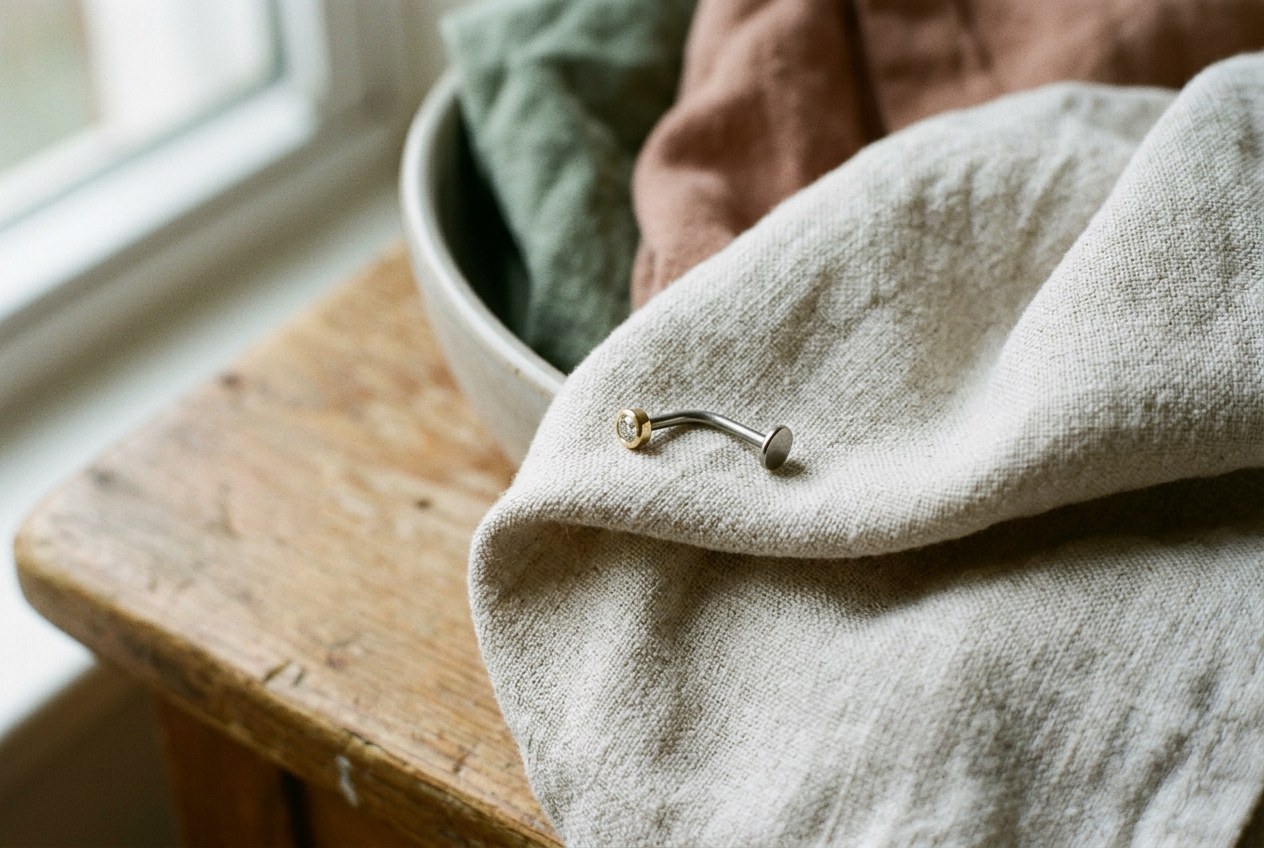
Push-Pin Flat Backs That Loosen Need This Tug Test
A threadless end can look seated while its pin is still shallow. This tool-free check separates a secure fit from one likely to disappear into the bedding.
August 23, 2026 · 8 min read

A flat back earring, meaning the post’s backing sits flush against the ear, should feel uneventful on a pillow. The problem is that a threadless decorative end can appear attached even when only the tip of its pin has entered the post. It holds through dressing. It may not hold through eight hours of side pressure.
The anchor for this comparison was an 18-gauge implant-grade titanium labret post worn in a healed lobe. Gauge describes the post’s thickness. The matching control end was a low-profile bezel setting, where a narrow metal rim surrounds the stone, from the same compatible threadless system.
This is unisex jewelry advice. The mechanics do not change with the styling of the ear, although larger clusters, sculptural shapes and closely packed stacks give a pillow more surface to push against.
The low-profile end set the standard
A threadless end has a narrow pin that slides into a hollow post and stays there through spring tension. A slight, smooth bend in the pin is intentional. As the pin enters, the post presses against that bend and creates enough resistance to retain the end without screw threads.
With the low-profile bezel end, seating was easy to read by touch. Its base met the opening of the post cleanly, the visible gap disappeared, and a straight outward pull produced no movement. The end also sat close enough to the lobe that pressure from the side did not create much leverage.
That last detail matters overnight. Threadless retention works along the pin’s length, while a pillow often pushes across the face of the jewelry; a broad or raised ornament turns that sideways pressure into a small rocking motion, which can work a partly inserted pin outward even though the same end seemed stable during the day.
The control did not need a hard push once it reached its stop. More pressure would not have made it more secure. Threadless jewelry has no screw to tighten, so the useful distinction is fully seated versus shallowly seated, not loose versus overtightened.
Three fits that looked similar but behaved differently
The first weak fit came from shallow insertion. The end sat close to the post, yet a fine seam remained between them. It resisted a light touch because the pin had entered far enough to catch, but the end shifted outward during the straight tug test. This is the most deceptive version.
From the front, especially in a crowded ear stack, it can look finished.
The second fit used a pin with too sharp a bend. Some bend supplies the tension, but a kink or an aggressive angle can make the pin meet the inside wall before reaching full depth. Pressing harder risks damaging the pin, the hollow post or the decorative setting. The clue was an early stop paired with a persistent gap.
The end felt tight during insertion, although it was not seated.
A pin can also lose useful tension after it has been repeatedly bent back and forth. If it slides into a compatible post with almost no resistance and withdraws during a gentle straight pull, the problem is not insertion force. The end or post needs assessment and possibly replacement. Do not keep reshaping the pin by guesswork.
The bulky decorative end produced the clearest nighttime tradeoff. Its matching pin could pass the tug test when fully seated, but the raised shape was easier to press sideways than the small bezel control, particularly when the post left extra room behind the lobe. A longer wearable post can accommodate swelling or thicker tissue, yet on a healed piercing it may let the front lean and rock.
A large end is not automatically insecure. It gives poor seating more consequences. If the design has a wide cluster, a high-set stone or a shape that catches on hair, its pin needs to reach full depth and the post length needs to suit the ear.
The repeatable straight tug test
Start with clean, dry hands and good light. Hold the flat disc behind the ear between two fingertips so the post cannot slide backward while the end is inserted. Align the pin with the opening and press the decorative end straight inward. A small amount of resistance is expected.
Grinding, scraping or a hard stop well before the bases meet is not.
Next, inspect the meeting point. On the front of a lobe piercing, there should be no pin showing between the ornament and the post. Depending on placement, the opening may be difficult to see, so run a clean fingertip lightly around the base instead of twisting the jewelry. The low-profile bezel control felt level all the way around when seated.
A lifted edge signaled misalignment or a gap.
Support the flat back again. Grip the metal base of the decorative end rather than pulling on a stone, pearl, chain or prong, then apply a gentle straight pull away from the ear. Use only enough force to check a small clasp. This is a retention test, not an attempt to separate the pieces.
A passing end stays flush without sliding, clicking outward or revealing part of the pin. Release it and check the seam once more. For sleep-friendly jewelry, repeat this check after changing the end, after snagging it on clothing, and whenever it begins to sit at a new angle.
If the end moves, do not solve the problem by pushing harder and immediately going to bed. On a healed piercing, remove it over a clear tray or folded towel, inspect the pin for a kink or damage, and reseat it in a straight line. Stop if resistance feels rough or the pin repeatedly stalls. A professional piercer can check the tension and compatibility without improvising with household tools.
Skip routine removal and testing on a fresh or irritated piercing. Initial jewelry may need extra post length for swelling, and unnecessary handling can disturb the channel. Ask the piercer who fitted it to assess an end that lifts or shifts.
Read the failure before replacing the jewelry
A visible gap with ordinary insertion resistance usually points to shallow seating. Misalignment is common when the decorative end is tiny, the piercing sits high on the ear, or fingernails prevent a straight grip. Better lighting and support behind the disc may be enough.
An end that stops early every time needs closer inspection. The pin may be over-bent, the post opening may contain residue, or the components may not belong to the same system. Threadless ends are not universally interchangeable, even when the listed gauge appears to match, because pin diameter and post construction can differ. Forcing mixed components is not worth the loss risk.
An end that seats fully but pulls free too easily may have insufficient pin tension or wear inside the post. That is a fitting problem, not a cue to pinch the ornament with pliers. Tools can mark gold, deform a hollow titanium post and loosen a stone setting while appearing to fix the pin.
If a properly seated end passes the straight tug test but repeatedly loosens after sleep, look at leverage. The large decorative end may be pressing into the pillow, or an overly long post may be letting it tip. The practical alternative is the shape used as the control here: a low-profile bezel or small smooth disc on a correctly fitted post. Save the raised cluster for a placement that does not bear your sleeping weight.
What to check before buying another end
Match the new end to the post manufacturer or to a compatibility recommendation from a reputable piercer or retailer. The material matters too. Implant-grade titanium is light and commonly selected for body jewelry, while solid gold can offer a finer finish at a higher cost; vague descriptions such as titanium-colored do not identify the underlying metal.
Examine the underside in the product image. A broad, flat base distributes pressure better than a narrow projection, and a low setting is less likely to tilt. Decorative size alone does not reveal security, but height and uneven weight tell you how much sideways load the end may receive.
Post length is part of the purchase. A disc that presses into the skin is too tight, while a large space behind a healed lobe gives the front room to rock. Properly fitted threadless jewelry should allow normal comfort without behaving like a loose hinge.
The small titanium bezel remains the useful benchmark. If a more elaborate end cannot seat as clearly, pass the same straight tug or lie comfortably against a pillow, the extra decoration is not earning its place in an overnight stack.
Questions people ask
Do threadless pins need to be bent?
A slight, smooth bend creates the spring tension that holds a threadless end inside its post. A sharply angled or kinked pin can stop before full insertion, while a nearly straight pin may lack retention. Have uncertain tension checked rather than repeatedly bending the pin at home.
Can a large decorative end still be sleep-friendly?
Yes, if its pin is fully seated, its base lies evenly against the post and the post length limits rocking. Raised clusters and uneven shapes receive more sideways pressure from a pillow, so they deserve a tug check before bed. A low-profile end remains the more predictable choice for a side sleeper.
Should a threadless end click into place?
Some combinations give a faint tactile stop, but a click is not a universal sign of correct seating. Check for a closed seam and no movement under a gentle straight pull. If the end clicks outward during that pull, it was not securely retained.
Can
I perform the tug test on a fresh piercing?
Do not repeatedly manipulate or remove jewelry from a fresh, swollen or irritated piercing. Initial posts are often fitted with room for swelling, which changes how the end sits. If the front lifts, the disc presses or the jewelry shifts unexpectedly, let a reputable professional piercer inspect it.
One update a day
Today's fashion update, in your inbox
One fashion update each morning — no hype, no filler, just pieces worth wearing.