Platform Flip Flops Can Make the Pedals Harder to Read
A thick sole and a free heel can weaken your sense of the pedals. Check elevated thong sandals while the car is safely parked, or change shoes before you leave.
Women's · August 13, 2026 · 7 min read
The test pair was a black square-toe platform thong sandal with synthetic-leather Y straps and a one-piece molded EVA sole, meaning the lightweight foam commonly used for cushioned midsoles. It looked tidy with wide-leg trousers, survived a week of ordinary walking without visible damage and felt less cooperative the moment I considered the driving position.
That distinction matters. A sandal can be wearable on a sidewalk yet poorly suited to working pedals, where the foot has to lift, angle and apply pressure without the shoe lagging behind. In the test pair, the platform remained fairly stiff under the forefoot, while the uncovered heel rose clear of the footbed whenever the toes relaxed. The sandal was doing exactly what it was designed to do.
Unfortunately, it was designed to be a platform flip flop.
This is women's footwear coverage because that is where elevated square-toe thong sandals are most widely sold and styled, although the mechanical issue applies to any loose, thick-soled shoe. It is not legal or professional driving advice. Footwear rules vary by location, and public road-safety guidance generally focuses on whether a driver can maintain control rather than whether a particular fashion category has been singled out.
The problem starts behind the heel
Heel retention is the shoe's ability to stay attached at the back as the foot lifts. A conventional flip flop has almost none: the toes and thong post keep it roughly aligned, while the heel is free to separate from the footbed.
That loose construction is tolerable during walking because the wearer can shorten a stride, curl the toes or let the sandal slap back into place. None of those compensations improves pedal work. Curling the toes changes how the forefoot presses, and lifting the entire leg to keep the sandal attached can make a small ankle movement larger and clumsier.
The black test pair exposed this quickly. Seated in a stationary car with the engine off, parking brake set and keys put aside, I placed the heel where it would normally rest and moved the forefoot between the pedal positions without pressing them. The platform trailed behind on each lift, then shifted slightly sideways when the foot changed angle. It never fell off.
It did not need to fall off to be distracting.
A back strap would alter that behavior, provided it fits snugly enough to hold the heel without forcing the foot forward. Decorative ankle ties are less convincing when they stretch, loosen or sit too high to control the rear of the sole. The useful part is a secure strap connected to the shoe's structure, not a length of cord doing public relations near the ankle.
A thick platform edits out pedal feel
Pedal feel is the pressure and movement a driver senses through the sole while operating a pedal. Thicker material places more foam between the foot and that feedback, while a rigid slab also limits the forefoot's ability to bend where the toes meet the foot.
The test sandal's EVA platform felt moderately cushioned on pavement, but that cushioning was paired with a broad, inflexible shape. Pressing the sole by hand showed little forefoot flex. Twisting it from toe to heel produced more resistance than a basic sneaker or thin walking sandal. Neither check proves how a person will drive, but both reveal how much work the shoe may ask the ankle and leg to do.
Stack height, the amount of material between the foot and the ground, also changes the effective size of the foot. A square toe makes that footprint wider at the front, and the extra platform extends beyond the toes and heel, so the wearer has to account for an outline larger than the body can directly feel. The fashion benefit is the point: a substantial sole gives loose trousers clearance and makes a minimal thong upper look deliberate. The control tradeoff is the same substantial sole.
Price does not settle it. Budget foam platforms and designer leather-covered versions can share the relevant construction: an open heel, limited forefoot flex and a sole thick enough to mute feedback. Better materials may improve durability, lining quality or finish. They do not automatically make a loose platform stay with the foot.
Run this check without starting the car
Do the evaluation only while safely parked, with the engine off, the parking brake engaged and the vehicle secured according to its manual. This is a fit check, not an invitation to experiment in traffic. If anything feels vague or catches during the stationary check, stop and change shoes.
First, sit in the normal driving position and leave the platform flat on the floor. Lift the forefoot while keeping the heel relaxed. If the foot rises before the sandal does, or the toes have to grip to bring it along, the shoe has weak heel retention. The black square-toe pair opened a visible gap at the heel immediately.
Next, move the foot slowly between the pedal positions without pressing them. Watch the sole rather than assuming it follows the foot. A platform that rotates, drags across the floor mat or brushes an adjacent surface has introduced movement that a close-fitting shoe would not. Floor mats must also lie flat and remain secured; footwear cannot compensate for a mat that slides or bunches.
Then place the forefoot lightly against each pedal with the vehicle still off. Notice whether you can identify the pedal edge and change pressure with a small ankle movement. The test sandal spread that contact across a thick block of foam, which made the boundary feel less distinct than it did through a flexible sneaker. Discomfort was not the issue.
Information was.
Finally, lift the foot clear and check whether the outsole, the surface that contacts the ground, catches on the mat or trim. Deep tread can grip pavement nicely yet snag textured carpet, while a platform projecting beyond the heel can contact the floor before the foot expects it. Any catch, delay or need to reposition the sandal ends the test. There is no prize for persuading an unsuitable shoe to become administrative footwear.
The useful alternative may already be in the car
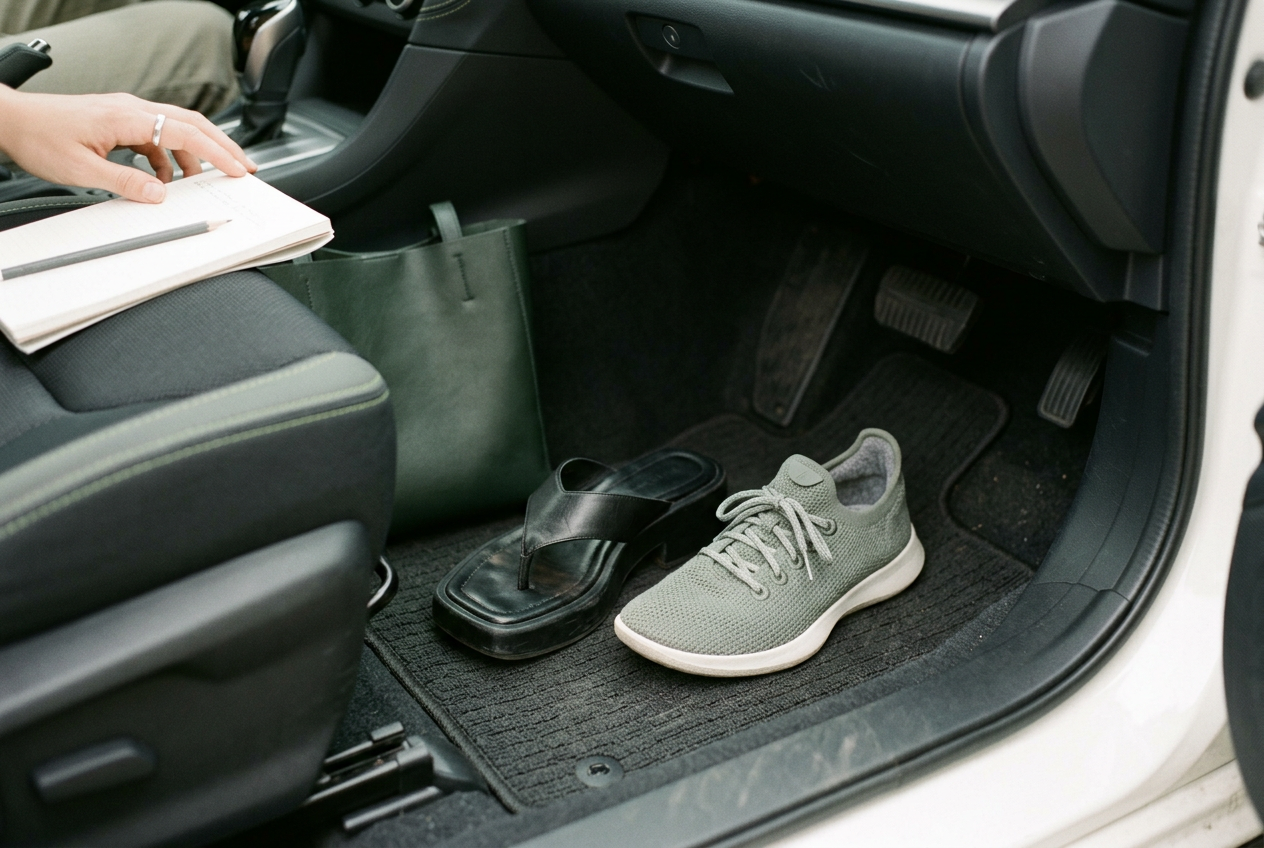
A low, secure sneaker is the straightforward option. Look for a heel counter that holds the rear of the foot, a sole that bends under the forefoot and enough traction to avoid slipping without an aggressively projecting tread. A lace-up pair lets the wearer adjust volume, which helps if the foot otherwise slides forward.
A flat sandal can work better than a platform when it has a properly fitted back strap and a flexible sole, although very thin soles may become uncomfortable during walking and very loose straps recreate the original problem. Ballet flats vary: some stay on securely, while shallow cuts and slick linings can let the heel lift. Apply the same stationary check rather than trusting the category name.
The cheapest solution is often a clean pair of driving shoes already owned, kept where they cannot roll into the footwell. Store them in the trunk, a door compartment large enough to contain them or a closed bag, then change before starting the car. Never leave loose footwear near the pedals. The swap costs a minute and preserves the platform sandal for the part of the outfit it handles well.
That is my decision on the black square-toe pair. I would wear it for a short walk, dinner or any plan with forgiving pavement and limited distance. I would not choose it for driving, because the free heel and stiff foam slab both failed the stationary check, and the alternative was an ordinary flexible sneaker rather than the cancellation of fashion.
Questions people ask
Are all platform flip flops unsuitable for driving?
Construction varies, so a category-wide verdict would be too broad. A lower platform may flex more than the test pair, but an open heel can still separate from the foot. Check retention, sole movement and pedal feel while safely parked. If the toes must grip or the platform shifts, change shoes.
Does adding an ankle strap fix the pedal-control problem?
A structural back strap can improve heel retention when it fits snugly and connects firmly to the sole. It does not make a thick, rigid platform flexible or restore feedback filtered by foam. Decorative ties and stretchy straps may also loosen, so the complete shoe still needs the stationary check.
Where should I keep spare shoes in the car?
Keep them contained somewhere they cannot enter the driver's footwell, such as the trunk, a closed bag or a suitable storage compartment. Change footwear before starting the car, then secure the sandals as well. A loose platform under a seat can become a pedal-area problem even when nobody is wearing it.
One update a day
Today's fashion update, in your inbox
One fashion update each morning — no hype, no filler, just pieces worth wearing.