Peep-Toe Shoes Look Current Again, but the Opening Matters
The new peep toe exposes more than a pinprick of nail. That extra space can improve fit, but only when the cutout follows the foot rather than forcing toes through it.
Women's · August 19, 2026 · 7 min read
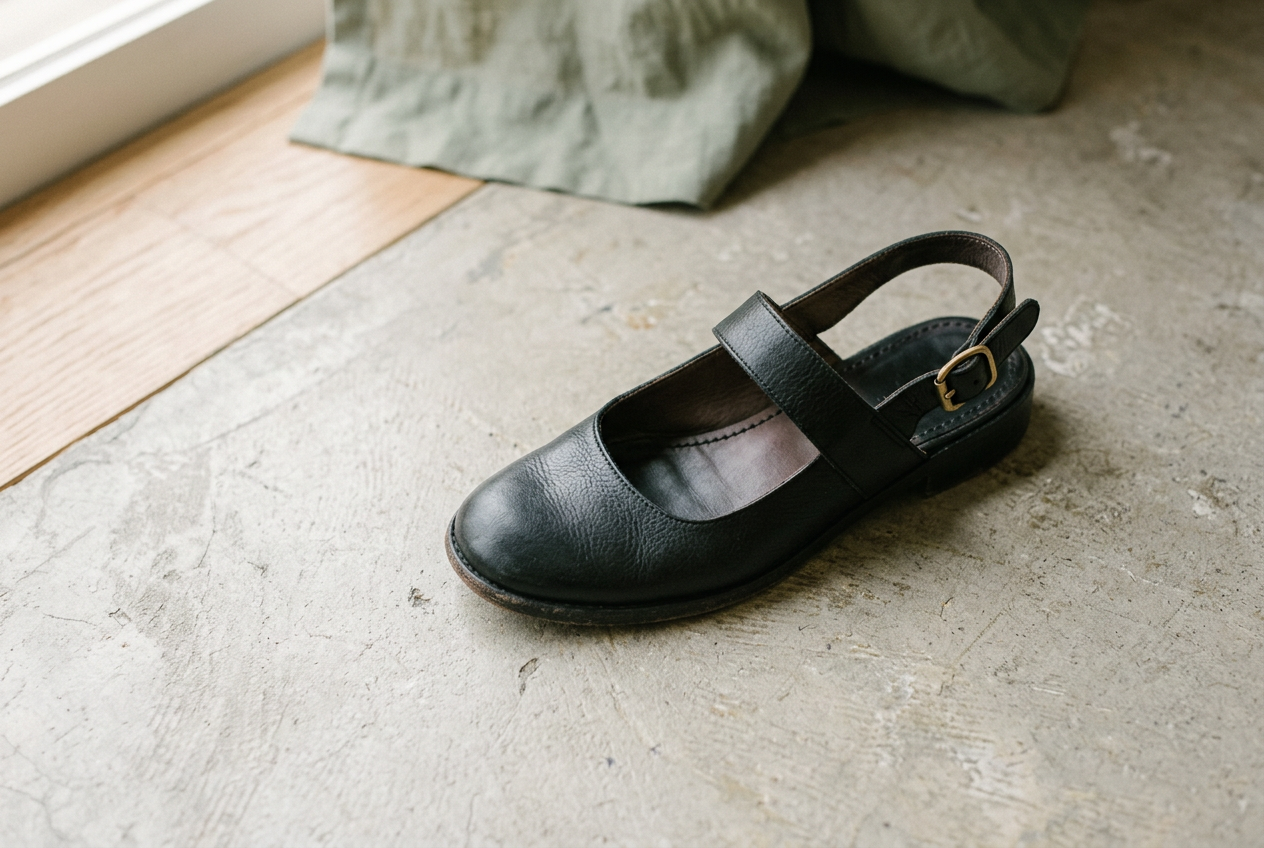
The pair that clarified this shift for me was a black nappa-leather slingback with a low block heel and a rounded rectangular opening, worn three times over one week. The cutout showed the first three toes rather than presenting one squeezed big toe, and that proportion looked current without requiring the foot to behave like a narrow display form.
This is women’s coverage, and the sizing references follow women’s footwear, though the underlying mechanics apply to any open-toe shoe. On the test pair, the usual size was correct in length. The issue was placement: my second toe is slightly longer than my big toe, and its nail sat close to the upper edge of the opening during the first wear.
That small contact point told me more than the silhouette did. A peep toe can look generous from above while remaining shallow where the toes need vertical room, particularly when the upper curves down sharply or has a stiff lining bonded underneath it.
The pinhole opening is fading
The older peep-toe pump often had a tiny central aperture, meaning the opening exposed only a narrow section at the tip. It photographed as a coy flash of nail color, but the shoe still enclosed most of the toe box, so the big toe and second toe could be pushed toward one another while the front edge pressed across their nails.
Recent runway imagery and retail assortments have leaned toward openings that appear designed into the shoe rather than punctured through it. The more persuasive versions use a horizontal oval, a softened square or a broad asymmetrical cutout. They reveal enough of the toes to make the opening legible from standing height, which matters because a tiny slit can disappear visually and leave the shoe looking like a closed pump that does not quite fit.
The black slingback sat in the useful middle. Its opening was not an open-toe sandal front, and the upper still framed the toes, but the width allowed the big toe and longer second toe to lie forward rather than overlap. By the third wear, the nappa leather had relaxed slightly across the forefoot. The lined edge did not stretch much, which is typical: an upper may soften while a reinforced opening keeps nearly the same dimensions.
That distinction makes the opening, not the leather’s general softness, the better predictor of comfort.
Toe length decides where the edge should sit
A deliberate opening helps only when its top edge clears the wearer’s longest toe. For feet on which the big toe is longest, a centered oval can work because the opening’s deepest point usually aligns with that toe. The surrounding upper contains the smaller toes and limits forward slide.
A longer second toe needs a flatter or wider opening. If the cutout rises steeply toward the center, the second toenail may sit under leather even though the big toe is visible, creating pressure that becomes noticeable on stairs and downhill pavement. That was the near-failure on the test slingback. Standing still felt fine; walking pushed the foot forward just enough for the second nail to meet the edge.
There is a quick fitting check. Stand with full weight on both feet, then rise onto the balls of the feet as if taking a step. The longest toe should remain inside the sole’s boundary, while the upper edge should neither cover the nail tip nor bisect the nail bed. A cutout that ends on the nail can rub away polish, but the larger concern is repeated pressure on the nail itself.
Avoid fixing that contact by sizing up automatically. Extra length can place the widest part of the foot behind the shoe’s widest point, and a loose heel or slingback then permits more forward movement. The result is often greater toe pressure, not less.
Width needs structure, not merely a larger hole
Wide forefeet are poorly served by the smallest peep toes because the opening acts as a narrow exit point while the upper compresses the toes behind it. Yet a very broad cutout has its own problem: without enough upper over the joints, the foot can spread beyond the sole or slide forward until the toes grip.
Look at the quarters, the sections of upper wrapping the sides and back of the foot, as well as the opening. A secure slingback and side panels that reach forward can hold the foot without cinching the toe joints. On a pump, the topline must grip around the instep and heel; otherwise the wearer tends to clench the toes to keep the shoe on.
The test pair worked because the rectangular opening had rounded corners and the leather continued low along both sides of the forefoot. The shoe held behind the toe joints rather than tightening directly across them. It became less convincing late in the third wear, when the slingback shifted lower and allowed a little more forward travel. Adjusting the strap one hole shorter stopped the slide, though it also made the back strap more noticeable.
A square opening can be useful for toes that finish at similar lengths, provided its corners do not land against the big toe or little toe. An asymmetrical cutout may suit a foot that slopes sharply from the big toe downward because it follows that line, but it is less adaptable if the second toe is longest. The shape must agree with the foot in front of it. Editorial styling cannot solve that mismatch.
Material determines whether the edge negotiates
Soft nappa leather is forgiving across the vamp, the upper section covering the front of the foot, but the cut edge may still contain folded leather, stitching and reinforcement. Press the opening between two fingers. A padded, rounded edge is usually kinder than a thin hard rim, even when the hard rim initially looks cleaner.
Patent leather changes less and can feel sharper where the finish folds inward. Synthetic uppers vary, though a laminated material with a rigid backing should be treated as fixed rather than something that will break in. Suede conforms well, but its edge can darken where toes or moisturizer repeatedly touch it. Mesh offers width tolerance while giving little protection against the foot sliding forward, especially on a heel.
The black slingback’s smooth lining made it comfortable barefoot, but the same low-friction surface increased movement as the foot warmed. A thin forefoot liner, placed behind the opening rather than directly under the toes, reduced that travel during the final wear. It also consumed some internal volume, so this is a useful correction for a slightly loose shoe, not a rescue for a tight one.
Heel shape matters here. A low block heel keeps the pitch, meaning the downward angle from heel to toe, moderate enough that the opening does not bear the full force of each step. On a higher heel, the same cutout can become a pressure point. A platform reduces the effective pitch, but a rigid platform may make the wearer roll through the step less naturally.
The walkable version is quieter than the runway version
The most directional peep toes use dramatic cutouts, sculpted heels or elongated fronts. They establish the silhouette clearly, but a cutout extending back toward the toe joints can remove the material that stabilizes the foot. That tradeoff is manageable for a short event and less persuasive for commuting.
For regular wear, I would choose a broad opening that exposes two or three toes, a heel low enough to limit forward slide and an outsole that bends near the ball of the foot. The opening should be wide in relation to the toe box, not deep enough to turn the shoe into an unstable mule. The test slingback met that standard after its strap adjustment, though I would not buy the same construction in patent leather or on a steep heel.
Price is not a reliable shortcut. At the lower end, inspect the cut edge for exposed seams, hard binding and glue ridges; at the cost of a decent pair of leather work shoes, expect a lined opening, a stable heel counter and leather that bends without collapsing. Paying designer prices may buy a more unusual proportion, but it does not guarantee that the cutout suits a long second toe or a broad forefoot.
Styling has also moved away from the overtly retro peep-toe pump. The current shape works best when treated as a partially open shoe: with full-length trousers that break lightly over it, a straight midi skirt or relaxed tailoring that leaves the cutout to provide the summer signal. A small opening paired with a tight pencil skirt can look more period-specific. That may be the intention, but it is no longer the neutral choice.
I remain undecided on the most exaggerated cutouts. They look new in images because the negative space is unmistakable, yet the black slingback proved that the more modest rounded rectangle already changes the line while preserving enough upper to walk normally. The useful threshold is visible toe separation without visible toe gripping.
Questions people ask
Should peep-toe shoes fit more tightly than sandals?
No. The upper should hold the foot behind the toe joints without squeezing them, and the heel or slingback should prevent forward slide. A tight toe box will not become comfortable merely because it has an opening; the edge can concentrate pressure on one nail.
Which peep-toe shape is best for a long second toe?
Choose a wide, fairly horizontal oval or softened rectangular opening that clears the second toenail when you rise onto the balls of your feet. A small centered keyhole often favors a longest big toe and may cover or press the second toe.
Can a peep-toe opening stretch with wear?
The leather around it may soften, but a lined, stitched or reinforced edge usually changes little. Buy for the opening as it fits now. Nappa leather can negotiate mild pressure across the forefoot; patent leather and rigid laminated synthetics are less likely to do so.
How can
I stop my toes sliding through a peep toe?
Secure the heel strap first, then try a thin forefoot liner positioned behind the toe opening. If the toes still grip or extend over the sole, the shoe’s pitch, width or length is wrong, and added padding will only reduce space.
One update a day
Today's fashion update, in your inbox
One fashion update each morning — no hype, no filler, just pieces worth wearing.