One Packing Method Won’t Keep Every Linen Garment Smooth
Loose rolling protects a linen shirt better than a sharp fold, while trousers and dresses often benefit from a broad bundle. The creases that remain do not all respond to bathroom steam.
August 25, 2026 · 8 min read
The useful test piece here is a pale blue, midweight 100% linen shirt with a pointed collar, button placket and square patch pocket. It is a regular-cut shirt worn untucked, and that pocket matters: whenever the front was folded through its center, the extra layer of linen held a hard horizontal line long after the rest of the shirt relaxed.
This is unisex advice. The packing mechanics depend on a garment’s construction and fit rather than the department where it was sold, though a fitted dress with darts or a sharply tailored pair of trousers needs more protection than a loose camp shirt.
Linen will wrinkle in a suitcase. The realistic goal is to prevent narrow, heavily compressed creases that look accidental and resist humidity, while accepting the softer all-over rumpling that gives worn linen its texture. Rolling, flat folding, bundle wrapping and packing around a firm item each put pressure in different places, so choosing one method for an entire linen wardrobe creates avoidable work at the destination.
Start with the fabric, not the suitcase
Pack linen clean and fully dry. Residual moisture makes compressed folds set more firmly, while a shirt that is still warm from ironing can pick up the shape of whatever sits above it. Close buttons or zippers that help the garment hold its shape, but do not strain them; on the blue shirt, fastening every second button kept the placket aligned without making the front rigid.
Smooth the garment on a bed or table before doing anything else. Pull sleeves straight, flatten pocket bags and untwist dress straps. Existing wrinkles become deeper under pressure, and no clever folding pattern cancels a crease that was already trapped beneath another layer.
Suitcase position matters almost as much as technique. Linen should sit above shoes, toiletry bottles and dense knitwear, with no narrow charger brick or sandal edge pressing into it. If compression straps are necessary, fasten them firmly enough to stop movement but not so tightly that they emboss a line across the clothes.
Rolling works best when the roll stays broad
Rolling removes the single sharp fold that often cuts across a shirt front, but a tight travel roll replaces it with many small compression lines. The method works when the cylinder is loose, broad and placed where it cannot be crushed.
For the blue shirt, lay it face down with the collar flat. Bring each sleeve diagonally across the back, then fold the sides inward without crossing the patch pocket. Turn up a small section of the hem and roll toward the shoulders, stopping below the collar so it sits outside the tightest part. The finished roll should yield when squeezed rather than feel solid.
That approach left the body softly rumpled, which eased after hanging, while protecting the pocket from the stubborn line produced by flat folding. It did not keep the collar immaculate. A pointed collar can curl if it is pinned against the suitcase wall, so place the shirt roll near the top with the collar facing an open area.
Loose rolling also suits pull-on linen trousers with an elastic waist, especially when the cut is relaxed and there is no pressed front crease to preserve. Align the legs, fold one over the other and roll from the cuffs toward the waistband. Stop before the waistband is pulled into a tight spiral.
A full or gathered linen dress is less cooperative. Rolling concentrates the skirt’s volume into a bulky cylinder, and the bodice may end up wrapped around that uneven center. It is acceptable for a soft, unlined shift dress, but not the first choice for a dress with darts, a button front or a shaped waist.
Flat folding is tidy but unforgiving
Flat folding makes efficient stacks and lets a shirt keep its familiar retail shape. It also creates narrow bends at the chest and hem, exactly where suitcase pressure can turn a temporary fold into a visible bar.
If space demands a flat fold, make it as large as the suitcase allows. On a shirt, fold the sleeves across the back, bring in only enough of the sides to fit the case and make one broad horizontal fold below the pocket rather than two compact folds through it. Place the collar at the top of the stack. A sheet of plain, colorfast tissue between the front and back can reduce friction, but it cannot protect a fold compressed under several pounds of packing.
Flat folding is more convincing for wide-leg linen trousers. Match the inner leg seams, meaning the stitched lines running from crotch to hem, then fold the trousers once at approximately mid-thigh rather than directly across the knee. A second fold may be necessary in a small case, but offset it from the first and keep heavy objects away.
For a straight linen dress, use the same logic: preserve the bodice, place sleeves inward and make the broadest possible turn through the skirt. Do not fold directly across waist darts, a buttoned placket or the lowest point of a V-neck, where layered seams create pressure ridges.
Bundle wrapping spreads the bends
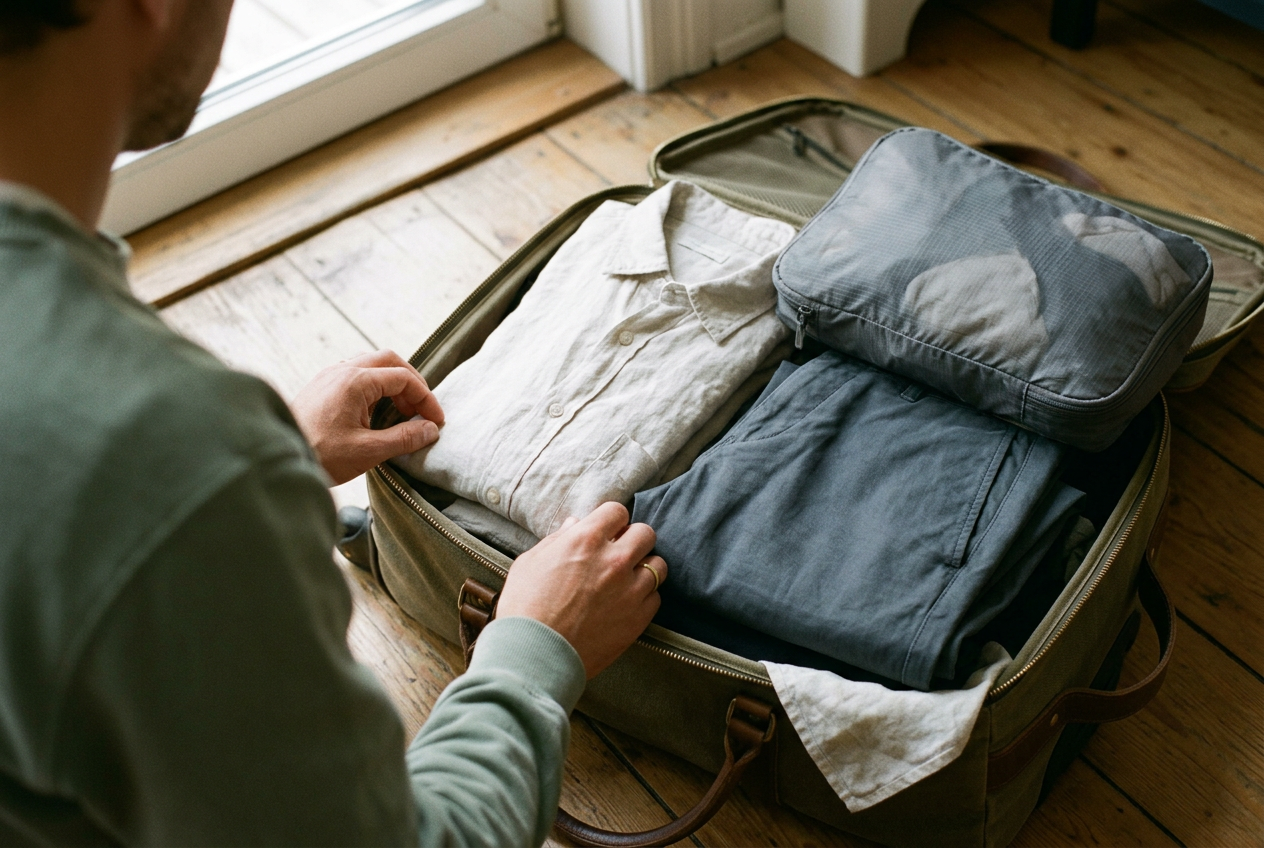
Bundle wrapping, meaning several garments folded around a central soft core, replaces sharp folds with larger curves. A pouch of underwear or a folded cotton T-shirt can form the core; trousers and dresses then wrap around it, with the most crease-sensitive garment placed on the outside where its curves stay broad.
Lay a dress flat, position the core around its lower torso and fold the skirt upward around the pouch without pulling. Bring the bodice down last, keeping the neckline smooth. Trousers can cross beneath it with the legs wrapping in opposite directions, which prevents all the bends from landing at one level.
This was gentler on a simple linen midi dress than rolling because the bodice remained flat and the skirt did not bunch. The tradeoff is access. Removing one garment loosens the whole bundle, so this method is inconvenient on a trip where the suitcase will be opened repeatedly.
The blue shirt also traveled well as the outer layer of a bundle, particularly because its pocket never met a narrow fold. Its collar remained exposed, however, and the method took more surface area to pack than a roll. Bundle wrapping earns its space when several linen pieces will be unpacked at once, not for one shirt tucked into an otherwise full carry-on.
A firm item can give linen one controlled curve
Packing around a firm item is a smaller, more predictable version of bundle wrapping. Choose a broad rectangular object with rounded or padded edges, such as a lightly filled packing cube. Avoid a book, boxed bottle or rigid electronics case, whose corners can mark the fabric.
Center folded trousers over the cube and bring each leg around a different side, keeping the knee area on a broad face rather than an edge. A column dress can wrap around the same cube with the bodice laid flat across the top and the skirt brought underneath. This method protects a shaped upper section while giving the longer fabric somewhere to go.
It is less useful for the blue shirt. The cube created a clean, generous curve through the body, but the collar and cuffs still needed separate positioning, and any overfilled edge showed as a rectangular impression. Rolling was quicker and left fewer defined marks.
Firm-item packing also fails when the suitcase is overstuffed. Once the surrounding clothes squeeze the cube, its broad edges become pressure points, which defeats the reason for using it.
Know which wrinkles humidity can release
Hang linen as soon as the suitcase opens. Use a wide hanger for a shirt or dress, undo the buttons and smooth the hem with clean hands. Trousers should hang from the waistband or cuffs so their own weight pulls along the leg.
Bathroom humidity can relax shallow ripples, light rolling marks and the soft compression wrinkles left across a loose skirt. Hang the garment in the room while a hot shower runs, away from spray, then let it dry fully before wearing. A handheld steamer can address the same wrinkles more directly; keep the head moving and support the fabric without pulling it out of shape.
Hard lines need contact. A crease through the blue shirt’s patch pocket, a fold pressed into a trouser placket or a sharp mark across a dress dart is unlikely to disappear through ambient humidity because several layers were compressed together. Dampen the area lightly and press it from the reverse with an iron at the setting allowed by the care label. Many pure linen garments tolerate substantial heat, but blends, linings, buttons and applied finishes may not.
Use a pressing cloth, meaning a clean piece of cotton placed between iron and garment, on dark colors or areas prone to shine. Lift and set the iron instead of dragging it across a shaped seam. The touch-up may cover only the collar, placket and pocket rather than the whole garment, which is why preventing those few hard creases saves more time than chasing every soft wrinkle.
Questions people ask
Is rolling always the best way to pack a linen shirt?
No. Loose rolling worked best for the regular-cut blue shirt because it kept a hard fold away from the patch pocket. A tailored shirt with a stiff collar, darts or structured cuffs may travel better as the outer layer of a bundle, provided nothing presses across its front.
Can shower steam remove suitcase wrinkles from linen?
Bathroom humidity can soften shallow rumpling and broad rolling marks after the garment hangs for a while. It rarely removes a narrow crease formed through a placket, pocket, dart or trouser seam. Those areas usually need direct steam or a dampened press with an iron.
Should linen trousers be rolled or folded?
Roll relaxed pull-on trousers loosely, especially when they have no crease to preserve. Flat-fold tailored or wide-leg trousers along their seams, using the broadest fold the suitcase permits, or wrap them around a lightly filled packing cube so the knees do not sit on a sharp bend.
Does tissue paper stop linen from creasing?
Tissue can reduce friction between layers and may stop details such as buttons from catching, but it does not remove pressure. A compact fold beneath shoes will still set. Use tissue as a small aid inside a broad fold, then protect the garment’s position in the suitcase.
One update a day
Today's fashion update, in your inbox
One fashion update each morning — no hype, no filler, just pieces worth wearing.