Why Some Linen Pants Survive a Full Day of Sitting
Linen will wrinkle, but deep seat creases and bagged knees are not inevitable. Fabric density, fiber blend, lining and hip ease determine how well pants recover.
August 10, 2026 · 8 min read
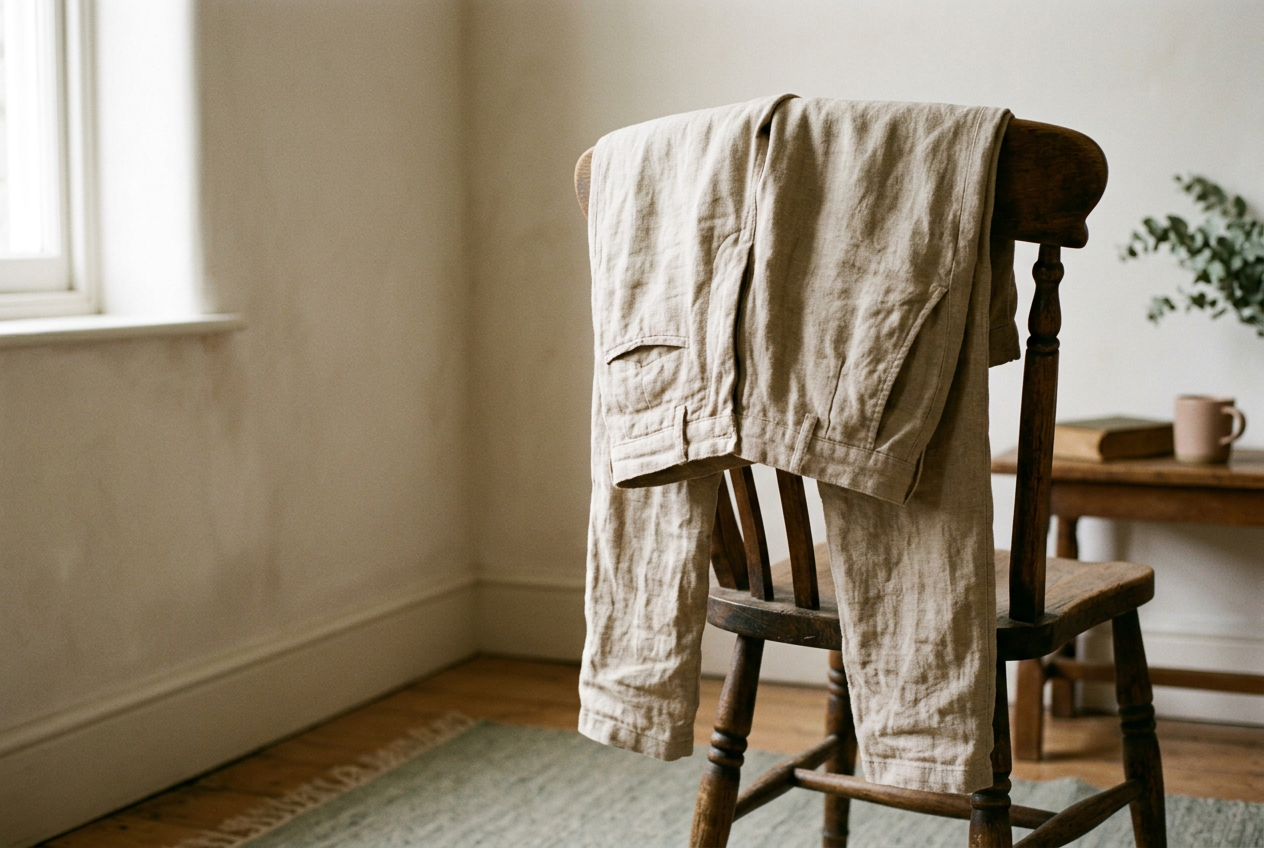
The useful test case is a familiar summer trouser: natural beige, full length, labeled 100% linen, unlined, light enough to show the outline of a hand through the fabric, and fitted neatly across the seat. It looks crisp on the hanger. After several hours at a desk, the lap develops sharp horizontal folds, the back of the knees crumples, and the kneecaps keep a rounded bulge after standing.
That pair has not failed because linen wrinkles. Linen fibers bend readily but have limited elastic recovery, meaning they do not spring back toward their original shape as readily as wool or many synthetics. The problem is that a light, open cloth and a close fit concentrate pressure in the same places, turning expected rumpling into creases that remain until the pants are steamed, washed or pressed.
This is unisex advice. The relevant measurements are the body and garment circumferences at the seat, upper thigh and knee, regardless of which department supplied the pants.
Start with the cloth, not the linen percentage
A 100% linen label says what the fibers are. It says little about how the finished fabric will behave.
The test pair uses a light plain weave, meaning each yarn passes over one yarn and under the next in a simple grid. Plain weave can be strong and beautiful, but a sparse version has less material supporting each bend. Hold it toward a window or bright fitting-room light. If individual yarns are easy to distinguish and the spaces between them appear prominent, expect the cloth to collapse more readily at the lap and knees.
Opacity is an imperfect shortcut, especially with dark colors, yet it is more informative than softness alone. A heavily softened linen can feel expensive while having very little body. Scrunch a section in your fist for several seconds, release it, then smooth it once with your palm. Fine surface lines are normal.
A hard-edged bundle of creases that stays compressed points to a fabric that will need regular steaming.
Return to the beige test pair and pinch the cloth at the thigh. It feels almost weightless, which is pleasant in heat, but the layer offers little resistance when folded. That tradeoff is real: the lightest linen often feels coolest, while a medium-weight fabric hangs more cleanly after sitting and is less likely to become translucent under tension.
Density matters as much as weight
Weight and weave density overlap, but they are not identical. A fabric can use thicker yarns and still be woven loosely, giving it a substantial hand without stable coverage. Density describes how closely the yarns sit together; closer yarns spread stress across more of the cloth instead of letting a few strands take the strain.
Look at the pants over a bent knee. If the weave opens visibly or the color becomes much lighter at that point, the fabric is under meaningful tension. Repeated sitting can encourage yarn slippage, where yarns shift away from one another around a seam, as well as persistent knee shaping. Neither effect is cured by accepting wrinkles as part of linen’s charm.
A linen twill, meaning a weave with subtle diagonal ribs, may drape more fluidly and disguise creasing better than a very light plain weave. It is not automatically wrinkle-proof. The useful distinction is whether the cloth feels compact and returns toward flat after being bent, rather than whether the product description uses words such as premium or washed.
Dense fabric has costs. It can feel warmer, take longer to dry and produce a more tailored line than someone seeking loose beach pants wants. For office wear, travel or dinner after a day seated, that extra body is usually the better compromise.
Blends can improve recovery, with tradeoffs
Pure linen gives the driest hand and most recognizable irregular texture. A blend can be the more practical purchase when the main concern is sitting.
Linen blended with cotton often feels familiar and may crease a little less sharply, though cotton also holds wrinkles and does not guarantee strong recovery. Linen-viscose fabric, with viscose being a regenerated cellulose fiber known for fluid drape, can hang softly and feel cool; in a thin weave, however, it may stretch at the knees rather than support them. Check the cloth itself instead of assuming softness equals resilience.
A small amount of elastane can help pants accommodate the hip and knee, but stretch is not the same as recovery. If the base fabric is loose and the trousers are cut tight, the knees can still bag because the cloth remains extended for hours. High synthetic content generally improves wrinkle resistance, though it changes linen’s dry feel and may hold more heat.
For the beige test pair, a compact linen blend would be a more useful alternative than merely sizing up in the same open 100% linen cloth. More room would reduce strain, but it would not give the fabric body it never had.
Hip ease decides where the creases settle
Ease is the difference between body measurements and garment measurements. Linen trousers need enough of it through the seat and upper thigh to let the wearer sit without pulling the fabric into a tight horizontal shelf across the lap.
Watch the pockets. Side pockets that flare while standing, back pockets that gape, or front pleats that spread flat are signs that the hip area is already using up its intended ease. When seated, that tension travels toward the rise and knees, where folds become deeper and the cloth stays distorted longer.
The waistband can fit correctly while the seat is too small. This often happens when a shopper chooses a size by waist measurement, then relies on a partly elastic waistband to make the rest of the pants feel wearable. If moving up one size fixes the seat but leaves the waist unstable, the better answer is a different cut or a waist alteration, not a belt cinched hard enough to gather the fabric.
Rise matters too. A short or restrictive rise pulls the crotch seam upward when seated, creating radiating creases across the front. More hip ease cannot correct a rise that does not match the body. Sit, cross one ankle over the opposite knee, and lean forward.
The pants should move without the waistband dragging down or the front seam pulling tight.
Our light beige pair looks trim while standing because the fabric skims the seat. That same neatness is the warning. A straighter leg with a fraction more room at the thigh would preserve the line better over a full day than a narrow cut that photographs cleanly for five minutes.
Lining helps selectively
A lining creates a smoother inner surface and keeps the outer cloth from gripping skin or underwear. In linen trousers, a partial lining through the seat can reduce show-through and soften the deepest creases around the lap, particularly when the outer fabric is light.
It does not make weak cloth strong. A tight lining may even worsen pulling because the two layers compete for room. Check that the lining hangs freely when standing and does not tug across the thighs when seated. Breathable cupro or viscose linings generally feel less clammy than inexpensive polyester, although any extra layer adds warmth.
Full lining can make sense for tailored linen pants intended for air-conditioned rooms. For hot outdoor wear, a denser unlined cloth may be more comfortable and easier to wash. The test pair’s lack of lining is not its central flaw; the open weave and close hip are doing more damage.
Use a sitting test before buying
Spend several minutes seated in the pants before removing the tags. Use a firm chair rather than a soft sofa, since a firm seat puts clearer pressure across the lap and back of the thighs. Stand, wait a minute, then inspect the knees, front rise and seat in natural light.
Expect narrow lines across the lap. Be cautious if the knees remain domed, the front folds turn white at their peaks, or the fabric stays sharply doubled beneath the seat. Rub one crease lightly between finger and thumb. If it relaxes, routine movement may be enough; if it holds like a pressed fold, the trousers will probably need steam before a second wear.
Also inspect seam areas. Open spaces around the seat seam or pocket corners suggest that the cloth is being pulled apart. Do not treat that as normal linen wrinkling. It is a fit or fabric-stability problem, and repeated wear can make it more visible.
Pay for construction, not a purity claim
Pure linen is not automatically the investment choice. At any price, inspect density, seam behavior and room through the hip. A modestly priced linen blend with compact coverage can outwear a costly, tissue-light pure linen trouser when both spend most of the day against a chair.
Care expectations belong in the calculation. Light linen may need steaming after every long wear, while a denser cloth can often rest overnight and look presentable with localized steam at the lap. Hanging pants from the waistband lets their own weight soften wrinkles. Folding them immediately along accidental seat creases sets those lines more firmly.
Wash according to the care label and avoid high dryer heat, which can shrink linen and remove the ease that made the trousers wearable. If the beige test pair already strains through the seat, even slight shrinkage will deepen the same folds the next time it reaches a desk chair.
Questions people ask
Are wrinkles in linen pants always a sign of poor quality?
No. Fine creases and an overall rumpled surface are inherent to linen because the fiber has limited elastic recovery. Deep, fixed folds, persistent knee bulges and opening around seams point more strongly to light or unstable fabric, excessive tension, or a cut that lacks room through the hip and thigh.
Is heavier linen always better for pants?
Heavier linen usually has more body, but weight alone does not guarantee stability. Check whether the yarns sit closely together and whether the fabric springs partway back after being squeezed. A heavy, loose weave can still distort, while a compact medium-weight cloth may recover better and feel cooler.
Should linen pants be sized up to prevent creasing?
Size up only if the larger size gives useful ease through the seat and thigh without making the waistband unstable. If the rise still pulls or the larger waist must be tightly belted, switch cuts. Extra fabric at the waist does not correct a mismatched rise or fragile weave.
Can knee bagging be removed from linen pants?
Light bagging often relaxes after hanging overnight or with steam directed from the inside. A pronounced bulge caused by a stretched, open weave may return as soon as the pants are worn again. Steam without pressing the knee into a hard crease, then let the leg hang straight until dry.
One update a day
Today's fashion update, in your inbox
One fashion update each morning — no hype, no filler, just pieces worth wearing.