Jelly Sandal Buckles Lose Their Advantage in Heat
Buckle holes adjust a jelly sandal when it is cool. Once the plastic warms, strap stretch and concentrated hardware pressure can turn that precise setting into a suggestion.
November 16, 2026 · 7 min read
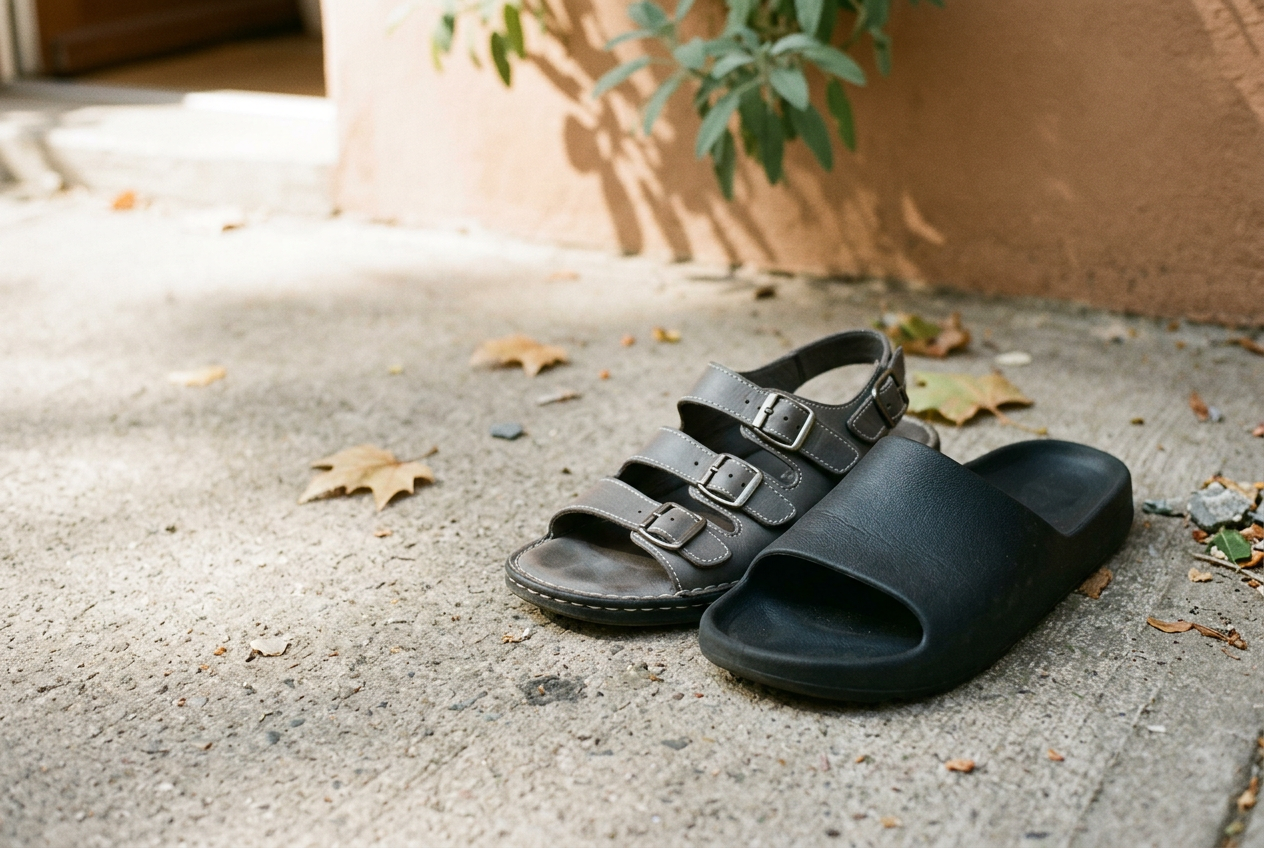
The test case was a smoke-gray fisherman-style jelly sandal with a five-hole ankle strap and metal pin buckle, worn against a black molded slide whose upper and sole formed one continuous piece. Both were unlined, flexible and sold as casual warm-weather shoes. Neither contained the sort of footbed that would interest an arch.
This is unisex fit advice. The important measurement is foot volume, meaning the amount of space your foot occupies through its width and height, rather than the gender printed beside the size selector.
I wore the pairs over one warm week on the same ordinary circuit: pavement, public transit, indoor errands and a longer walk that was ambitious only by jelly-shoe standards. The buckled pair began on its middle hole, snug enough to touch the ankle without leaving an indentation. The molded slide began close across the forefoot, with no visible gap at the sides.
This was a wear comparison, not a laboratory heat test. Plastic formulas vary, direct sun can make a shoe much hotter than the surrounding air, and a dark upper may absorb heat differently from a clear one. The useful result is therefore the direction of change: where each shoe softened, where pressure moved and whether its fit still felt controllable.
The buckle adjusts one point, not the whole strap
The fisherman sandal was made from soft PVC, or polyvinyl chloride, a thermoplastic commonly used for the glossy, flexible body of a jelly shoe. A buckle makes that material look conventionally adjustable. Move the pin to another hole and the circumference changes. In a cool room, it works.
Outside, the distinction between circumference and tension started to matter. The buckle still held the selected hole, but the PVC on either side of it flexed more as the shoe warmed, especially where the strap left the rigid buckle frame and curved toward the ankle. My foot had not become smaller. The strap had become less resistant.
That change was modest at first. The heel began lifting slightly later in each step, and the ankle strap could be pulled farther from the skin without opening the buckle. Moving to the next tighter hole restored contact, but it also drew the metal frame inward, concentrating pressure over a smaller patch near the ankle bone. The shoe felt tighter at the hardware and looser everywhere else.
This is adjustment, technically, in the same way that moving a troublesome chair counts as interior design.
The middle hole remained usable after the pair cooled. Warmth did not instantly ruin the strap or tear the pin through it. Yet the hole carried more load once the softened PVC began moving, and its originally round opening showed the tendency that matters with repeated wear: the pin pulls toward one edge rather than distributing force across the strap.
A reinforced hole would slow that distortion, although reinforcement is uncommon on inexpensive jelly sandals because adding a separate eyelet or a layered strap complicates a shoe whose appeal partly rests on cheap, wipe-clean construction. A thicker strap can also help, provided its edges are rounded. Thick PVC with a sharp molded edge merely supplies a sturdier object for rubbing.
Hardware creates its own fit problem
The metal buckle never failed. That is not the same as saying it improved the shoe all day.
Rigid hardware interrupts a flexible strap, so the frame and pin stay put while the surrounding plastic bends. On the smoke-gray pair, the pressure point became clearer after the strap warmed and I tightened it one hole. The buckle sat closer to the ankle, while the free end curled more readily and began slipping within the keeper, the small loop that holds the strap end flat.
Sweat made the problem less dignified. Moisture reduced friction between the foot and the footbed, which let the foot slide forward slightly; the ankle strap then had to check that movement, and its buckle edge pressed harder even though the overall sandal felt looser. No setting solved both ends of the shoe. Returning to the middle hole reduced hardware pressure but allowed more heel lift.
Placement matters here. A buckle sitting well behind or below the ankle bone is easier to tolerate than one aligned directly over it, and a broad strap spreads load better than a narrow one. Look inside the shoe before buying. If the metal frame or pin can touch skin through the fastening slot while the sandal is cool, warmth is unlikely to improve relations.
Metal also takes on heat from its surroundings. I would not leave a buckled jelly sandal in a parked car or direct sun and then put it straight on, though the plastic itself is also a reason to avoid that treatment. Let the pair return to a wearable temperature rather than testing whether decorative hardware can cook an ankle.
The molded slide moved less, within limits
The black slide had no buckle, holes or separate strap ends. Its upper rose from the sole as one molded structure, so there was no small section carrying the full pull of the foot. The plastic still softened during wear, but the change spread across the arch of the upper rather than gathering around a pin.
That made its fit more consistent over the same route. The forefoot remained held without a new hard spot appearing, and the opening did not seem to change shape as noticeably while walking. A one-piece upper can flex as a system, which is less glamorous than a buckle and more useful when the shoe warms.
The molded construction did not make the slide universally secure. There was no ankle strap, so my toes worked harder on quicker steps and inclines, and anyone between sizes would have no mechanical way to reduce the upper’s volume. If a molded slide gaps over the instep in the fitting room, heat will not turn it into a fitted shoe. If it starts too tight, buying it in hopes of strategic stretching asks the plastic to make a sizing decision on your behalf.
Material matters as much as construction. Some jelly-looking shoes use TPU, or thermoplastic polyurethane, which can offer different rebound and abrasion behavior from a soft PVC formula. Retail descriptions are often vague, but the material label molded into the sole or printed on the packaging is worth checking. “Synthetic” tells you almost nothing about heat response.
Nor does “molded” guarantee that a shoe will keep its shape. Thin uppers can flare outward, and very soft slides can flatten under the forefoot. The advantage in this comparison was load distribution: without punched holes and hardware, the black slide had fewer places where warm flex could become a localized fit failure.
What to check before paying for the buckle
A buckle earns its place when it changes the starting fit without creating pressure. Try the sandal late enough in the day that your feet are not at their smallest, fasten it on a middle hole and walk until the material has had time to warm against the skin. A pair that only fits on the tightest hole while cool has no useful adjustment left.
Pull the fastened ankle strap gently away from the foot. Some flex is normal, but watch where it occurs. Even bending along a broad strap is preferable to a sharp kink beside the buckle, an elongated hole or a narrow section that turns pale under tension. Check whether the free end stays inside its keeper after several steps.
The smoke-gray pair passed the basic cold fitting and still became less precise outdoors. That is the limitation shoppers should price in. Buckled jellies often sit above the cheapest molded slides because they require separate hardware and assembly, but the added cost buys styling and initial adjustability rather than guaranteed hot-weather control. At the budget end, I would choose the better-shaped molded upper over a decorative buckle mounted on thin PVC.
For a fisherman silhouette, where the ankle strap contributes real retention, look for a broad strap, rounded edges and enough holes to leave one setting available on either side of your starting point. A buckle backed by plastic, rather than exposed directly to skin, is preferable. The sole should also bend at the forefoot rather than folding through the arch, because an unstable base makes every strap work harder.
The molded slide is the steadier choice for errands and flat walking when its upper matches your foot volume from the start. The buckled sandal remains more adaptable between cool mornings and mildly swollen feet, but each tighter setting increases the chance that rigid hardware becomes the dominant sensation.
After the week, I would keep the smoke-gray pair for shorter outings and wear the black molded slide when the route involved sustained pavement. The buckle survived. Its promise of precise adjustment did not survive warmth quite as well.
Questions people ask
Do buckle holes stop jelly sandals from stretching in heat?
No. The buckle can remain securely pinned while the PVC strap stretches or flexes around it. Holes control the strap’s starting circumference, but they do not stop warm material from becoming more yielding between the buckle and the foot. Reinforced holes and broader straps reduce localized strain.
Are molded jelly straps always more stable?
A one-piece molded upper usually distributes movement more evenly because it has no buckle hole carrying concentrated tension. Stability still depends on material thickness, shape and fit. A molded slide that gaps over the instep or uses very soft plastic may move more than a well-made buckled sandal.
Should jelly sandals fit tightly when they are new?
They should feel close without pinching, trapping the toes or pressing hardware into the ankle. Do not size down on the assumption that heat will create a perfect stretch. Warm plastic may loosen unevenly, while feet also swell during wear, leaving pressure at the edges and movement through the center.
Which style is better for a hot day with plenty of walking?
Choose a molded upper if it fits securely while cool and the route is mostly flat, since it removes the buckle as a pressure point. For stronger heel retention, a broad buckled strap can work, but leave adjustment in both directions and avoid hardware positioned directly over the ankle bone.
One update a day
Today's fashion update, in your inbox
One fashion update each morning — no hype, no filler, just pieces worth wearing.