Fisherman Sandals Work Best When the Cage Earns Its Weight
Leather, jelly, and hybrid fisherman sandals share a caged toe, but they do not earn it equally. The useful pair protects without trapping heat or swallowing the foot.
August 20, 2026 · 8 min read
The fisherman sandal has moved from practical summer shoe to shape-making accessory. Its defining feature is the caged upper, where interlaced straps close off most of the toe while leaving narrow gaps for air. That extra material matters: it changes how the shoe bends, where it rubs, and how much of an outfit it occupies.
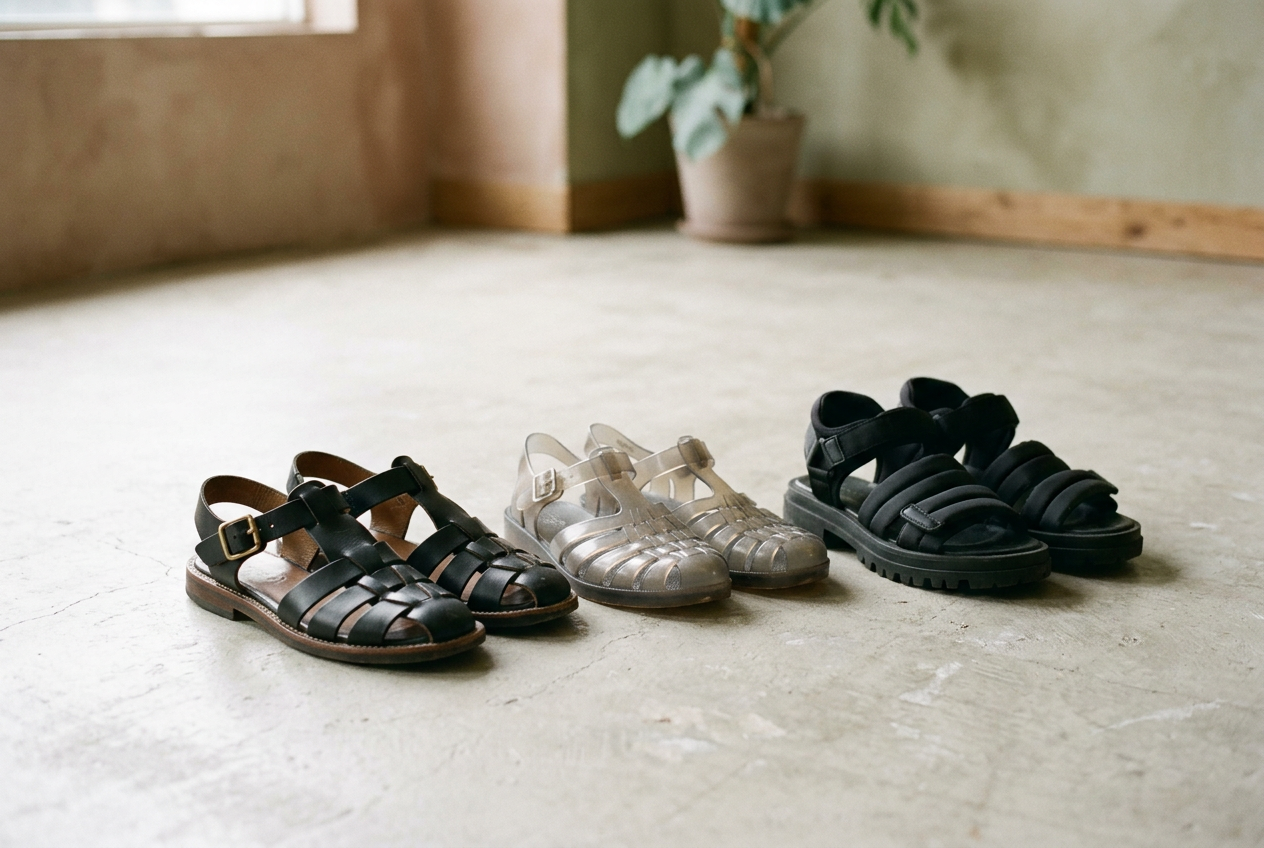
The anchor for this comparison is a black leather pair from my own wardrobe, worn repeatedly over one warm week with loose trousers, straight jeans, and a calf-length skirt. The upper is smooth leather, the toe is rounded rather than bulbous, and five broad straps cross a central strip before meeting an adjustable ankle buckle. Underneath sits a thin rubber outsole with little cushioning.
That pair clarified the split. A fisherman sandal can be a useful middle ground between an open sandal and a closed shoe, especially on crowded sidewalks or uneven ground, but only if its cage flexes with the foot. Once the sole becomes thick and the upper stiff, the protection starts to feel like an explanation for bulk that the wearer still has to carry.
This is unisex advice. The silhouette appears across women’s and men’s departments, though sizing conventions vary, and the more important fit questions concern width, strap placement, and heel security rather than the label on the box.
The leather version justifies the coverage
On the black pair, the leather cage blocked small knocks without sealing the foot. The gaps between straps let heat escape, and the material softened where the toes bend after several wears. That softening was the useful kind of break-in: the upper stopped resisting the forefoot rather than collapsing out of shape.
Leather still asks for patience. During the first long outing, the central strip pressed lightly against the top of the second toe, while the rear strap needed one looser buckle hole as the day warmed and the foot expanded. Neither issue became a blister, but both show why a fisherman sandal should be tried while standing, with the toes flexed rather than neatly at rest.
The toe cage also protected a pedicure and kept grit away better than a sparse strappy sandal. It did not keep out dust, and it would be generous to call it weatherproof. Water enters through the openings, then sits against the foot until the leather and footbed dry. A leather pair is for city walking and mixed summer dressing, not repeated soaking.
Construction decides whether the higher price band makes sense. Look for straps that feel smooth on both sides, enough space between them to release heat, and a sole that bends at the ball of the foot. Leather fisherman sandals tend to cost around what shoppers expect from good leather shoes rather than disposable vacation footwear, so a rigid upper glued to a platform sole is a poor bargain even if it photographs well.
The black pair earned its cage because the upper and sole moved together. Its weakness was underfoot, not overhead: after a full walking day, the thin footbed felt flat. A cushioned insole would help only if the shoe has enough internal depth, since adding one can push the toes upward into the central leather strip.
Jelly changes the problem rather than solving it
A jelly fisherman sandal usually uses PVC, meaning polyvinyl chloride, or another molded plastic for the cage and often the sole. That makes it washable and indifferent to a splash, which is real function around pools, beaches, and sudden summer rain. The material does not absorb water like leather.
It also does not manage sweat well. The openings may look generous, yet every strap touching the skin is nonabsorbent, and the molded footbed can become slick as heat builds. Ventilation is not just the amount of visible foot; it also depends on whether moisture can leave the contact points. On a humid walk, jelly can feel hotter than a leather cage with similar spacing.
Fit adjustment is usually limited. Some pairs have a working buckle, but many rely on molded holes, a fixed heel strap, or a decorative fastening attached to an upper that barely gives. Plastic will not break in like leather. If an edge catches the little toe in the fitting room, warmth and walking are unlikely to make that edge kinder.
Jelly does have a coherent visual role. Clear, smoky, or saturated translucent versions make the cage look intentional, and the lower price band can be reasonable for a water-friendly second sandal. The mistake is buying one as an all-day walking replacement for leather. Check the inside for molding seams, particularly at the toe opening and heel, then walk on a warm surface if the return policy allows indoor testing.
Compared with the black leather pair, jelly gave up adjustability and long-wear comfort for easier cleaning. That is a fair exchange near water. Away from it, the plastic cage mainly delivers the silhouette.
Hybrids need closer inspection
The hybrid category combines a fisherman upper with sneaker or hiking-shoe components: padded textile straps, hook-and-loop closures, foam midsoles, rubber toe guards, or deeply treaded outsoles. A midsole is the cushioning layer between the foot and the ground. These pairs can be the most comfortable underfoot, but they are also where the shape acquires the most visual weight.
Some additions earn their place. A foam midsole helps on hard pavement, while two adjustable straps can accommodate swelling and different instep heights. Textile webbing dries faster than substantial leather, and a properly positioned toe guard protects more effectively than decorative straps floating above the toes.
The less convincing hybrids stack a thick sole under a dense upper without improving either airflow or control. If the heel still lifts, the platform only makes the shoe heavier. If padding wraps every strap, the apparently ventilated cage can hold warmth around the forefoot. Lugged tread, meaning a sole patterned with deep gripping projections, is useful on loose or wet ground but unnecessary for a mostly indoor summer shoe.
Compare the weight of both shoes by hand, then bend one at the forefoot. A hybrid that feels reluctant before it is on the foot will ask the ankle to move that stiffness through every step. The black leather pair had less cushioning, yet its low weight made it easier over short urban distances than a more padded shoe whose heel moved independently of my own.
Hybrids also occupy more of an outfit. They work cleanly with wide shorts, technical trousers, or a plain column dress because those clothes can hold a substantial shoe. Under narrow ankle-length pants, a broad cage and thick outsole tend to interrupt the line rather than finish it.
Fit starts at the toe, not the buckle
Fisherman sandals can look adjustable while offering only one meaningful point of adjustment. The buckle changes heel hold, but it cannot widen a fixed cage or move a strap away from a prominent toe joint. Anyone between widths should prioritize the forefoot fit and accept that the ankle strap is for fine-tuning.
There should be a small margin beyond the longest toe, with no toe pushing through a side opening. Too much extra length is also a problem because the cage’s flex point will sit ahead of the foot’s natural bend. On the black pair, the correct length placed the widest part of my foot under the broadest opening, which prevented the leather edges from pinching as I stepped.
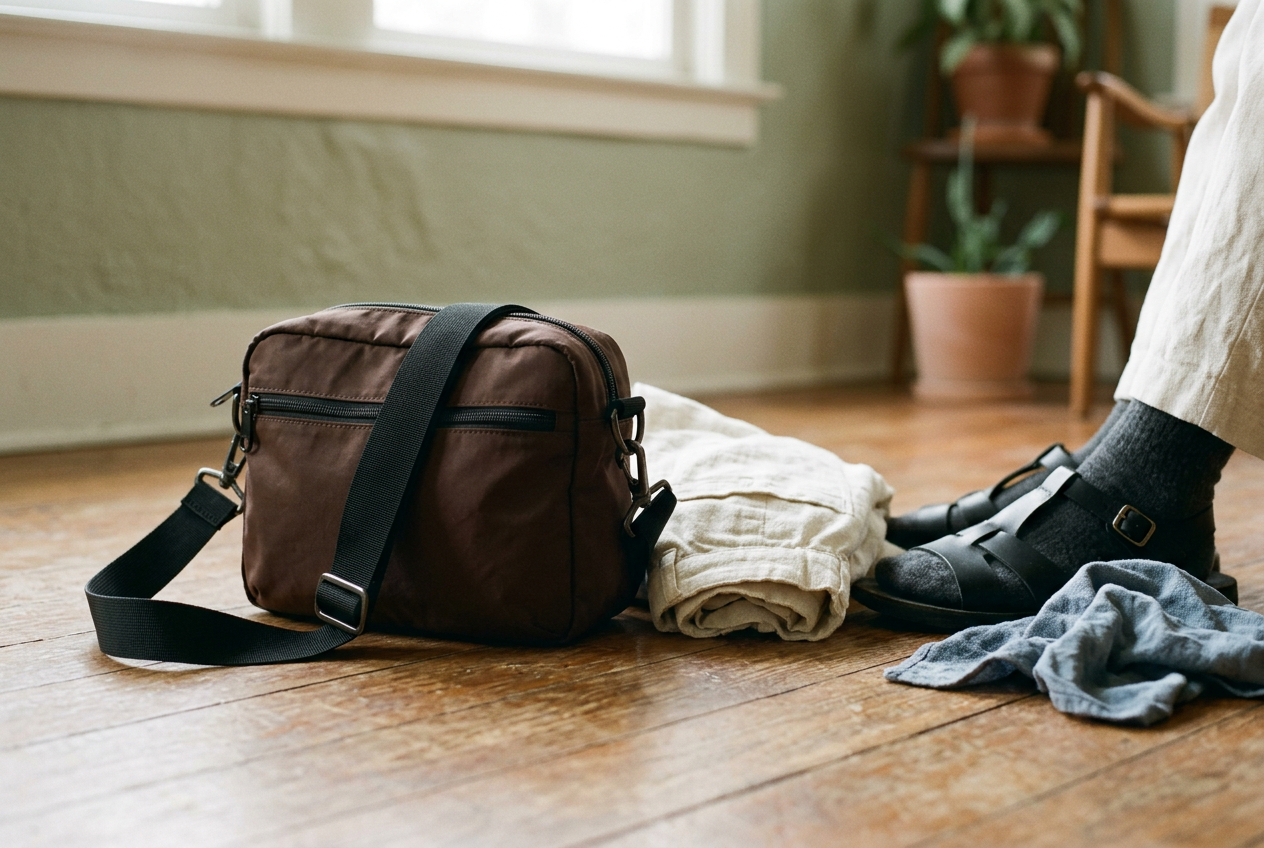
Try both shoes late in the day, when feet are more likely to be warm, and test them without assuming socks will repair the fit. Socks can reduce friction in leather pairs, but they also add volume inside a closed cage. With jelly, they defeat much of the water-ready appeal and may still slide against the plastic footbed.
The version likely to last stylistically
Leather has the strongest styling longevity because its material already belongs to familiar shoe categories. A dark brown or black pair can sit under relaxed tailoring, washed denim, or a simple summer dress without making the cage the whole point. As the leather creases, the shoe generally looks worn rather than obsolete.
Jelly is more cyclical. Its translucence and shine announce a summer trend, which can be appealing, but the effect is harder to detach from a particular season. Choose jelly for color, water, or deliberate nostalgia rather than as the neutral pair expected to carry several years of outfits.
The fate of hybrids depends on proportion. Low-profile versions with real adjustment and moderate cushioning should outlast the current appetite for bulky shoes. Oversized soles paired with thick cages are less settled. They can look convincing now, particularly beside roomy clothes, yet removing even one exaggerated element would make them easier to keep wearing.
My black leather pair remains the useful benchmark. It protects the toes more than an open sandal, breathes better than a closed shoe, and stays visually quiet because the sole is slim. I would pay more for that balance, though I would not pay an investment-shoe price without better cushioning or a replaceable outsole.
The verdict stays divided. Leather adds function when the straps flex and the fit is exact. Jelly earns its place around water. A hybrid deserves the extra bulk only when its cushioning, grip, or adjustment answers a real walking need; otherwise, the cage has become weight without protection.
Questions people ask
Do fisherman sandals run wide or narrow?
The category is inconsistent because the cage can disguise a narrow internal shape. Judge the broadest part of the forefoot, not the apparent width of the sole, and reject any pair that lets a toe press through an opening. An ankle buckle can secure the heel, but it cannot correct a cage that is too narrow.
Are leather fisherman sandals comfortable for all-day walking?
They can be, provided the upper flexes at the forefoot and the sole has enough cushioning for the distance. The black leather pair stayed comfortable across shorter city outings but felt flat after a full walking day. A heavier hybrid may suit long pavement hours better if its heel remains secure.
Can jelly fisherman sandals get wet?
Molded plastic uppers tolerate water and wipe clean easily, but buckles, glued components, and decorative hardware may still need drying. Wet plastic can become slippery against bare skin, so secure heel hold matters. Rinse off salt or grit, then let the pair dry away from direct heat.
How should fisherman sandals fit at the toes?
The longest toe should sit inside the cage with a small forward margin, while the side openings remain clear of toe joints. Flex the shoe while standing. If a strap edge presses immediately, leather may soften a little, but molded jelly is unlikely to change enough to fix the placement.
One update a day
Today's fashion update, in your inbox
One fashion update each morning — no hype, no filler, just pieces worth wearing.