Fisherman Sandals Look Lighter. Check the Sole Before You Buy.
Slim straps and cream leather have softened the fisherman sandal, but only a change beneath the foot reduces its weight. The useful clues are EVA, limited rubber and a flexible forefoot.
Women's · November 19, 2026 · 7 min read
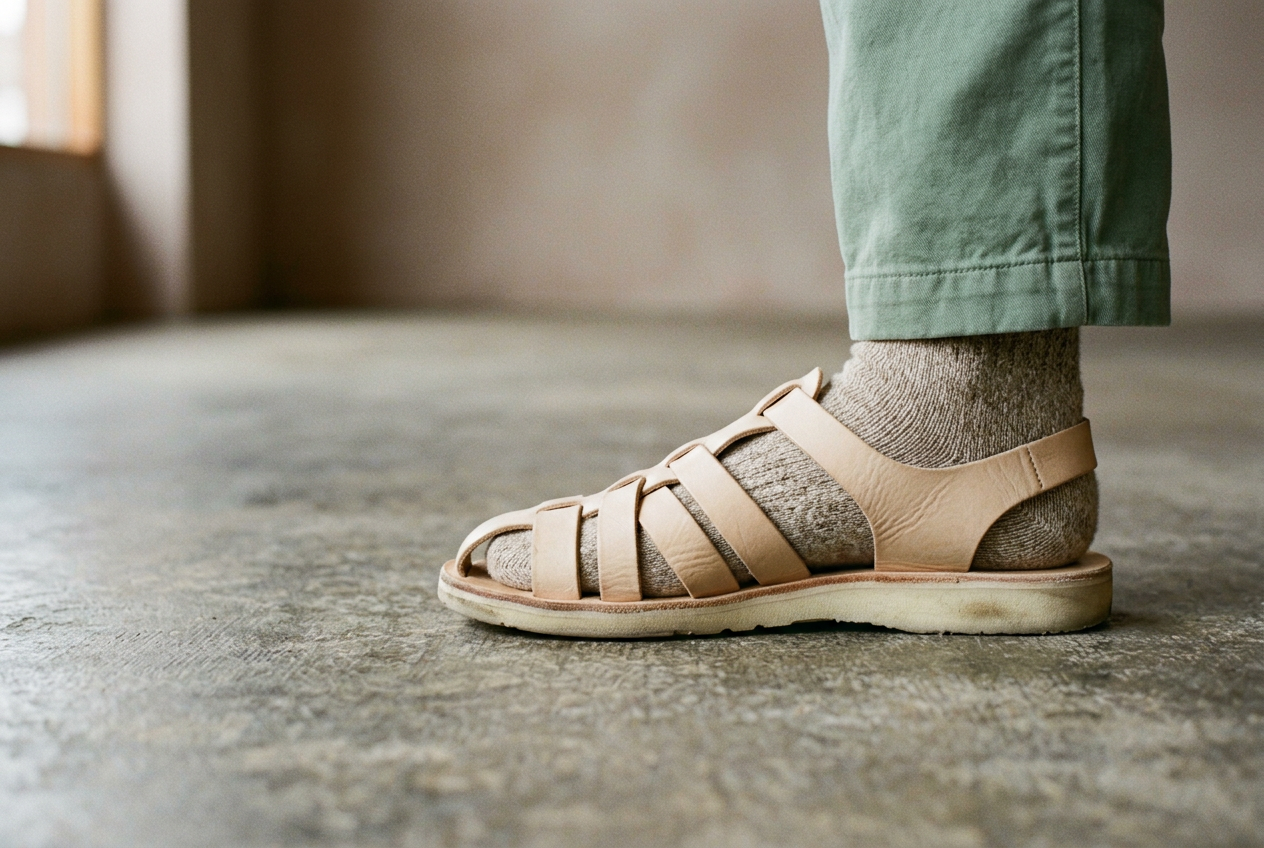
The fisherman sandal has lost some of its visual ballast. Current women’s versions arrive in bone, chalk and pale tan rather than the dark brown most associated with the traditional shoe; their leather strips are narrower, their buckles smaller, and their soles often matched to the upper instead of outlined in black. Seasonal fashion coverage reads this as a lighter sandal. Sometimes it is.
The Dr. Martens Wrenlie Fisherman Sandal is a useful case because one line in the brand’s product documentation makes a material claim rather than a styling one: the sandal sits on a lightweight Zebrilus sole made from EVA. EVA, or expanded ethylene-vinyl acetate, is a foam commonly used to cushion athletic shoes. That matters more to weight than the Wrenlie’s open sections or relatively soft Milled Nappa leather.
Without a published weight for every size, it would be careless to assign the Wrenlie a neat number or declare it the lightest sandal in its bracket. The construction still tells us something. An EVA base generally carries less mass and flexes more readily than a similarly proportioned unit made from dense rubber or PVC, while the pebbled leather upper should require less softening than a thick, smooth hide. The shoe looks softened, but its sole suggests that at least part of the change is physical.
The sole is where the trend becomes real
A pale upper can make a covered sandal appear cooler without changing what the foot has to move. Narrowing the straps removes a little material, although not enough to transform a heavy rubber platform. Even the visual space between straps can mislead: a sandal with generous cutouts may still feel anchored to the pavement if its outsole is thick, stiff and dense.
The better product descriptions name the sole material by layer. A foam-backed sole has a cushioning foam section beneath the foot, sometimes protected by a harder rubber sheet or small rubber pads where abrasion is greatest. That arrangement can reduce weight while preserving grip. A full rubber outsole tends to resist wear better, but if the entire platform is rubber, the sandal may feel heavier and take more effort to bend.
Molded foam sits at the other end of the spectrum. Crocs’ Stomp Fisherman Sandal, for example, uses the brand’s molded Croslite material and presents an exaggerated profile that looks heavier than its foam construction suggests. The comparison with the leather Wrenlie is useful. One shoe has the familiar substantial appearance of a platform but a foam body; the other uses leather and heritage-shoe details over an EVA base.
Neither can be judged by silhouette alone.
Rubber placement deserves attention. A thin rubber contact layer under foam adds durability with a smaller weight penalty than a deep rubber block, while isolated rubber pods can protect the heel and forefoot yet leave exposed foam vulnerable along the edges. If product photographs show the bottom, look for where the harder material begins and ends. A completely uniform outsole may indicate one molded material, but the description should confirm which one.
Less stiff is not the same as less structured
Weight and stiffness often travel together, but they are not interchangeable. A thick foam sole can be light and resistant to bending because of its shape. A thinner rubber sole may weigh more for its size yet flex easily at the ball of the foot. The useful test in a store is to hold the heel and press the toe upward: the sandal should bend where the foot bends, not fold through the arch.
A shank, meaning a reinforcing piece through the middle of the sole, can steady a platform and stop it twisting. That support may suit someone who dislikes a floppy sandal, although it also makes the shoe feel more present during a long walk. Product pages rarely explain shanks clearly, so the twist test helps. Hold the toe and heel, then rotate gently in opposite directions.
Some resistance is reassuring. No movement at all points to a longer break-in or a deliberately rigid ride.
Return to the Wrenlie here. EVA addresses the mass underfoot, and the milled leather addresses initial upper stiffness, but the covered shape still puts several edges across the foot. Soft leather is not friction-free leather. If one strip lands on the little-toe joint, where feet often widen and swell in heat, a lighter sole will not rescue the fit.
The first fitting should happen late enough in the day for the foot to have expanded. Fasten the ankle strap as it will be worn, then check that the toes are not gripping to keep the shoe on and that no vertical strap bows away from the foot. Narrow straps can concentrate pressure more sharply than broad ones. The new delicacy has a tradeoff.
What makes the covered shape workable in heat
Ventilation depends on the position of the openings, not their total visual effect. Space around the toes helps, but a closed or tightly woven vamp, the upper section over the front of the foot, can still trap warmth across the broadest area. Openings along both sides let heat escape more effectively than decorative slots placed only on top.
Lining changes the experience too. Unlined leather can feel cooler and soften closely to the foot, although unfinished edges may rub and dye can transfer when damp. A smooth leather lining adds material but usually gives the straps a cleaner underside. Synthetic padding may feel comfortable during the fitting and warmer after a longer walk.
If the product page only says “leather upper,” inspect the underside or ask what touches the foot.
Foam can make hot pavement easier to tolerate because it places a cushioning layer between skin and ground, but a deeply cupped synthetic footbed may collect perspiration. Closed-cell foam, which contains sealed air pockets, absorbs little water; that does not mean the surface stays dry. A leather-covered footbed can manage the sensation better, though it takes longer to dry after rain and may show darkened toe marks.
Color affects upkeep more reliably than temperature. Chalk and cream make the fisherman outline look less enclosed, particularly with light trousers or a bare leg, yet pale leather exposes buckle marks, denim transfer and dust around every strap junction. Cleaning woven intersections takes longer than wiping a two-strap sandal. Anyone buying the pale version for daily transit should budget for a soft cloth and spot cleaning rather than assuming the finish will age invisibly.
After a week, the upper may have relaxed while the sole remains much as it began. That distinction matters when deciding whether to keep a slightly stiff pair. Leather can yield across pressure points, but an outsole that barely flexes in the fitting room is unlikely to become foam-like through determination. Return the shoe if the sole fights the foot or a strap sits directly on a joint.
Break-in is reasonable for surface stiffness, not misplaced construction.
The buying decision is in the specifications
Fisherman sandals now span from molded high-street foam pairs to leather versions priced around a good pair of sneakers, with luxury interpretations costing several times more. Paying more can buy finer leather, neater edge finishing and a replaceable outsole, but it does not guarantee lower weight. Some expensive pairs retain dense rubber precisely because it wears well and gives the silhouette its grounded character.
Before ordering, search the product page for “EVA,” “foam midsole,” “lightweight outsole” or a stated weight per shoe. Check whether any rubber is a thin protective layer or the whole sole. Then enlarge the side view. Stack height, the amount of material between the foot and ground, can reveal why a technically light shoe still feels bulky or unstable.
The Wrenlie’s EVA specification clears the first test. Its leather cage still needs a fit check, especially across the forefoot, and its Dr. Martens styling has not become visually weightless. That is the more interesting direction of this trend: covered sandals are being engineered to demand less from the foot without giving up their substantial outline.
Thin straps alone are not worth paying extra for. A pale color alone is a styling choice. Foam beneath the foot, sensible rubber placement and a forefoot that bends are the construction changes that make the fisherman sandal easier to use through summer. I remain undecided on whether the silhouette itself has become light; the best versions have merely stopped insisting that sturdiness must feel heavy.
Questions people ask
Are fisherman sandals too hot for summer?
They can work in heat when the openings continue around the sides and the footbed does not trap moisture. A tightly covered vamp, synthetic padding and straps crossing the widest part of the foot can make even a pale sandal feel warm once feet swell.
How can
I tell whether a fisherman sandal is genuinely lightweight?
Read the sole specification rather than relying on thin straps or color. EVA and other molded foams usually reduce mass; a limited rubber contact layer can add wear resistance without recreating a dense outsole. A listed shoe weight is best, but many brands do not provide one.
Should fisherman sandals feel tight when they are new?
The leather may feel firm, but no strap should press into a toe joint or leave the toes gripping for stability. Fit later in the day, when feet are fuller, and return a pair that is rigid through the forefoot. Leather relaxes; badly placed straps do not move.
Are pale fisherman sandals harder to maintain?
Yes. Cream and bone leather show dust, denim dye and grime around the woven strap intersections sooner than dark brown or black. Wipe marks promptly with a method approved for the specific leather, and let damp sandals dry away from direct heat so the upper does not harden.
One update a day
Today's fashion update, in your inbox
One fashion update each morning — no hype, no filler, just pieces worth wearing.