Fisherman Sandals Keep Toes In and Grit Under the Straps
A week in one woven leather pair exposed the difference between a useful cage and a foot-shaped grit trap. Strap spacing matters more than the closed toe.
August 31, 2026 · 7 min read
Fisherman sandals have moved beyond their practical, faintly school-uniform origins, but the current appeal still rests on function: more coverage than a strappy sandal, more air than a loafer. That proposition sounds excellent until a grain of sand enters through the side and declines to leave.
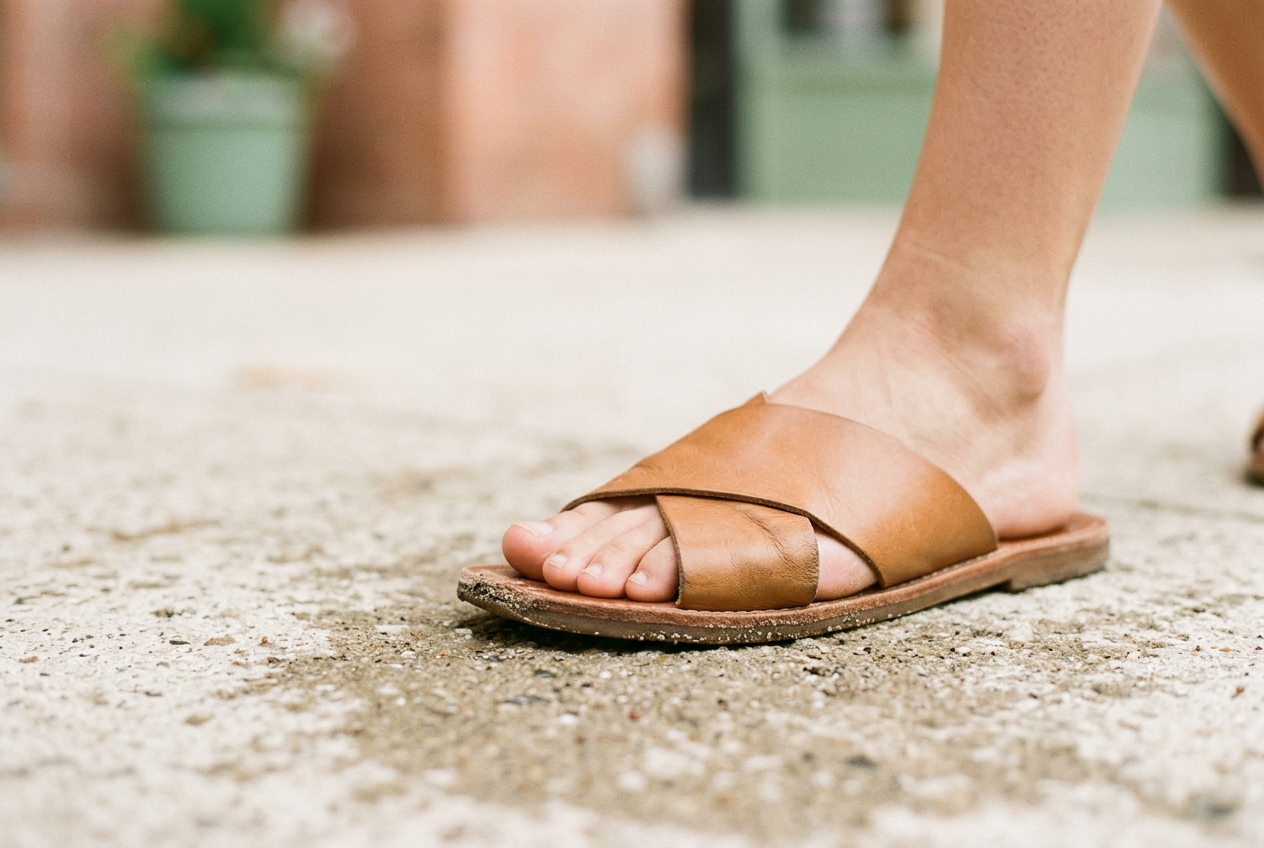
For this unisex wear test, I used one tan leather pair for seven warm days of commuting, errands and park walking. The test pair had a closed heel, an adjustable ankle buckle, a rubber outsole and six narrow leather straps running across each side, joined by a central strip over the top of the foot. Its rounded toe was mostly enclosed, with small openings between the woven sections.
That specific cage kept returning the same verdict. It protected the front of the foot from curbs and crowded sidewalks, but its narrow gaps admitted debris more readily than they released it, while two straps folded directly over the toe joints by the end of the week.
The cage matters more than the toe shape
The vamp, meaning the part of the upper covering the front of the foot, determines whether a fisherman sandal behaves like a ventilated shoe or a decorative basket. On the test pair, the central strip held six side straps in fixed positions. That made the upper stable, but it also placed leather across the widest and most flexible parts of the foot.
During an ordinary pavement commute, the front straps felt secure rather than tight. After several hours in warm weather, the distinction became less charming. Feet spread and swell through the day, and the fixed cage allowed little sideways movement because every strap fed into the same central strip; loosening the ankle buckle reduced pressure at the instep, but did nothing for the forefoot.
This is the first useful dividing line. Fisherman sandals with a dense, symmetrical weave tend to look polished and shoe-like, yet they leave fewer open areas for expansion. Versions with four or five broader straps, especially when the front pair sits ahead of the main toe joints, give the foot more room without abandoning the covered shape.
A closed toe is not automatically restrictive. Poor strap placement is.
Where the grit stayed
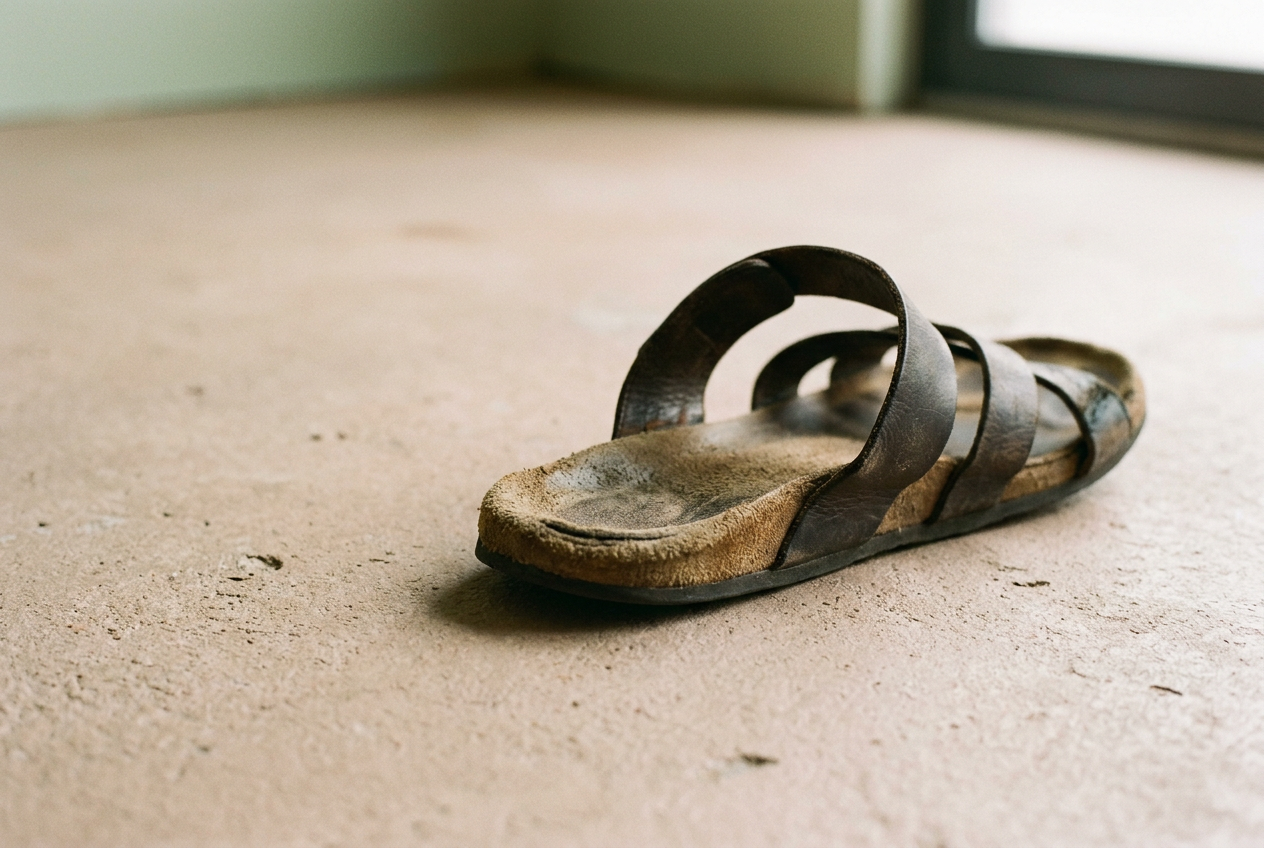
The park path supplied the least glamorous part of the evaluation. Fine grit entered through the lowest side openings, traveled under the ball of the foot and lodged where the leather upper met the insole. The narrow woven gaps then made it difficult to shake out without stopping, unbuckling the sandal and tipping it upside down.
On smoother city sidewalks, the problem was smaller but not absent. Dust collected beneath the forward straps and mixed with perspiration, which created a faint abrasive line across the toes. Nothing reached blister territory during the week, though the rubbing became noticeable late in the day. Fisherman sandals spare toes from direct exposure, then occasionally sand them by hand.
The construction explains why. A cage with many small openings catches particles at several edges, while a sparse layout offers both an entrance and an exit. Wider side windows let grit fall away during a normal stride. Narrow openings around the sole edge admit debris at foot level, exactly where it can become trapped beneath the upper.
Synthetic cages can make this worse when the material stays rigid. Soft leather gradually flexes and lifts away from the foot, creating a little escape space, although it also absorbs sweat and needs time to dry. Molded plastic or coated synthetic straps wipe clean quickly, but if their edges press or hold grit, they are unlikely to become more diplomatic after a week.
For pavement, transit and indoor floors, this nuisance may remain manageable. For sandy paths, gravel or a vacation involving an actual beach, a densely woven fisherman sandal combines the debris intake of a sandal with the evacuation procedure of a shoe.
The toe-joint crease appeared early
By the third wear, two diagonal creases had formed where the front leather straps crossed the toe joints. Creasing itself is normal. Leather bends where the foot bends, and a sandal that never creases is usually a sandal that is winning an argument against the foot.
Placement made the difference here. One strap on the test pair sat over the base of the big toe, while its opposite number crossed the smaller toe joints. Each step folded those straps sharply rather than allowing them to move as a unit with the foot. The leather softened over the week, but the folded edges became more defined and pressed down when the forefoot expanded.
A broader strap can distribute that pressure, provided its edge does not land on the joint. Narrow straps concentrate force along their edges. Braided or woven leather may look pliable on a product page, yet the points where several pieces overlap become thicker and less flexible than the individual strips suggest.
Before buying, bend the sandal at the ball of the foot and watch where the upper folds. If a strap buckles into a hard ridge at the same point, walking will repeat that fold hundreds of times. The useful alternative is a layout with an open flex zone, meaning a gap in the upper positioned where the toes meet the foot, or a broad front panel that bends without stacking several edges together.
Swelling exposed the fit problem
Morning try-ons flatter this style. The test pair felt close and tidy at the start of each day, with no heel movement and enough length ahead of the toes. Later, the forefoot pressed visibly against the outer straps, and a shallow mark remained across the big-toe joint after removal.
Sizing up would have added length without changing the strap positions, which is why extra shoe size is a poor fix for a rigid cage. A wider fitting is better when available. An adjustable forefoot strap is better still, though uncommon in traditional woven designs; some fisherman-inspired sandals replace part of the cage with a buckle or hook-and-loop section, sacrificing purity for the radical benefit of accommodating a foot at 5 p.m.
This advice applies across women’s and men’s wardrobes because the mechanical problem is the same, though shoppers should compare actual measurements rather than relying on the gender printed on the box. Anyone between sizes, wide through the forefoot or prone to heat swelling should prioritize width and strap position over a perfectly snug first impression.
There should be slight space between the upper and the sides of the forefoot before a long walk. Leather can soften, but it does not reliably move a badly placed seam or make a narrow sole wider.
The city-walking verdict
The six-strap test pair worked best for short trips on clean pavement, where toe coverage and a secure heel mattered more than ventilation. It was less convincing for an uninterrupted day out. The problem was cumulative: grit that required removal, creases that pressed after several hours and a fixed forefoot that became tighter as the day warmed.
For regular city walking, the practical fisherman sandal has fewer, broader straps, generous side openings and no layered join directly over the toe joints. A central strip can stabilize the upper, but it should not pull every cross strap taut. Look for an adjustable ankle or instep closure, a flexible rubber outsole and a footbed that does not become slick with perspiration.
Dense woven leather still has a place. It looks more finished than a sport sandal and offers useful protection in crowded settings, so it can earn its typically higher price than a basic open sandal when the fit is right. I would not pay near boot money for a rigid cage that needs optimism, bandages and a private gravel-removal ceremony.
At the lower end, synthetic versions are easier to rinse and may suit wet use, but check every strap edge with a finger and reject sharp molding lines. In the middle price band, lined leather generally feels better against bare skin, although lining adds thickness and can reduce internal room. More expensive leather does not rescue a poor layout.
The test pair will stay in rotation for office days with limited walking. For long summer routes, the alternative is less picturesque and more useful: an open-toe sandal with two adjustable straps, or a fisherman design with a sparse cage and a clear gap over the toe joints.
Questions people ask
Should fisherman sandals feel snug when new?
They should hold the heel and instep without allowing the foot to slide, but the forefoot should not press firmly against the side straps. A close morning fit can become restrictive after hours in the heat, and sizing up rarely fixes a cage that is narrow in the wrong place.
Are leather fisherman sandals better than synthetic ones?
Leather usually softens and conforms more readily, though layered woven sections can remain stiff and leather needs drying time after sweaty or wet wear. Synthetic straps are easier to rinse, but rigid edges and pressure points may not improve with use, so the strap layout still matters more than the material label.
Can fisherman sandals work for wide feet?
Yes, if the sole is wide enough and the cage uses broad, well-spaced straps rather than a dense weave. Look for visible room beside the forefoot, avoid seams over the big-toe joint and favor adjustable sections; extra length alone will not create usable width.
How do you stop sand getting trapped in fisherman sandals?
Choose larger side openings and avoid narrow gaps positioned directly above the sole edge. On sandy routes, there is no complete fix short of removing and shaking out the sandal, which is why a sparse cage or an open sandal remains the more practical choice.
One update a day
Today's fashion update, in your inbox
One fashion update each morning — no hype, no filler, just pieces worth wearing.