Almond-Toe Shoes Make Room, but Not as Much as You Think
Retail shelves now favor a softened almond shape over blunt squares and severe points. It works under more trousers, but width and taper still decide whether it is comfortable.
Women's · August 24, 2026 · 7 min read
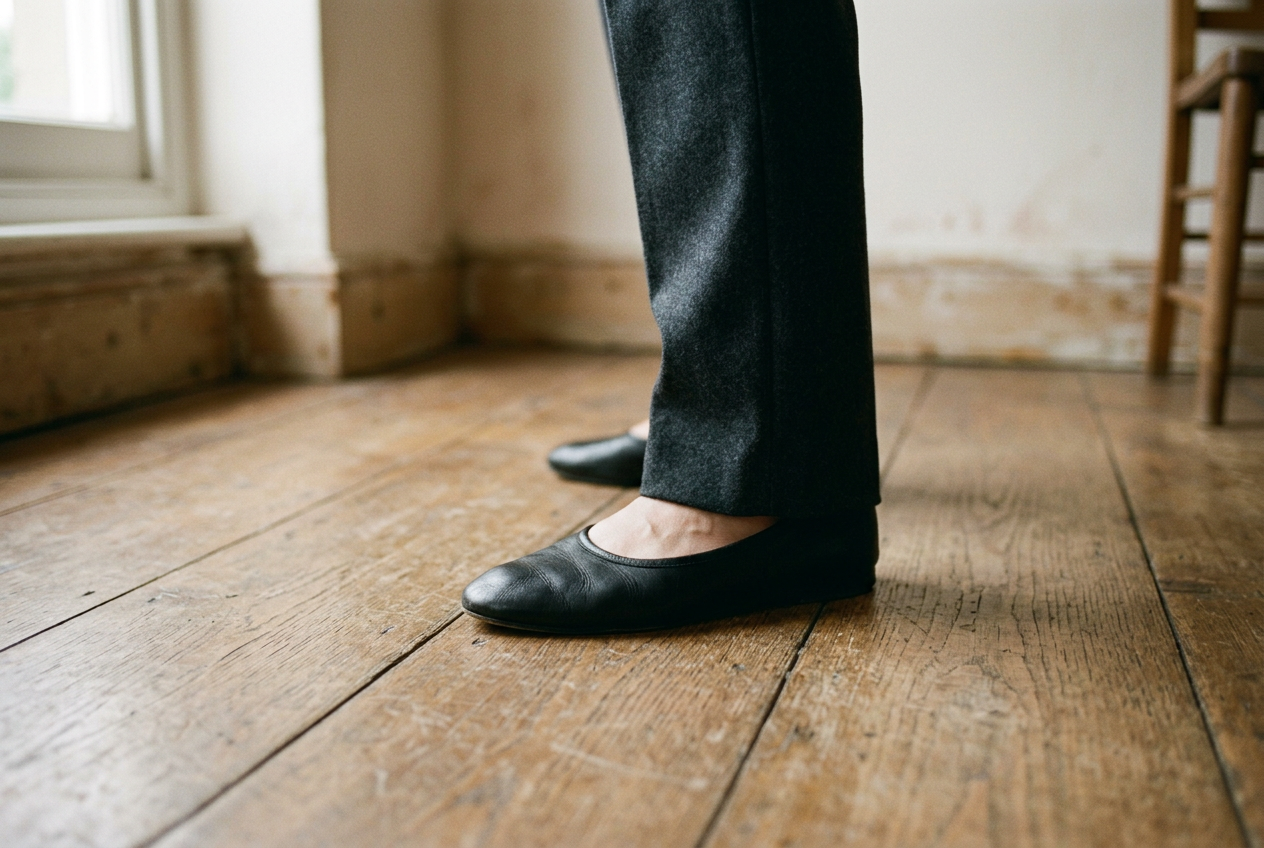
The shoe I kept returning to while reviewing this shift was Aeyde’s Uma ballet flat in black leather. Its front narrows gradually rather than ending in a hard point or a ruler-straight edge, and that small geometric adjustment explains why the almond toe is becoming useful now: it looks directional without forcing the rest of an outfit to accommodate it.
This is women’s coverage, although the fit mechanics also apply to almond-toe loafers and boots sold in men’s departments. The strongest evidence sits in women’s flats, low pumps and ankle boots, where retailers have spent several seasons moving between square fronts and elongated points.
A review of brand product pages, multi-brand retailers and searchable resale platforms shows almond shapes appearing across mass-market, contemporary and designer price bands. The language is less settled than the silhouette. One retailer may call a shoe almond-toe, another may describe a nearly identical front as tapered, oval or softly pointed, which makes the trend look smaller in search results than it appears on the page.
The Uma flat shows what changed
A true almond toe has a curved front that reaches its furthest point near the center, with the sides beginning to taper ahead of the ball of the foot. The toe box, meaning the enclosed area around the toes, can still be shallow or narrow even when its outline looks gentle.
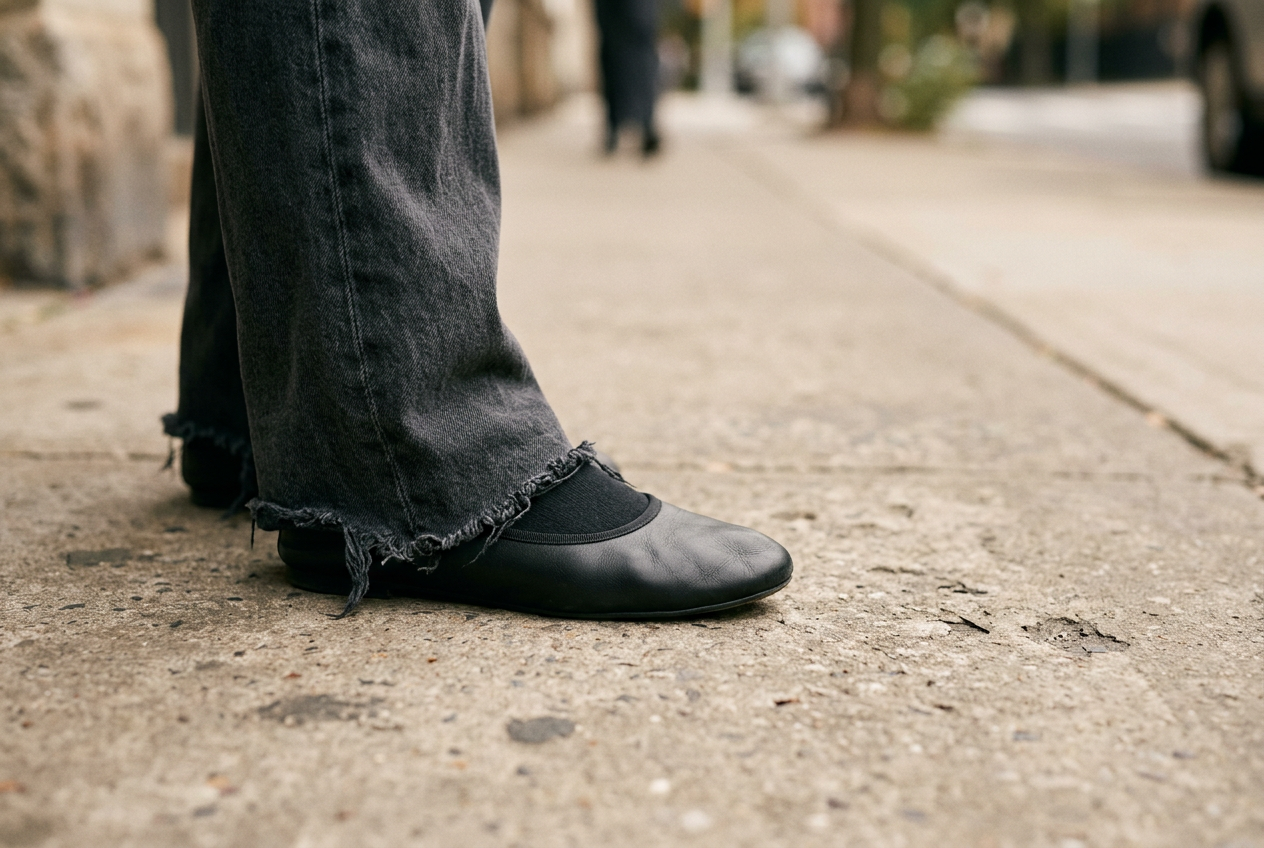
The leather Uma is a useful case because it avoids the exaggerated length associated with a sharp court shoe while retaining more definition than a round ballet flat. Under full-length charcoal trousers with a straight leg, only the centered tip and part of the vamp remain visible. The vamp is the section of upper covering the front of the foot. That glimpse reads cleaner than a broad square edge, which can look abruptly cut off beneath a narrow hem, but it does not project as far beyond the fabric as a needle-like point.
That compatibility matters more than novelty. Current trouser wardrobes are mixed: wide legs remain visible, straighter cuts have returned, and many people still own cropped pants from the square-toe cycle. A moderately elongated almond can move among all three without making the trouser look dated by association.
The same Uma flat is less persuasive with a very short, tight ankle pant. Exposing the whole low-cut shoe emphasizes how conservative a plain almond ballet flat can look, especially in smooth black leather with a small bow. Mesh, metallic leather or a higher-cut Mary Jane gives that outfit more tension. The toe alone cannot carry it.
Retail adoption is broad, but the labels lag
Almond toes now appear in the practical center of assortments rather than only in expensive fashion shoes. They are visible on office pumps, slingbacks, ballet flats, loafers and slim ankle boots, including styles from specialist footwear labels and larger high-street retailers. Square toes have not disappeared, particularly on sandals and block-heeled shoes, while sharp points still dominate dressier pumps and some kitten heels.
The change is one of emphasis. Retailers are softening the extremes.
That makes the almond toe a bridge trend in origin, though not necessarily in outcome. It gives shoppers who are tired of severe points a cleaner option than a fully rounded shoe, and it lets brands update familiar patterns without rebuilding an entire last, the foot-shaped form around which a shoe is made. Small adjustments to the last can alter internal width, however, so two shoes with nearly identical overhead outlines may fit differently.
Material makes the distinction clearer. Soft nappa leather can yield across the forefoot after wear, although it will not create meaningful extra length. Patent leather and heavily coated synthetics resist that movement, so an almond-shaped patent pump may feel closer to a pointed shoe than its softer outline suggests. Unlined mesh conforms more readily but can let the toes show through the upper, making a cramped fit visible as well as uncomfortable.
At mass-market prices, inspect the taper and material rather than paying for the trend label. In the contemporary band, where a pair may cost roughly as much as a good leather sneaker or more, the case for spending rests on the last, lining and sole rather than the almond outline. Designer pricing buys no automatic protection from a shallow toe box.
The toe-room claim needs qualification
A square toe usually offers the clearest potential advantage for a broad forefoot because the inner edge does not immediately angle toward the second toe. Potential is the important word. A fashion square can still be narrow across the ball, leaving unused space at the front corners while squeezing the foot farther back.
A sharply pointed shoe creates a different problem. The foot must stop before the decorative tip, so the shoe often needs extra overall length to preserve usable room. That extension can catch under a long trouser hem, make stairs awkward or cause heel slip if the shoe is sized up to relieve pressure at the front.
The almond shape moderates both failures, but only when the taper starts beyond the widest part of the foot. On the Uma flat, the visual narrowing is gradual enough to illustrate the right buying test: ignore the final inch of the shoe and look at where the side walls begin moving inward. If they turn before the base of the toes, the shoe is likely to compress the forefoot no matter how softly rounded the tip appears.
People with a wide forefoot, bunions or a second toe longer than the big toe should treat almond shoes as model-specific rather than categorically comfortable. A removable insole can reveal more about available volume, but many slim ballet flats use fixed insoles and offer little adjustment. Trying half a size up may add length while creating heel movement, which is not a useful trade if the topline then rubs.
For online orders, compare the outsole at its widest point with a shoe that already fits, check whether reviews repeatedly mention narrowness, and return the pair if the toes overlap or the upper presses while standing. Leather may soften. A misplaced taper does not move.
Resale favors recognizable shapes, not precise taxonomy
Secondhand platforms complicate the trend reading. Searches on The RealReal, Vestiaire Collective, eBay and Poshmark turn up almond-toe shoes from many seasons, yet sellers often choose broad categories such as pointed, round or ballet flat instead of describing the front precisely. Search volume therefore cannot be treated as a clean measure of demand or adoption.
The listings are still useful for judging longevity. Moderate almond pumps, loafers and ankle boots recur without being tied to one conspicuous season, while dramatically squared platforms and extremely extended points carry a clearer period stamp. Condition photographs also show where the shape fails: creasing across the vamp is normal, but bulging at the sides near the little toe suggests the last was too narrow for the previous wearer.
A used version of the Uma, or any similarly minimal leather flat, deserves close inspection at the tip. Scuffing concentrates there because the centered front reaches obstacles first, while a thin outsole can wear through near the toe before the upper looks exhausted. Ask for an outsole photograph if one is missing, and check whether the heel counter, the structured rear section holding the heel, has collapsed inward.
Resale pricing varies too much by brand, condition and platform to support a simple almond premium. The better conclusion is visual: the shape already has a deep secondhand base, but much of it predates the current retail swing. That history supports longevity, even as it weakens any claim that almond toes are wholly new.
The useful buying line
Choose a restrained almond if the shoe needs to work under several trouser widths. The front should extend only slightly beyond the toes, the side walls should remain nearly straight through the forefoot, and the upper should have enough depth that the big toe does not print against it. Smooth leather is the most adaptable material, provided it is not stiffly coated.
Keep a square toe if forefoot width is the priority and the shoe already fits, especially in sandals where the shape does not have to disappear beneath a hem. Keep a sharp point for occasions when visual length is the purpose and walking time is limited. Replacing either solely to acknowledge the shift is not worth the money yet.
The almond toe looks likely to outlast its bridge phase because it solves a styling problem without becoming visually neutral. Its risk is overextension. Once brands lengthen the tip and pull the sides inward, the shoe has returned to pointed territory under a friendlier product description.
The black Uma under straight charcoal trousers remains the useful benchmark: enough taper to show beyond the hem, no hard corner interrupting the line, and no decorative point demanding extra floor space. The purchase decision belongs farther back, where the shoe meets the widest part of the foot.
Questions people ask
Are almond-toe shoes comfortable for wide feet?
They can be, but the outline alone is not reliable. Look for side walls that stay straight until they pass the ball of the foot, plus adequate depth over the toes. A wide-fit almond shoe is a better bet than sizing up in a narrow standard last, which may trade pressure at the front for heel slip.
Do almond-toe shoes work with wide-leg trousers?
Yes. A slightly elongated almond tip remains visible beneath a wide or puddled hem without presenting the blunt horizontal edge of some square shoes. Avoid very soft, collapsible flats under heavy trousers, since the hem can catch beneath the heel; a firmer sole or low heel gives the fabric a cleaner path.
Are square-toe shoes already out of style?
No. Square toes remain useful in open sandals, boots and shoes built for a broader forefoot. The most exaggerated versions look more season-specific, but a modest square with rounded corners can stay in rotation. There is little reason to replace a comfortable pair unless its hard edge fights with the trousers you wear most.
What should
I check when buying almond-toe shoes secondhand?
Request clear photographs of the outsole, centered tip, vamp and heel counter. Side bulges can indicate a narrow fit, deep asymmetric creasing may show the shoe twisted during wear, and concentrated tip damage can shorten its remaining life. Compare the outsole shape with a pair you own before relying on the seller’s toe description.
One update a day
Today's fashion update, in your inbox
One fashion update each morning — no hype, no filler, just pieces worth wearing.