A Wavy T-Shirt Neckline Was Probably Built That Way
Pressing may flatten a rippled collar for one wear, but it cannot restore weak ribbing or correct an uneven seam. Here is how to spot both before buying.
October 9, 2026 · 7 min read
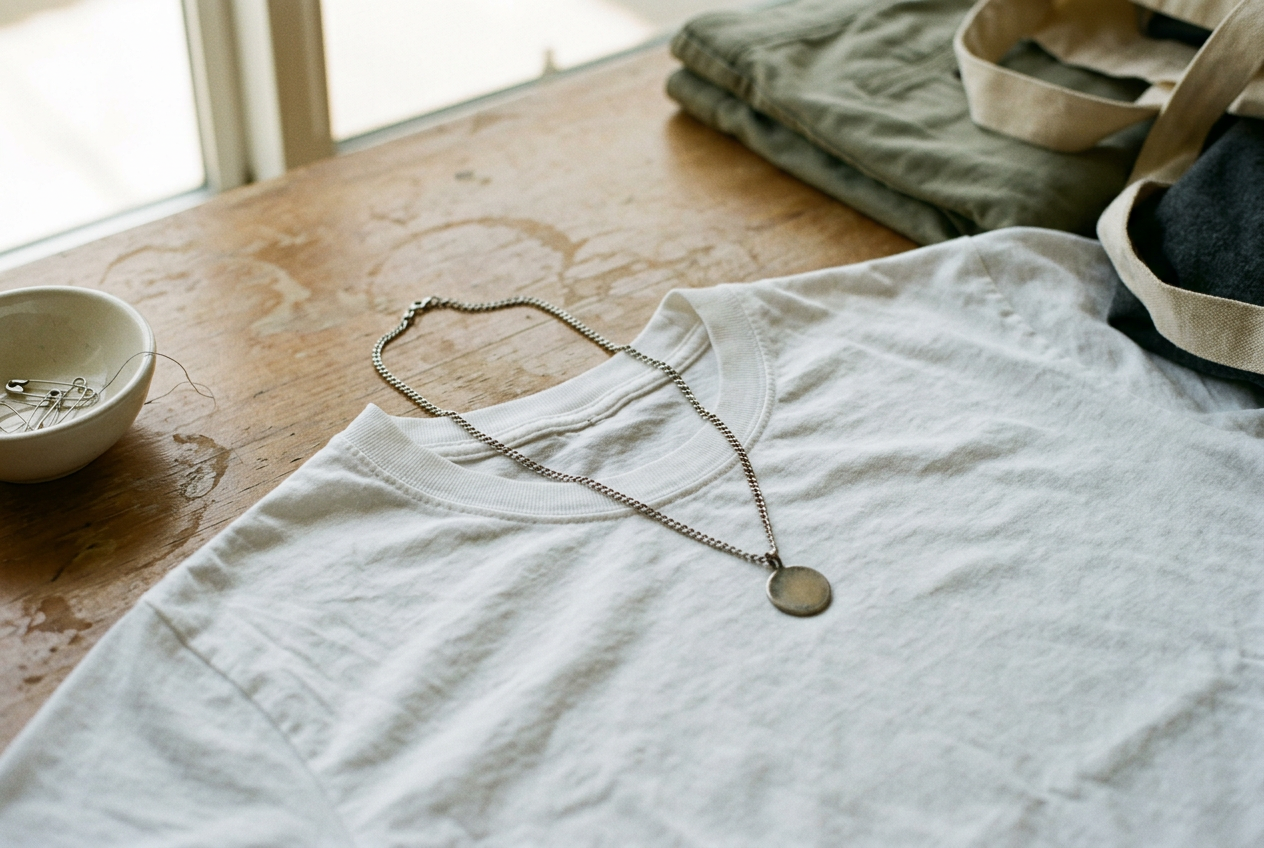
Keep one ordinary garment in mind: a midweight white cotton T-shirt with a narrow crew neck, worn twice under a blazer and then washed according to a cold-wash care label. The body still looks presentable, but the collar now rises and falls in shallow waves instead of sitting flat against the neck. Ironing smooths it until the shirt is worn or washed again.
That failure is often blamed on laundering. Washing can reveal it, but the underlying problem may have been cut and sewn into the shirt. The useful distinction is between avoidable distortion, which gentler handling can reduce, and poor recovery or construction, which home care cannot permanently correct.
This is unisex advice. Neck opening size and styling vary across wardrobes, but rib knit, seam tension and cotton shrinkage behave the same way.
The collar and the body do different jobs
Most basic T-shirts use jersey, a smooth knit fabric that stretches more across its width than along its length, for the body. The neck is usually finished with rib knit, recognizable by its vertical ridges and greater crosswise stretch. On our white crew-neck tee, that narrow rib band must expand over the head, return close to its original size and hold the larger body opening in a clean curve.
Recovery means a fabric’s ability to return toward its original dimensions after stretching. A firm rib can recover through its knitted structure alone, though some collars include elastane to improve snap-back. Elastane is helpful rather than conclusive: a loose, lightweight rib with a small amount of stretch fiber can still bag out, while a dense all-cotton rib may hold its shape well when it has been cut and attached correctly.
The body fabric and neckband also shrink at different rates. Cotton yarn can relax and contract in washing, especially after heat, while the rib may respond differently because its knit structure, yarn thickness or fiber blend is not identical. If the body opening tightens more than the band, excess collar length has to go somewhere. It forms waves.
That is why fabric weight alone does not settle the quality question. A substantial tee can have a weak collar, and a lighter shirt can keep a neat neckline if the rib has enough density and recovery for the opening.
Seam construction can build in the ripple
A neckband is normally cut shorter than the neckline opening and stretched as it is sewn in. The neckband ratio, meaning the band length in relation to the opening it must finish, has to suit the stretch and recovery of that particular rib. Too long, and the band has no useful tension. Too short, and it pulls the neckline into puckers or makes the shirt uncomfortable over the head.
Distribution matters just as much. If the sewing operator stretches one section heavily and barely stretches the next, the finished collar may look acceptable after pressing at the factory, yet relax into uneven waves after laundering. The white crew-neck tee will often show this first near the shoulder or at the back join, where a small mismatch becomes conspicuous once the fibers release their finishing treatment.
The seam itself can also roll or torque. Seam torque is twisting caused when fabric grain, feed or stitching tension does not stay balanced. A twisted neck seam may pull the rib toward the outside in one area and tuck it underneath in another, producing a ridge that follows the stitching rather than an even ripple around the entire opening.
Look at the line of topstitching. It should follow the neckline smoothly without abrupt narrowing, skipped stitches or spots where the body has been caught into a tiny fold. Topstitching can stabilize the seam allowance, the narrow fabric edge hidden inside the garment, but overly tight stitching can restrict the knit and create its own puckering.
Pressing changes the appearance, not the cause
Steam and light pressure can temporarily flatten cotton fibers and persuade a rolling seam allowance to sit in the intended direction. That is useful when the collar was merely folded during drying. It does not add recovery to stretched rib or remove excess band length.
A quick diagnosis is to press the white tee, let it cool fully and then pull the neck opening gently as it would stretch over the head. If the waves return as soon as the rib relaxes, the problem sits in the material or the band length. If one hard ridge remains in the same place, construction is the more likely culprit.
Repeated high heat is a poor long-term strategy. It may shrink cotton enough to create a brief improvement, but the body, rib and thread may not contract evenly, while sustained heat can shorten the useful life of elastane. Press from the inside with moderate heat that matches the care label, and stop once it is clear the result will not hold.
Inspect the neckline before paying
Start by laying the shirt flat rather than judging it on a hanger. A hanger can pull the body downward and disguise extra length in the band. The collar should lie in one plane, with no scalloped edge and no section that flips outward before the garment has been worn.
Next, stretch a small section of rib sideways with your fingers and release it. Good recovery feels immediate and controlled. A band that stays visibly longer, feels papery or collapses into a soft fold is a warning, particularly on a close crew neck that must stretch substantially every time it goes over the head.
Turn the neckline inside out. Check whether the seam allowance remains an even width and whether the neckband join sits flat rather than forming a bulky lump. Follow the stitching around the full opening; a visibly stretched patch in the body fabric, often seen as tiny horizontal ripples beside the seam, can indicate uneven feeding during sewing.
Then compare the collar with the body. A very loose rib paired with dense, stable jersey is a questionable match because the band must control a heavier opening. A narrow band also has less fabric through which to distribute strain, so it needs especially good recovery. Wider vintage-style rib can be more forgiving, though it changes the look of the shirt and may sit higher against the neck.
For online shopping, enlarge front and back product images and look for rippling where the collar meets the shoulder. Check fiber content, but do not treat an elastane percentage as a guarantee. A retailer that provides close construction photos and a workable return policy offers more protection than a vague claim about premium cotton.
Washing can prevent extra damage
The first wash often exposes a weak neckline because water lets cotton fibers swell and relax. Reduce unnecessary stress by turning the shirt inside out, using a cool gentle cycle and avoiding a tightly packed machine, where the collar can be pulled around heavier garments. Close zippers and hooks on other pieces or separate them so they cannot snag the rib.
Lift the wet shirt by supporting its body, not by pinching the neckband. While it is damp, place it flat and guide the collar into a smooth circle with your fingertips, without stretching the opening wider. Air-dry flat when practical, or use low dryer heat if the care label permits it; hanging a saturated cotton tee from its neckline gives gravity time to lengthen the rib and distort the shoulder area.
These choices matter most for the white tee before it develops waves. Once the band has lost recovery, careful washing may keep the damage from worsening, but it will not recreate the original knit tension. Fabric softener is no repair, and aggressive shrinking is unpredictable.
Price is a weak quality signal
An inexpensive multipack tee may use lighter rib and faster construction, but a higher price does not prove that the collar ratio was correct. Some costly shirts prioritize a soft, washed-in hand, which can mean a relaxed neckline by design. That tradeoff may be appealing if the intended fit is slouchy; it is poor value when the goal is a sharp crew neck under tailoring.
Spend more when the extra money is visible in dense rib, even stitching and a neckline that springs back after handling. Skip the upgrade when the selling point is only fabric prestige and the collar already lifts from the shirt on the rack.
For a favorite graphic tee or a garment with sentimental value, replacing the neckband is possible for someone comfortable sewing stretch knits, or through an alterations service willing to do knitwear. The new band must be matched to the opening and applied under even tension. On a plain white basic, that work can cost more in time or labor than replacing the shirt, and pressing the old band every week is rarely a satisfying middle ground.
Questions people ask
Can a rippled T-shirt neckline be fixed permanently?
Only if the cause is corrected. A loose or overstretched neckband usually needs to be removed and replaced with rib that has stronger recovery and the right length for the opening. Pressing and damp reshaping can improve the appearance temporarily, but they cannot restore damaged elastic fibers or redistribute an uneven seam.
Does elastane stop a T-shirt collar from stretching out?
Elastane can improve recovery, but construction and fabric density still matter. A poorly cut band containing elastane may ripple, while a dense all-cotton rib can perform well. Test the collar’s snap-back and inspect how evenly it lies instead of relying on fiber content alone.
Should
T-shirts be hung or folded after washing?
Fold them once dry if you want to minimize stress at the neckline. During drying, support the whole garment rather than hanging a wet cotton shirt from a narrow hanger, which can pull at the neck and shoulders. A dry, lightweight tee can be hung safely if the hanger fits its shoulder width.
Why did the neckline ripple after the first wash?
The first wash removes some factory finishing and lets cotton fibers relax, so mismatched shrinkage, weak rib recovery or uneven sewing becomes easier to see. A crowded wash, high heat or rough handling may add distortion, but a collar that immediately develops regular waves often had a material or construction problem already.
One update a day
Today's fashion update, in your inbox
One fashion update each morning — no hype, no filler, just pieces worth wearing.