A Tighter Buckle Won’t Always Keep a Slingback Up
If a slingback strap keeps dropping, inspect its path around the heel before adding another hole. Buckle placement, elastic tension and the shoe’s last decide whether adjustment can help.
Women's · August 23, 2026 · 7 min read
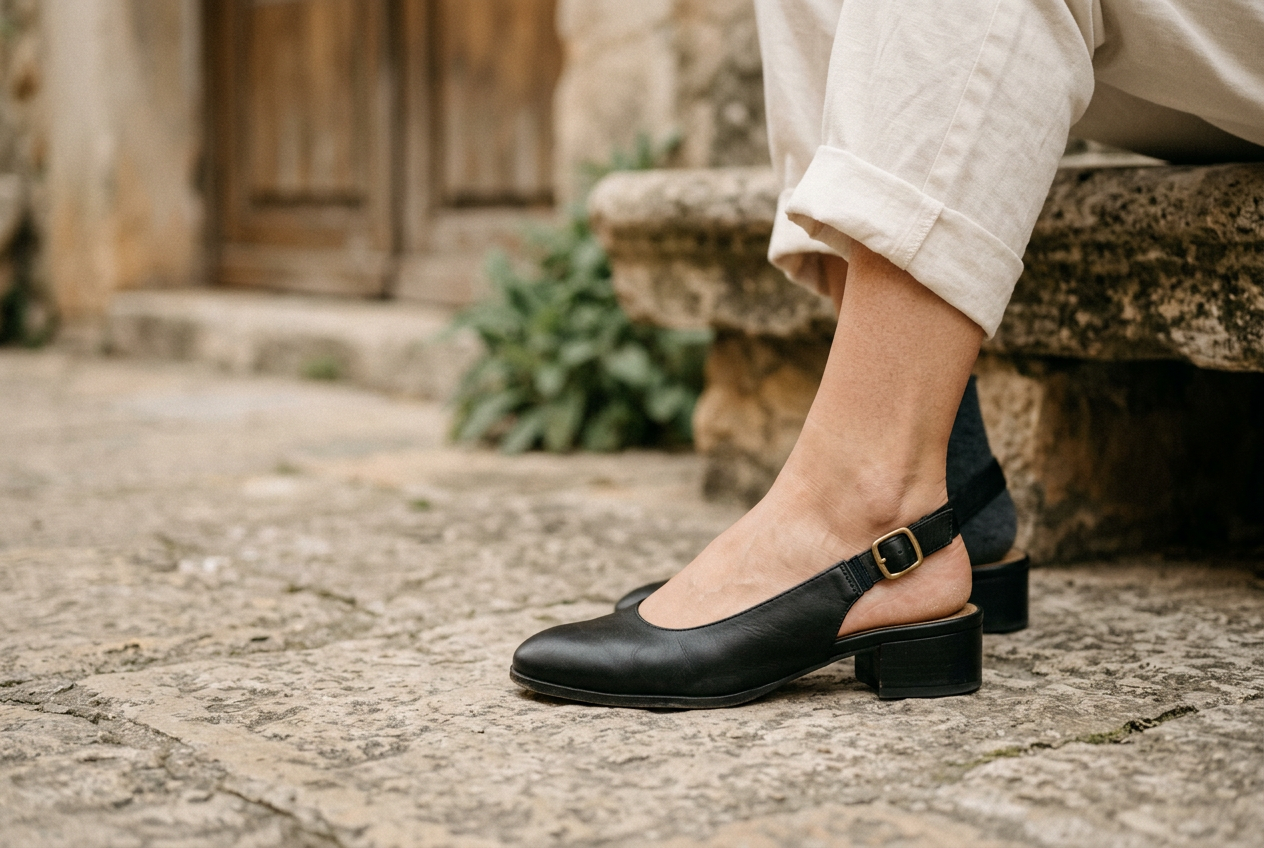
The test pair was a black leather slingback pump in my usual women’s size, with a low heel, leather lining, a slim adjustable strap and a short elastic insert beside the buckle. Across a workweek of ordinary walking, the right strap stayed put while the left dropped within minutes. Tightening it stopped the drop, but pushed that foot into the pointed toe and left a deep strap mark.
That was not an improvement. It was discomfort with better attendance.
This guide is for women’s slingbacks, particularly pumps and dress sandals with an adjustable rear strap. The mechanics apply to flats and higher heels too, although a steep heel can make a poor match more obvious because the foot is already inclined to move forward.
The strap needs the right path around the heel
A slingback stays on through tension and geometry. Viewed from the side, the strap should travel around the heel on a mostly level path, meeting the back of the foot where the heel still has enough outward curve to resist it. A strap that angles sharply downward has little to catch against, while one anchored much lower at the sides may be pulled down with every step.
This explains why buckle tightness can feel convincing in front of a mirror and fail halfway down the hall. Standing still gives the strap one job. Walking asks it to manage heel lift, shoe flex and the small rotation that happens as weight moves from the outside of the foot toward the big toe.
On the black pump, the successful right strap crossed the heel just above its broadest rear curve. The left attachment sat at the same height, but my left heel is slightly narrower and straighter, so the strap migrated downward until it reached a position where the buckle could no longer rescue it. One shoe worked. The construction had not changed; the heel had.
Check the strap from both sides while standing naturally. It should lie flat rather than twist onto one edge, and its rear section should not point toward the sole. If the strap starts in a sensible position but immediately travels down when you take several brisk steps, tighten it by one hole and repeat the test. More than one hole can change how the whole shoe fits.
Buckle placement controls where the tension lands
The buckle should sit on the flatter outer side of the foot, forward of the rounded back of the heel and clear of the ankle bone. This position lets the leather wrap smoothly around the rear of the foot while keeping a rigid piece of hardware away from the most mobile and curved areas.
A buckle placed too far back can tilt as the heel moves, concentrating pressure at one corner and encouraging the strap to roll. If it sits too high, it may knock against the ankle bone. When it is positioned so far forward that nearly the entire side strap must slide through it, the available holes may tighten the shoe without changing the rear strap’s useful angle.
Look at where the buckle lands after adjustment, not merely at how many holes remain. On the test pump, moving the left buckle one hole tighter pulled the hardware backward onto the beginning of the heel curve. The strap felt firmer under a finger, yet the buckle rotated while walking and the front of the shoe became cramped.
An extra hole would have made that arrangement worse. A cobbler can add a clean hole to a leather strap when the existing spacing is the only problem, but no hole can move the buckle away from an ankle bone or raise a badly anchored strap. Do not punch a returnable pair until the shoe has passed an indoor walk test.
Elastic should recover rather than carry the shoe
The elastic insert, sometimes called a gore, is the short stretch panel that lets the strap move with the foot. A firm gore can make a slingback easier to buckle and reduce sharp pressure as the heel lifts. It should stretch a little, then return promptly when the foot comes down.
Soft elastic can create the opposite result. Each step lengthens the strap, the shoe separates farther from the heel, and the strap lands lower when it rebounds. Old elastic may also lose recovery, leaving a strap that looks correctly adjusted on the table but behaves longer on the foot.
Press the shoe down with one hand and pull the rear strap gently with the other. The gore should extend evenly without buckling or remaining elongated. Compare both shoes. A noticeably looser insert on one side points to a material problem rather than a sizing decision, particularly if that shoe has been tried on more heavily or stored with the strap stretched.
The black pump’s elastic recovered well, which ruled out the easy suspect. Tightening still failed because the left strap needed a different angle, not greater force. Elastic can accommodate movement; it cannot manufacture a heel curve for the strap to sit on.
Heel shape reveals a mismatch in the last
A last is the foot-shaped form around which a shoe is built. It determines the width of the heel seat, the pitch beneath the foot and where the side of the shoe expects the heel to sit, even though a slingback leaves much of that area open.
People with narrow or relatively straight heels often find that pumps fit through the toes yet leave too much space around the rear. A pronounced heel curve gives a slingback more structure to catch, although a strap positioned directly across the fullest area can rub. Foot asymmetry matters as well. Buying for the larger foot remains sensible, but an exposed heel makes the smaller side harder to disguise.
Set the shoe on a level surface and place the foot fully back without buckling it. The heel should sit centrally on the sole rather than spilling over one edge or floating inside a platform wider than the foot. Buckle the strap at a comfortable hole, then watch the heel from behind while taking several slow steps. Side-to-side swiveling suggests the heel seat is too broad or the front of the shoe is not holding the foot securely.
A loose forefoot can imitate a strap failure. If the foot slides forward inside the vamp, the heel becomes narrower relative to the rear strap and creates slack. Tightening the slingback then pulls against the heel while the toes continue moving forward, which is how a shoe manages to feel loose and punishing at once.
For pointed styles, check that the ball of the foot sits at the shoe’s widest flex point and that the toes are not being asked to fill the decorative tip. A half size down may shorten the heel seat, but it can also compress the forefoot. A different last, perhaps with a narrower heel and more room across the ball, is the useful alternative.
Run one adjustment test before deciding
Start with the strap at the loosest hole that keeps it in contact with the heel. Walk on a clean indoor floor for several minutes, including a turn, a few brisk passes and a short flight of stairs if available. A staircase increases heel movement quickly, so there is little need to conduct a full commute in shoes that may be going back.
If the strap drops, tighten it by one hole. Repeat the same route. The adjustment has worked only if the strap stays up without forcing the foot forward, leaving a hard indentation or moving the buckle onto the ankle bone. Mild contact is normal; a thin strap sawing at the heel is not a break-in plan.
A leather strap may soften with wear, which can reduce edge stiffness but can also make rolling easier. Synthetic straps may give less predictably and can be damaged by an improvised hole. Neither material changes the basic geometry. If the strap keeps descending despite comfortable tension, or it stays only when the front of the shoe hurts, the last does not match the heel closely enough.
Adhesive heel grips can help when a closed shoe has a small amount of rear space, but a slingback offers little surface for them and visible pads tend to collect lint. Clear silicone strap cushions add friction and bulk; they may get one occasion out of a pair, though they can alter pressure rather than correct the fit. For a new shoe, returning it is usually cheaper than assembling a small medical-looking department behind the ankle.
The black pumps failed the test on my left foot. They went back. A similar leather slingback with a slightly higher side attachment and a buckle positioned farther forward held both heels at moderate tension, without an added hole or a toe box full of consequences.
Questions people ask
Why does only one slingback strap fall down?
Feet are rarely identical. One heel may be narrower, straighter or smaller, so the same strap angle catches securely on one side and slides on the other. Try one tighter hole on the slipping foot, but reject the pair if that adjustment creates toe pressure or moves the buckle onto the ankle bone.
Can a cobbler shorten a slingback strap?
A cobbler can often add a hole or shorten a leather strap when excess length is the sole problem. That work will not correct a low attachment point, an awkward buckle position or a heel seat that is too wide, so confirm the strap follows a stable path before paying for alteration.
Do slingback straps stretch with wear?
Leather can soften and lengthen slightly, while an elastic insert may lose some recovery over time. Buy for secure, comfortable tension now rather than assuming the strap will improve. A pair that already needs its tightest hole has little adjustment left if the materials relax.
Should I size down when a slingback falls off?
Only if the entire shoe is too long and the smaller size still places the ball of the foot at the widest part of the sole. Sizing down to trap the heel can crowd the toes without fixing the strap angle. A narrower heel last is often the better choice.
One update a day
Today's fashion update, in your inbox
One fashion update each morning — no hype, no filler, just pieces worth wearing.