A Thick White T-Shirt Can Still Get a Baconed Collar
Collar thickness feels reassuring in the fitting room, but recovery predicts whether a white T-shirt will keep its shape. Check the rib, elastane and seams before buying.
November 15, 2026 · 7 min read
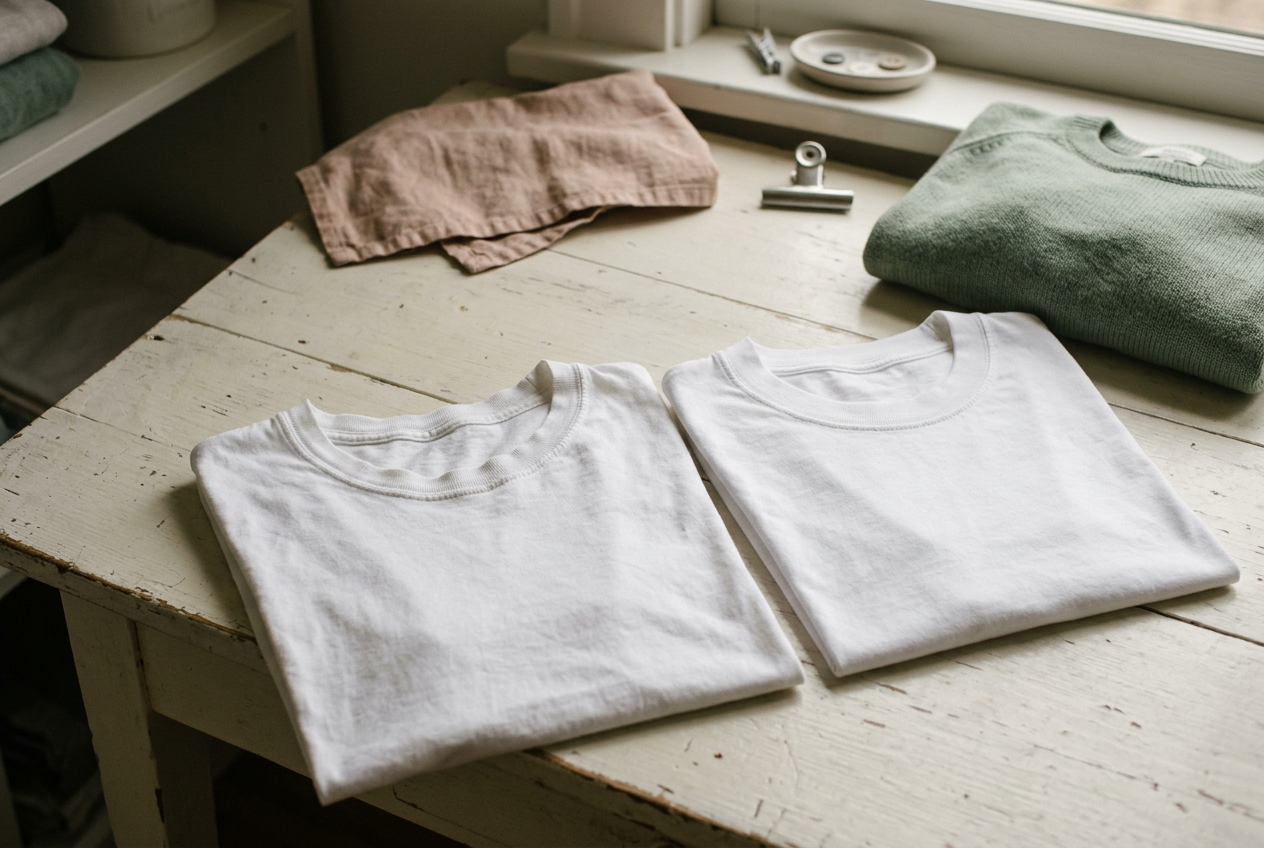
The white crewneck that prompted this test looked like the durable choice. Its cotton jersey body felt dense, the fabric was opaque, and the neckline sat close enough to look clean under a jacket. After four ordinary wash-and-wear cycles, however, the narrow collar had started to ripple at the front.
That ripple is often called baconing, meaning the neckline develops persistent waves rather than returning to a flat circle. The shirt body had not twisted or shrunk in any obvious way. The failure was concentrated in the rib.
Rib knit, the stretchy fabric commonly used around a T-shirt neck, is built differently from the jersey below it. Its alternating raised and recessed columns allow it to expand over the head, then contract again. How well it contracts is its recovery, and recovery matters more than how thick or firm the collar feels on the rack.
This is unisex advice. Neck opening preferences vary across women’s and men’s departments, but the construction test applies to any cotton crewneck, regardless of the label over the rail.
Start with the stretch-and-release test
Lay the shirt flat or hold it by the shoulder seams, without letting the body’s weight pull on the neck. Pinch a section of collar at the side, where a small test is less likely to distort the visible front, and stretch it gently outward for two or three seconds. Release it without smoothing.
A promising rib snaps back into line and leaves the neck opening looking much as it did before. Poorer rib may return slowly, remain slightly longer, or produce a shallow wave where it was stretched. Put the shirt down for a minute and check again. A collar that still needs coaxing in the store is unlikely to become more disciplined after detergent, heat and repeated trips over the head.
Use moderate pressure. This is a recovery test, not an attempt to find the breaking point, and an aggressive pull can damage a perfectly good neckline or make the result meaningless. Compare two shirts from the same size range if possible, using the same movement on each.
On the test shirt, the narrow rib felt substantial between finger and thumb, yet the stretched section returned with a faint ripple. I initially treated that as handling rather than evidence. Four washes later, the same behavior had spread across the front neckline, where the collar was repeatedly stretched during dressing and pressed against the body.
Thickness can disguise weak recovery because a dense collar feels reassuring at first touch. A lighter rib with a small amount of stretch fiber may rebound more cleanly, while a thick all-cotton rib can gradually stay where wear and washing have pulled it.
Narrow and wide ribs fail differently
Collar width changes both appearance and stress. A narrow rib gives a white tee a refined edge and can sit neatly under an open shirt, but there is less material to distribute tension around the neck opening. If the knit has weak recovery or the seam begins to stretch, the resulting wave becomes obvious quickly.
A wider rib spreads that load across more fabric. It often reads sportier or more substantial, and it can tolerate a little movement without looking misshapen, although width alone does not guarantee stability. A broad, loose rib can flare away from the body; a narrow, resilient one may outlast it.
Look at proportion rather than chasing a supposedly ideal measurement. The collar should suit the weight of the body fabric and lie flat without appearing strained. On a dense tee, an extremely narrow rib attached with a visibly stretched seam deserves more scrutiny, because the heavy body may pull against a neckline that has little structural margin.
The original white crewneck had precisely that mismatch: a weighty body paired with a slim collar that looked polished when new but carried all the strain in a narrow band. The alternative that held its shape better was not dramatically thicker. Its rib was wider, recovered faster in the hand, and sat against the shirt without little gathers along the attachment seam.
Read the fiber label, but keep testing
Elastane, also called spandex in US labeling, is a stretch fiber that helps fabric return toward its original shape. If the collar contains it, even in a modest proportion, that can improve recovery. Some labels list separate compositions for the main fabric and rib trim, which is the useful distinction here.
Many do not. A tag may describe the shirt as cotton even when the collar construction differs, or it may give one overall composition without explaining where a stretch fiber appears. Treat a clearly listed cotton-and-elastane rib as helpful evidence, not a promise, because knit tension, yarn quality and sewing can still undermine it.
An all-cotton neckline is not automatically a poor buy. Firmly knitted cotton rib can recover well, soften attractively and avoid the eventual brittleness that stretch fibers may develop after repeated high-heat drying. It needs to pass the hand test, though. If an all-cotton collar feels loose before its first wash, laundering is a gamble rather than a repair plan.
Check care instructions at the same time. High dryer heat puts extra stress on stretch fibers and can encourage cotton components to shrink at different rates, which may pull a neckline into waves. A shirt that requires air-drying costs more attention, even if it costs less money, and that care burden belongs in the buying decision.
Seam support decides whether the rib can work
Turn the neckline inside out. The rib should meet the body in an even seam, without puckered sections, skipped stitches or obvious areas where the main fabric has been fed in unevenly. Small gathers can signal that one layer was stretched more than the other during sewing; after washing, the imbalance may become more visible.
Next, look inside the back neck. Neck tape, a strip sewn over the interior seam, reduces rubbing and helps stabilize the neckline. Tape running from shoulder to shoulder offers broader support than a short strip confined to the back collar, particularly when the body fabric is heavy.
Tape does not rescue weak rib. It supports the seam so that the collar can do its job without the shoulder area stretching around it. The distinction matters: a beautifully finished interior may still surround a rib that fails the release test, while a plain but even seam can perform well if the knit rebounds promptly.
Gently roll the collar edge between your fingers. The seam should feel consistent rather than bulky in one area and thin in another. At the center front, check whether the collar already tips outward. That small lift tends to become conspicuous on a white shirt because light catches the edge and emphasizes every ripple.
Predict the first wash before committing
A fitting-room test cannot reproduce laundering, but it can reveal how much risk the neckline carries. Photograph the shirt lying flat before removing tags if the return policy allows home evaluation, then follow the care label exactly. Reshape the collar with your hands while damp and let it dry without hanging from the neck.
Once dry, compare the opening with the photograph. Look for a longer front curve, ripples near the shoulder points, an edge that rolls outward, or tiny gathers where the rib meets the body. Try the stretch-and-release test again. A collar that now returns more slowly has begun to lose recovery, even if it still looks acceptable when worn.
The test shirt was washed cold and dried with low heat, a routine mild enough for most everyday tees yet realistic enough that I would keep doing it. By the fourth cycle, reshaping helped only until the next wear. Ironing flattened the waves temporarily, but maintenance could not restore the rib’s original tension.
That is the point at which a bargain stops being economical. A white tee is frequently washed, pulled on and expected to work alone, so a failing neckline cannot hide behind complicated styling. Layering it under a crewneck sweater remained possible, but it no longer did the main job I bought it for.
Spend on construction, not heft
At the budget end, variation between individual shirts can be noticeable. Test the exact garment rather than assuming every unit from a familiar multipack will behave alike. Even seams, prompt rib recovery and sensible care instructions are more useful than a premium-feeling hangtag or unusually heavy fabric.
In the middle of the market, extra money may buy a better-knit collar, shoulder-to-shoulder tape and more consistent sewing. Those details justify the difference when the shirt will be worn alone and washed every week. A higher price is harder to defend when it buys only body weight, especially if the collar remains narrow, all cotton and slow to recover.
Investment-level tees still need the same examination. Expensive cotton can feel smooth and dense while the neckline is chosen for visual delicacy rather than resilience. If that slim collar passes the release test and has clean reinforcement, the tradeoff may be worthwhile. If it ripples in your hand, the price does not change the mechanics.
For a dependable everyday white crewneck, I would choose the shirt with the quickest collar recovery over the one with the thickest body. I would also accept a slightly wider rib, even if it looks less minimal on the hanger, because the original narrow collar proved that refinement lasts only while the edge stays flat.
Questions people ask
Can washing fix a loose T-shirt neckline?
Washing may temporarily tighten cotton as it shrinks, but it will not rebuild recovery in a rib that has stretched out. Gentle reshaping while damp can improve the appearance. If the collar repeatedly loosens during wear, heat or ironing will only mask the problem for a short time.
Is elastane always better in a T-shirt collar?
Elastane usually helps a collar rebound, but construction and care still matter. A poorly sewn cotton-and-elastane rib can ripple, while a firmly knitted all-cotton collar may hold its shape for years. Avoid high dryer heat when stretch fiber is present, since repeated heat can shorten its useful life.
Does a wider collar rib prevent baconing?
A wider rib distributes tension across more material and can make early movement less visible, but width does not prevent baconing by itself. Test how quickly the knit returns after a gentle stretch, then inspect the attachment seam. A broad collar that remains elongated is still a weak collar.
Should
I return a new white tee if the collar already ripples?
If the unworn collar stays wavy after resting flat, return it when the policy permits. Minor packing creases should relax, but persistent rippling near the front or shoulder seams suggests uneven sewing or poor recovery, both of which regular washing is more likely to expose than correct.
One update a day
Today's fashion update, in your inbox
One fashion update each morning — no hype, no filler, just pieces worth wearing.