A Real Buckle Keeps Jelly Sandals Adjustable in the Heat
Warm PVC, sweat and soft skin expose the difference between a working buckle and buckle-shaped decoration. The best construction stays adjustable without putting metal on an ankle bone.
August 26, 2026 · 7 min read
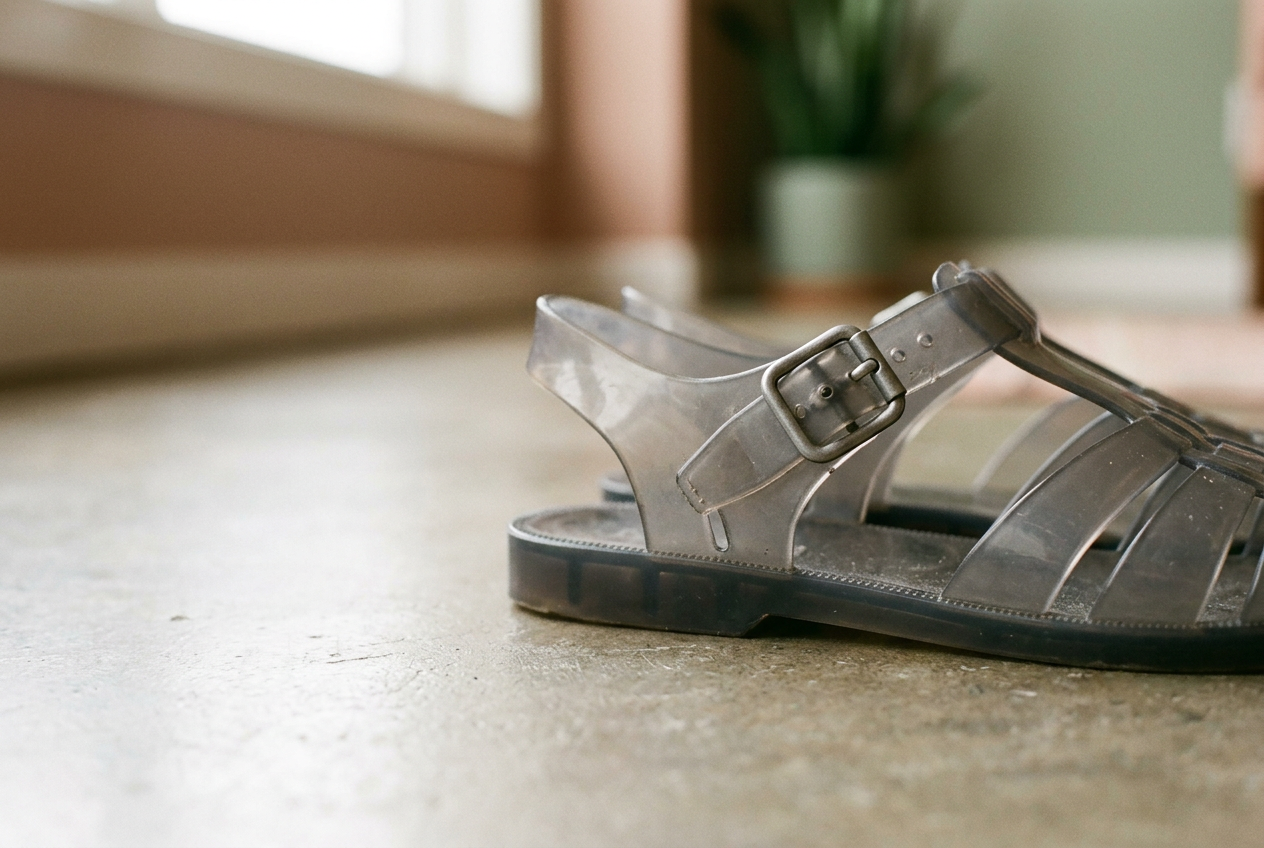
The useful detail on a jelly sandal is not the shine, color or amount of metal visible from standing height. It is the third buckle hole.
Take a smoke-gray fisherman-style jelly sandal with an ankle strap made from flexible PVC, or polyvinyl chloride, the plastic traditionally associated with jelly shoes. If that strap passes through a working five-hole pin buckle, meaning the metal pin enters a punched hole to set the length, the third hole leaves room to tighten or loosen as the material and foot change through the day. That small reserve is the point of the buckle.
A decorative buckle offers no such reserve. A one-piece molded strap may fit neatly without metal, but it has no reserve either. Warm weather makes this distinction less academic, because the sandal, the foot and the skin all become less cooperative at once.
This is unisex fit advice. The construction behaves the same across wardrobes, although people with lower-volume feet, narrow heels or prominent ankle bones will notice the differences sooner.
The third hole is the useful test
A working buckle should close near the middle of its adjustment range when the foot is cool. On the reference smoke-gray sandal, that means starting around the third hole rather than using the tightest or loosest setting in the store. The exact hole count varies, but the principle does not: spare holes on both sides let the wearer respond to swelling, sock thickness or a strap that relaxes.
The strap should lie flat without pulling the buckle frame sideways. If the pin sits at an angle, the hole is already carrying force unevenly, which encourages it to lengthen into an oval rather than remaining a clean circle. Once that happens, tightening the strap may make the sandal feel secure for a while, but the pin keeps drifting toward the weakened edge. PVC is patient until it is not.
The most useful hands-on check takes less than a minute. Open the buckle, flex the strap beside a hole and inspect whether the plastic turns pale, forms a sharp crease or feels much thinner where it passes through the frame. Then buckle it again and walk until the foot rolls through a full step. The heel should not lift enough to make the ankle strap saw backward and forward.
A buckle cannot rescue poor placement. If the hardware sits directly over the ankle bone, tightening it trades movement for pressure, and warm, damp skin makes that bargain worse. A functioning adjustment attached in the wrong place is still functioning. So is a tiny clamp.
Heat changes the fit before it ruins the material
Jelly footwear is commonly made from PVC, though some pairs use TPU, or thermoplastic polyurethane, a flexible plastic that can feel springier and may recover its shape differently. Material labels are not always prominent, so check the product description, molded markings or packaging rather than guessing from transparency alone.
Normal summer wear does not guarantee that either material will permanently stretch. Formulation, strap thickness and construction matter, while a hot car or prolonged direct sun can expose a shoe to more heat than a foot ordinarily would. The practical change during wear is often temporary softening combined with sweat, swelling and reduced friction inside the sandal.
That combination makes a marginal fit feel loose. A foot that stayed centered indoors begins moving forward on the footbed, meaning the surface directly beneath the foot, while the ankle strap twists and the forefoot rubs against edges that seemed harmless during a carpet test. The shoe may not have grown much at all. It has merely stopped resisting movement as firmly, which is enough to make every curb informative.
With the smoke-gray buckle sandal, the third hole matters here. Moving the pin inward by one setting restores tension without asking the wearer to add a pad, accept heel lift or hope the foot becomes less sweaty out of politeness. Later, if the foot swells, the strap can move outward again.
Adjustment survives only while the holes and buckle attachment survive. Thin plastic around a punched hole can tear, especially when the strap enters the buckle at an angle, and a narrow metal frame may leave a pressure line even when the length is correct. Look for enough material around each hole, a smooth frame without sharp corners and a buckle attachment that does not twist when lightly pulled.
Decorative buckles adjust the appearance
A decorative buckle can be fixed to the upper while a concealed snap, elastic section or molded strap handles the closure. There is nothing inherently dishonest about that construction if the real fastening method works. The problem comes when the visible buckle suggests adjustability that the sandal does not have.
Trace the strap with a finger. If it does not pass through the buckle frame, or if the pin never enters a usable hole, the metal is decoration. Check whether the actual closure offers another form of adjustment. A short elastic insert accommodates some movement, but it does not let the wearer choose a new resting length after the plastic relaxes.
Elastic can also pull the buckle against the foot, concentrating pressure exactly where the decorative part is heaviest.
This construction can suit a foot that matches the mold closely. It is less useful for a narrow heel paired with a wider forefoot, or for anyone whose feet change noticeably between a cool morning and a hot evening. The sandal may remain wearable, but security becomes dependent on the original shape rather than a setting the wearer controls.
Visible hardware also adds a failure point without necessarily adding a benefit. Rivets can press through soft plastic, buckle frames can heat in direct sun, and plated surfaces may react poorly to repeated sweat or saltwater exposure depending on their finish. A decorative buckle deserves no price premium merely for being shiny. Metal should either adjust the shoe or stay out of the way.
Molded straps remove pressure and choice
A one-piece molded jelly upper joins the straps to the sole as a continuous plastic form, without a separate buckle or closure. Its cleanest advantage is the absence of hardware. There is no frame against the ankle, no pin digging into softened skin and no punched hole beginning its slow career as a split.
The tradeoff is fixed geometry. If the molded ankle or instep strap fits securely when the sandal is warm, with no toe gripping and no heel lift, the simplicity can work well. If the strap starts slightly loose, heat and sweat will not improve matters, and there is no meaningful way to shorten it without altering the shoe.
Molded straps can also feel tighter across a high instep even when the overall length is correct, because the upper cannot open to admit the foot and then close around it. Sizing up may create more vertical room, but it also lengthens the footbed and changes where the straps cross. That can replace pressure with sliding, a familiar footwear achievement in which the problem moves but remains employed.
Permanent deformation is easiest to spot after the sandal has cooled. Set the pair side by side on a flat surface and compare the strap openings. A strap that remains higher, wider or twisted has changed shape rather than merely warming during wear. Do not try to shrink it with boiling water or concentrated heat; uncontrolled heat can warp the sole, alter the finish or create a new fit problem with greater confidence.
For a lower-volume foot, the fixed molded upper is the riskier buy unless the initial fit is unusually precise. A higher-volume foot may prefer its broad, hardware-free contact, provided the strap edges do not cut across the instep.
What earns the money
At the lowest, impulse-buy end of jelly footwear, inspect the buckle rather than assuming it works. Decorative hardware and thin punched straps can look more elaborate than a plain molded slide while offering less control. Paying more makes sense when the added construction is visible: a working buckle, cleanly finished holes, enough strap length for several useful settings and hardware positioned away from the ankle bone.
The smoke-gray reference sandal earns consideration only if that third hole leaves room in both directions. A pair that already needs its tightest setting in a cool fitting room has no response when the upper softens. One that starts on the loosest hole cannot accommodate swelling without being worn too tight from the beginning.
Try both shoes, because feet and molded uppers are not reliably identical. Walk on a hard floor if the retailer permits it, then stop and check whether the heel has shifted, the toes are gripping or the buckle has rotated. For online orders, keep the protective film and packaging intact until the pair has been tested indoors during a warmer part of the day.
Choose a real buckle when fit changes through the day or when the heel needs active restraint. Choose a molded strap when hardware pressure is the larger problem and the shape fits without negotiation. Skip the decorative buckle unless the hidden closure is independently secure, comfortable and clear about what it can adjust.
Questions people ask
Do jelly sandal straps stretch permanently in heat?
They can deform, but warm-weather looseness is not always permanent stretch. Softened plastic, sweat and foot swelling can create extra movement during wear. Let the sandals cool on a flat surface, then compare both strap openings; a difference that remains after cooling points to deformation.
How can
I tell whether a jelly sandal buckle is real?
Follow the strap through the buckle. A working pin buckle has usable holes, and moving the pin changes the strap’s closed length. If the strap is riveted beneath the buckle or closes elsewhere with a snap or elastic insert, the visible buckle is decorative.
Should
I size up in jelly sandals if I am between sizes?
Not automatically. Extra footbed length can increase sliding, especially with a molded upper that cannot be tightened. Prioritize correct strap placement and enough toe room, then check whether the heel stays centered after the material warms; if only whole sizes are offered, compare both rather than relying on a standard sizing rule.
One update a day
Today's fashion update, in your inbox
One fashion update each morning — no hype, no filler, just pieces worth wearing.