A Nickel-Free Earring Claim Can Miss the Parts That Touch You
A post, its solder joint, the decorative top and the backing can contain different metals. Here is how to read beyond a nickel-free label before buying.
August 12, 2026 · 8 min read
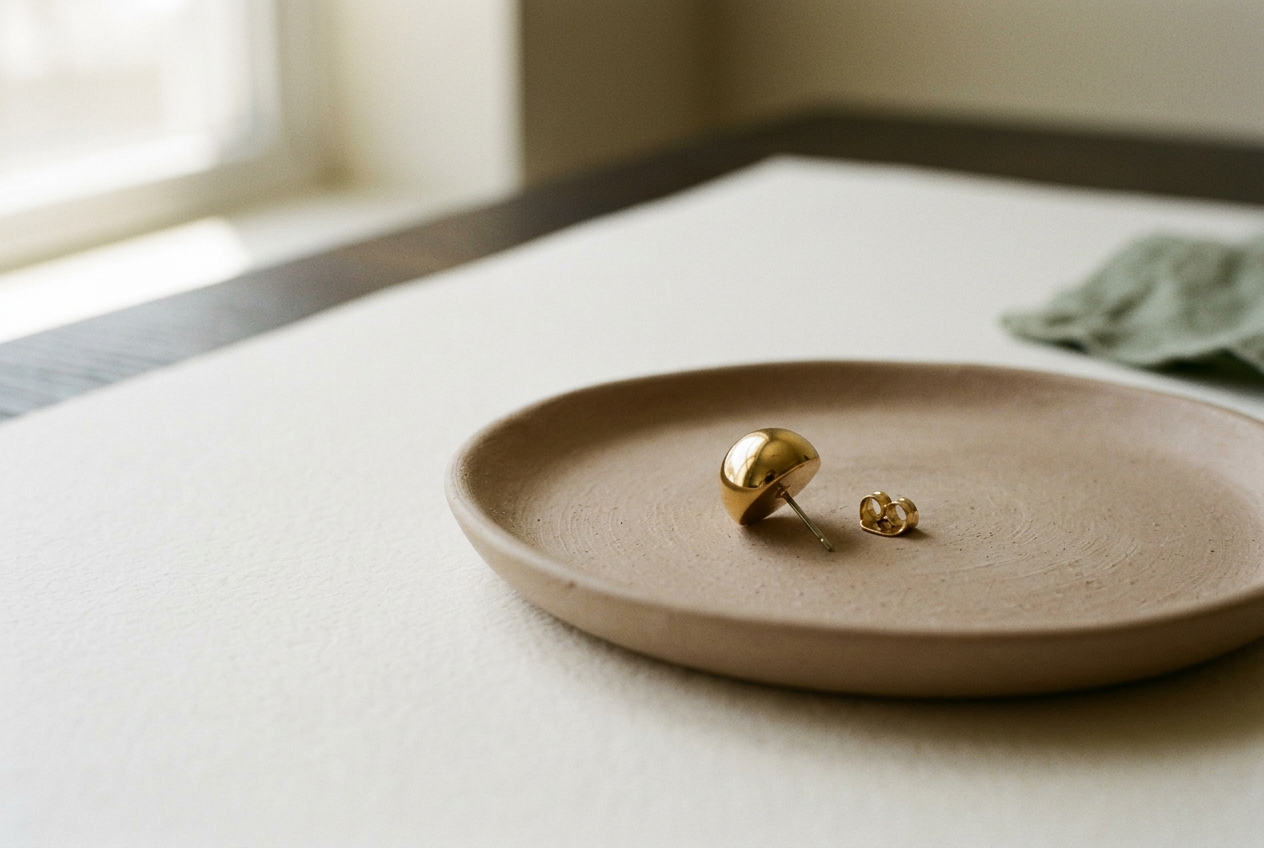
Start with a familiar gold-tone dome stud: a rounded decorative front, a straight post and a butterfly backing, with “nickel-free” prominent on the product page. Turn that small earring sideways and the problem becomes visible. It is not one piece of metal. The post can be steel, the dome can be plated brass, the solder joining them can be another alloy, and the removable backing can come from a general stock supply.
All four areas can touch skin. The post sits inside the piercing channel. The backing presses behind the lobe. The rear face of the dome rests against the front, particularly when a stud is heavy or the post is short.
The solder joint sits at the point where those surfaces meet.
That does not mean the pair contains nickel, or that every wearer will react. It means the two-word claim does not yet give enough information to compare it with another pair. This is unisex buying advice because the construction and skin-contact points do not change across wardrobes.
Nickel-free can describe a test, not a full recipe
Nickel allergy commonly appears as allergic contact dermatitis, meaning an itchy or inflamed skin reaction after contact with an allergen. For an earring shopper, the distinction between nickel content and nickel release matters: an alloy may contain nickel while releasing only a limited amount under specified test conditions.
European Union REACH rules restrict nickel release from posts inserted into pierced ears and from products intended for direct and prolonged skin contact. The limit for post assemblies is lower than the limit for other skin-contact items. This is a release standard rather than a promise that no nickel atom exists anywhere in the object.
A bare “nickel-free” statement on a US listing rarely tells you whether the seller means no intentionally added nickel, no detectable nickel, compliance with a release test, or only that the named post material is nickel-free. “Hypoallergenic” is less useful still. It does not identify a metal, an alloy standard or the parts covered.
Return to the dome stud. If its page says only “nickel-free post,” the claim is narrow: it says nothing definite about the dome, solder or butterfly back. If the page says “all metal components are nickel-free” and names each material, the disclosure is much easier to compare.
Read the post and backing as separate parts
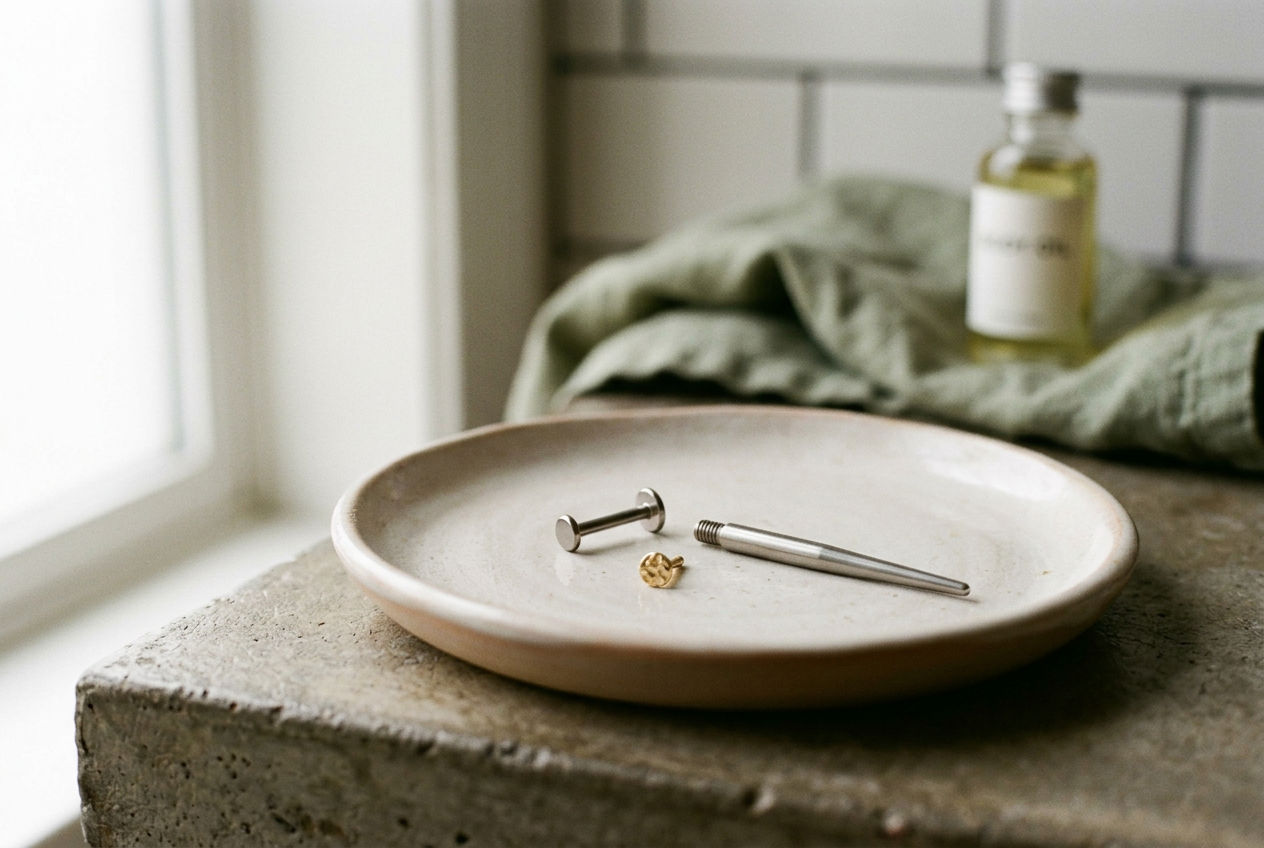
The most useful post description names both the metal and, where relevant, a recognized material specification. “Titanium” is clearer than “hypoallergenic metal,” while “implant-grade titanium meeting ASTM F136” is more specific again; ASTM F136 is a standard for a titanium alloy used in surgical implants. Commercially pure titanium may instead be identified to ASTM F67.
Those standards do not make every finished earring suitable for every person, and a compliant post does not certify the rest of the design. Still, they tell you considerably more than “surgical quality.” “Surgical steel” is a broad retail phrase, and some stainless steels contain nickel as part of the alloy. A named steel grade or standard lets a shopper assess the claim rather than infer safety from the word surgical.
Solid gold also needs one more line of detail. Karat describes the proportion of gold in an alloy, not the identity of every remaining metal. White gold may be alloyed with nickel or with alternatives such as palladium, so “solid 14k gold” and “nickel-free solid 14k gold” are not equivalent disclosures. With sterling silver, the 925 mark identifies the silver proportion but does not, by itself, name everything in the balance.
Then inspect the backing description. A titanium post supplied with a stainless steel butterfly back is a mixed-metal earring, even if the retailer files the whole product under titanium jewelry. A silicone backing may still contain a metal core. For the dome stud, the best listing would identify the backing independently instead of leaving “titanium” to describe the pair by association.
Plating is only as dependable as its wear points
Plating is a thin metal coating applied over a different base material. On our gold-tone dome, the visible gold color might sit over brass, and an intermediate nickel layer may sometimes be used beneath decorative plating to improve the finish or act as a barrier between metals. A claim that the outer gold layer is nickel-free does not answer whether the underlayer or base contains nickel.
The distinction matters because plating wears unevenly. The edges of a decorative top rub against fingers, clothing and storage trays, while the post experiences friction every time it moves through a piercing. Sweat, cosmetics and repeated cleaning can also shorten a coating’s useful life. Once the surface is scratched or thinned, the base metal can become the skin-contact metal.
“PVD gold” names a coating method, physical vapor deposition, rather than the composition of the entire earring. It can produce a durable finish, but shoppers still need the substrate beneath it. “Gold vermeil” has a more specific US trade meaning: gold of at least 10 karat over a sterling silver base, with a minimum plating thickness required by Federal Trade Commission guidance. That tells you more about construction, though it still does not automatically establish that every finding, solder seam or backing is nickel-free.
For frequent wear, solid implant-grade titanium, niobium or specifically disclosed nickel-free solid gold avoids the central weakness of surface plating: there is no thin decorative barrier that must remain intact to keep an undisclosed base away from skin. The tradeoff is visual and financial. Titanium and niobium offer fewer conventional fine-jewelry finishes, while solid gold usually moves into a higher price band than plated fashion studs.
The solder joint is small but badly placed
Solder is the lower-melting metal alloy used to join components. On the dome stud, it may form a tiny collar where the post meets the decorative top, directly beside the piercing entrance. A product page can accurately call the post titanium while saying nothing about that joining material.
Some titanium earrings avoid conventional solder by machining the front and post as one piece, mechanically setting the decorative element, or using a threadless or threaded connection. A threadless earring uses a tension-fit pin to secure the decorative end to a hollow post. These constructions can make the material map easier to understand, but only when the manufacturer identifies the post, end and any setting separately.
Decorative fronts complicate the map further. An enamel flower may be mounted in a brass cup. A crystal can sit in a plated setting whose rear edge touches the lobe. Resin or acrylic may cover the visible face while an undisclosed metal plate remains behind it.
Product photography usually shows the attractive front, so look for a side view and a photograph of the reverse.
If there is no reverse image, the useful customer-service request is concrete: ask for the material of the post, backing, solder or joining method, base metal, plating layers and rear surface of the decorative top. That request takes a few minutes. A vague reply that repeats “hypoallergenic” does not add evidence and is not worth paying a premium for.
A disclosure you can compare
The strongest product copy reads like a component map. For the ordinary dome stud, that might mean a post identified to a titanium standard, a titanium backing, a brass decorative top under a named plating system, and a clear statement about the joint and all skin-contact surfaces. You can then decide whether the plated brass front is acceptable for occasional wear or whether you want one-piece titanium for daily use.
Prioritize the post and backing for a healed piercing because they maintain prolonged contact, then check the rear of the top and its joint. For a fresh or unsettled piercing, material choice and fit need more care; professional piercers commonly favor appropriately sized implant-grade materials rather than plated fashion jewelry. A post that is too short can also press the decorative back against swollen tissue, turning an otherwise small contact point into sustained pressure.
The lower-cost option is often a plated pair with limited component disclosure. It can make sense for brief, occasional wear if you do not have a known sensitivity and accept that the finish may eventually wear. For daily earrings, paying more for a fully identified solid material can buy a clearer construction and fewer unknown layers, which is a more useful benefit than a broad hypoallergenic label.
If earrings repeatedly leave the piercing itchy, sore, weeping or swollen, stop treating the issue as a shopping puzzle. Remove the suspected item when it is safe to do so and seek guidance from a qualified clinician or professional piercer, particularly if symptoms are severe or the piercing is new.
Questions people ask
Does nickel-free mean an earring contains no nickel anywhere?
Not necessarily. The phrase may refer to no intentionally added nickel, a nickel-release test, the post alone or all named components, depending on the seller and market. Look for wording that identifies the post, backing, decorative top, base metal, plating layers and joining material separately.
Are titanium posts enough for sensitive ears?
A well-specified titanium post removes one major unknown, but the backing, solder joint and rear of the decorative top can still touch skin. Look for a named titanium grade or standard and confirm whether “titanium” describes the complete earring or only the shaft through the piercing.
Is gold-plated jewelry nickel-free?
Gold plating does not establish what is underneath it. The base may be silver, brass or another alloy, and there may be an intermediate plating layer. Check the full layer stack and remember that exposed edges, scratches and worn posts can bring the underlying material into contact with skin.
What should
I ask a retailer before buying nickel-free earrings?
Ask for the material of the post, backing, decorative top, base metal and solder or other joint, plus the composition of each plating layer. If the answer only repeats “nickel-free” or “hypoallergenic,” compare it with a pair that supplies a component-by-component material statement.
One update a day
Today's fashion update, in your inbox
One fashion update each morning — no hype, no filler, just pieces worth wearing.