A Flat Back Earring Needs Swelling Room, Not Daily Wobble
Extra post length protects a fresh piercing during swelling. Once the tissue settles, that same space can tip the stud forward, catch on hair and keep irritation going.
August 11, 2026 · 7 min read
A flat back earring, meaning the post’s backing sits flush against the ear, can feel far calmer overnight than a butterfly-backed stud. The disk does not have sharp loops to press into skin or collect hair. Post length still decides whether the design behaves.
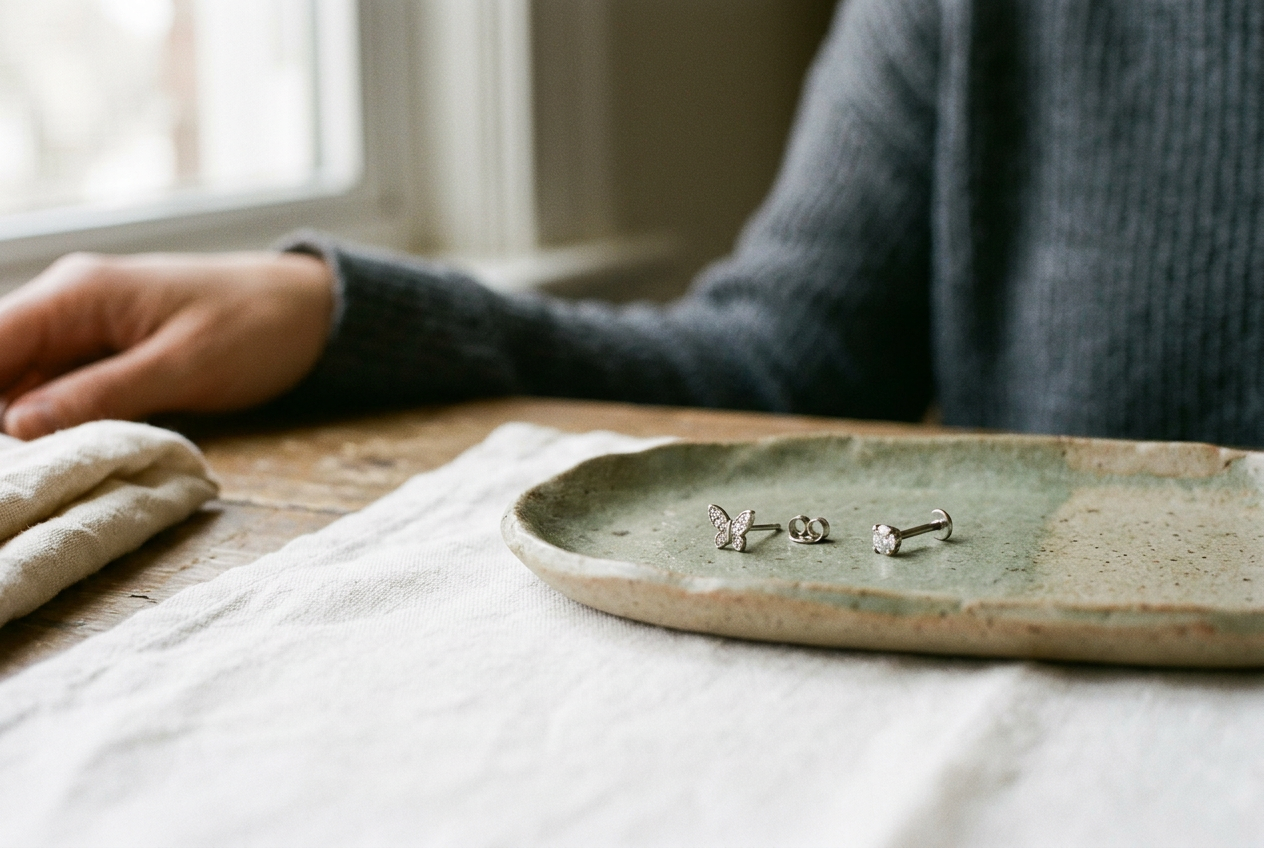
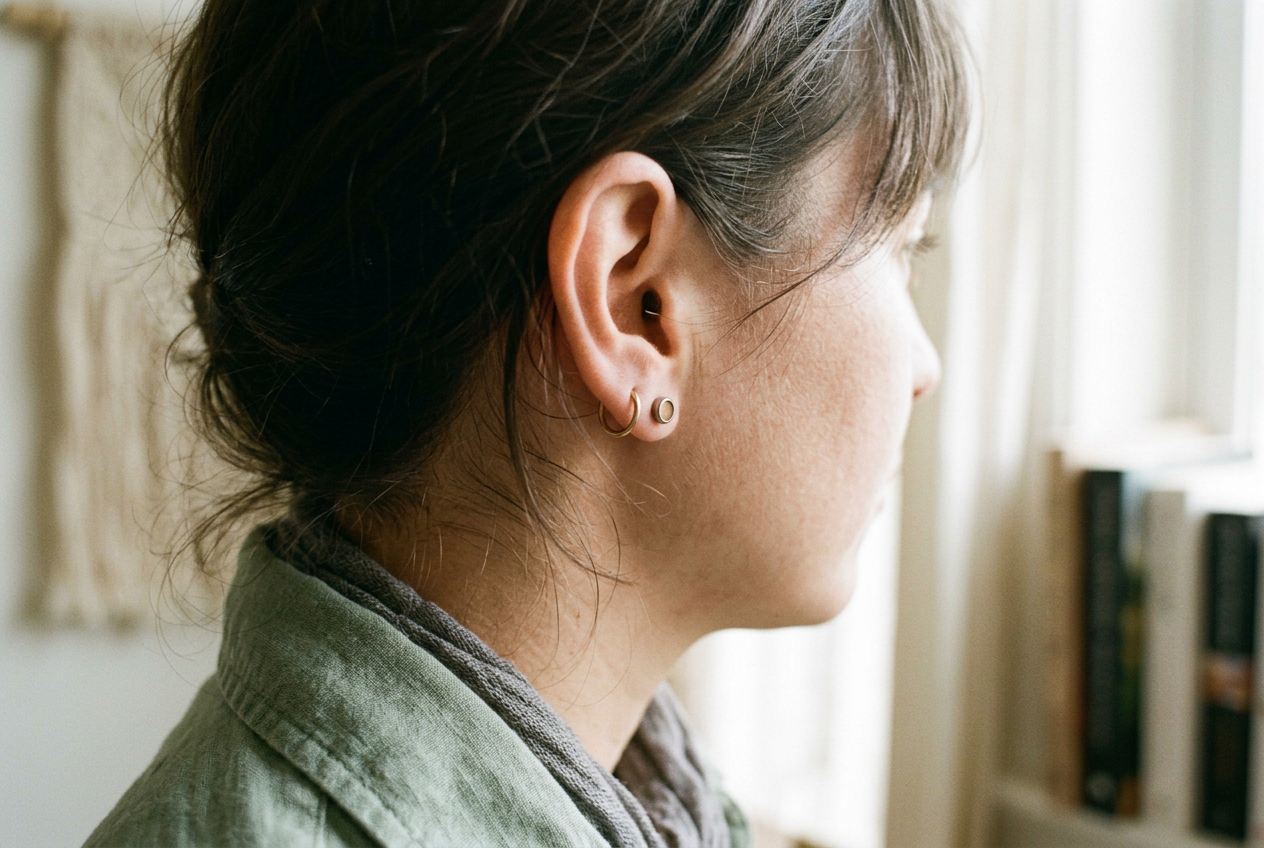
The fitting case for this walkthrough is a small bezel-set titanium stud worn in a fully healed second-lobe piercing, with a threadless labret post and flat disk at the back. A threadless labret is a straight post whose decorative end is secured by tension rather than a screw. The stone is held inside a smooth metal rim, so the front itself is unlikely to catch.
After a one-week wear check, the problem is visible: the stud begins the morning upright, then angles down as the post travels forward. A narrow section of bar appears behind the front. Hair winds around it, and the disk taps the ear instead of resting close to it. The jewelry is sleep-friendly in construction, but not in this fit.
This is unisex advice. Post length depends on anatomy, piercing placement and current tissue condition, not the wardrobe category assigned to the jewelry.
Why a little extra post changes the whole stud
A flat back works best when the front and disk stay close enough to stabilize each other without compressing the tissue. Too much distance lets the jewelry move along the piercing channel, the tunnel of healed tissue around the post. Gravity pulls the decorative end downward. A heavier cluster or charm makes that tilt more obvious, though even the small titanium stud in this fitting case can droop once the bar has room to act as a lever.
Movement is the main nuisance. The exposed section catches strands of hair, towel loops and the edge of a knit collar, while the backing shifts during sleep and can press at an angle against the ear. Repeated motion may leave the piercing tender or crusty even when the titanium itself is well tolerated. A longer post is not proof of a metal sensitivity.
Look at the jewelry from the side rather than judging it in a mirror straight on. In the second-lobe example, the front should sit level with the ear and the disk should remain nearby without cutting a circle into the skin. If pushing the stud gently backward reveals a conspicuous length of bare post at the front, or pushing it forward creates the same gap behind the ear, there is more travel than the settled piercing needs.
Do not aim for a clamped fit. Skin should not bulge around the front or swallow the edge of the backing. The right visual is stable, not tight.
Swelling room belongs to a particular stage
Fresh piercings are commonly fitted with longer posts because tissue can swell after the procedure. That reserve matters. Jewelry that starts perfectly flush may become restrictive as the area reacts, leaving pressure marks or allowing an end to embed in the skin.
The tradeoff changes as swelling settles. The original post can become awkward before the piercing is ready for casual jewelry changes, which is why a professional downsize often happens during healing rather than after someone declares the piercing finished. Downsizing means replacing the original post with a shorter one while keeping enough room for the tissue’s current state.
Timing cannot be judged from a calendar alone. Different placements settle at different rates, and a piercing that looks quiet from the front may still be delicate inside. An experienced piercer can assess the channel, swelling and angle without asking the wearer to repeatedly remove and reinsert jewelry at home.
A healed piercing may still need slight clearance. Ears can puff after a snag, sustained pressure or irritation from a product, and a disk sitting hard against the skin is not an upgrade over a loose post. The goal is modest space that permits normal tissue movement without producing daily wobble.
Run a one-week fit check
Use the small titanium stud as the reference. Leave it in during an ordinary week, provided the piercing is healed and comfortable enough for routine wear, then observe what happens during dressing, sleep and hair care. Do not keep tugging it to test the maximum travel; ordinary movement gives better information and causes less irritation.
Start with alignment. The bezel-set front should remain where it was positioned rather than pointing toward the floor by midday. A decorative end that repeatedly tips, even after being straightened, suggests the post is giving it too much runway. Placement angle can also cause drooping, so a shorter bar is not guaranteed to correct every tilted piercing.
Next, check for visible post. A momentary gap while cleaning or moving the jewelry is different from a section of bar that stays exposed during normal wear. In this case, the recurring silver line behind the bezel is the useful clue because it appears without the ear being pressed or manipulated.
Notice snags rather than counting them. One towel accident can happen with well-fitted jewelry. Hair repeatedly wrapping around the post, the disk catching while a sweater comes off, or the stud shifting whenever headphones are removed points to excess movement. Flat backs reduce hardware at the rear, but they cannot cancel the leverage created by an overlong bar.
Comfort completes the check. Tenderness that develops after sleep, a pressure point caused by the disk sitting crooked, or irritation that improves when the stud is stabilized deserves attention. Pain that is worsening, heat, spreading redness, marked swelling or discharge needs more than a jewelry-sizing experiment; contact a qualified piercer promptly, and seek medical care for signs of infection or feeling unwell.
What to take to a piercer
Bring the earring you want to keep wearing and explain when it moves. Mention whether the piercing is healed, whether swelling has changed recently and which activities produce snags. A clear description of the front tipping during the day is more useful than asking for the shortest available post.
The piercer should assess the wearable length, the section of post that passes through the tissue, while leaving enough clearance for that ear. They can also check whether the disk diameter suits the placement. A broader disk may feel stable on some anatomy, but it does not correct a post that is plainly too long, and a large backing can create its own pressure against nearby piercings in a close stack.
With threadless jewelry, the decorative titanium end can often be reused if it is compatible with the replacement post. Expect to pay for a new post and possibly a fitting or insertion fee; ask the studio before the appointment, since policies and jewelry systems vary. That is usually a narrower purchase than replacing the entire stud, but compatibility matters more than forcing an existing end into unfamiliar hardware.
Keep the longer post. A piercer may decide it is useful if temporary swelling returns or if the jewelry moves to a thicker placement, though it should not be reinstalled into an irritated piercing without an assessment.
Material does not fix length
Implant-grade titanium is a sensible material to discuss with a reputable studio because it is lightweight and available in polished flat-back components. Solid gold designed for body piercing is another option. Neither prevents drooping when the post is too long.
Finish quality and construction matter too. Rough threading, damaged components or a poorly polished surface can irritate the channel, while an unsecured threadless end can loosen. In the one-week titanium case, however, the repeated forward slide is a geometry problem first. Buying a more expensive decorative top would leave that geometry unchanged.
Questions people ask
Should a flat back earring touch the skin?
It should sit close and remain stable, but it should not clamp the ear. Look for a backing that rests near the skin without leaving a deep circular mark, causing bulging or disappearing into tissue. A small amount of clearance is useful; a gap that allows constant sliding is not.
Do flat back earrings work for a fresh piercing?
Flat backs are commonly used for fresh piercings, but the initial post must leave room for expected swelling and should be selected by a professional piercer. Do not replace fresh jewelry with a shorter post just because the extra length looks untidy. The tissue may still need that reserve.
Can
I downsize a healed flat back earring myself?
A fully healed, calm piercing may permit routine jewelry changes, but professional fitting is worthwhile when length is uncertain or irritation has started. Threadless ends also need compatible posts and correct tension. Repeated removal while testing several lengths can aggravate the channel and make the fit harder to judge.
Will a shorter post stop my earring from drooping?
It can stop drooping caused by excess travel, especially when bare post is visible and the front shifts throughout the day. It will not change a piercing channel that was made at an angle, nor will it fully stabilize an unusually heavy end. A piercer can separate those causes before changing the post.
One update a day
Today's fashion update, in your inbox
One fashion update each morning — no hype, no filler, just pieces worth wearing.