A Buckle Does Not Make a Jelly Sandal Adjustable
A pin buckle can change the fit of a PVC sandal, but only when the strap has somewhere to travel. On a stiff molded upper, it may just move the sore spot.
September 28, 2026 · 7 min read
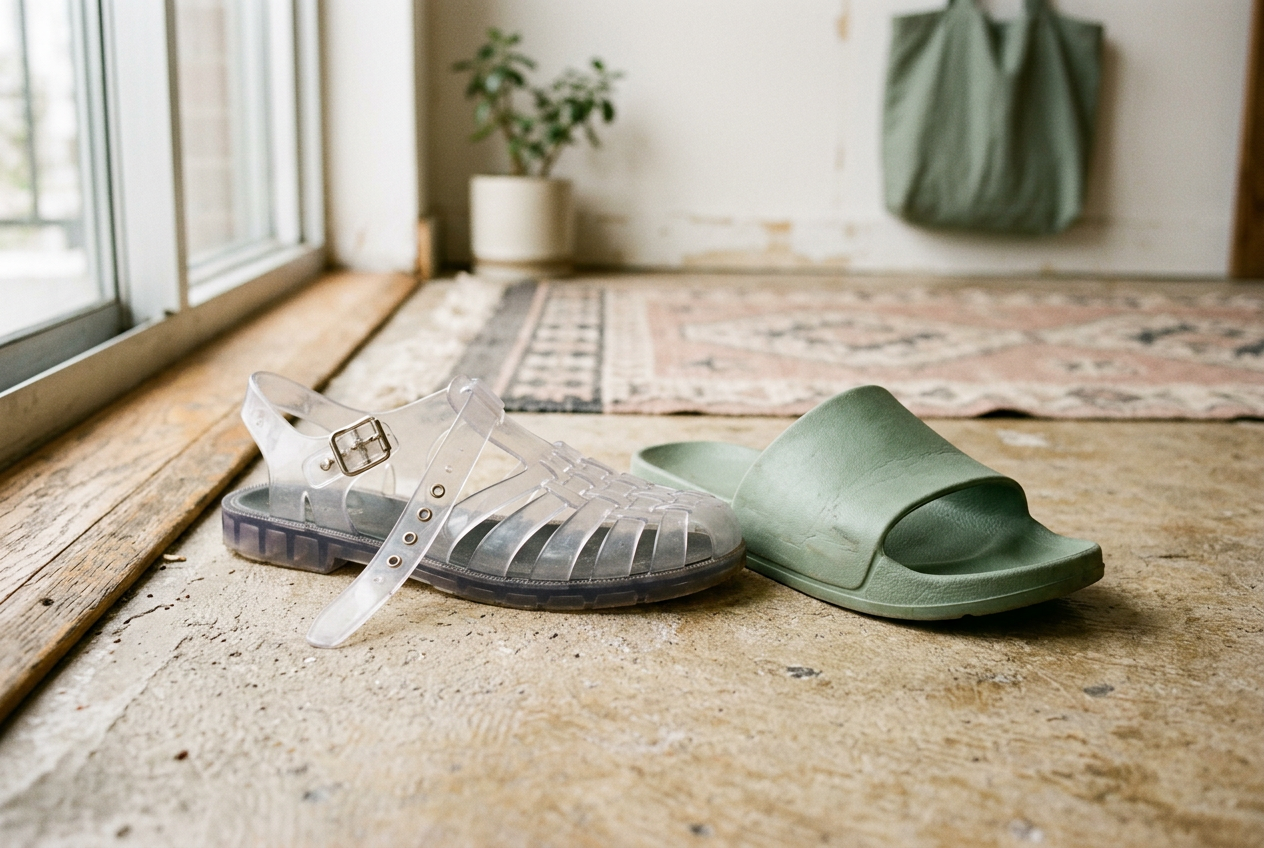
The pair that clarified this was a clear PVC fisherman sandal with a closed toe, a five-hole ankle strap and a metal pin buckle. I wore it through one hot week, alternating it with a one-piece jelly slide whose two straps were molded directly into the sole.
On the fisherman sandal, moving the pin by one hole looked convincing while the shoe was off my foot. Once fastened, however, most of the broad upper stayed exactly where the mold had put it. The ankle opening changed a little, but the fit over my instep, meaning the top of the foot between the toes and ankle, barely moved. What did move was the buckle frame, which pressed into a new patch of skin.
That distinction matters across women’s and men’s sizing, so this is genuinely unisex fit advice even though retailers may file the same translucent sandal under one department. PVC does not negotiate with a high instep merely because somebody attached hardware to it.
Real adjustment needs strap travel
A functional pin buckle shortens or lengthens a strap by pulling material through the frame and securing it at a different hole. The useful part is not the number of holes. It is the distance the strap can travel while the rest of the upper remains free enough to follow.
The clear fisherman pair failed this test over the midfoot. Its buckle was attached to a narrow-looking tab, but that tab flowed directly into a broad, stiff PVC cage. Pulling the strap tighter brought the buckle farther around the ankle; it did not reduce the volume, meaning the interior space available around the foot, across the whole upper. Loosening it created a small gap beside the buckle while the molded ribs continued to grip the instep.
You can check this in a store without putting the sandal on. Undo the buckle, hold the body of the upper still and pull the strap tail through the frame. A genuinely adjustable strap should move independently for a useful stretch, with enough spare length that neighboring holes alter the circumference rather than twist the hardware. If the whole side of the shoe lifts when you pull, the mold remains in charge.
Look underneath as well. On the test pair, the buckle frame and its PVC mounting tab formed a firm lump against the outside of the ankle. Tightening the strap did not flatten that junction. It rotated the lump inward.
This is where molded straps can be more honest. The jelly slide in the comparison offered no adjustment, but its fixed bands flexed across a wider area and returned to their original shape after each step. It either matched the foot or it did not. There was no tiny metal prop suggesting a negotiation that the plastic had already declined.
Hole spacing decides whether the change is wearable
Buckle holes should create small enough changes that one setting can hold the foot without the next setting pinching it. Wide spacing leaves a familiar choice: heel lift on the loose hole, concentrated pressure on the tight one.
On the clear fisherman sandal, the middle setting held my heel but placed the buckle mount hard against the ankle. The next looser hole stopped that local pressure, yet the heel moved enough for the rear PVC edge to rub with every stride. The tighter hole added no useful stability at the forefoot because the molded cage did not contract there. It only made the ankle feel bound.
Do not judge spacing by counting holes. Fasten two adjacent settings and watch what changes. The strap should lie flatter or closer around the intended part of the foot, rather than pulling the buckle sideways or buckling the upper into a ridge. A ridge is a warning: PVC edges tend to become more noticeable after the foot warms and expands.
For online shopping, product photos can still reveal some of the mechanics. Enlarge the side view and trace the strap from its tail to its attachment point. A long, distinct strap with several usable holes has a better chance of changing circumference. A decorative buckle planted near the end of a broad molded panel has less room to work, even when the product description calls it adjustable.
Customer photos are useful for one detail: spare strap. If the model is already using the last hole and only a short tail remains, that design offers little extra room for swelling or a higher instep. Size charts rarely describe this because they concentrate on foot length, the measurement jelly sandals are least mysterious about.
Heat exposes the difference
PVC, or polyvinyl chloride, softens somewhat with warmth but does not behave like a woven strap that distributes tension by conforming to the foot. During the cooler part of the day, the fisherman sandal felt secure. After sustained walking in hot weather, my foot occupied more of the upper and the damp skin stopped sliding cleanly against it.
The first irritation appeared beneath the buckle mount, followed by rubbing along the rear edge when I moved to the looser hole. Switching settings changed the location faster than it changed the fit. By the end of the week, the sandal itself had developed visible flex creases near the ankle strap, but the broad instep section had not relaxed enough to create dependable extra room.
The molded jelly slide grew warmer and less ventilated under its bands, yet it spread pressure more evenly because there was no rigid frame interrupting the strap. Its failure was different: on damp feet, the fixed upper allowed a little forward movement, and the toes had to work harder to keep the slide in place. That is tiring rather than surgical. Neither option deserves a comfort medal.
Try jelly sandals late in the day, when feet are closer to their warm-weather volume, and walk for more than a lap around the carpet. Pay attention to whether the foot settles or continues pressing against one edge. Redness that follows the exact outline of a buckle mount is a construction issue, not a promising break-in story.
Socks can help during a short indoor fitting, particularly because they make pressure lines easier to spot without starting a blister. They are less useful as evidence of summer comfort. Bare, warm skin creates more friction, and jelly footwear is usually purchased for precisely the weather in which that becomes relevant.
The buying test
For a high instep, prioritize a separate strap that crosses the area needing room. An adjustable ankle strap cannot compensate for a fixed, shallow forefoot cage, while a buckle positioned directly over the instep can help if both ends attach independently and the strap has enough travel.
For a narrow or low-volume foot, a molded jelly slide may fit better than a nominally adjustable fisherman sandal whose cage remains roomy while its ankle strap cinches. The slide’s fixed bands need to hold the foot before it starts moving forward; adding an insole usually reduces ventilation and creates another slick layer rather than correcting the mold.
Budget jelly sandals and pricier fashion versions can use the same basic PVC construction, so hardware alone does not justify paying more. Better-finished buckle edges, a softer mounting tab and closer hole spacing are worth examining, but they still cannot alter a rigid upper. Spend for a shape that fits first. Decorative metal is available at every price.
At home, keep the clear fisherman pair on a clean surface and test each plausible hole while standing, then walk until the foot warms. Returns matter here because the useful setting may reveal itself only after several minutes. Do not wear the pair outdoors hoping the upper will transform; minor softening is plausible, wholesale remolding is not.
I kept returning to the middle hole on the test sandal because it looked correct and held the heel. The pressure under the buckle returned too. That pair’s adjustment was real at the ankle, narrow in range and irrelevant to the tightest part of the shoe, which is a more useful verdict than the word adjustable on a product page.
Questions people ask
Do buckled jelly sandals stretch with wear?
PVC may soften in warmth and develop flex creases, but a stiff molded upper should not be expected to gain dependable volume. If the buckle only adjusts an ankle tab while the instep remains tight, wearing the sandal longer is more likely to prolong pressure than correct the fit.
How can
I tell whether a jelly sandal buckle really adjusts?
Undo it and pull the strap through the frame while holding the upper still. Look for independent strap travel, usable spare length and adjacent holes that change the circumference without twisting the buckle. If a broad section of the molded upper moves as one piece, the practical range is limited.
Are molded jelly straps less comfortable than buckled ones?
Not necessarily. A well-shaped molded strap can spread pressure more evenly than a stiff buckle mount, although it cannot accommodate much variation in foot volume. The choice comes down to whether the fixed mold already matches your foot, rather than whether one design carries more hardware.
Should jelly sandals fit tightly at first?
They should hold the foot without leaving a sharp pressure line during a warm indoor test. A little surface stiffness may ease, but pinching over the instep or under a buckle mount is poor evidence for future comfort. Use the return window before hot pavement and bare skin make the decision permanent.
One update a day
Today's fashion update, in your inbox
One fashion update each morning — no hype, no filler, just pieces worth wearing.