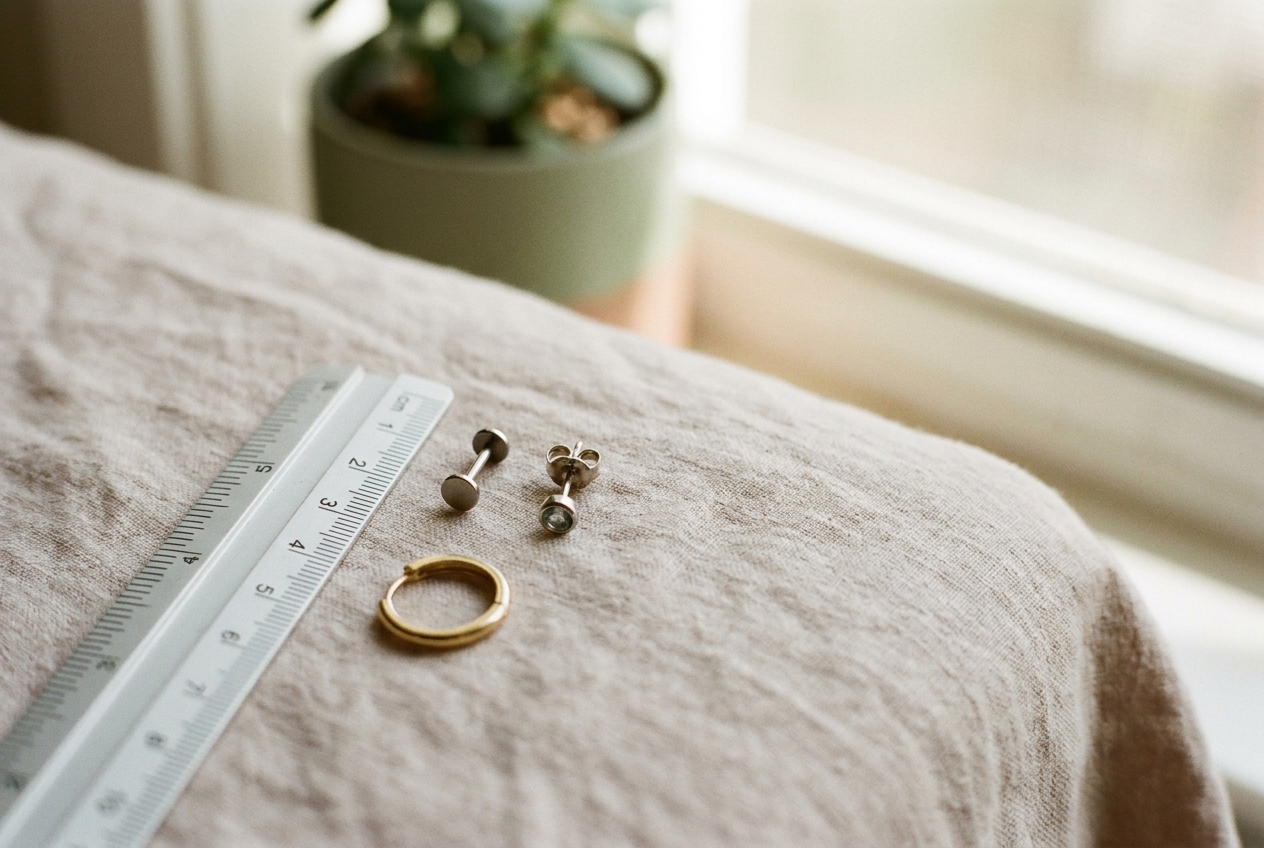
A 16-Gauge Flat Back May Not Fit Your Old Piercing
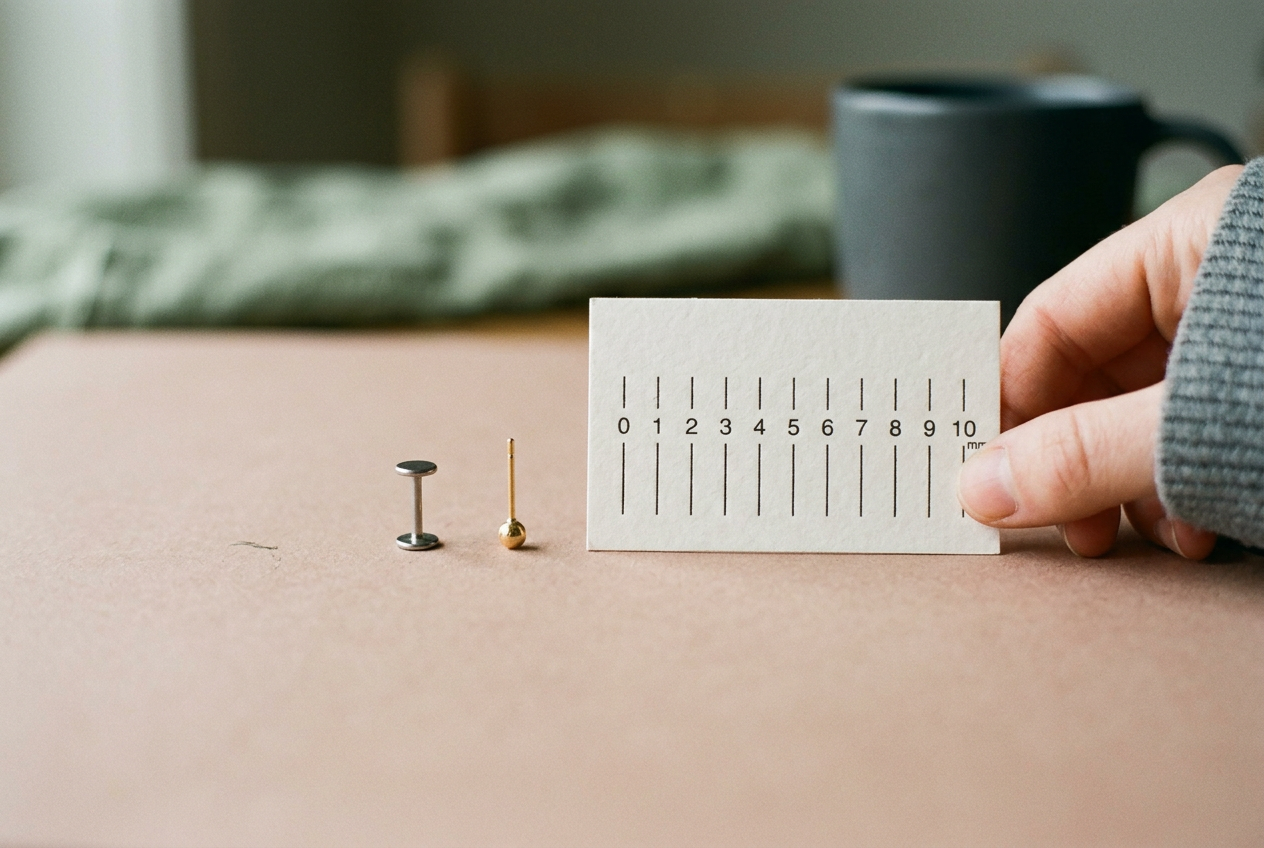
A 16-gauge post is 1.2 millimeters thick, which can be too wide for a piercing accustomed to a slim fashion stud. Read the measurement before ordering, and do not force the upgrade.
September 29, 2026 · 8 min read
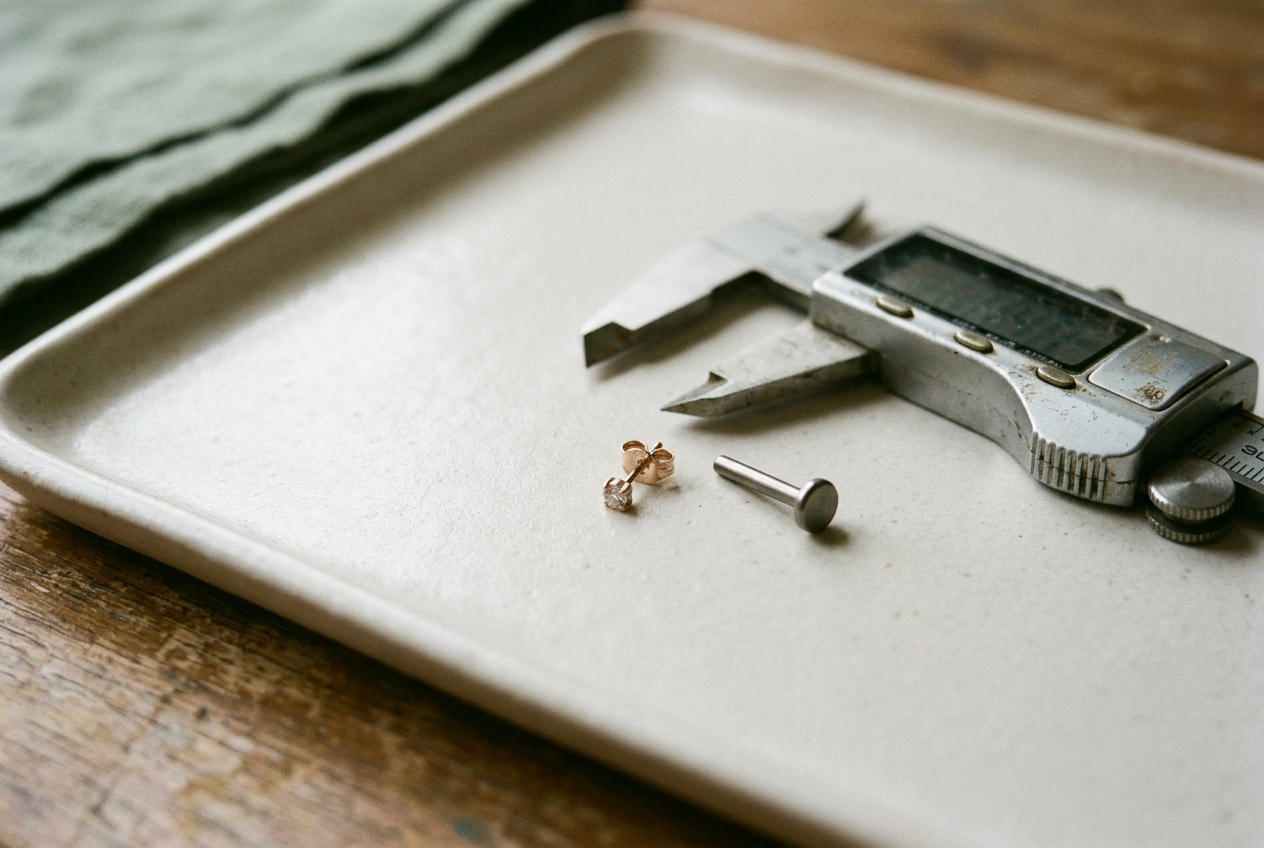
Keep one earring in view: a 16-gauge implant-grade titanium flat back with a 1.2-millimeter post, bought to replace a slim butterfly-back stud in a long-healed lobe piercing. The top may look interchangeable with any tiny gold dot. The post is not.
That difference is where many online orders go wrong. A conventional fashion stud is often around 20 gauge, or 0.8 millimeter, while flat backs commonly come in 18 gauge or 16 gauge. Moving from 0.
8 to 1.2 millimeters sounds minor until the new post stops at the entrance, pinches halfway through or leaves the lobe sore after being pushed.
This is unisex fit advice. Gauge describes the post rather than the wearer, and the same mechanics apply whether the finished stack is a row of diamonds, plain titanium discs or mixed gold hoops.
The conversions that matter for everyday earrings
Gauge, the measurement used for a post’s thickness, works backward: a lower gauge number indicates a wider post. Most shoppers comparing standard earrings with piercing-studio jewelry only need a short run of conversions.
20 gauge equals about 0.8 millimeter. This is common territory for slim fashion studs and some nostril jewelry.
18 gauge equals about 1.0 millimeter. It is only 0.2 millimeter wider than 20 gauge, but that does not guarantee an easy change.
16 gauge equals about 1.2 millimeters. Many flat-back labret posts are sold in this size; a labret post is a straight post with a fixed flat disc at the back.
14 gauge equals about 1.6 millimeters. This is firmly thicker than a conventional earring post and should not be treated as a casual swap for one.
Larger stretched sizes continue in the same reverse direction: 12 gauge is about 2 millimeters, 10 gauge about 2.5 millimeters and 8 gauge about 3.2 millimeters. At 0 and 00 gauge, inch-based conventions and manufacturer rounding can produce variation, so the millimeter listing becomes more useful than the gauge label.
For the titanium flat back in our example, the decisive line on the product page is not “16g.” It is “1.2 mm.” Millimeters let you compare products across retailers without memorizing the system, and they expose listings that use a gauge name while rounding the corresponding diameter.
Why a healed piercing can reject a thicker post
A long-healed piercing is not an empty opening that keeps its original dimensions forever. It is a fistula, meaning the skin-lined channel formed through the tissue, and that channel can settle closely around the jewelry worn in it. Leave a slim post in place for years and the piercing may fit that post with little spare room.
The jump from a 20-gauge stud to our 16-gauge flat back adds 0.4 millimeter to the diameter, making the new post 50 percent wider. Diameter also understates how different the two posts feel to tissue, because the cross-sectional area of a 1.2-millimeter circle is more than twice that of a 0.
8-millimeter one.
Placement matters too. A straight post must follow the existing channel’s angle, which may tilt upward or sideways rather than running squarely through the lobe. When the earring meets the wall of that channel, pushing harder can feel like a size problem even if the gauges match. Swelling, old scar tissue and a piercing that has narrowed during a jewelry-free stretch add further resistance.
Cartilage is less forgiving. It does not stretch like a fleshy lobe, and pressure from an oversized or poorly angled post can produce sustained irritation. A piercing being old does not make force safe.
Check the current post before buying
Start with the jewelry that fits comfortably now. Its original product specification is better evidence than a visual comparison, since the difference between 0.8 and 1.0 millimeter is difficult to judge by eye.
A digital caliper can measure the straight wearable section of a clean post, but do not include external threading or a decorative end in the reading.
If the current size remains unknown, choose a reputable piercing studio over guessing upward. A piercer can assess the channel and check sample sizes without turning a jewelry purchase into an accidental stretch. This costs more time, and the studio may charge for fitting or require the purchase of suitable jewelry, but it is a better trade than paying for a post that cannot be worn.
Post length is a separate measurement. Gauge tells you thickness; length tells you how much straight post sits between the front and the backing. A flat back earring, meaning the post’s backing sits flush against the ear, can still press painfully if its post is too short, while an overly long one can tilt and catch on hair.
For a settled lobe, the disc should rest against the back without sinking into the skin, and the front should not leave a deep indentation. A professional may initially fit extra room if tissue is irritated or recently pierced, then downsize the length after swelling has resolved. Buying a thicker post does not solve a length problem.
Resistance is the stopping point
Replacing jewelry at the same known gauge in a fully healed, calm piercing is different from making the channel larger. Clean hands and an aligned post should be enough for an ordinary jewelry change. If that post does not pass with light pressure, stop. Pain, bleeding, marked swelling or the need to shove are not normal fitting steps.
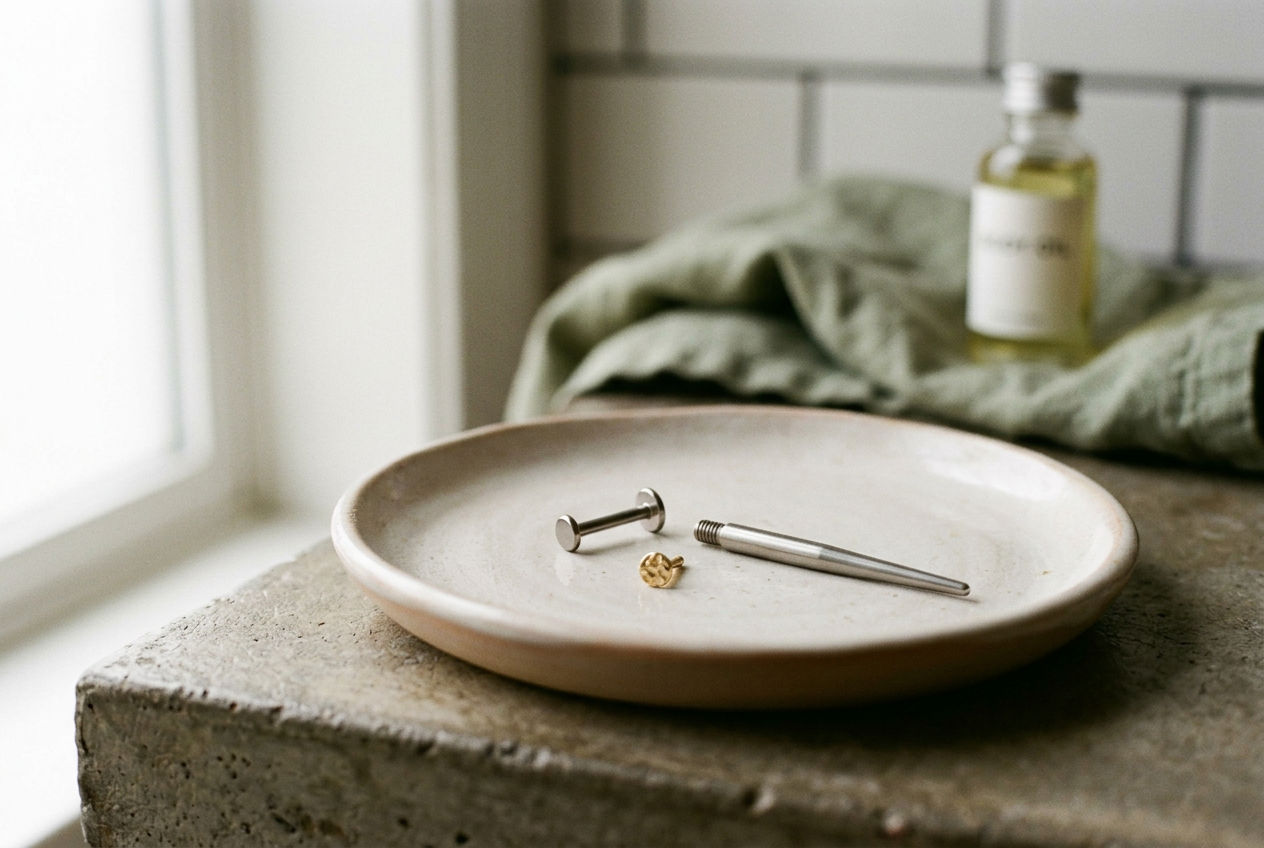
A taper, a gradually widening tool used to guide jewelry or enlarge a piercing, is not a shortcut for forcing our 16-gauge post through a 20-gauge channel. Used without a clear view of the piercing’s angle and condition, it can damage tissue; it also should not be worn as jewelry, where its uneven weight can pull on the channel.
Leave the change to a professional piercer when the current gauge is unknown, the new jewelry is more than one size larger, the piercing sits in cartilage or the channel has scar tissue, recurring irritation or an awkward angle. The same applies when a smaller post will not enter, since narrowing or another fit issue may be involved. A piercer can determine whether the jewelry can be inserted with an appropriate transfer tool, whether gradual stretching is reasonable or whether the planned size should be abandoned.
Fresh and still-healing piercings are not home-stretching projects. Jewelry changes during healing can disturb the channel, and symptoms that suggest infection or an embedded backing call for assessment rather than experimentation with another post.
Material matters once the size is right
Our example flat back is implant-grade titanium, a lightweight material available in grades intended for long-term contact with the body. Look for a retailer or studio that identifies the standard, such as ASTM F136 or ASTM F67, rather than relying on the loose phrase “titanium steel.” Solid nickel-free 14-karat or 18-karat gold is another established option, though it usually costs more.
Construction changes the wearing experience. A threadless post holds its decorative end with a slightly bent pin that creates tension inside the hollow post, so there are no screw threads to drag through the piercing. Internally threaded jewelry keeps its screw threads inside the post for the same practical reason: the surface passing through the channel stays smooth.
That smooth 16-gauge titanium post may be excellent once it fits. It is light, stable and compatible with small interchangeable ends, while the flat disc avoids the protruding shape of a butterfly backing during sleep. None of those advantages makes it worth forcing through a smaller channel.
For earring stacking, keep one gauge across established flat-back placements when possible. It makes replacement posts easier to organize and lets decorative threadless ends move between compatible posts, although pin and post systems can still differ by maker. If the first lobe piercing only tolerates 20 gauge, leave it there and build the stack around it rather than enlarging it for visual uniformity.
Questions people ask
Is 16 gauge thicker than 18 gauge?
Yes. A 16-gauge post is about 1.2 millimeters thick, while an 18-gauge post is about 1.0 millimeter.
The numbers run backward, so the lower gauge is wider. That small numerical difference can still create noticeable pressure in a piercing accustomed to 18-gauge jewelry.
Can a 16-gauge earring fit a standard piercing?
It may fit a piercing already wearing 16-gauge jewelry, but many slim fashion studs are closer to 20 gauge. Check the current post’s millimeter measurement or have a piercer size the channel. Do not assume a healed lobe will accept the wider post, and stop if insertion requires force.
Can
I stretch from 20 gauge to 18 gauge at home?
Even a one-step change can irritate tissue when the piercing is angled, narrowed or lined with scar tissue. If an 18-gauge post does not glide into a fully healed and calm piercing with light pressure, stop and visit a professional piercer rather than using a taper or pushing through pain.
Does a flat back need a thicker gauge?
No. Flat backs are sold in several gauges, and the backing shape does not require a wider post. Choose the gauge that matches the piercing, then select a post length that leaves the disc resting comfortably without pinching. The 16-gauge version is not automatically better than an 18-gauge alternative.
One update a day
Today's fashion update, in your inbox
One fashion update each morning — no hype, no filler, just pieces worth wearing.