Your Square Toe Sandals Fit, but the Front Edge Fights Your Step
A square toe can extend past the working part of your foot, while a rigid sole makes the mismatch harder to ignore. This walking test catches it before the return window closes.
November 24, 2026 · 7 min read
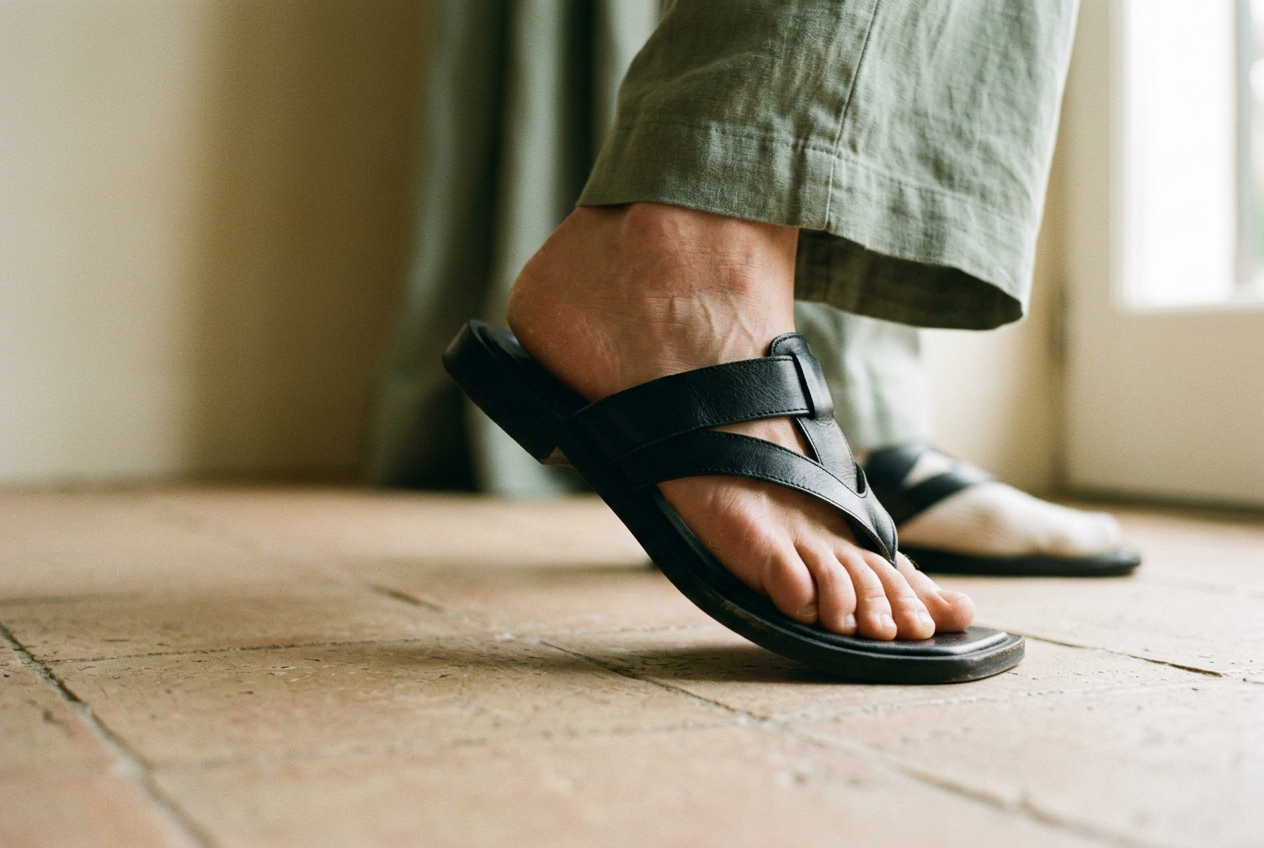
The test case was a black square-toe thong sandal with a synthetic-leather footbed, a thin foam layer and a firm rubber outsole. Standing still, it fit: the heel sat inside the back edge, the foot’s widest point met the widest part of the sandal, and no toe crossed the front.
Walking was less agreeable. After several days of ordinary wear on sidewalks and indoor floors, the outside front corner kept brushing the ground at the end of each step. My stride became shorter without a conscious decision, and my toes started gripping the footbed to manage a sole that preferred remaining horizontal. A shoe can pass the mirror test while failing the pavement test.
The pavement, as usual, has no interest in diplomacy.
This is unisex fit advice. Square toe flip flops appear across women’s and men’s footwear, and the mechanics do not change with the department label, although sizing systems and the position of the toe post often do.
The sole has to leave the ground somewhere
Push-off, meaning the final part of a step when the heel rises and the foot moves forward over the toes, requires the sandal to roll or flex under the forefoot. A bare foot bends at the ball, the line running across the joints behind the toes, rather than at the ends of the toes themselves.
A well-matched sandal follows that movement. Its forefoot bends near the same line, or its curved profile lets the body roll over the front without demanding much flex. On the black test pair, the rubber outsole resisted bending and the broad front remained planted after my heel had started to rise, so the foot had to work around the platform instead of moving with it.
That resistance matters more on a square toe than on a rounded sandal with the same measured length. A rounded front tapers away from the ground beside the toes. A broad square front carries material into both corners, including the areas where no toe may be available to lift or control it.
The big toe usually contributes heavily to the last phase of a step. If the sandal projects forward beside it, rather than directly in front of it, that extra corner becomes dead length: visible material that completes the fashionable outline but does not correspond to the working shape of the foot. The black pair’s outside corner was the problem, not the center of its front edge.
Correct length does not guarantee correct placement
Sandal length is commonly checked at the heel and longest toe. That catches obvious undersizing, but it misses where the toes sit within the outline and where the sole expects to bend.
On a thong sandal, the toe post controls placement. If the post sits too far back, the foot cannot move forward enough to use the front platform, even when there appears to be generous space ahead. If it sits too far forward, the webbing between the toes takes pressure while the heel drifts toward the rear edge. Neither issue improves after a determined week of pretending.
The black sandal’s toe post held the big toe near the inside front quadrant, while the smaller toes angled away from the outside corner. That left a wedge of unoccupied sole ahead of the fourth and fifth toes. It looked intentional from above. During push-off, it behaved like an extension attached in an awkward place.
Foot shape changes the result. A person whose first few toes form a relatively straight line may fill a square front neatly, while a foot with a strongly tapered toe line can leave both a front corner and part of the outer edge unused. The correct choice is not the sandal that displays the most even border around the foot; it is the one whose flex and outline agree with where the foot moves.
A rigid sole makes the outline more demanding
Material determines how much mismatch a sandal will forgive. Thin rubber can flex readily, soft foam can compress, and an unreinforced leather sole may loosen through wear, although none of those outcomes is guaranteed merely by looking at the product description.
A stiff rubber outsole paired with a firm synthetic footbed behaves more like a small platform. The foot can bend inside it, but the sandal may lag behind, tugging at the toe post or slapping down after each step. Thick leather stacks can also feel rigid when new, and a higher price does not make the hinge point migrate toward the wearer’s foot.
Flex point, meaning the place where the sole naturally bends, is more useful than general softness. A sandal may feel cushioned under a thumb yet remain difficult to roll through because the outsole does not yield across the ball. Cushioning reduces pressure in one direction. It does not shorten a projecting corner or teach a firm sole where to bend.
The black test pair softened slightly at the footbed over the week, but the outsole geometry stayed put. The front corner still met the floor early, and the toe post still held the foot behind the square edge. Waiting longer would have meant spending more time walking around the design rather than breaking it in.
The walking test takes less time than styling the pair
Start on a hard, level floor while the outsole is clean and returnable. Put on both sandals, stand naturally and check that each heel is contained without pushing against the rear edge. The longest toe should remain on the footbed, while the ball of the foot should sit over the area where the sole can bend.
Walk at your usual pace for several passes. Do not take the long, deliberate fitting-room steps that make almost any shoe look cooperative. Watch for a stride that becomes choppy, toes that curl to hold the sandal, or a front edge that slaps after the heel rises.
Next, ask someone to record a low side view, or prop a phone securely near floor level. The useful moment is the final part of the step. If the heel lifts while most of the square front remains flat, the sole is resisting rollover; if one corner drags or pivots against the floor, the fashionable outline extends beyond the area your toes can guide.
Then remove the sandal and bend it with both hands. It should flex near the ball rather than folding through the middle, which offers little help during push-off and can make the arch area unstable. Compare that bend line with the crease left by the base of your toes on the footbed. A large mismatch is a fit failure even when the overall length is correct.
Finally, repeat the walk in a flexible rounded or softly squared sandal you already own. Use separate passes rather than wearing a different shoe on each foot. The comparison should not require analysis: if your normal stride returns and the toe gripping stops, the square pair is charging a comfort fee for its outline.
Better square toes keep the shape without the obstacle
A square toe does not need to be abandoned. Look for a softened square with clipped or beveled corners, meaning the sharp edges are cut at an angle, because that removes material from the areas most likely to catch while preserving a broad front appearance.
Press the forefoot before buying. The sole should bend across the ball with moderate hand pressure, and it should do so without forcing the entire sandal into a fold at the arch. A slight upward curve at the front can also help the sole roll away from the floor, provided the curve does not lift the toes into an uncomfortable position.
Toe placement deserves equal attention. In square toe flip flops, the post should let the foot sit forward enough to use the platform without pulling hard between the toes. Broad straps can stabilize the foot more effectively than a narrow thong alone, particularly when the sole has some weight, though a strap cannot correct a flex point located too far ahead.
Soft rubber and flexible leather are easier bets than dense plastic or a rigid layered sole, but construction outranks the material name. Handle the shoe. Walk in it. A costly leather sandal with a decorative square extension can fight the same step as a mass-market synthetic pair, while an inexpensive molded rubber style may work if its front flexes in the right place.
For the black test pair, the alternative was not a larger size. More length would have added material ahead of the toes, and sizing down would have moved the heel too close to the back. A softly squared sandal with a narrower outside corner and a flexible forefoot preserved the clean line without requiring shorter steps. That was the useful trade: slightly less severe geometry, considerably less supervision from my toes.
Questions people ask
How much space should square toe sandals have in front?
The toes should stay within the footbed, but there is no universally correct border. Judge the space by location: a small margin directly ahead may be harmless, while a large unused corner beside tapered toes can catch during push-off. Walk before deciding that an even-looking border means a good fit.
Will rigid square toe sandals soften with wear?
The upper and footbed may soften, especially if they are leather or foam, but the outsole’s shape and bend line may change very little. Do not rely on break-in when a front corner drags, the toe post fixes the foot too far back, or the sole stays flat as the heel rises.
Should
I size down if the square front looks too long?
Only if the heel, ball and toe-post placement also improve in the smaller size. Sizing down to remove visible space can leave the heel at the rear edge or place the ball behind the sole’s flex point. A different last, meaning the form that gives a shoe its shape, is often the better answer.
Are square toe flip flops comfortable for long walks?
They can be if the forefoot flexes, the toe post positions the foot correctly and the corners clear the ground during push-off. A rigid fashion pair that shortens your stride is better treated as a limited-walking shoe. Persistent rubbing, gripping or pain is a reason to stop wearing it, not a break-in challenge.
One update a day
Today's fashion update, in your inbox
One fashion update each morning — no hype, no filler, just pieces worth wearing.